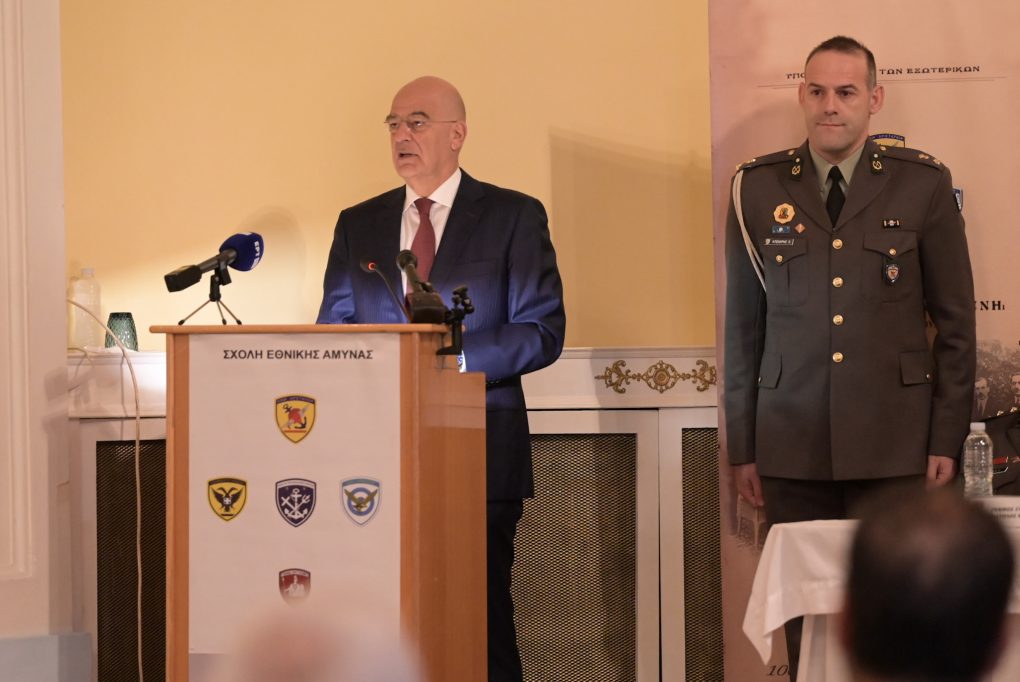
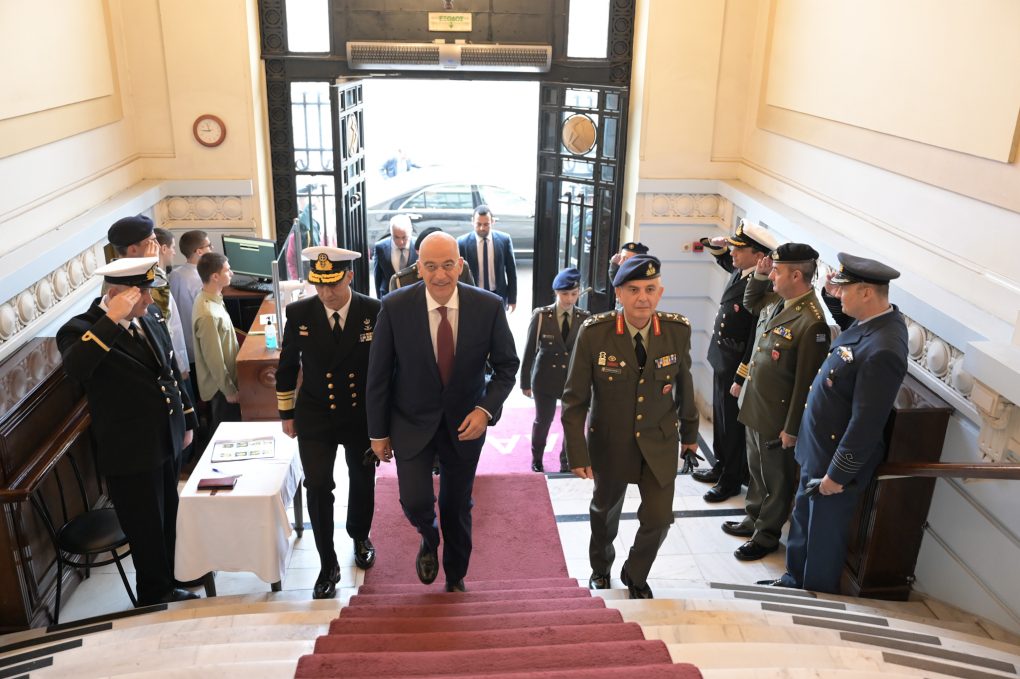
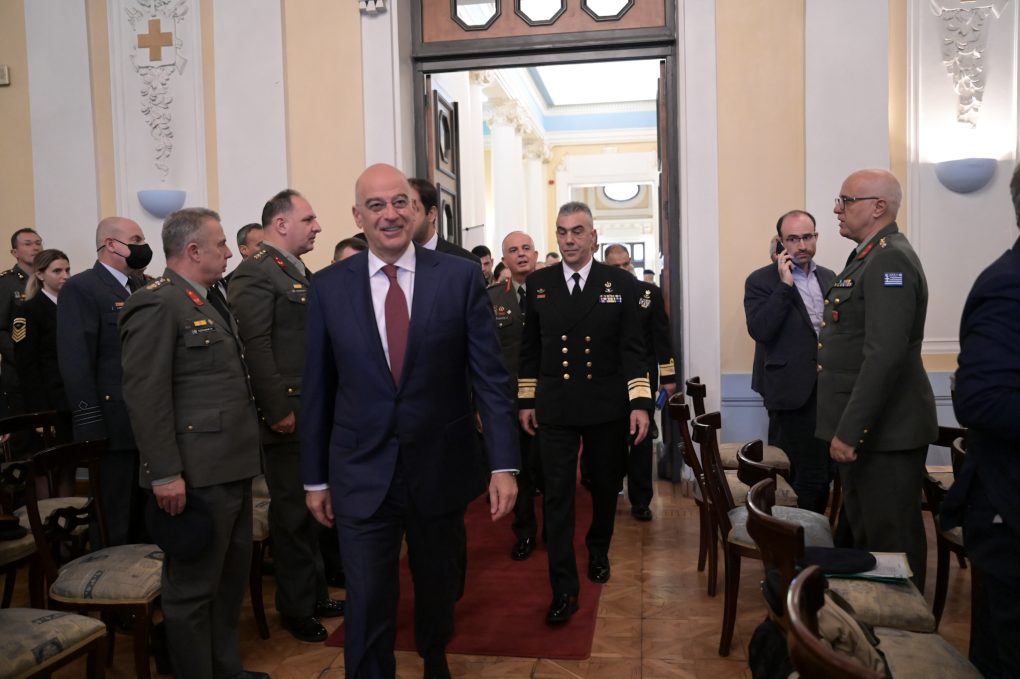
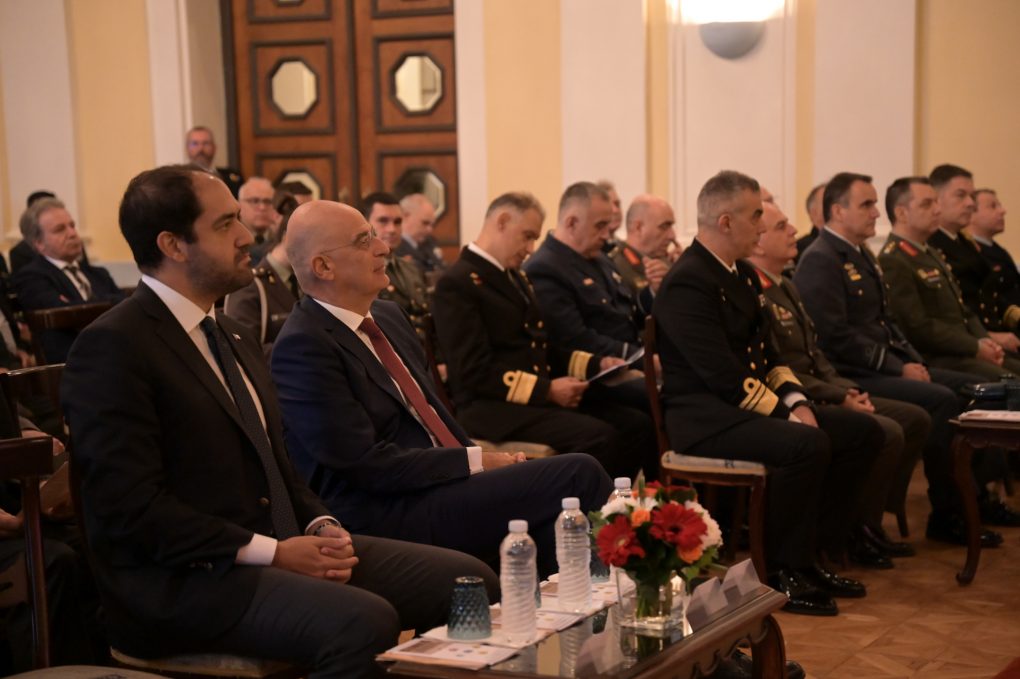
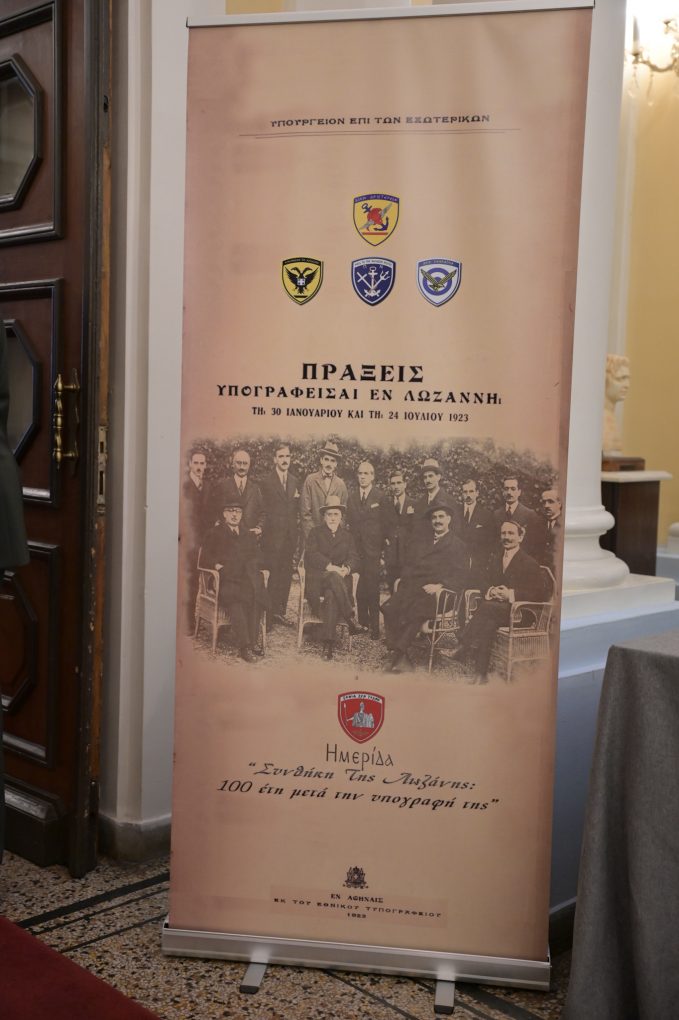
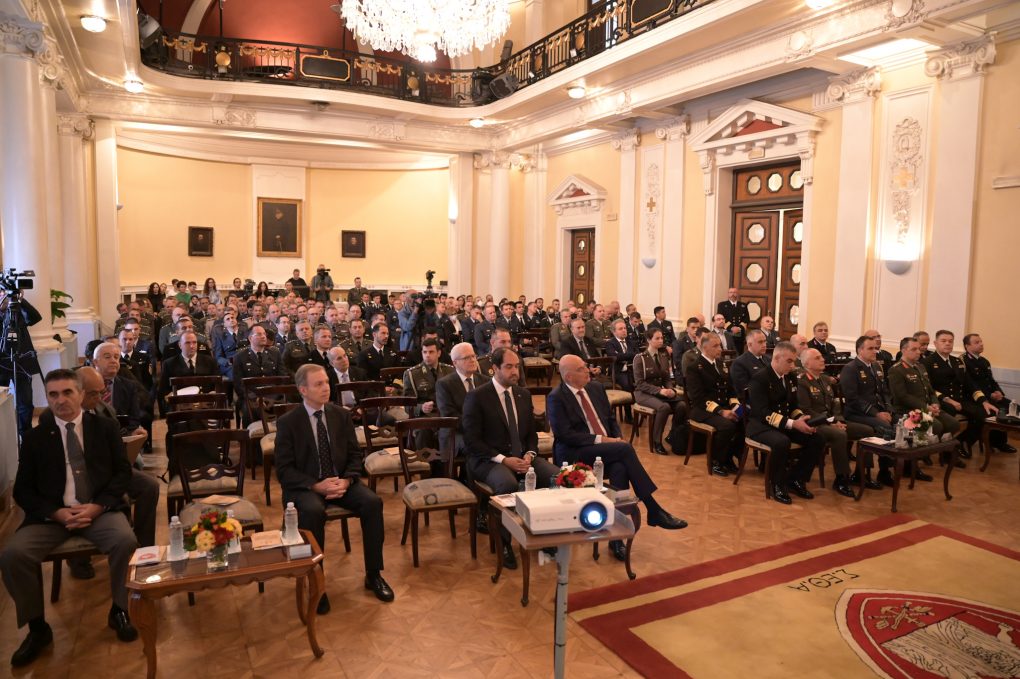
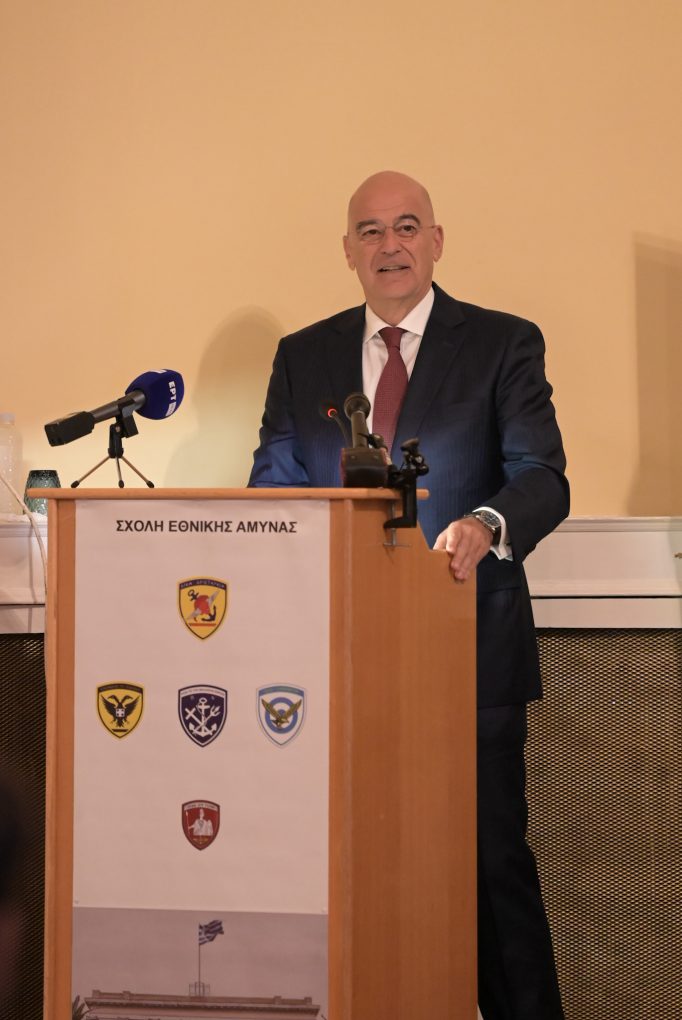
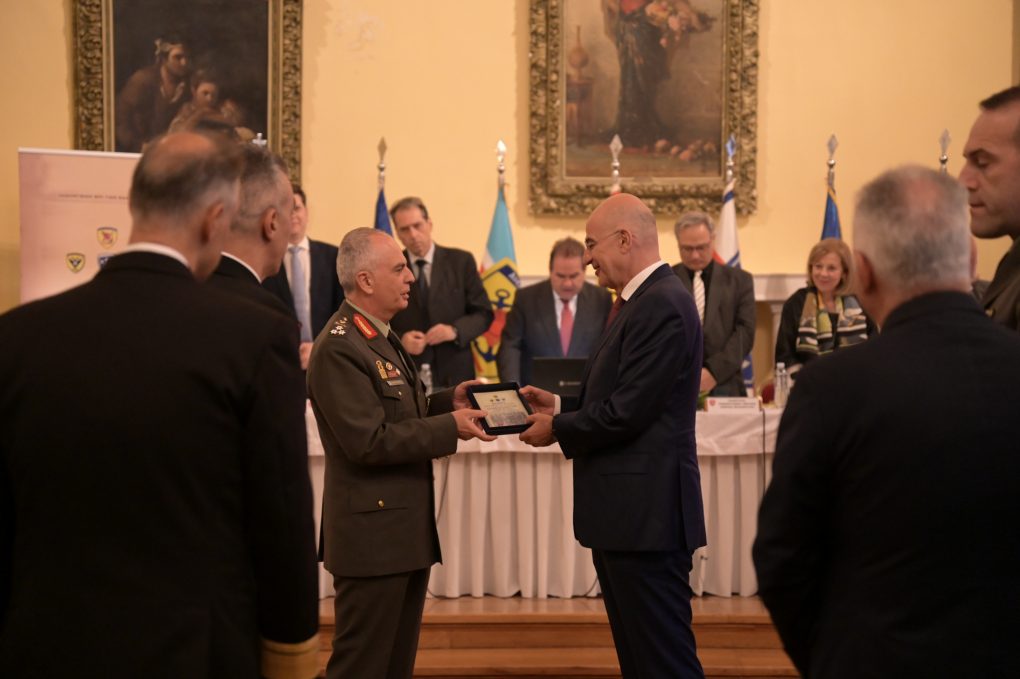
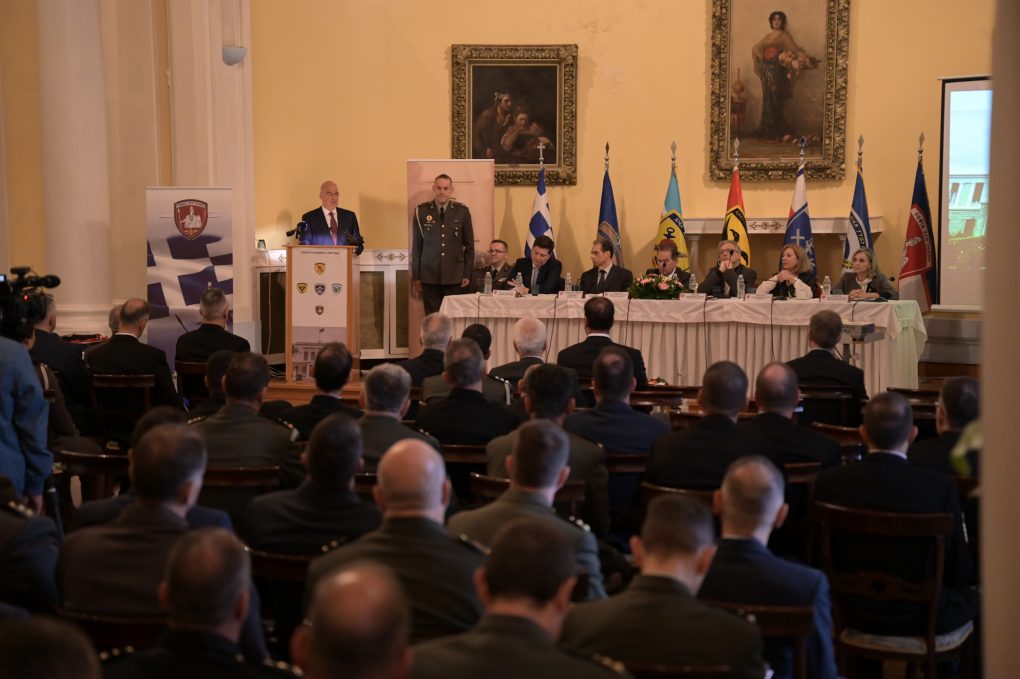
On Monday, 13 November 2023, the Minister of National Defence Nikos Dendias opened the works of an event organised by the Hellenic National Defence Academy on the subject “The Treaty of Lausanne: 100 years since its signing”, which took place at the Armed Forces Officers’ Club.
The opening of the event's works was also attended by the Deputy Minister of National Defence, Mr. Ioannis Kefalogiannis, the Deputy Chief of Hellenic National Defence General Staff, Vice Admiral Fragiskos Leloudas HN, as representative of the Chief of Hellenic National Defence General Staff, General Konstantinos Floros, the Chief of Staff of the Hellenic Air Force
General Staff, Major General (HAF) Ioannis Birbilis, as representative of the Chief of Hellenic Air Force General Staff, Lieutenant General (HAF) Themistoklis Bourolias, the Deputy Commander of the Hellenic Army Inspectorate General – Doctrine and Training Command, Major General Georgios Bakolas, as representative of the Chief of Hellenic Army General
Staff, Lieutenant General Angelos Choudeloudis, and the Chief of Staff of the Hellenic Navy General Staff, Rear Admiral Georgios Floros HN, as representative of the Chief of Hellenic Navy General Staff, Vice Admiral Ioannis Drymousis HN.
The event was also attended by Hellenic Police Major General Emmanouil Dourvetakis, as representative of the Chief of the Hellenic Police, Lieutenant General Lazaros Mavropoulos, Fire Service Major General Dimitris Kalaniotis, as representative of the Chief of the Fire Service, Lieutenant
General Georgios Pournaras, Lieutenant CG Smaro Bourdouma, as representative of the Chief of the Hellenic Coast Guard, Vice Admiral Georgios Alexandrakis CG.
In his address for the opening of the works, the Minister of National Defence stated the following:
“It is with great pleasure that I address today's event by the Hellenic National Defence College for the 100 years since the signing of the pivotal Treaty of Lausanne which, among others, to which I will refer shortly, is the greatest depiction, at the International Law level, of Greek – Turkish relations from 1923 to 2023.
Of course, this event does not take place in a vacuum. It is taking place at a time of two major conflicts in our region. One in the north, after the Russian invasion of Ukraine. And one in the south-east, after the terrorist attack of Hamas against the state of Israel.
I do not need to repeat that we vehemently condemn the terrorist attack of Hamas, or state the obvious, that the protection of civilians must always be the top priority.
Ladies and Gentlemen, I would also like to comment something that was also mentioned by the Academy Commandant. Perhaps the Greek public is under the impression that, for the most part, the Treaty of Lausanne is a Treaty that only concerns Greek – Turkish relations.
Of course, this is far from the truth. The Treaty of Lausanne is an international agreement which, beyond Greece and Turkey, has also been signed by other countries, namely Great Britain, France, Italy, Japan, Romania, and the then Kingdom of Serbs, Croats, and Slovenes.
In my previous capacity as Minister of Foreign Affairs, I tried to highlight this fact of the Treaty of Lausanne by visiting all the countries that have signed the Treaty.
To mention some numbers, allow me to tell you that in total I visited all these countries 46 times, including Japan. By the way, Japan's positions concerning
International Law are very important for Greece, almost identical to Greece's, as well as to those of other countries in the broader region (Philippines, Indonesia, Australia).
Let me say outright that no one in the International Community can be left free to dream of challenging or, to put it more mildly, “updating” the Treaty of Lausanne. Because, in fact, no one can dream of and imagine any change of borders, either in our broader region or, and let me be clear on this, anywhere else. And we must clearly condemn any form of revisionism.
The Hellenic Republic views the Treaty as a guarantee of our territorial integrity, as well as the security policy of our broader region and, of course, the Hellenic Republic and this is not to be misconstrued.
It is obvious that, lately, the atmosphere in the Aegean and the Eastern Mediterranean has improved, compared to the tensions of previous years. After the catastrophic earthquakes in Turkey and my visit immediately afterwards, I think there was an opportunity to open a window to discuss with Turkey, within the framework of an honest dialogue.
However, I want to be clear on this too. The dialogue can not be without boundaries, without any framework. Discussions between states are no philosophical studies, nor do they take place in the absence of law.
Any discussion between Greece and Turkey and any serious hope for a new chapter in our relations, 100 years after the signing of the Treaty of Lausanne, must take into account that this dialogue must view the provisions of the Treaty of Lausanne and the International Law of the Sea as absolute facts.
And all that within the broader, obviously acceptable by all, framework of the principles of the United Nations Charter. Or, to explain it verbatim, in order to avoid misunderstandings: Matters of national sovereignty can not constitute the subject matter of dialogue by any country. This is the foundation of the clear stance of our country after the Russian invasion of Ukraine.
This is how we explained to the Greek society the clearness and the correctness of our position.
So, this is a great opportunity for a deep discussion on the Treaty of Lausanne, especially within the framework of the Hellenic National Defence College. A Treaty which, by the way, has not been observed in full, as in the case of e.g. article 14 concerning the rights of the Greek populations of the islands of Imbros and Tenedos and their administrative organisation.
I believe this discussion promotes not only knowledge, but also broader perception of the fundamental nature of this Treaty for peace, stability, and security in our broader region.
So, in this sense, allow me to wish you all success. I am certain that, with the exceptional professors here, success is guaranteed.
Thank you very much”.