

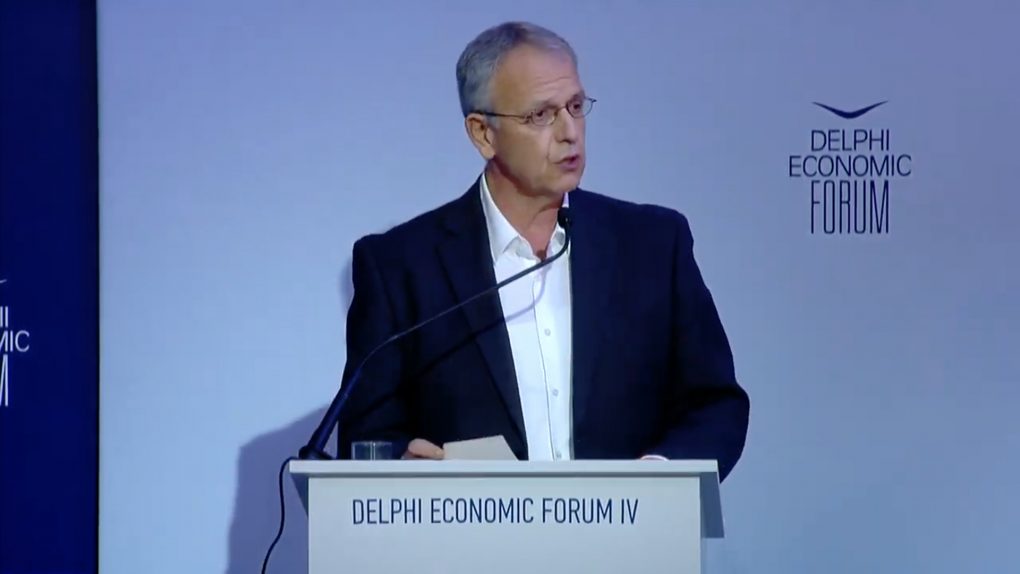
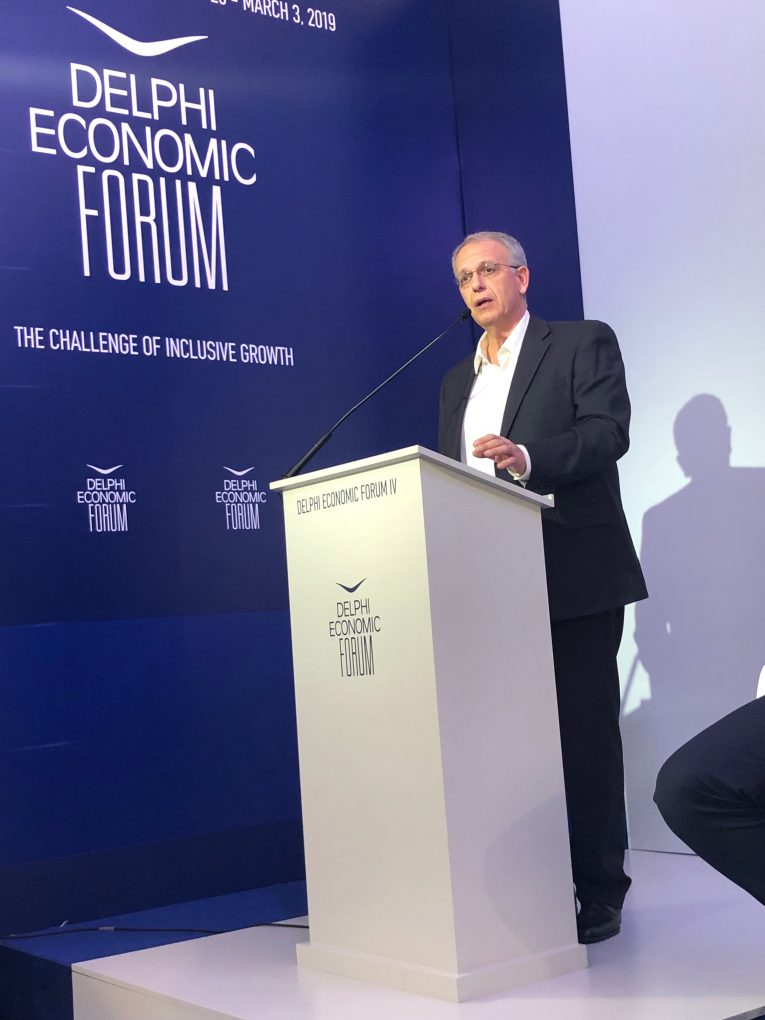
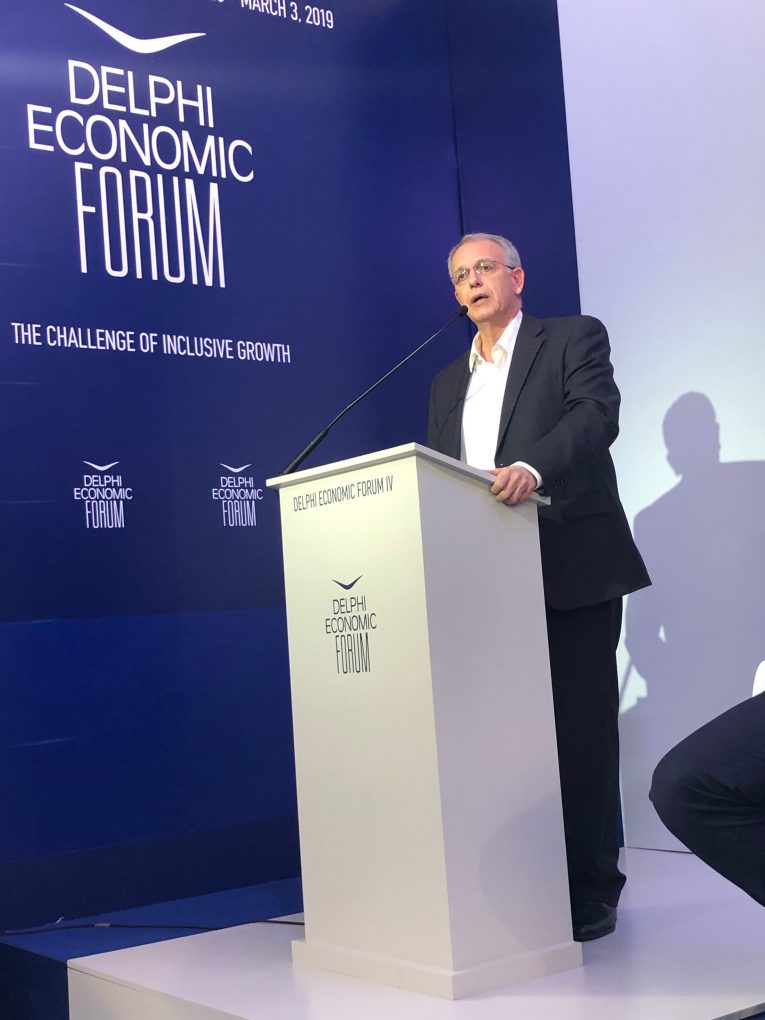
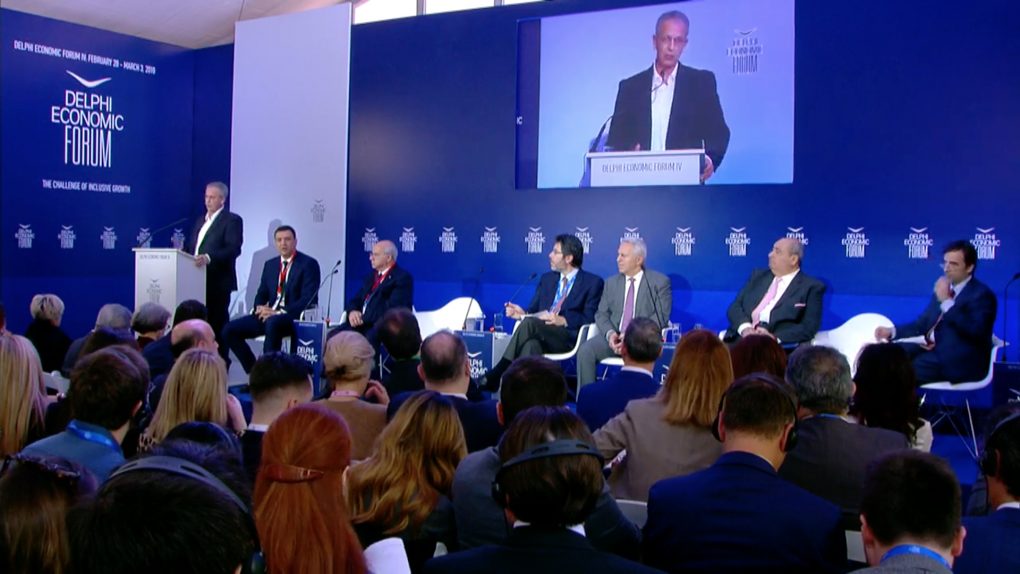
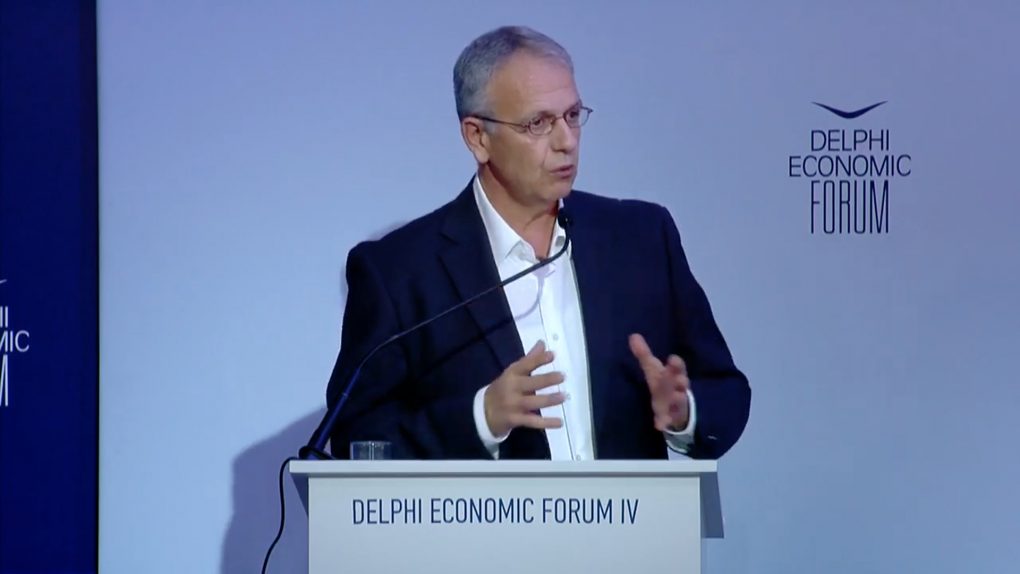
On Saturday, 2 March 2019, the Alternate Minister of National Defence Panagiotis Rigas delivered an address to the Delphi Economic Forum.
The complete text of his address is as follows:
“Ladies and gentlemen,
Defence and Economy have always constituted the central power pillars of modern states. They constitute interrelated ideas and interactive functions, which are founded on the state’s hard core and on any supranational organisations and coalitions.
Defence relies on the potential provided by the economy, while economy is developed in the context of the environment shaped by defence. They are both expanding in a constantly changing environment and any changes in these two pillars reflect the deep changes in a national and international level.
The internationalised structures with regard to economy, as well as the inter-state co-operations, combined with the developments in technology, constitute the new defence and security setting. In this context, new threats arise, as well as new challenges.
In such a changing international environment, a momentum with two opposite forces is shaped:
On one hand, the conservative version, leads to a sort of militarising international relations, while the other version has to do with a tendency to make military alliances get involved with politics, through direct projection in the economy level. The latter case, under certain circumstances, can be progressive in nature, thus serving the people and their needs.
To avoid distortions-which is what Democracy and its principles dictate-it is necessary that the military structures serve politics and not define it. To serve security and stability politics, politics that contribute to the creation of an international security and defence environment, thus favouring the states’ economic growth and societies’ development.
The above acknowledgment also defines the priorities we set:
So, our priority should be a peaceful and secure international environment, with democracy and economic growth, which will gradually lead to the easing of the inequalities. It is clear that this perception is the very opposite of neo-liberalism, which dictates the enforcement of economy to politics and the society and limits democracy only in the field of economy, thus disconnecting it from the people’s needs and rights.
The dilemma “security or democracy”, posed by some people, is spurious. Security guarantees democracy and democracy gives meaning to security, leading it to serve society’s needs.
What we try to achieve worldwide is to distinguish the target, the destination and set a course, utilising the respective assets. In any case, what we try to achieve is development that brings justice and welfare to the people; development that utilises science and technology achievements with regard to the people, through a manner that equally balances our planet and human societies, so that the future is secured and not undermined.
Greece, a country which constitutes a pillar of geopolitical stability, is located in an area surrounded by instability sources, as well as war tensions. We are a country that has been in the focus of two international crises and dealt with them successfully: The financial and refugee crises.
Regarding finances, we are already in a developmental stage and we shape a developmental model, which is friendly to investors and socially equitable as well.
Regarding the refugee-migrant crisis, the only true solution is to stop wars and at the same time, the countries with a high level of economic growth to support the poor countries in terms of development, instead of building walls of isolation with regard to people.
Ladies and gentlemen,
Our time is distinguished by the multi-levelled mobility and interaction in all areas. It is characterised by science and specialisation development, as well as the conjunction of disciplines and specialties. This is called inter-service cooperation in the Armed Forces and interdisciplinary approach with regard to sciences.
It is common knowledge that in modern-day circumstances, there are no water-tight boundaries between the sub-sectors of industry, or in economy and most certainly in industry, just like there are no geographical limits.
The defence industry, especially, with its development and the broadening of its scope, can constitute an important pillar for industrial development and the country’s productive regeneration.
The productive regeneration passes through the public and the private sector. This relationship is not a one-way relationship, just like it is not cut off from the rest of society.
Regarding the sector of defence industry, we try to achieve more participation on behalf of the domestic defence industry, public and private, to meet the needs of the Armed Forces and at the same time to support its export role.
We have acquired for the first time a National Defence Industrial Strategy, which has advanced at planning and institutionalisation level, leading us forward.
Our priority is to meet the current needs of the Armed Forces, but also to provide for their future needs within a framework of an increasing Greek added value and acquisition of know-how for the domestic industry.
We need the defence industry in terms of autonomy on one hand and complementarity on the other. That is the right balance for economies of our scale.
The Hellenic Defence Industry constitutes a real productive force with development perspectives, on the basis of the comparative advantages that our country possesses. It is a dynamic field, which is not simply viable, but reflects reliability and competitiveness as well, and it has great perspectives to enter the international markets.
Outreach is a term of survival for the defence industry. For this reason, we try to facilitate the creation of Greek companies’ associations, to participate in international competitions. We support independent, as well as collective efforts, in many ways.
Dear friends,
When we refer to Defence and economy, we do not mean that we support the war or the financial competition without limits or principles. Defence must serve the peace as a deterrent force and economy must serve society’s needs for a developmental perspective.
I wish and hope that when the time comes, after so many centuries of bloody human history, the wars will become a thing of the past. And if that is not possible then I wish that war, in the form of a bloody confrontation, will cease to exist. It is a wish that everyone should support.
This will be a conquest of our civilisation, a great step for humanity. So, from Delphi, the cradle of the Delphic Amphictyony, after approximately 2,700 years from its first assembly, let us send a message of peace, of a peaceful coexistence and common development of the peoples and of all countries of the world, without wars and in the framework of mutual respect of the rights of every country, every people, every population group, every human being”.