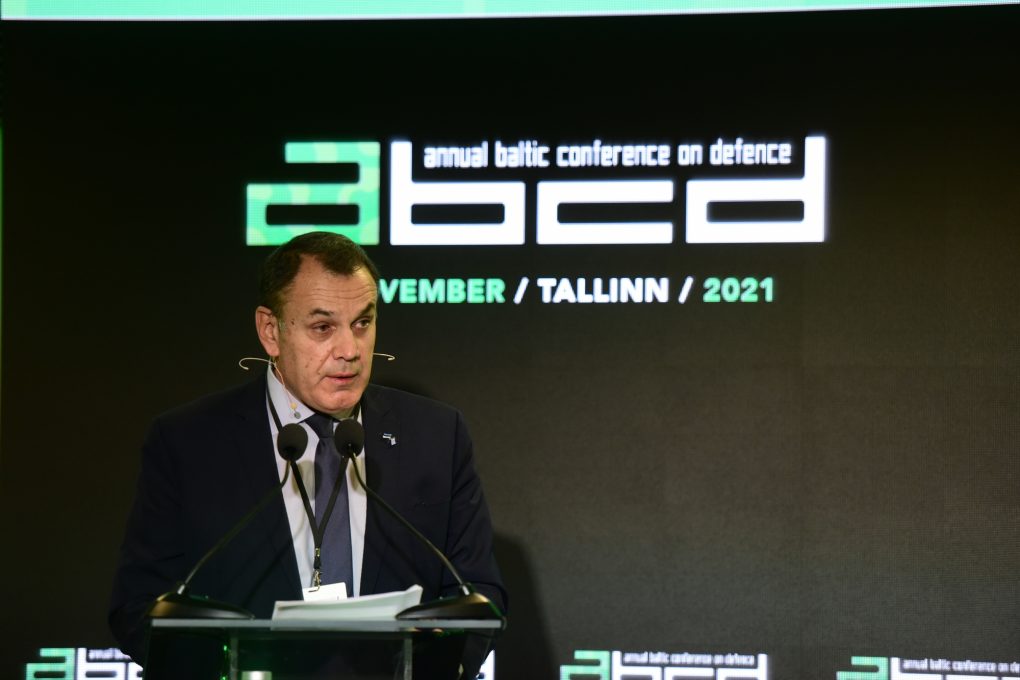
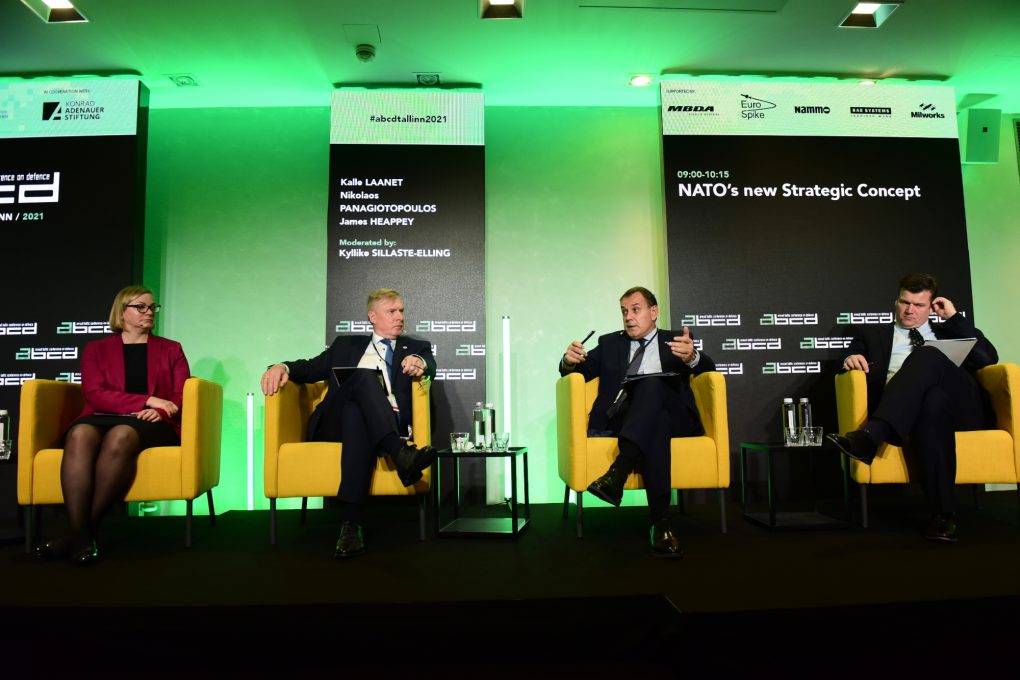
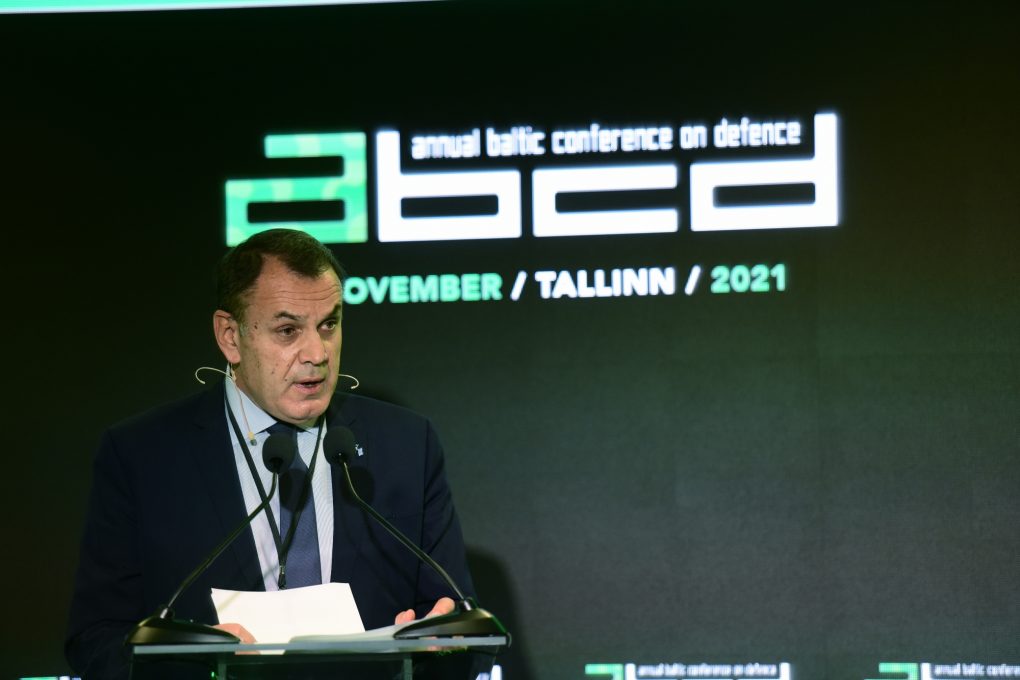
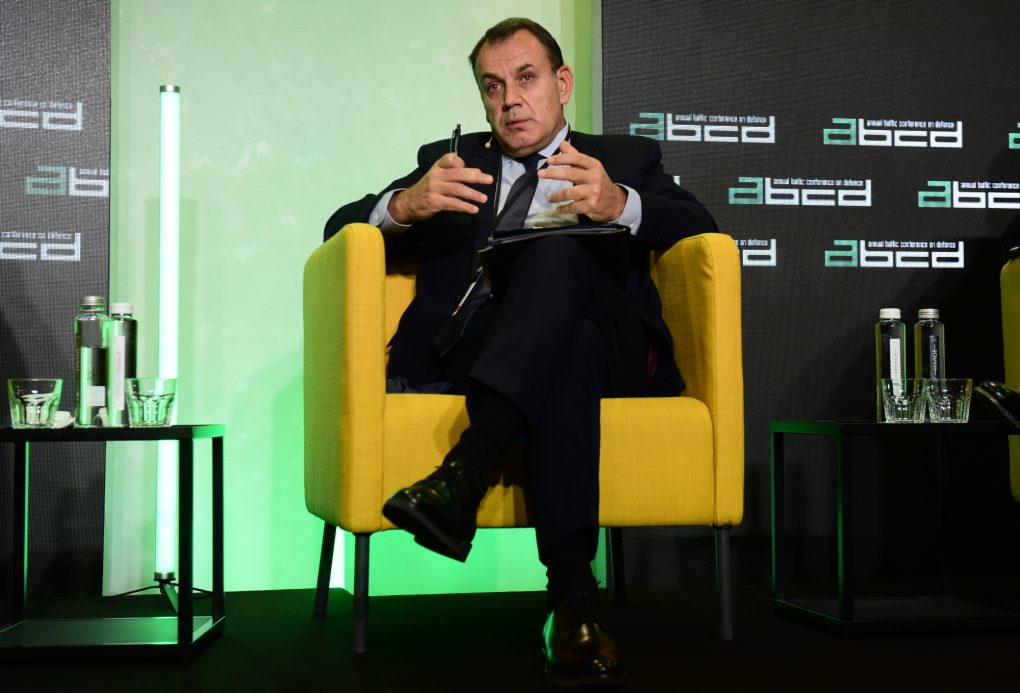
The Minister of National Defence Mr. Nikolaos Panagiotopoulos gave an address at the main session of the 15th Annual Baltic Conference on Defence on NATO’s new Strategic Concept.
The opening address of the session was given by the President of the Republic of Estonia, Mr. Alar Karis, and, except for the Greek Minister of National Defence, the conference was also attended by the Minister of Defence of Estonia, Mr. Kalle Laanet, and the Under-secretary of State for the Armed Forces of the United Kingdom, Mr. James Heappey.
In his address, Mr. Panagiotopoulos stressed the following:
“Ladies and Gentlemen,
The essence of our alliance, how we’ve come together at the core, nations united by firm commitment to the democratic principle, we’ve come together into a military alliance that is focused on, first and foremost, defending and protecting our territorial integrity and that’s basically, but not solely, what NATO is about, and protecting and defending our territorial, collective territorial integrity means of course being able to protect and defend our frontier line, our borders, not only the borders of Europe, but the borders of the Western alliance, and that’s what NATO should be able to contribute to at the end of the day, contribute to its basic principle of protecting and defending territories.
Ladies and Gentlemen,
Let me say how this is a great, distinct pleasure for me to be here today in Tallinn to participate in the Annual Baltic Conference on Defence concerning mainly NATO’s Strategic Concept. And, to conclude my speech, actually not, I’m joking, this is exactly what NATO’s new Strategic Concept is, what is a Greek doing in Tallinn participating in a conference on Baltic Defence, that is NATO’s new Strategic Concept, a 360 degree approach whereby each and every country that is a NATO ally is directly concerned about what is happening on the other side, the other flank, from south to north, from east to west, in a common 360 degree approach.
We are all in this together, a threat to one of us is a threat to every one of us, it’s a collective threat and that’s what we will be focused on doing from now on, addressing all kinds of threats, conventional threats, hybrid threats, new era threats, as one. That should be what the new Strategic Concept should be about.
Now, let me elaborate by also particularly not omitting to thank the International Centre for Defence and Security for hosting this conference and inviting me. There’s no better setting for this discussion about the future of the Transatlantic alliance and its new Strategic Concept. And I trust that all of us will take the opportunity to use this occasion for discussing a variety of issues pertaining to the dilemmas that national and international policymakers and citizens alike are facing, trying to make sense of the very complex security environment we’re witnessing emerging the confusing and unsettling new global security agenda.
Today more than ever as autocrats and some countries are seeking to enhance their power by adopting revisionist and aggressive strategic postures and policies, postures that violate International Law and threaten the Transatlantic interests, as well as regional stability, as in the case of the Baltic sea region or, I would argue, the Eastern Med, we need to keep the moral high ground by promoting our common values, which are the core of our Transatlantic community. We are a community of countries bound by common values, the democratic principle, open societies, the rule of law, human rights, everybody who does not adhere to those values is, I would say, a candidate for being on the other side, another side, and that, I believe, should be our firm conviction because we care about values after all.
To the east, Russia’s actions seem to undermine the liberal international order that NATO is explicitly dedicated to preserve. Of course, Russia is punching far above its weight, I would argue, and in the long run its military outreach, coupled with a feeble economy, that is likely to substantially weaken its position over the long term. Yet, as a permanent member of the UN Security Council and one of the few major nuclear powers, Moscow will remain an important actor with the potential to cause serious inconsistencies. Thus, NATO has to dig in for the long haul in its relations to Russia by applying a firm dual track approach. On the one hand, we must use our resources efficiently to apply a credible well-balanced proportionate and sustainable response to Russia’s aggressive actions, thus needing to continue bolstering our deterrence and defence posture by fully implementing all relevant concepts and by developing the required forces in every field, hence resilience, responsiveness, readiness, and rapid reinforcement, including supply, distribution, and stock of fuels in the eastern flank, are precisely the key imperatives for strengthening the alliance’s deterrence and defence posture.
To substantiate this approach and the related requirement to enhance the effectiveness of NATO Integrated Air and Missile Defence System, I am certain that the newly-established Integrated Air and Missile Defence Centre of Excellence, the IAMD CoE at Souda Bay, Crete, will strengthen our relevant in-depth knowledge as part of NATO Member States and their Partners.
Now, on the other hand, since I elaborated about the dual track approach, our full and expedited implementation of NATO’s agreed defence and deterrence posture to counter Russia’s strategic implementation efforts had to be adequately complemented by a meaningful dialogue with Moscow in order to avoid misunderstandings, miscalculations, and unintended escalation. Especially during times of tension like the one we are currently witnessing, dialogue is needed in order to increase transparency and predictability and help alleviate pressures or prevent and deter regional and international crises.
Ladies and Gentlemen,
I really like to put myself inside the other side’s shoes whenever I try to decipher its intentions and possibly its actions, and, I must say that my firm conviction is that as Russia has lost strategic ground while NATO and the West, the Western countries, the European Union was growing over time, this tended to enhance its basic insecurities, and basic insecurities could often lead to basic mistrust, basic mistrust could often lead to an increasingly aggressive and threatening posture. So, we should take this into account by also maintaining our firm commitment to defending our democratic values at the same time, and I think this is a very delicate balance that needs to be maintained and I do believe that the Baltic Republics and Northern Europe is especially sensitive, yet aware of this delicate balance that needs to be maintained, and I think this is for, in the long haul, I think it’s for the collective good of everybody. We must keep engaged with Moscow, but also make it very clear to Moscow where the red lines lie, where our commitments lie at the end of the day.
So, in this context, arms control agreement could help reduce the risk of a conflict. Although some of them have ceased to exist, and any attempt to restore them does not seem realistic until a fundamental change in Russia and Russian policies takes place, this does not mean, however, that arms control has lost its relevance as the bedrock for avoiding misperceptions and fateful mistakes. All in all, no scenario regarding our relation with Russia is impossible or inevitable. In this situation, NATO’s task should be to follow the well-known maxim of “hope for the best, prepare for the worst” and, may I add, “be distrustful of everybody, but also have good intentions”, in particular with respect to entering a dialogue or opening up a channel of communication.
Ladies and Gentlemen,
In the south, beyond the threat posed by international terrorism, the Alliance is increasingly faced not only with a return of tangible geostrategic competition, but also with evolving and diffuse threats and challenges. Let me name but a few:proliferation of weapons of mass destruction, risks to maritime security, intensification of transnational organized crime, illegal trafficking of weapons and of people, hybrid threats, use of proxies in military conflicts, violation of international law and security challenges stemming from the climate crisis, stemming from migratory flows, and in particular their weaponisation as we witnessed in the north-eastern Greek-Turkish border in Evros last year, in Spain’s Ceuta enclave and, of course, last, but not least, as we are actually witnessing as we speak in the Lithuanian – Belarus border, I think we should all be very decisive and blunt in taking a position and probably taking action tomorrow collectively in order to dissuade state actors from weaponising or instrumentalising migration or refugee flows for financial or geopolitical gains. And that, I believe, should be a very strong position from all of us.
Therefore, in order to remain credible, the alliance needs to demonstrate that it takes the evermore complex security challenges emanating from the wider Middle East, North Africa, and the Sahel very seriously. What is required is a renewed strategic and more coherent approach focusing on cooperative actions in areas that can produce a multiplier effect or spillover effect and allow the expertise of the alliance to truly make a difference. In this respect, the scope and frequency of a two-way political dialogue with our partners, without exclusions, should be increased. Thus, with a view to addressing pervasive instability in a truly efficient 360 degree perspective, NATO should adopt a more coherent vision for its southern flank, as far as its engagement is concerned, and should act on the recognition that projecting stability to the south should be a strategic priority. This should be a part of the process of the adaptation of the alliance and should be encapsulated in the new Strategic Concept.
Ladies and Gentlemen,
A little bit further, China’s geopolitical rise, economic potential, and raw military power are a clear indication that the international balance of power is shifting, thus having implications for the alliance’s interests.
China seems to be mounting a direct challenge to the American supremacy as a leading superpower, I would say initially on a regional level, then who knows, potentially tomorrow or the day after tomorrow on a global scale. But we should be aware of this, it’s a direct challenge, let’s say, to the reigning military superpower of our era and that should be a concern for us all. To all intents and purposes, as a multitude of competing geopolitical visions of the future are in the ascendant, we on our side need to rejuvenate the shared foundations of Transatlantic relations and to reaffirm the political commitment of the Transatlantic bond, for this bond now remains as valid as ever.
We strongly believe that the Transatlantic partnership firmly rooted in our history strengthens our collective defence, sustains our common values, defends our common interests. It also reaffirms the commitment of all of us to the purposes and principles of the UN Charter. To this end, the next Strategic Concept should help demonstrate that the collective understand the scope base and strategic direction of change and the challenges and threats it’s generating. In essence, it will serve as NATO’s new guiding principle in the new era. So, the new Strategic Concept should therefore articulate an explicitly comprehensive political vision of international security and its complexities with a clear set of strategic objectives; defy the nature of the medium- to long-term threats and security challenges to NATO’s collective security; and also identify options that allies consider the most efficient with which to respond to those threats and challenges; and also acknowledge their interconnectedness, while incorporating many of the principles of previous concepts that have been validated and have lost none of their relevance. The next concept should enable NATO to maintain its capacity to deal with immediate security challenges and at the same time become more efficient at responding to the unexpected.
The next Strategic Concept has to be marked by both continuity and change. Many of the basic themes that characterize the current concept have to be present in the next one, namely we need to reiterate the basic principles and values enshrined in the Washington Treaty. These are our ideological roots and ideological roots should always be preserved.
Second, we need to recommit to the three core tasks and the fact that the strong transatlantic bond remains crucial for the defence of our joint interest.
Third, we need to reemphasize the importance of unity, solidarity, consistency and coherence, in order to project confidence and explain NATO’s adherence to the 360-degree approach, from the security threats that the Baltic Republics are facing to the security challenges and geopolitical uncertainty that is present in the SE Flank of NATO; I believe everybody should be aware, and acknowledge each other’s reality. That is how we come together as an Alliance.
In the same spirit, we need to preserve and induce greater cooperation between NATO and the EU. Let me point out in all our eyes a practical aspect in this partnership that probably escapes some of you. Investment in defence expenditure requires substantial spending, as you all know. The EU does hold the key to the countries’ purses, in terms of being able to regulate on a fiscal level, its level of spending; its level of spending in defence as well. Not all countries have the same needs.
We have different needs, as we are at the outer frontier, in terms of our defence spending. Now, maybe, if there is an active engagement between NATO and the EU, there could be a potential for acknowledging the different needs in defence spending, that each country has to face. In that respect, I think the two actors, the two organisations, could interact with each other, and that has nothing to do with Europe’s merging need for a strategical aytonomy, it has to do with intervention at the fiscal management level.
We had to spend a lot, billions of Euros in the last couple of years, in order to enhance the total capability of our Armed Forces, because we are compelled to do so, because of the strategic security challenges we are facing in our immediate neighbourhood, and beyond. That wouldn’t have been the case if we were situated, I don’t know, towards the West, closer to the Atlantic. But we need to do so. That has affected our fiscal capabilities.
And Europe, as an entity, should be able to understand that because, while we spend on our defence, and the same goes too for the Baltic Republics, this happens in order for us to be able to protect and defend the European borders, our western borders. Now, this has to be acknowledged. I believe that a stronger and more intense engagement in the two organisations that have so much in common, the EU and NATO, will help to highlight and clarify these inescapable realities.
Dear friends,
in conclusion, in an interdependent world all of us have to work towards achieving greater security for our citizens. History has repeatedly shown that the path to progress, security and prosperity lies within the boundaries of international law, and respect for the purposes and principles of the Chart of the UN. All in the basic meaning of good neighbourly relations.
Greece steadfastly remains a reliable ally and a pillar for reconciliation and security in the Eastern Mediterranean, and in particular NATO’s Southern flank, in the fluid, unstable and unpredictable security environment that we currently face. We are critically contributing to the strengthening of NATO’s readiness and its responsiveness, by keeping our defence expenditure above the 2% GDP threshold, and by over exceeding this year’s 20% target on investment for NATO military equipment.
Also, by continuing our active participation in NATO’s operations, missions and activities. In this context, the agreement that we recently signed between Greece and France for the establishment of a strategic partnership for cooperation, defence and security, as well as the amendment of the Mutual Defence Cooperation Agreement between Greece and the United States of America serve and aim at promoting the security and prosperity of our societies, but also the overall scope of dealing effectively with the current unprecedented and complex security environment that Europe and North America are facing from multiple directions.
Last but not least, the security of one is the security of us all. This fundamental principle forges a solid framework for cooperation and preserving peace and security across the North Atlantic and Europe.
Admittedly, the current political and economical situation presents itself as new and extremely complex to both the US and Europe. Yet, we must not forget that NATO is still a formidable geostrategic player, the biggest military alliance in the world right now.
A group of democratic countries sharing and investing in a set of common values, so NATO’s journey of adaptation and modernisation continues incessantly, on and on, and the next stop will be the Madrid summit in 2022, where we will take stock of the situation, carrying on and designing what NATO’s role should be in the new, complex era.
Thank you very much for your attention”.