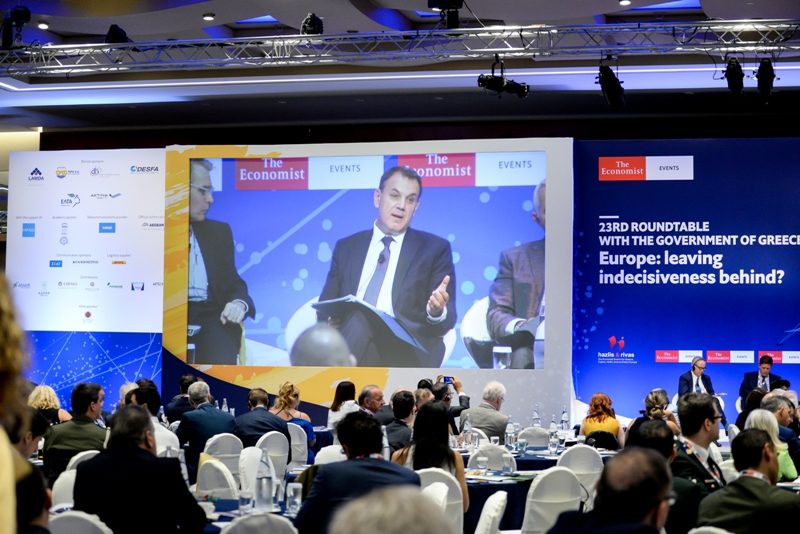
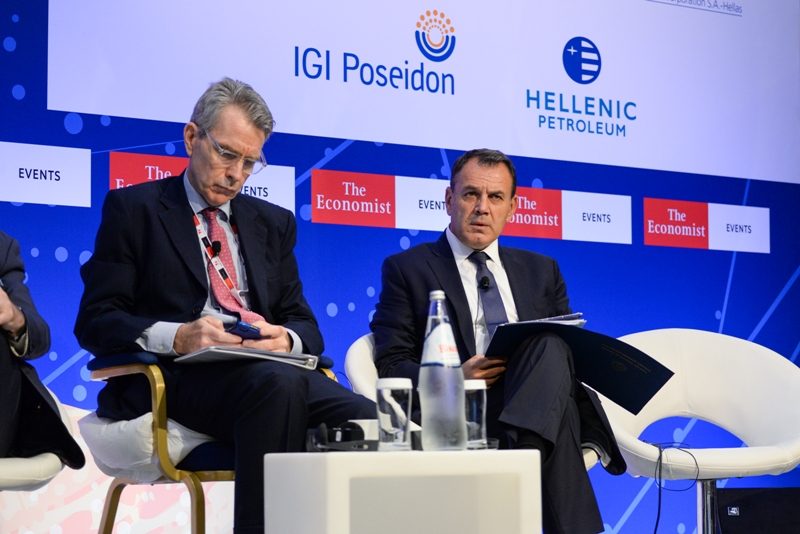
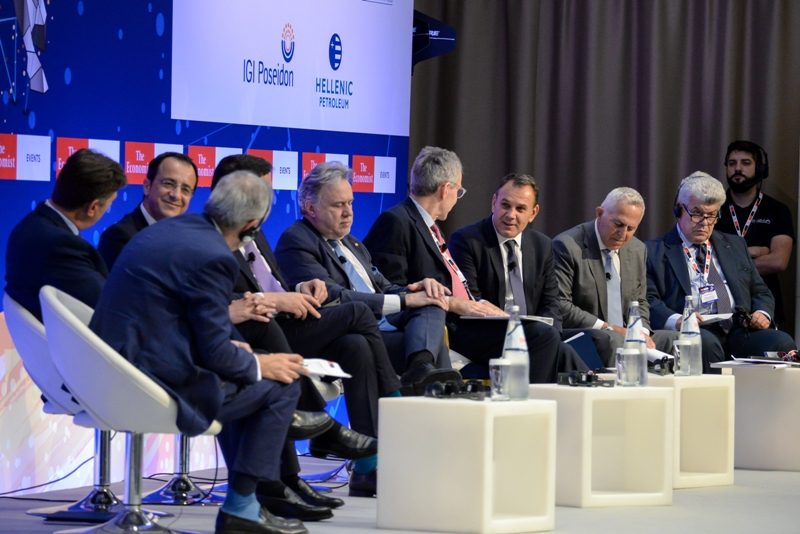
On Wednesday, 17 July 2019, the Minister of National Defence Nikolaos Panagiotopoulos participated as a speaker in the Economist’s 23rd Roundtable with the Government of Greece on the subject “Europe: Leaving indecisiveness behind?” taking place in Athens, where he gave the following address:
“Ministers,
Mr. Ambassador,
Distinguished guests,
Ladies and Gentlemen,
today the Prime Minister of Greece will visit the Ministry of National Defence for a first official comprehensive briefing on the current status of the country’s Armed Forces in order to move forward, according of course to his guidelines.
Furthermore, it is a pleasure to be in this panel with all those distinguished guests, representatives of foreign policy from neighbouring countries, former Ministers, my dear Ambassador, with whom we had an excellent conversation the other day, and, of course, my predecessor at the Ministry of National Defence, Mr. Apostolakis, whose presence here signifies continuity, if you will, in the political leadership of the Ministry because, at the Ministry of National Defence, we all work towards a common goal, regardless of political affiliations and positions. To maintain, enhance, and reinforce the deterrent power of the country’s Armed Forces.
So, without saying much about foreign policy – besides the panel includes people more competent on that than myself – I should say that our job at the Ministry of National Defence is to ensure that the fighters can fly, the warships can sail, the military vehicles can move, fully functional and operational, in order to provide the country with a security “umbrella” and the deterrent power it needs to deal with any aggression.
I’d like to state that the current global environment is indeed characterised by a trend of increasing instability. It’s not what someone said that everyone is getting ready to fight everyone. I don’t believe that. However, the end of the bipolar geopolitical system has led to changes and increasing uncertainties, as well at to the evolution of old threats and the emergence of new ones. When we hear threat, we obviously think of a security challenge. Conventional threats are now combined with a series of asymmetric or hybrid threats. So, security challenges are readjusted accordingly. One such challenge is, of course, terrorism, especially the kind characterised by elements of religious fundamentalism.
Other security problems come from the movement of people, due to inability to sustain themselves in their countries or due to unequal wealth distribution which, currently, makes millions of people around the globe look for a better life elsewhere, taking the relevant risks. Where else? In the countries of the western world, mainly Europe.
Climate change is a special kind of asymmetric threat. Here, at the Armed Forces, only a week in my tenure, I realised this when the Armed Forces had to take action twice to prevent or restore damages caused by extreme weather phenomena in various areas of Greece. I fear that extreme and extraordinary phenomena now become the norm, due to climate change, and this is a challenge that must be dealt with by the country’s competent authorities, not just the Ministry of National Defence of course, but all the competent Ministries, the General Secretariat for Civil Protection, which has been in a state of readiness for a long time now in the middle of summer.
Moreover, there are modern realities affecting security challenges. The ageing European population is one of them. This is in contrast to the population explosion in other areas, human trafficking, and organised crime; another geopolitically important aspect is the exploitation of resources, either in terms of hydrocarbon drilling or the transport thereof. Specialists say “when you’re not a producer, the next best thing for a country is to be a transporter of hydrocarbons via pipelines passing through your country’s territory”.
A special kind of security challenge is also the malicious manipulation of technological advancements, in one word “cyberthreats”. Regarding our country, the East Mediterranean region is first of all a critical sea border of Europe. The other day, I essentially mentioned that the East Mediterranean region is the sea border not just of Europe, but also of the West. In this region, we have had migration flows coming into mainland Europe in large numbers during the past years. Greece can’t change its geographical fate, hence it will be the first point of reception of these migration flows. The security problems and the challenges arising from this situation are obviously due to the conflicting interests of the countries in the broader region, but also to the emergence of revisionism in certain countries, as well as of new radical sources of religious and national fundamentalism.
We are certainly concerned regarding the protection of Christian minorities and minority populations in the region. We are concerned about Libya, we are concerned about the situation in the Balkans, but we maintain our composure. Above all, when it comes to shaping national strategy and individual policies, this country must maintain its composure, sobriety, and abidance by the values and rules of International Law. We can’t do otherwise, we never did.
Factor in other traditional problems, such as the Middle East issue and the perpetuation of the Cyprus issue and you have the final tally of our main challenges. Transport of energy resources, dealing with radical religious fundamentalism, ethnic and religious tension, I wouldn’t say conflict, national revisionism, and, I would say, a mix of selfish national policies, involving also some of our European partners.
Migration flows, cyberattacks, these are the main security challenges we are faced with, since we consider our country to be – and we work in that direction – a key country of the regional security system, a stabilising factor, and a security provider in the region. And this is – and I’m sure you know this better than me – the key word and the goal towards which we work. We are based on a firm policy of principles and positions based, above all, on the non-violation of borders, regional cooperation, particularly with the neighbouring countries, equality of bilateral relations, and, of course, abidance by the rules of International Law.
Greece follows these rules. As a country, we don’t like being provoked, I have said so before, and we don’t like provoking. But when provoked, we must structure our response with composure, sobriety and at the same time strength and resolve. This is a real deterrent concept. Resolve contributes to the success of a country’s deterrent power. And the main executive instrument of a country’s deterrent power is its Armed Forces. This is the goal towards which we work; this is why I took office, although I still seek my predecessor’s advice because, no matter what, he is an excellent soldier, made of Armed Forces material. To this end, I cooperate with my excellent Deputy Minister, who is part of the political leadership of the Ministry of National Defence, the Staff, the Chiefs, the entire Armed Forces, because, at the end of the day, as I said at the handover ceremony with some emotion, due to the atmosphere of the day, we are all soldiers of Greece and now I also have this role.
We seek and will continue to seek good neighbourly relations in the Balkans. The Balkans must become a region producing stability and not instability, as it has always done, with grave consequences for Europe and the world.
To this end, I think good neighbourly relations are very important. My country has evidently worked for this with everyone. I am concerned about the revisionist and a little out of control, at least compared to its western influences until recently, behaviour of Turkey who, in addition to its usual actions, recently came back with particularly aggressive rhetoric by top officials. This is concerning, but not frightening and for this reason, as I said, we enhance, as a military option, or try to enhance our Armed Forces’ deterrent power.
And one last comment, I think it is imperative to make it, on the Prespes Agreement. I am not questioning anyone’s intention that this Agreement was struck for a good cause, to enhance stability in the region, to strengthen the geopolitical constants in the region and prevent changes. It’s just that, in my opinion and with the best of intentions, and I’d like to stress that, in order for this Agreement to last and have positive results, both parties must remain focused on the observance of its essential terms. This is my opinion as a jurist, if you will. If it is implemented with total compliance with its essential terms, I think we can have a better future.
In conclusion, I’d like to repeat that, as the political leader of the country’s Armed Forces – and this is a huge honour for me – I will work with dedication, with all my powers, together with the rest of the political leadership, in excellent cooperation with the Armed Forces personnel and, mainly, the military leadership, to have Armed Forces who provide security in the region, keep Greece safe, and help the Greeks feel safe in their country. This is our goal, our most important duty”.