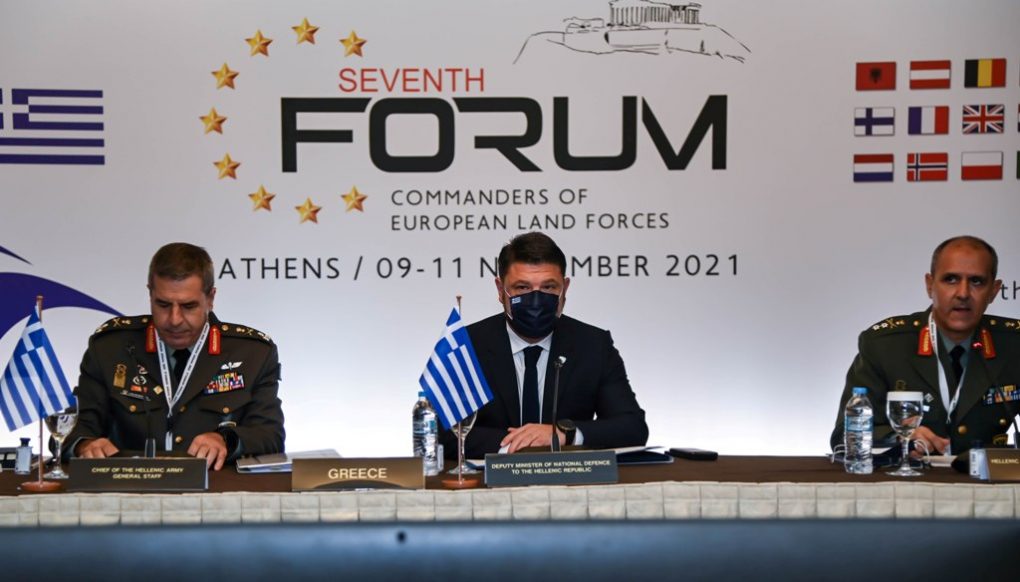
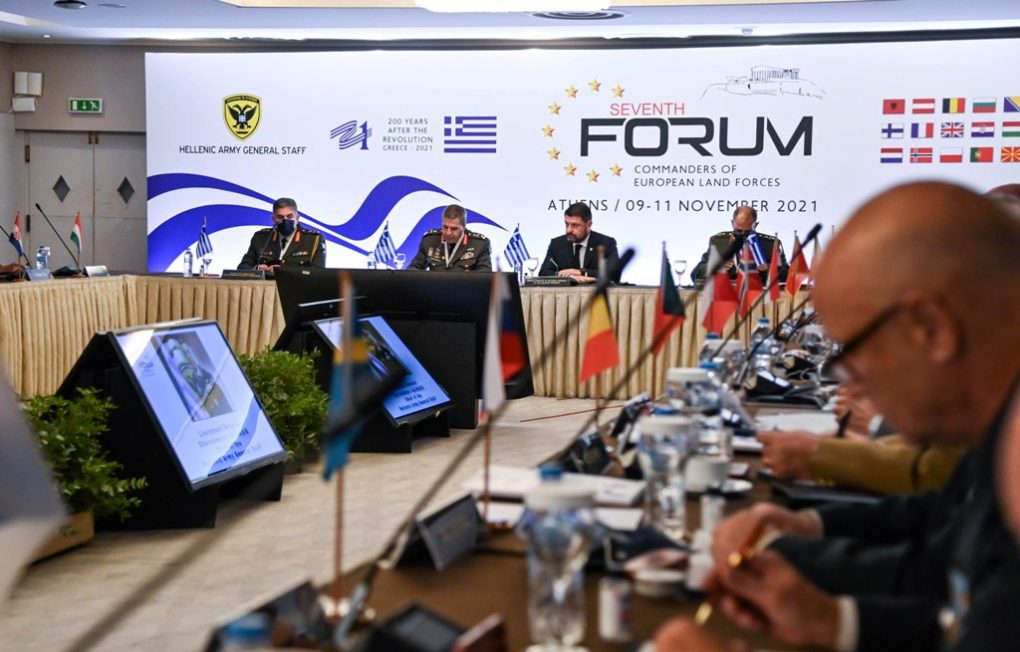
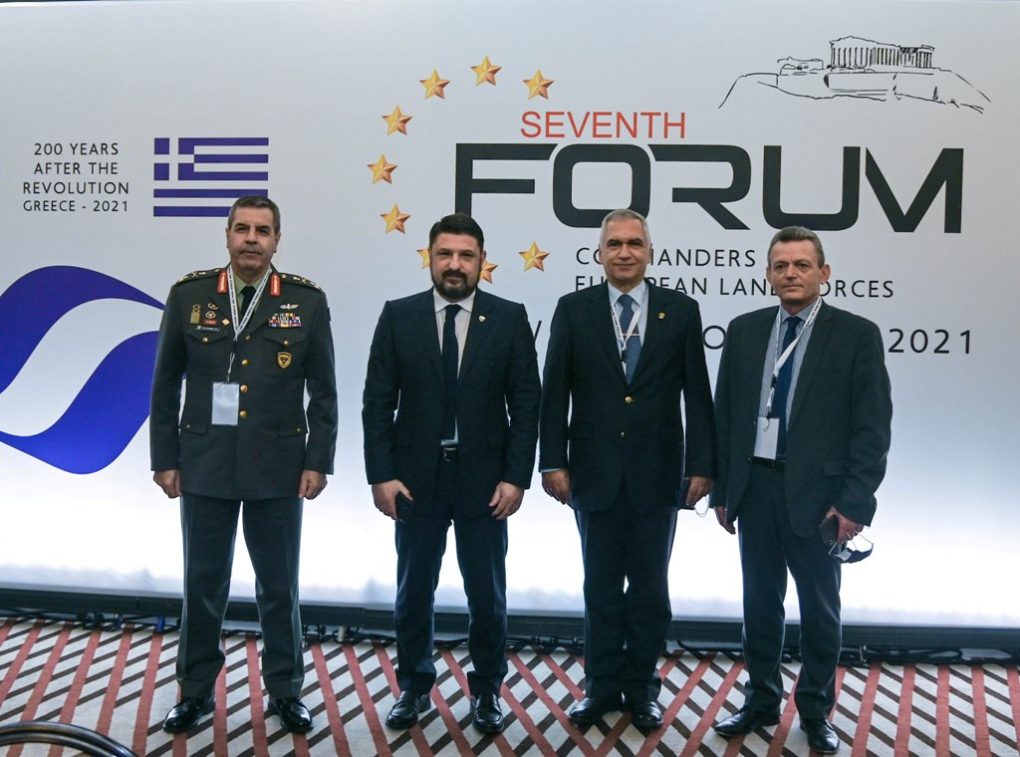
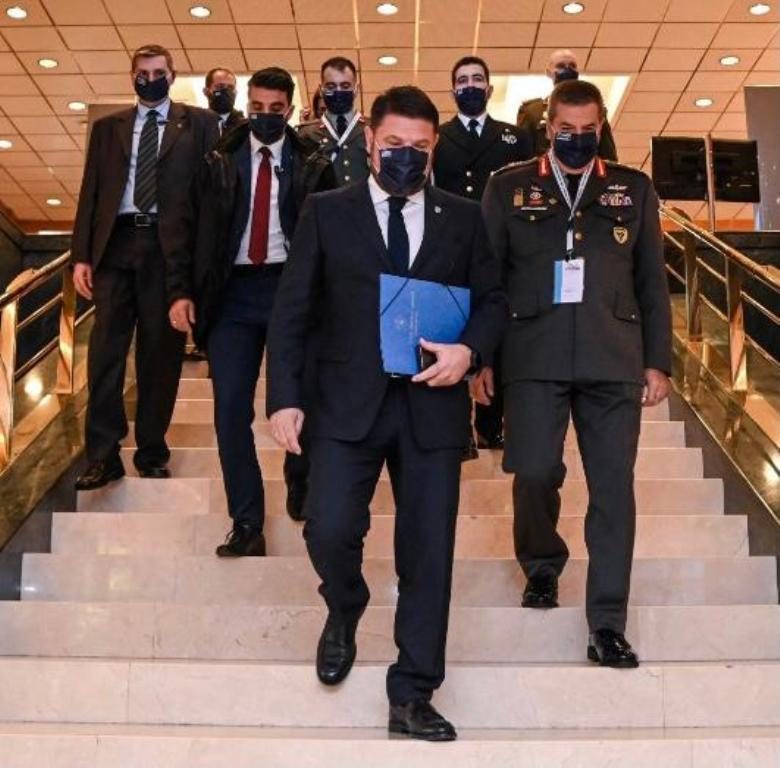
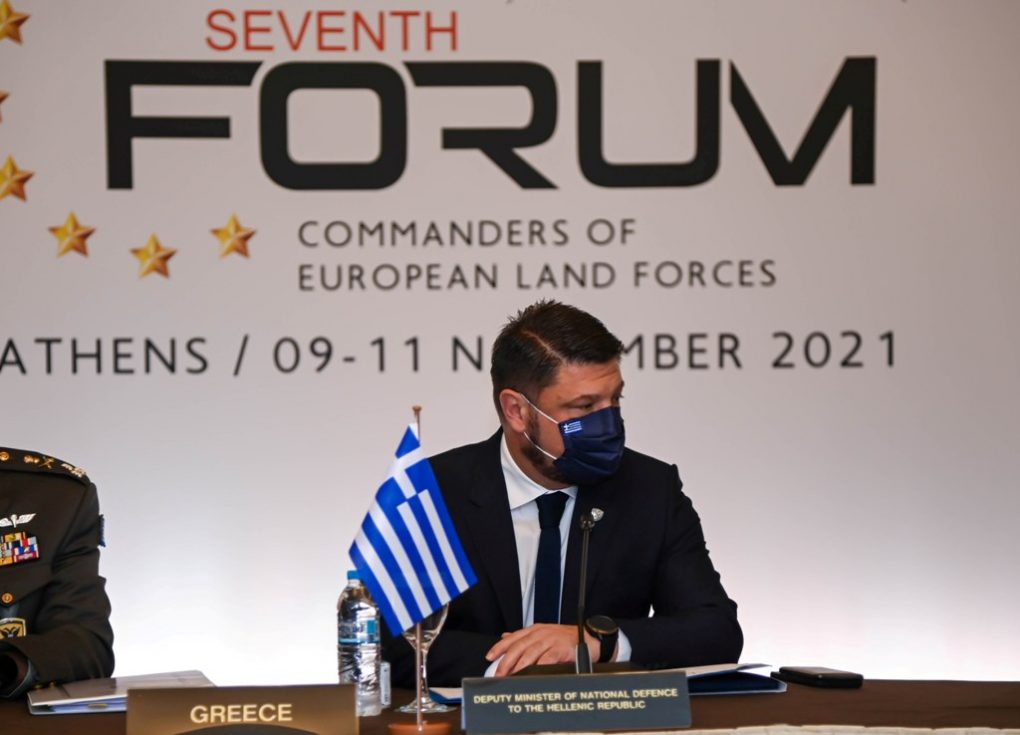
The Deputy Minister of National Defence Mr Nikolaos Chardalias, proclaimed today, Wednesday 10 November 2021, the commencement of the proceedings of the 7th Forum of the Commanders of European Land Forces.
The forum is hosted this year for the first time by our country and the Hellenic Army General Staff (HAGS), from 10 to 11 November 2021, focused on “The Challenges which the European Armies Face – Capabilities for Security Synergies to Counter them”. 28 land forces commanders participate from the European Union’s member – states, other European states, but also commanders of other structures, such as USAREUR – AF, EUMC, as well as ΝΑΤΟ LANDCOM.
During his address the Deputy Minister mentioned the following:
“With particular pleasure, I accepted the kind invitation of the Chief of the Hellenic Army General Staff, in order to participate in the commencement of proceedings of the 7th Forum of the Commanders of European Land Forces, which this year is hosted by Greece, in the year of the 200th anniversary since the commencement of the struggle for the Nation’s Independence, a struggle which resulted in the foundation of the modern Greek State, consolidating the country’s presence, after a centuries-old absence on the global political map, as a modern, democratic and lawful state.
Therefore, in this emblematic historic circumstance for all of Hellenism, we welcome you to Athens, the city which constitutes the birthplace of Democracy, Art and Culture, to a Conference which aspires, on one hand to enrich with its fruitful conclusions our knowledge and our policy, and on the other hand to offer a substantial field for the exchange of ideas, views and proposals, on issues pertaining to defence, security and the threats which Europe faces.
At the first streak of dawn of the 3rd decade of the 21st century, it is an indubitable fact, that the displacement of the centres of world power, the alteration of traditional national identities and the diffusion of human networks, mutates the international environment to a more connected, antagonistic and unforeseeable reality, forcing the European Union, NATO and other International Organisations, to constantly face a plethora of asymmetric challenges and threats.
The modern security environment is characterised by intense phenomena of instability, fluidity, high interdependence and fragile balances which shape a particular global agenda, which includes constantly pressing threats, such as war conflicts, climate change, migration, religious fundamentalism, international terrorism, organised crime, piracy, cyber-attacks and proliferation of weapons of mass destruction.
The above challenges, in combination with the indubitable geopolitical and technological antagonism, form a particular global mosaic, which gets even more entangled because of the COVID-19 pandemic, a medical crisis never seen before which redefined the world security framework, at all levels.
The world, at least as we have experienced it since the end of the Cold War, is transforming in an unforeseen manner and the developments seem to surpass the capacity of even the traditionally great power entities, states or even alliances, to predict them, resulting in most actors reacting more cautiously against them, instead of defining them.
Western societies, in the context of countering these new hybrid threats, request from their governments, with increasing exigency, to respond to the obligation of retaining a feeling of security, always respecting the applicable constitutional limits and the personal freedom of its citizens.
Thus, initiatives are developed at the national level, always under the common component of the need to activate the national Armed Forces, to provide assistance to the competent state bodies and the filling of gaps discovered at the level of security and defence.
It is commonly estimated that the European Union must redefine its position and decide if it will remain just a major financial market or if it will assume the corresponding role as a major geopolitical power and provider of security in the global realm.
And that can only happen with the further development of the capabilities of its Common Security and Defence Policy, as a substantial aspect of its external action, which will promote its global strategic role, but also its capacity to act autonomously, when and where it is deemed necessary.
Of course this implies that we need a more integrated and cohesive approach to our constituent national policies, an approach which will contribute to the more successful achievement of our strategic interests, always in the context of increased mutuality and equal terms of competition in our relations with other global actors.
Naturally, the assumption of a greater share of responsibility is required in the field of security and defence, fully utilising the Union’s defensive initiatives and striving more intensely for the integration of these initiatives to the national defence planning of the member – states, in order to achieve more cohesion, solidarity, but also the progressive shaping of a common defence policy.
It is certain that the building of increased military capabilities in the European Union will not only contribute to the achievement of its operational goals, but it will also further contribute to the enhancement of its industrial base, which will gradually morph into technological domination, which constitutes a fundamental perspective of strategic autonomy.
Greece constitutes an unreserved supporter of the multilateral approach, with regards to perplex, global challenges of our times and at the same time a stable supporter of the absolute need for Europe’s strategic autonomy, without that meaning a weakening of our transatlantic bonds.
A powerful and autonomous European Defence Union will surely operate as an enhancement of NATO, resolving besetting issues of the European states in the fields of interoperability, military mobility, but also of their meagre defence budgets.
It must be fully clarified that the European Union does not, in any case, constitute a competitor of NATO, on the contrary, it constitutes an irreplaceable partner, which contributes to the wider capacity for defence and security of the North-Atlantic Alliance, complementing and enhancing it.
As a country, we unreservedly support a tighter, collaborative and mutually beneficial relation between NATO and the European Union, always according to the Joint Declaration of EU-NATO Cooperation, signed by the two Organisations, which constitutes the framework of cooperation and the principles of interactivity, mutuality and respect of autonomy in decision-making.
Nobody can dispute that the European Union, as a global actor, has indubitable geostrategic interests in the Eastern Mediterranean, the Middle East and the region of SAHEL, interests which it must obligatorily defend and furthermore it must undertake that challenge with a renewed sense of emergency, in order to fill in the gaps turning up due to the lack of NATO or UN intervention.
Dear guests,
Reaching the end of my brief remarks, I would like to make clear, than in a fragile and unforeseeable international environment, Greece, as the only country in the Eastern Mediterranean actively participating as a full member in all of the international and regional security organisations, but also acting with indubitable geostrategic superiority, constantly develops synergies and policies which promote defence and security, making the country a pillar of stability and peace for the wider region.
Always steadily oriented towards the European solidarity, International Law, the Law of the Sea and the principle of good neighbourly relations, we are building strong alliances with countries with which we share the same vision and the same principles, looking forward to the establishment of the conditions for viable social and financial development, for all of the states within our region.
It is made certain that the challenges and the threats which stand before all of us are so complex, that no country can effectively face them alone. Cooperation and solidarity between our states is required, so as to everlastingly secure our joint endeavour, the European Union.
I wish good luck to the proceedings of this major Forum which, I am convinced, will bring in substantial conclusions and inspired perspectives for the future of the European Armies.
Thank you”.