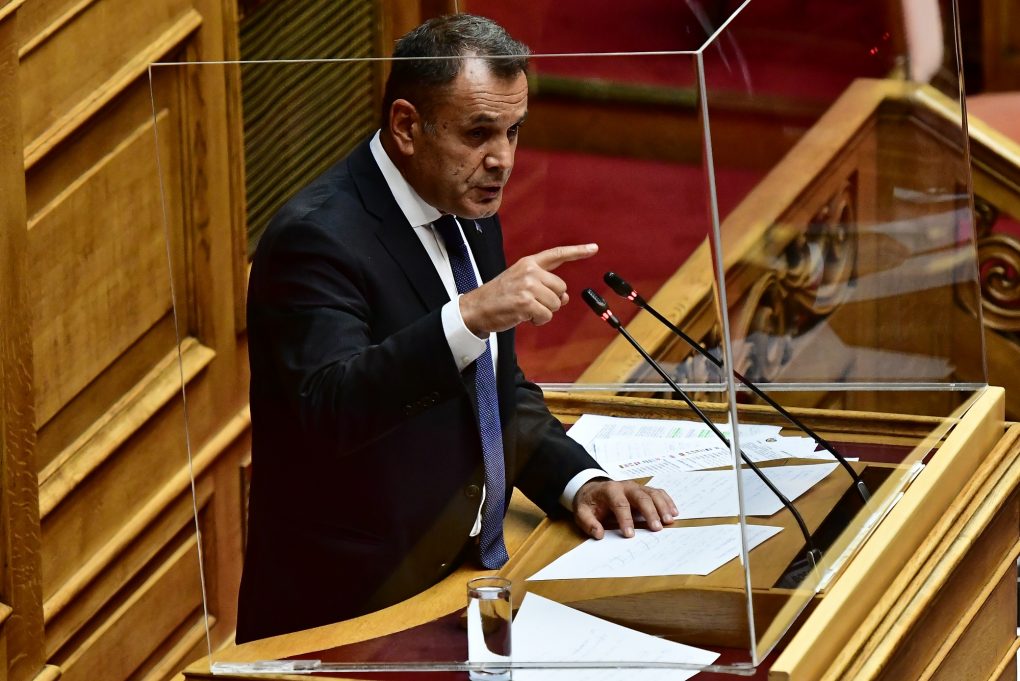
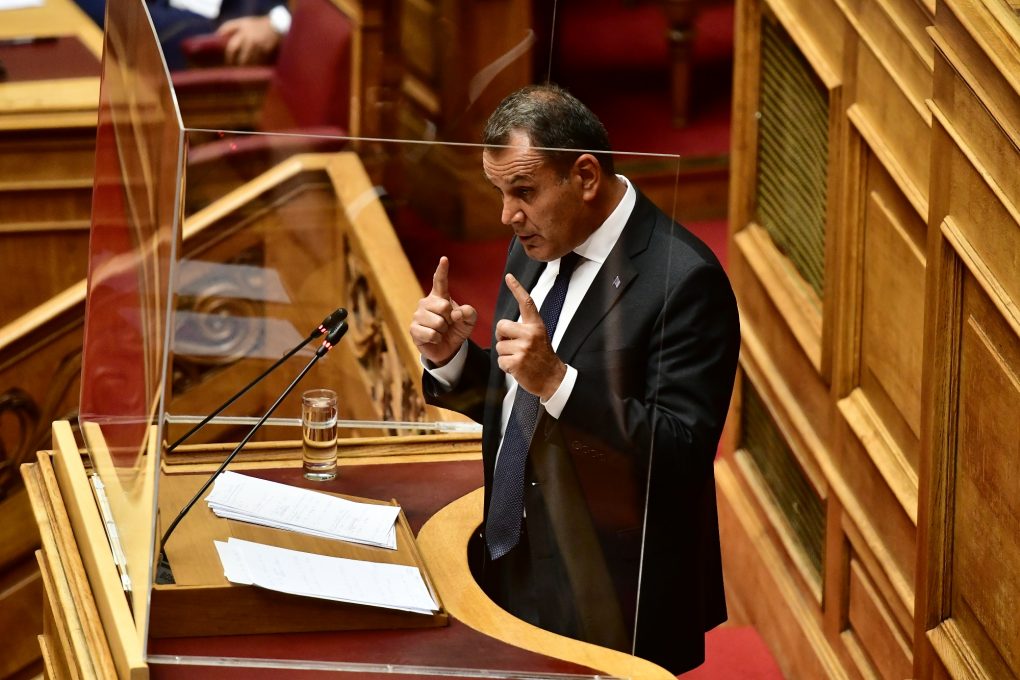
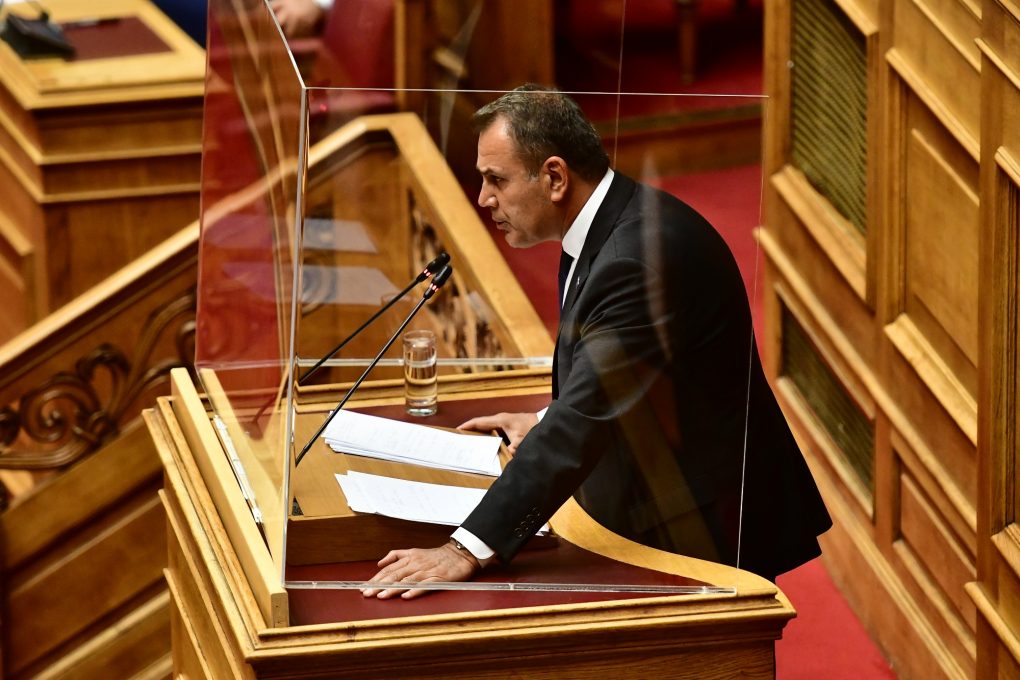
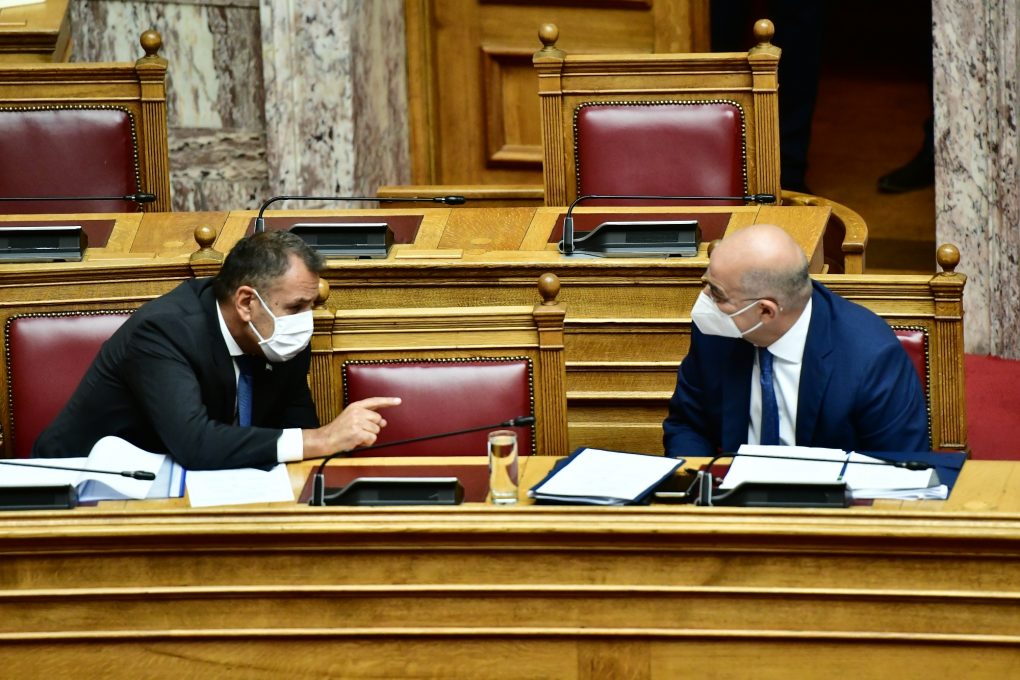
The Minister of National Defence Mr Nikolaos Panagiotopoulos made today, Thursday 7 October 2021, the following address during the talks conducted in the Parliament’s plenary session for the “Ratification of the Agreement between the Government of the Hellenic Republic and the Government of the French Republic for the establishment of a Strategic Partnership for cooperation on Defence and Security”:
“Ladies and gentlemen colleagues,
I will not try to adapt the historic nature of the day to the current talks, besides this was done in the best possible way by the Prime Minister a few hours ago and a few moments ago by the Minister of Foreign Affairs. Please allow me to make three or four comments as an advisement.
The motto “Greece – France – Alliance” is not new. It had been shouted by the Greek people when Konstantinos Karamanlis had disembarked from the airplane provided then by a friend of Greece and a personal friend of Karamanlis, the French President Valery Giscard d’ Estaing, so as to come here and restitute the Democracy in the country.
The relations between the Greeks and the French have always been good, there was always communication, as detailed by the Alternate Minister of Foreign Affairs who spoke before, Mr Varvitsiotis. However, this motto and the relations between the Leaders, acquire, in my opinion a new dimension, they are truly taking off, thanks to a more facile common comprehension in terms of personal “chemistry” but also an understanding on basic issues, geopolitics and what pertains to the challenges and the security threats, in our wider region, between the Prime Minister of Greece Mr Kyriakos Mitsotakis and the French President Emmanuel Macron. This understanding, this common comprehension, this chemistry, led to this agreement.
Thus, today here in the Parliament, I am trying to understand: The Government comes to ratify a Defence Agreement with the Greatest Military Force in Europe, which wishes to be more connected with us. This Agreement includes the coveted Mutual Defence Assistance Clause for which the Opposition was reproaching us because we had not agreed on it in previous Defence Cooperation Agreements with the French, like the one for the acquisition of the eighteen “Rafale”. You were reproaching us then by saying: “You did not achieve the Mutual Defence Assistance Clause”, “a very lacking effort”…
Today we should rejoice and not lament. We should all look for ways to support our national interests and not conduct opposition against Kyriakos Mitsotakis and furthermore with vehemence. We should find points to discuss about the Agreement or even analyse issues regarding the provision of defence assistance, which is a general provision of political and diplomatic character, not a clause in an insurance policy for some to discover the sub-clause of the sub-paragraph and hypothesise on current scenarios. We should do that instead of talking about Armaments, the cartridges of the Hellenic Defence Systems, Kalamata and the rest.
I remember saying it, but you insist on hearing it again. A few days after the assumption of my duties at the Ministry of National Defence, I was trying to find files to sign for a deposit or an installment to the Hellenic Defence Systems, to move forward with the pay of August 2019 and I was trying not to find files – to sign, to send them back – through which the penalty clauses were forfeit due to a delayed submission of Defence Material. That is what I was doing in 2019, to remind you what the conditions were before, regarding what you are reproaching us about today.
Let me make two more comments pertaining to armaments, since as I told you, many things have been said about the Agreement. The decision for the “Rafale” as well as the decision for the Frigates – one more element of this general convergence between Greece and France, the acquisition of these three Frigates – did not happen out of the blue, without any planning.
According to the new Forces Structure for 2020-2025, which we discussed at the end of last year, during the proposals of the General Staffs and according to the National Mid-term Defence Armaments Programme of the current period, regarding the financial part and the part of financial planning, the requirement of the Staffs to sufficiently cover the Defence requirements of the country is for 48 next generation aircraft, as well as for 12 to 13 Main Strike Units (Frigates and perhaps Corvettes).
So how can you claim that these decisions were made without any planning? How can you say that these decisions were not included in any framework, in any scheduling, when we have submitted and discussed about our plan with cost estimates, prioritised, spread out in a long period of time so as to cover the needs of all three Services of the Armed Forces for the next eight years. Are you under the impression that the Hellenic Air Force does not approve of the acquisition of the 18 “Rafale” which will become 24 to form a full Squadron of this type of aircraft? Are you under the impression that they are sulking? Are you under the impression that the “Belharra” did not constitute the number 1 preference of the Hellenic Navy? Is that your impression? You can ascertain the facts. We had narrowed the options down to a list of three to four final candidates for the Frigates. And in this hall, much speculation was going around, by many, that we are not taking heed of the Navy, that we will choose with other criteria, that we will not look upon its needs, that the reasons for the choice were geopolitical and did not respond to the narrow requirements of the Hellenic Navy personnel. However, look at what happened. And that happened because the Hellenic Navy worked really hard to evaluate the numerous proposals which were becoming more improved as time went by, because each candidate was approaching with new data to make them more attractive to the Hellenic side. And of course, proposals which were reflecting the main directive of the country’s Prime Minister: “You will select that ship which fulfills, in the best possible way, the requirements of the Hellenic Navy, without any other consideration”. That is how we proceeded, that is how the Hellenic Navy proceeded.
You are trying to divert the discussion and for that I owe some answers in a discussion fully dedicated to Armaments. I have to tell you this directly: We are not conducting an armaments competition with Turkey. We are conducting a race to cover the gaps created throughout a long period of time in the Armed Forces. Because the only decision you made when in office, gentlemen of the Opposition, was the noteworthy 500-million Programme of the Naval Cooperation Aircraft, of dubious emergency when it comes to the requirements of the Armed Forces. Five hundred millions was the cost of the acquisition of the new heavy duty torpedoes which we are concluding along with the cutting-edge guided missiles which will dramatically increase the firepower of the Army from Evros to the islands. These two together, as much as the P3P, of which I know that the first is already in the air, were delivered to us, but the Programme is on shaky ground and it has exceeded some financial limits, but that is another story.
I listened to the Rapporteur of the Main Opposition carefully, the honourable colleague Mr Katrougalos. We had decided – he told us – that the frigates would be built in Greece. And I ask: When did you decide that? In words? Orally? Because I do not have the text of such an Agreement. In the Letter of Intent which you never signed? This text that is not legally binding but just a simple declaration of intent by the two sides, in order to proceed to this great armament programme for the acquisition of the two and not the three – that is what the deal included at the time – “Belharra” for the Hellenic Navy? This LOI was never signed. I signed it with my French counterpart in October 2019 in Paris.
Let me also remind you of the “roadmap”, you know that the discussion about the acquisition of new frigates by the Hellenic Navy dates back awhile. It commenced on the days of Kostas Karamanlis – Nicolas Sarkozy. Then the issue of the acquisition of “FREMM” frigates commenced.
In February 2016 the French side came and proposed that we buy the new frigate, “Belharra”. In November 2017 a meeting of the joint Greek – French Committee of Defence – Technical Cooperation was conducted in Paris and the company submitted a proposal to produce Frigates. On 19 April 2018 the Supreme Naval Council approved the suitability of the proposed French “Belharra” frigate and the meetings continued.
In September 2018, at the premises of the GDDIA, a meeting between the representatives of GDDIA and HNGS with representatives of the “Naval Group” took place, where they were handed the proposed plan of the technical agreement between the two Ministries in English. The technical agreement was never signed, neither in the meeting of the two Ministers which took place in Paris in October 2018. In March 2019 “Naval Group” contacted GDDIA and asked for the signing of this noteworthy LOI on the part of Greece, given that we were moving towards a negotiation for an intergovernmental agreement. Nothing happened. An endless series of negotiations and the months were passing by.
The Letter of Intent was finally signed on 10 October 2019 in Paris by me and Ms Parly. It pertained to two Frigates and the negotiation commenced. The French were not exactly certain about their intentions, they were assisted in formulating their plan by our Hellenic Navy personnel. They had their own philosophy regarding the Frigate, we had ours. With every negotiation, with every meeting, the cost was growing higher and in August 2020 we concluded, not agreed, in a cost of 3,3 billions for two ships of Point-Defence. We deemed it unprofitable and we ceased, did not conclude, the negotiation. We asked to reconvene with a better proposal. The Budget was also burdened with the familiar case of the back pays by the State’s Council. It was considered unprofitable. The French left and returned with a better proposal, along with the other candidates. That was the “roadmap”.
You received a negotiation, that is what you said through your Leader and your Rapporteur. Excuse me, the issue is not to receive negotiations when you are the Minister of National Defence. The issue is to receive aircraft and ships after having conducted negotiations, having completed the negotiations, having concluded them. Do you know Mr Dritsas that within a year or less since the commencement of the initial talks with “Dassault”, we have already received a fighter aircraft? Look it up and you will see that these speeds are, to say the least, out of the ordinary.
Regarding the issue you understandably raised for the engagement of the domestic industry. Everyone wants ship-building projects for the Hellenic Shipyards. But if we want the delivery of these crafts in 2025 – early 2026 and late 2026 – early 2027, then we have to accept that this project cannot be processed by the Hellenic Shipyards in their current state and you know that there is an emergency and an attractive term in the contract from the French side, the speedy delivery of these ships, to the extent possible. I explained this earlier.
However, there are alternatives. If we proceed with the offered alternative and proceed to the acquisition of three Corvettes – as you know 5 billions have been reserved in the budget, for a long period of time, for the Hellenic Navy, 2,9 are reserved for the acquisition of these three Frigates, so there is a fiscal and financial margin – then I consider it certain that some of these ships (if not all) will be built in the Hellenic Shipyards, under the condition that they will have resolved all their problems. I believe that the conditions will exist, when we reach that point, because it is indeed understandable to have concerns about the engagement of the domestic Defence Industry. But since we are talking about it, I will tell you that on 6 October 2021 the GDDIA sent a letter to is counterpart in the French Ministry of Defence, through which it asks for the cooperation of the domestic Defence Industry with that of the French, as well as for the provision of technology and know-how in the execution of this contract, as stipulated by the term of the Defence Agreement we are called to ratify today.
And just one comment for “SAHEL”. The possible contribution of Greece in operation “Takuba”, in the Sub-Saharan Africa, does not arise as an obligation from the Agreement we are ratifying today. It arises, on one hand, from the context of the allied relation between Greece and France, an allied relation which today, of course, acquires a new particularly upgraded dimension and on the other hand, in the context of our country’s participation in an international mission, under the aegis of the EU. The country has been participating in the EUTM – European Union Train Mission since 2014, meaning the European Training Mission in Mali, with an Intelligence Lieutenant Colonel and a Major, with two Officers in the HQ, in a region with severe destabilising inclinations and possible threats for the vital geopolitical interests of the EU too, due to its proximity to North Africa and the Mediterranean. So “Takuba” constitutes a French initiative and is part of the wider “Barkhane” operation. The aim is the support of the Armed Forces of Mali.
Who is participating in this operation? I will read them to you: Sweden, Czech, Estonia (it is not a larger country than Greece nor is it closer to that region than Greece, based on our knowledge on geography), the Netherlands, Belgium, Italy, Portugal and the United Kingdom. Who has expressed their wish to participate, aside from us: Denmark, Hungary, Ukraine, Slovakia, Serbia, Romania, Norway, Lithuania, Poland, Finland, Georgia and Spain, twenty-three countries! I wonder why… What motivates these countries to state that they are willing to assist France in this international mission, either by contributing personnel to the HQ, or by contributing battle ready troops consisting of tens of men, not more? Because that ladies and gentlemen Colleagues, is a forerunner for the development of EU capabilities to the achievement of Strategic Autonomy which is our common desire – not to the establishment of the European Army yet, since this is a matter for the far future – so as to be able to take the initiative in regions where its critical geopolitical interests are at stake.
Ladies and gentlemen, I am mainly addressing the colleagues of the Main Opposition. Since today’s discussion has an intense French colour, Napoleon the Great had once said: “Never interrupt your enemy when he is making a mistake”. In here we may be political adversaries and sometimes harsh ones, but I think that in order to decide on critical National issues, we should not be consumed – and this does not actually happen – by hostility. I believe that if today you oppose this Agreement, you will make a great mistake. I persist on trying to interrupt you. In the major National issues there has to be concord and understanding between us.
Any discontent, any irritation, should stay out of the Parliament and furthermore out of the country as a whole. Let others be irritated by this Agreement which we wish to ratify today. Demonstrate that you meant it when you said that this Agreement moves towards the right strategic direction for the country and back the Agreement through your vote.
Thank you”.