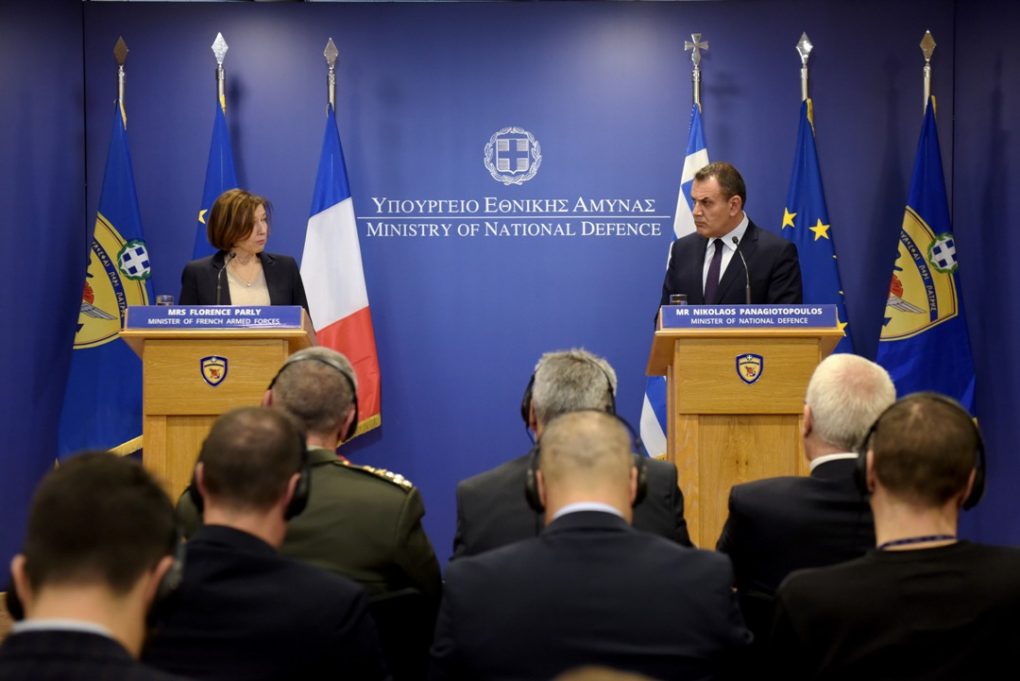
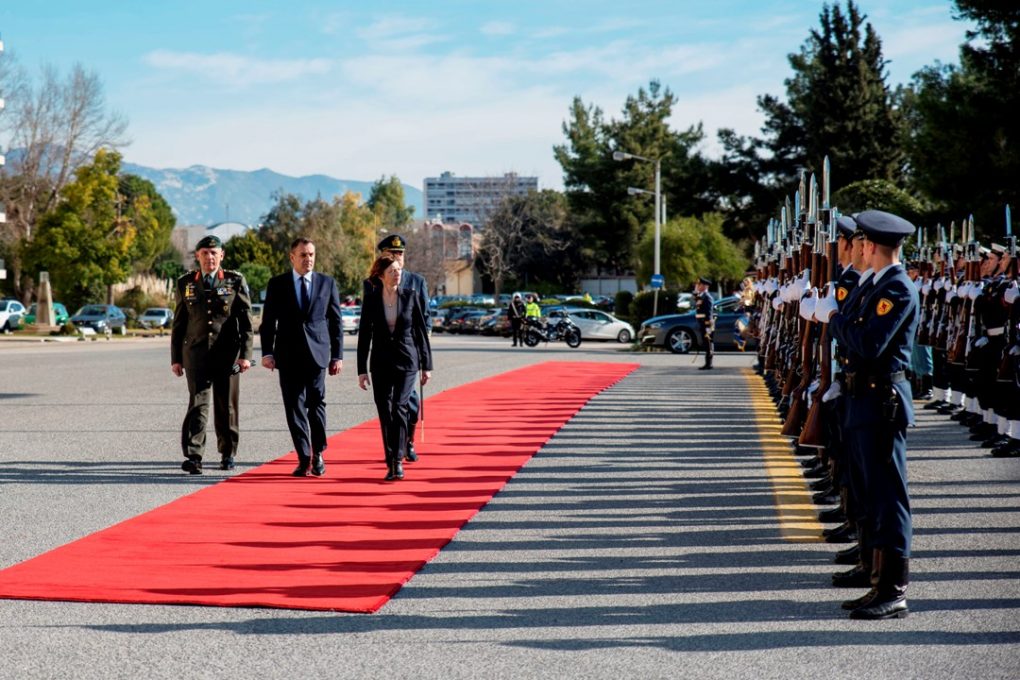
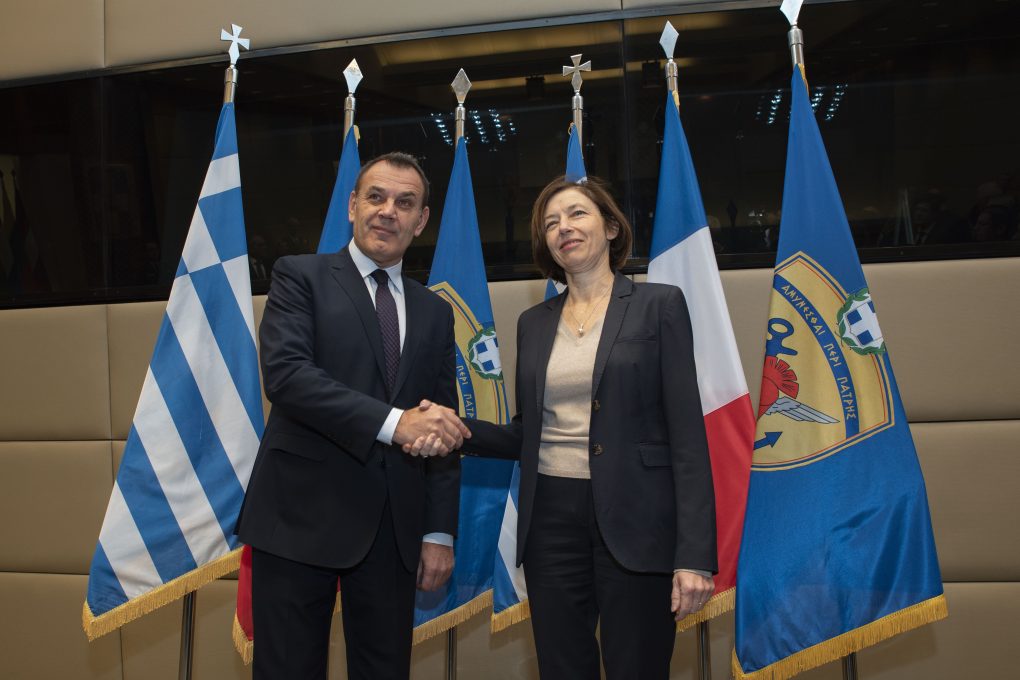
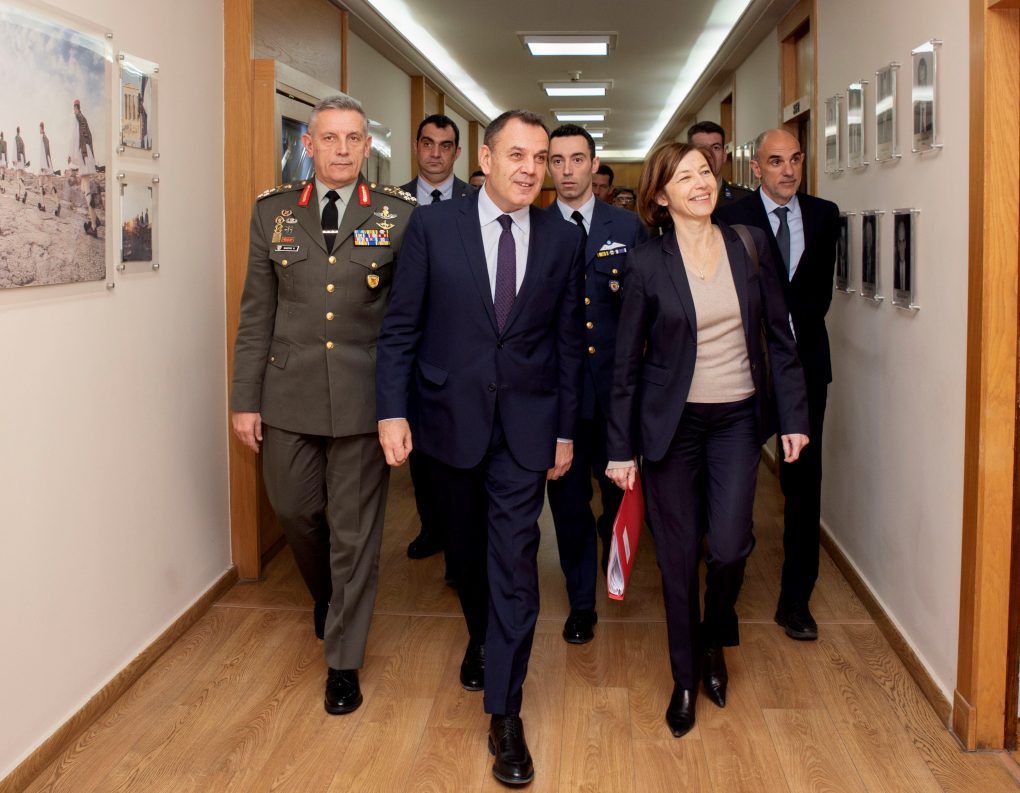
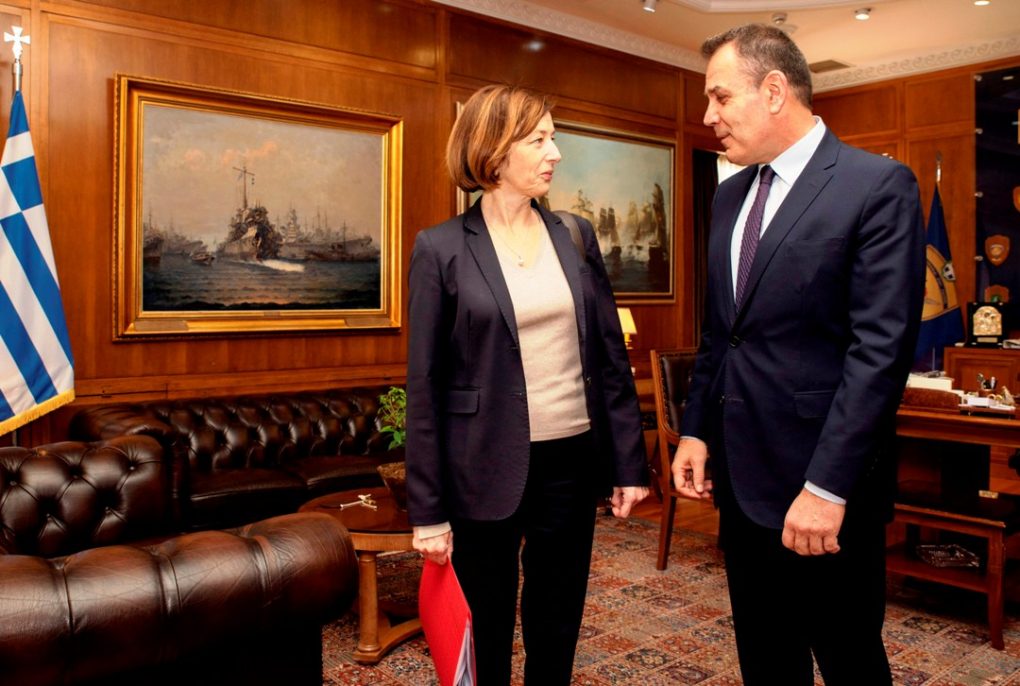
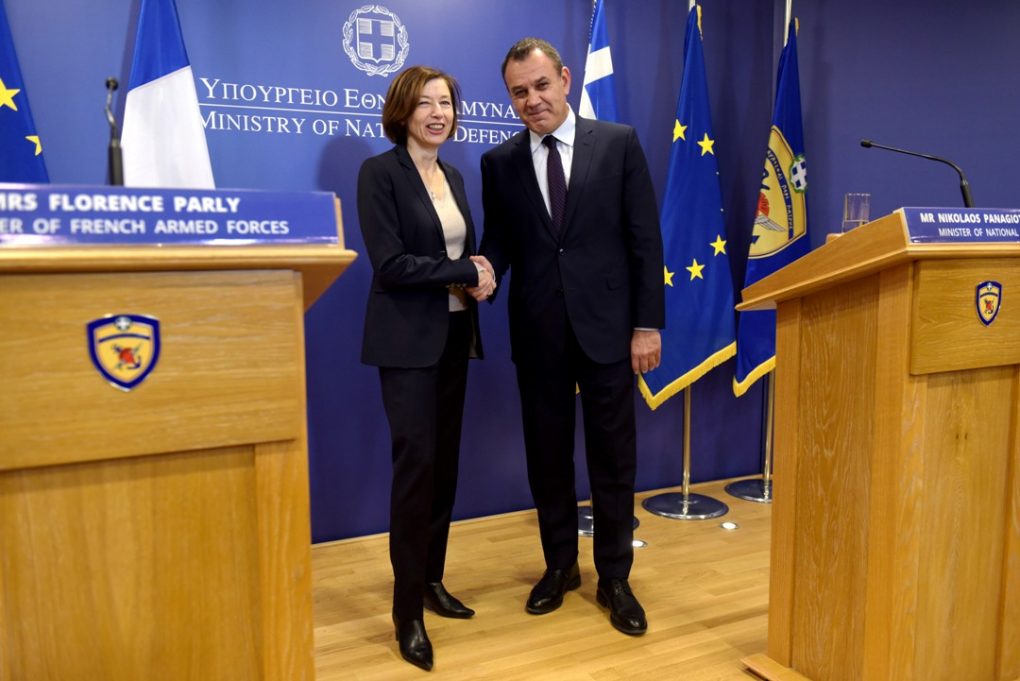
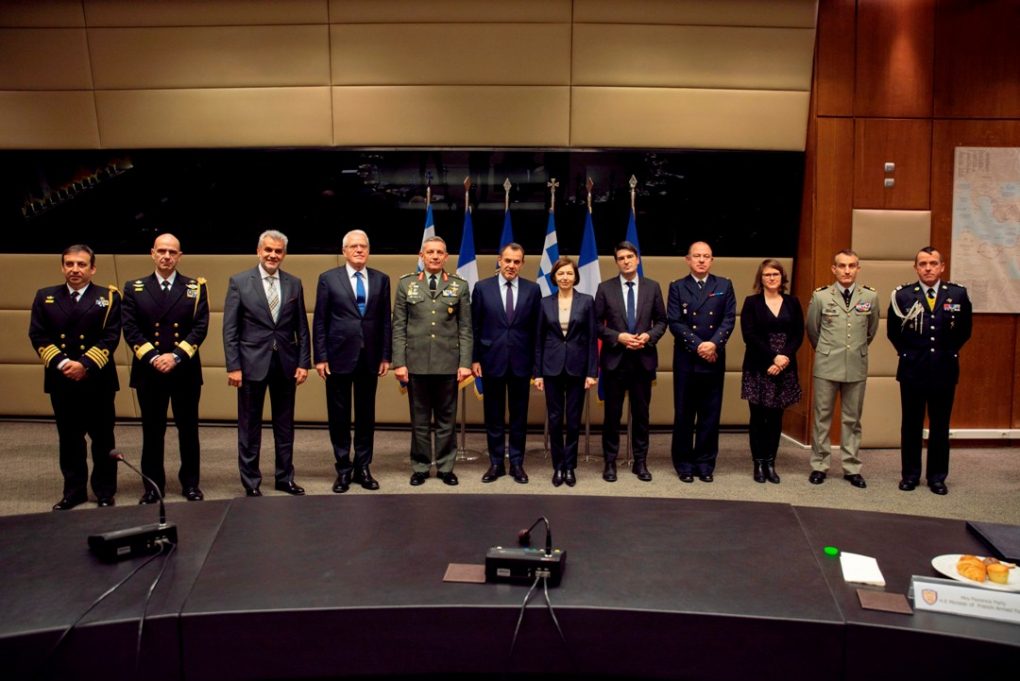
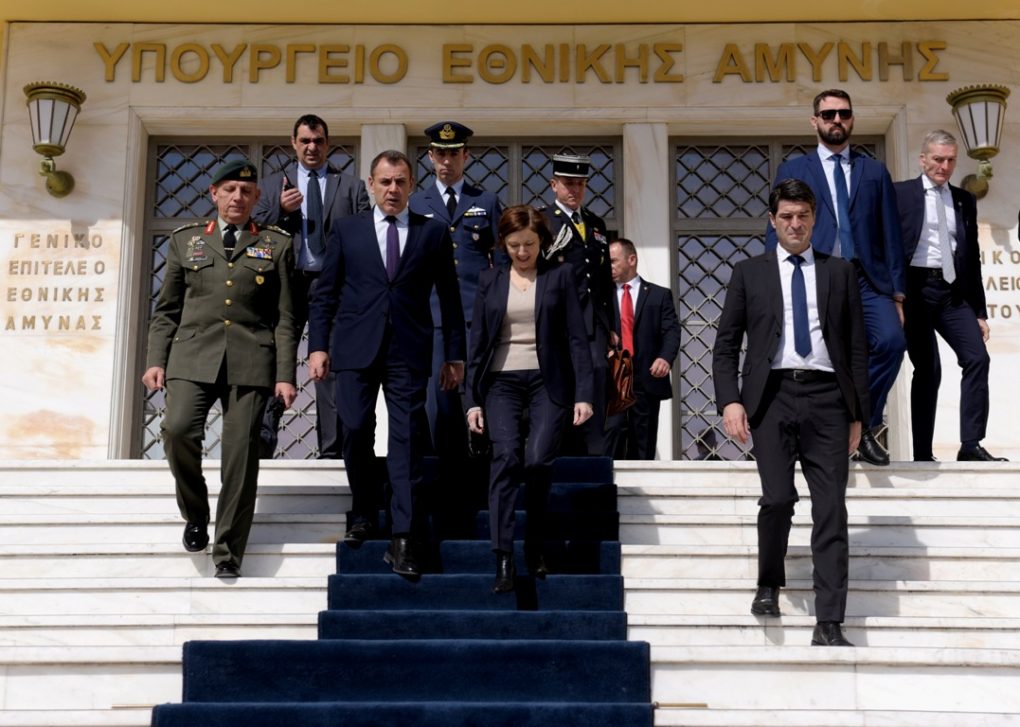
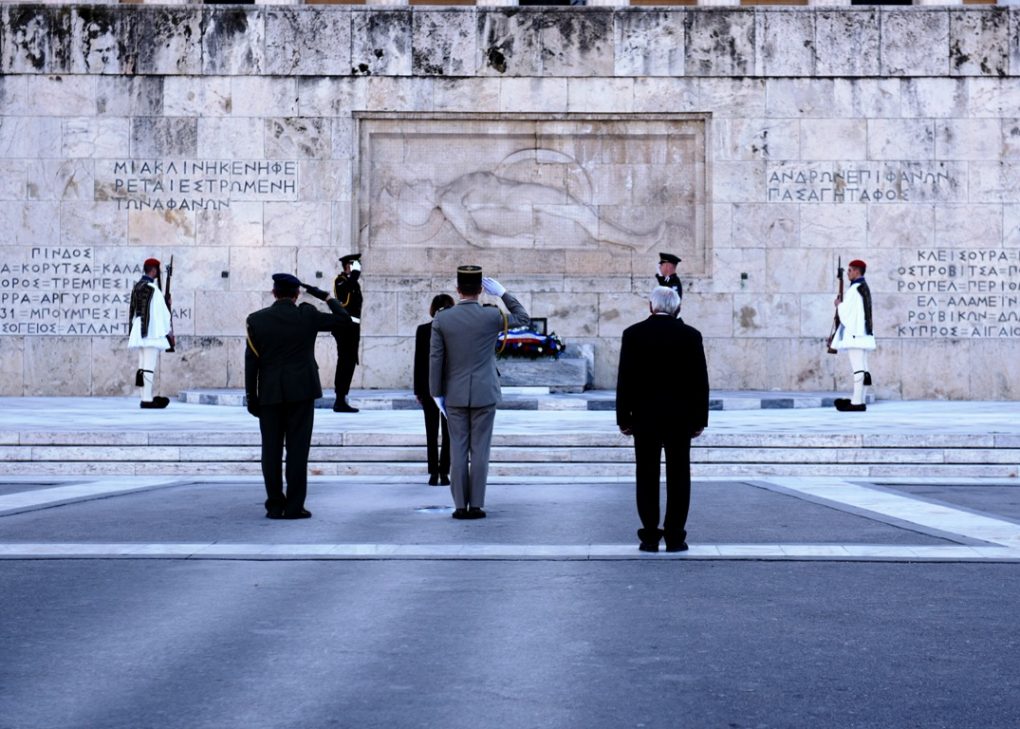
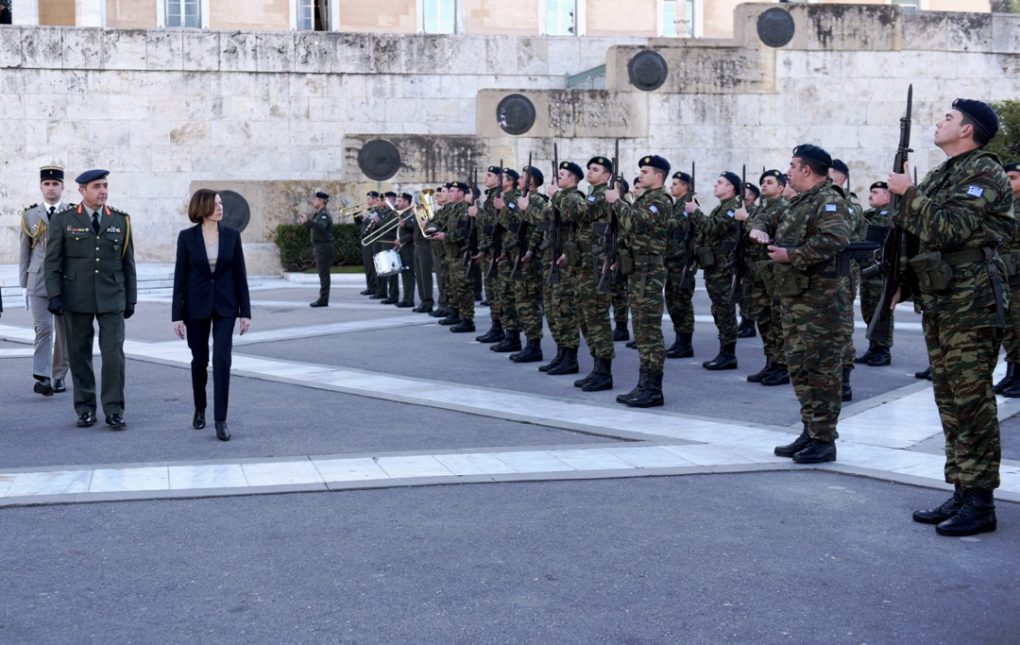
The Minister of National Defence Mr. Nikolaos Panagiotopoulos met with the Minister of Defence of the French Republic Ms. Florence Parly, on 24 February 2020, in the context of her official visit to Greece.
The two Ministers attended bilateral talks, held in “Ioannis Kapodistrias” Hall, regarding the further reinforcement of the bilateral cooperation in the field of defence. Moreover, they discussed topics of regional cooperation in the Balkans, as well as the security and stability challenges in the wider area of the Eastern Mediterranean.
The talks were also attended by the Chief of HNDGS General Konstantinos Floros, the Ambassador of the French Republic in Athens Patrick Maisonnave, the French Minister’s Military Advisor on matters of Armaments Major General Thierry Carlier, as well as numerous delegations of both sides.
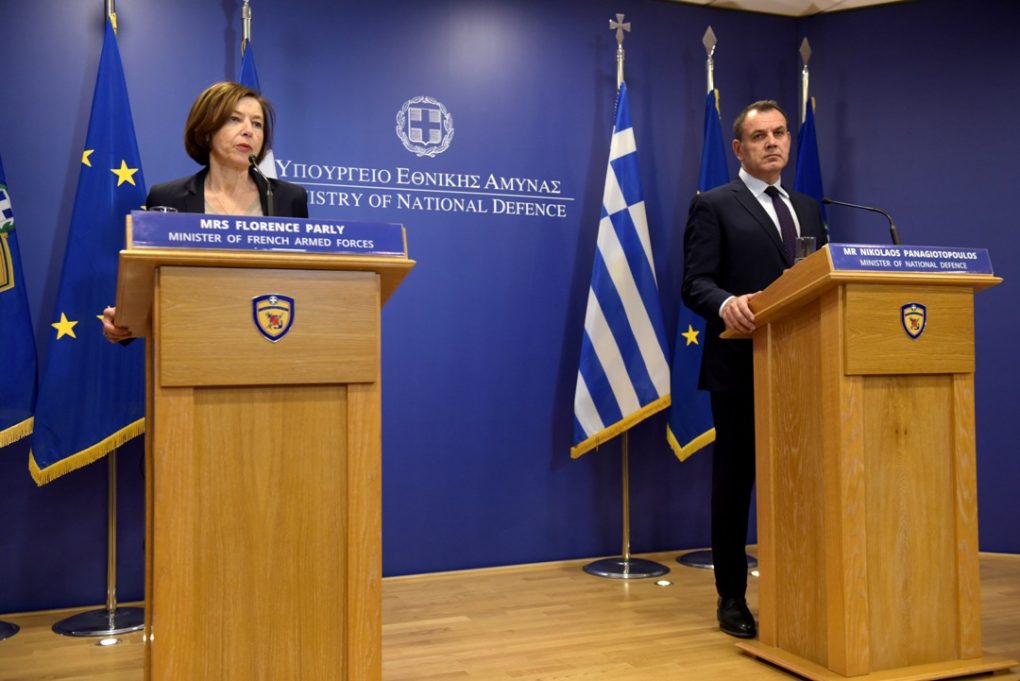
After the talks of the delegations of the two countries and the private meeting of the two Ministers, they delivered the following statements:
NIKOLAOS PANAGIOTOPOULOS: “I have today the great pleasure and honour to welcome the Minister of Defence of the French Republic, Ms. Florence Parly, at the Ministry of National Defence, in the context of her official visit to Athens.
This meeting is another proof of the constantly excellent relations of cooperation and the strong ties of friendship between our countries, both at a bilateral level and within regional and international organizations.
With my counterpart, Ms. Parly, we discussed, at first, matters related to the progress of the implementation of the decision of Prime Minister Mitsotakis and President macron, during their last meeting in Paris, for the establishment, by the end of next June, of a Strategic Partnership in Security between Greece and France. We also discussed the key axes of this agreement which will include, among other things, regular political meetings, an increased presence of the French navy in the area, joint military activities of naval and land forces and a reinforced mutually beneficial cooperation in industry.
We also confirmed that the bilateral defence cooperation is at an exceptional level due to the implementation of a great number of military training activities, exercises et joint trainings on an annual basis.
At this point, I would like to underline the recent exercise of amphibious operations “Alexander the Great” which was held from 27 January to 8 February in the Aegean Sea with the participation of French and US forces and in which our forces achieved a high interoperability level.
I would also like to point out the participation of the frigates “Spetsai” and “Psara” of the Hellenic Navy in the battle group of the aircraft carrier “Charles de Gaulle” which confirms the capabilities of cooperation among European states on “Force Projection” in the region of the Mediterranean.
We also discussed topical issues of cooperations in the defence-technical field and, particularly, matters of armament programmes of the Hellenic Armed Forces, such as the procurement of modern “Belh@rra” frigates, the technical support of Mirage aircraft and NH-90 Helicopters. We also discussed the prospects of a mutually beneficial cooperation in the field of defence, research and innovation.
Moreover, we had the chance to exchange views on the prospects of the European Defence Initiatives and the participation of our countries in them, focusing particularly on the “Permanent Structured Cooperation – PESCO” as well as on the French-led “European Intervention Initiative – EI2” of which we want to become a full member. As you know, we share a common vision with France regarding the European Defence and we will have an intensive cooperation in order to utilize the capabilities of the new defence initiatives and of the European Defence Fund.
Finally, we thoroughly discussed security and stability challenges in Eastern Mediterranean caused by Turkey’s destabilizing and illicit actions, specifically the signing of a completely null and void document which is a serious breach of the international Law and the Convention on the Law of the Sea, with Libya being one of its signing parties, and the imperative of its annulment as a prerequisite for any political solution in Libya.
I welcome again Minister Parly and I am glad because through the cooperation of our states, we contribute to ensuring peace and security, stability and prosperity in the wider area”.
FLORENCE PARLY: “I am particularly glad for the discussion I had this morning with the Minister of Defence. My presence in Athens proves France’s decisive commitment to stand by Greece in the respect of its sovereignty (as well as of Cyprus) on its/their maritime zones. It is a matter of respect of international law in which France, as you may know it, has an unrelenting position.
France fully realizes the challenges against security and the law of the sea which exist since several months in Eastern Mediterranean. As the President of the Republic of France declared, both in NATO and in the EU, initiatives undertaken by some states put stability and security in this area at risk. In this context, France and the European Union condemned this memorandum of understanding that has been signed by Turkey and Libya’s Government of National Accord in the severest manner. In this context, we also explicitly condemned, without any ambiguity, the violations of the commitments Turkey assumed during the Berlin Conference.
Regarding the development of the situation, we decided a very significant reinforcement of our bilateral defence and security cooperation between our two countries.
In the operational field, I am glad for the integration of the Greek frigate “Psara”, at this very moment, into the battle group of vessels that escort the aircraft carrier “Charles de Gaulle”. The naval cooperation will be continued and, as the President of the Republic stated, France intends to reinforce its naval presence in the Eastern Mediterranean.
The cooperation will also be expanded to the airspace and I confirm that French “Rafale” aircraft will be present in Greece, next May, in the context of “Iniochos 2020” exercise which aims to reinforce the interoperability of our air forces.
In this context of operational cooperation, I asked my Greek counterpart to consider the possibility of a significant cooperation of the Hellenic Armed Forces on the field, in Africa, to combat terrorism threat and to neutralize trafficking as farther as possible, before it reaches the coasts of the Mediterranean. This demanding commitment will offer a great operational experience and a greater interoperability of the armed forces.
Greece’s candidacy to be a member in the European Intervention Initiative is examined with consideration by France and by the College of the Initiative’s member-states.
Our cooperation will also expand to the field of capabilities. I am glad for the signing, before last Christmas, of the “Follow on Support” Agreement for the Greek fleet of “Mirage 2000” aircraft and for the negotiations which will soon be completed in relation with the upgrade of the Greek fleet of NH-90 helicopters. Finally, I wish to think that the exclusive negotiations which began last October will result in Greece acquiring two “Belh@rra” frigates. These peak technology vessels will allow Greece to significantly reinforce the deterrence capabilities that it needs in the Mediterranean and to develop a one-of-a-kind interoperability with the French Navy which has the same frigates.
In the context of the cooperation in the field of capabilities between our countries, I welcome the signing of a number of agreements betweens French and Greek agents of industry and research in the French Embassy on 13 February, because our bilateral cooperation at a European level as well includes the reinforcement of our industrial defence basis.
Finally, I remind that the President of the French Republic and the Greek Prime Minister met, as you know, on 29 January in Paris. They agreed to mark this new era in our bilateral cooperation by signing an agreement of a Strategic Partnership in defence and security, by next June.
The purpose of my visit in Athens today was also to formulate, together with Nikos Panagiotopoulos, the content of this important agreement.”
The following questions were asked by correspondents of the Media:
DIMITRIOS SPYRIDON (Athens News Agency): I have a question to Madame Minister. To what extent does your visit here today confirms and reinforces Greece’s relation with France and does France consider the possibility of participating in the trilateral cooperations of Greece-Cyprus-Israel and Greece-Cyprus-Egypt.
FLORENCE PARLY: My presence here demonstrates, if we may say so, the quality of the relations of Greece with France as well as their intensity. Because, since Mr. Panagiotopoulos took office as Minister of National Defence, we met several times in a short time period.
The quality and intensity of these relations is old, of course, and it is reinforced by the tensions in certain zones of common interest, that is in Eastern Mediterranean. In this context, we discussed my visit last week in Nicosia, Republic of Cyprus and I intend to visit Egypt soon, and all this has a particular importance and demonstrates, if we may say so, the necessity to coordinate our actions even better.
This, of course, is achieved through operational exercises as well. Some of them have been planned to be conducted very soon in this context and we also discussed the relation we have with Italy which also has a tendency to play an important role in Eastern Mediterranean.
STAVROS IOANNIDIS (SKAI): Madame Minister, what will be France’s reaction to a possible provocation by Turkey through a heated incident, either by conducting an attempt of drilling in areas within the Greek continental shelf on blocks in the south of Crete, or on blocks of the EEZ of Cyprus where France has interests?
FLORENCE PARLY: As you may know, France adheres to the respect of international regulations. France adheres to the respect of free navigation.
Therefore, France cannot support any operations of drilling which are conducted unilaterally on zones which have not been recognized, according to International Law, as zones of Turkish drilling.
This is the reason why France, together with other countries, wants to be present near these Exclusive Economic Zones in order to show its adherence to the respect of international rules and free navigation, and to show also a presence which will have a deterrence effect. This is how France intends promote the respect of international law.
MARGARITA RAFENBERG (AFP News Agency): My question is addressed to Mr. Panagiotopoulos. Greece has gone through a very difficult crisis. Is it a priority of the Greek government to invest, at this moment, in defence and how can this not burden the budget of the Greek state?
NIKOLAOS I. PANAGIOTOPOULOS: Of course, as I have repeatedly stated, the reinforcement of security and stability in any region – in our region as well – is a prerequisite to achieve financial growth and prosperity in economy and, in this manner, to improve our countries’ prospects in the future.
The security challenges we are dealing with in our wider region, including, of course and unfortunately, the behaviour of our neighbouring country Turkey, force us to do a great effort in order to upgrade our level of readiness and deterrence capability of the Armed Forces. This effort, of course, has also a financial impact. I think that if it is conducted in an organized and prioritized manner, then our country will be able to upgrade its armed forces successfully.
As I told you, this is a prerequisite for us to deal with the wider, if we may say so, challenge of financial growth and prosperity. Firstly, we need security and stability in the region. So I think that the effort to upgrade our Armed Forces, constantly, but now more intensively than before, is the only solution.
JOËL BRUNER (Radio France International): I have a question to Madame Minister. You referred to a French strategic presence in the Mediterranean today. Can you explain more on this presence? Specifically, what will be France’s action in the medium term to mitigate the tension?
FLORENCE PARLY: First of all, the presence of the French Navy in Eastern Mediterranean is justified, as you may know, by the continuation of the operations in the context of the international coalition against DAESH (ISIS).
Our aircraft carrier and the Carrier Battle Group are engaged since many weeks in this context, in a very particular environment which, I remind you, was marked by an almost cessation of its activities due to the very strong tensions in the relations of USA and Iran. Moreover, since the autumn of 2019 we had shown a naval presence in the Exclusive Economic Zone of Cyprus, in order to respond – and I am coming back to the previous question – to respond to the need of a deterrence presence in order to prevent drilling operations from being conducted in zones which have not been recognized as Turkish zones.
And we will continue this presence, along with other countries, I am specifically thinking of Cyprus, Italy, we also referred to a participation – why not? – of Greece, but this still needs to be further discussed, because we believe that these Exclusive Economic Zones must be protected. And this becomes more imperative because Turkey and Libya’s National Accord Government signed a Memorandum of Understanding, which does not fulfil any of the criteria set by the International Law and which resembles to a policy of fait accompli. France is definitely not satisfied by faits accomplis.