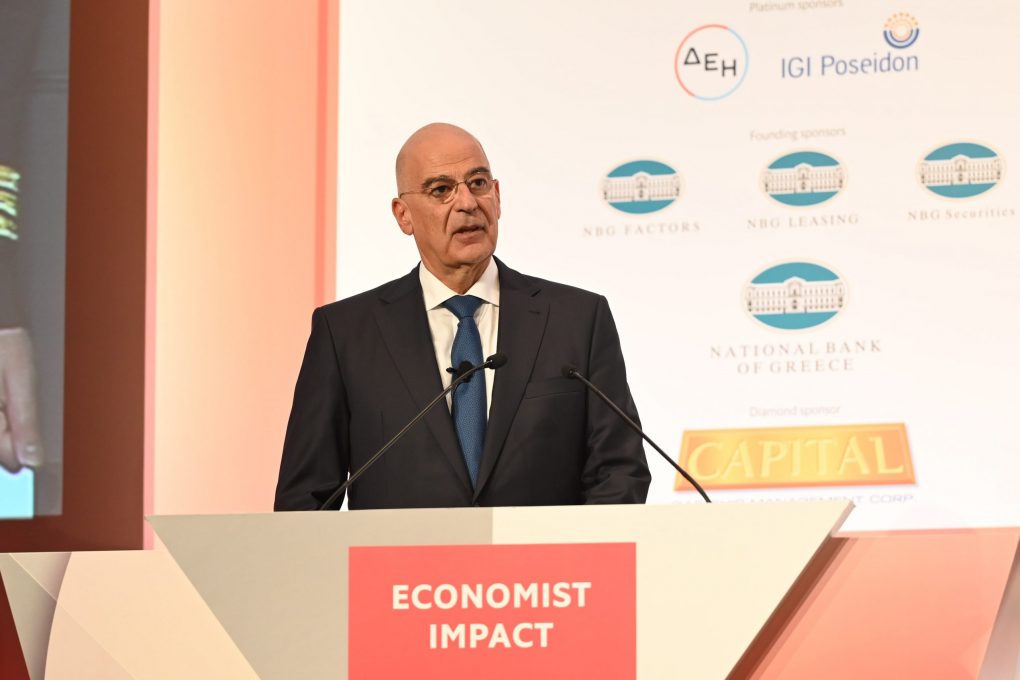
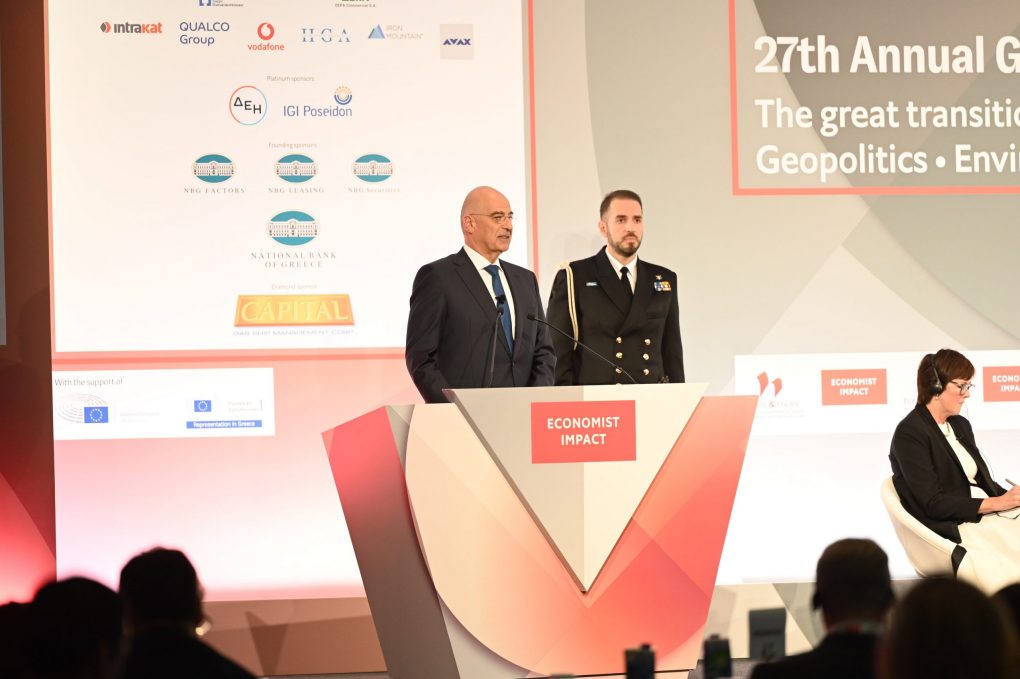
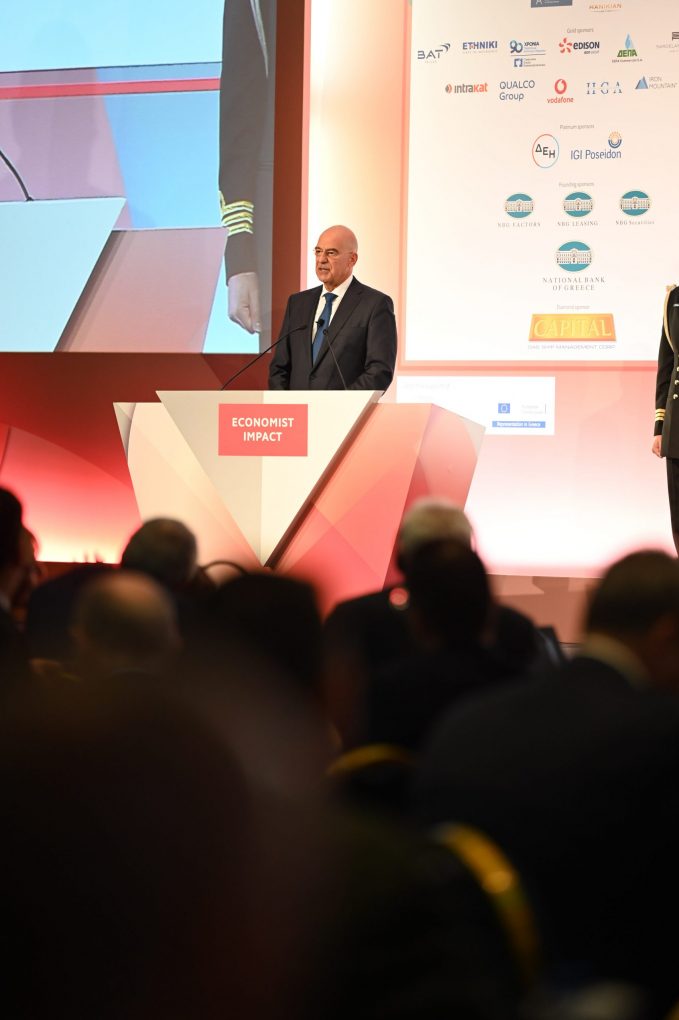
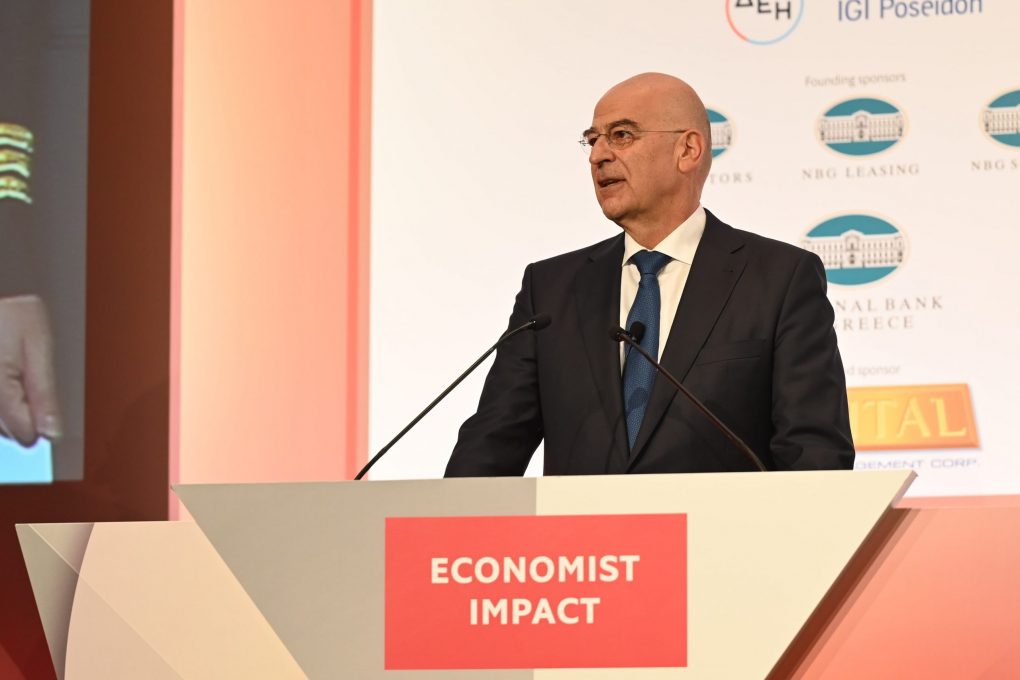
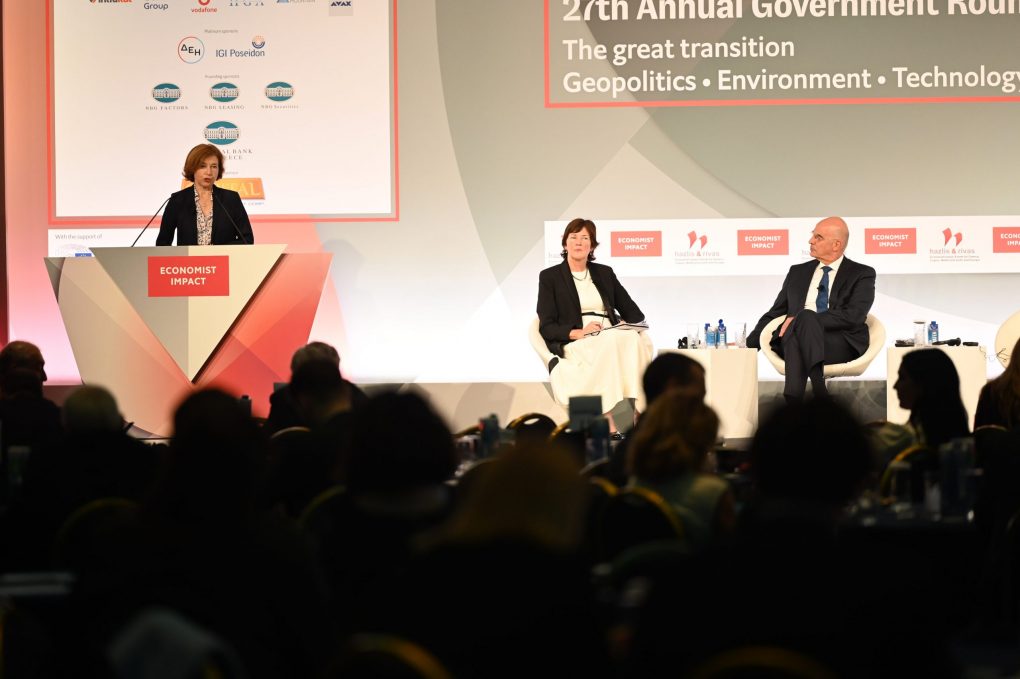
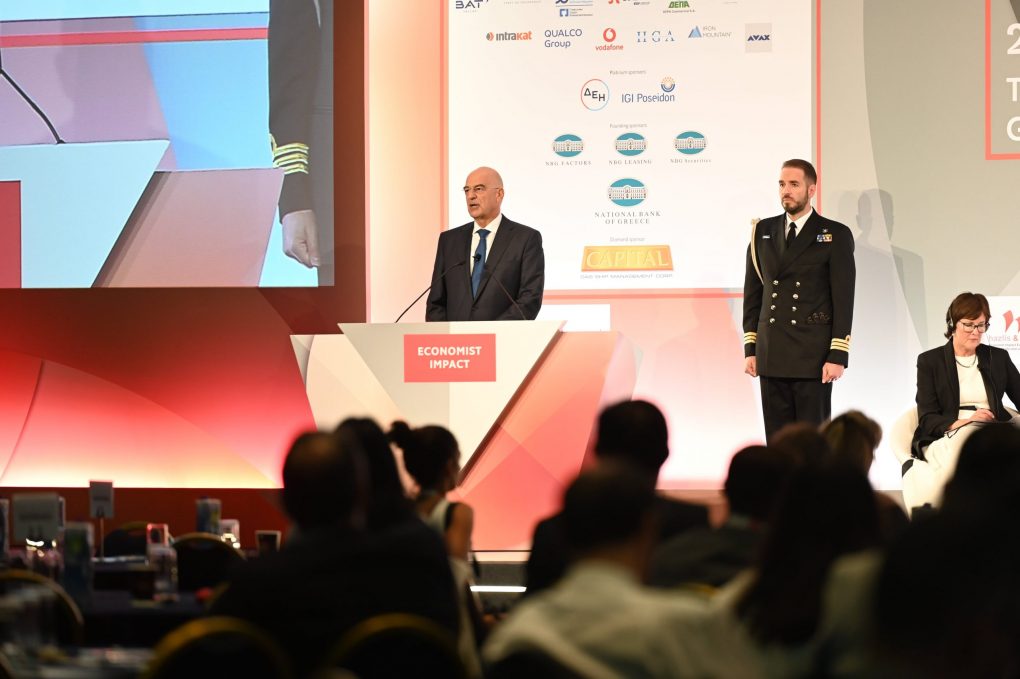
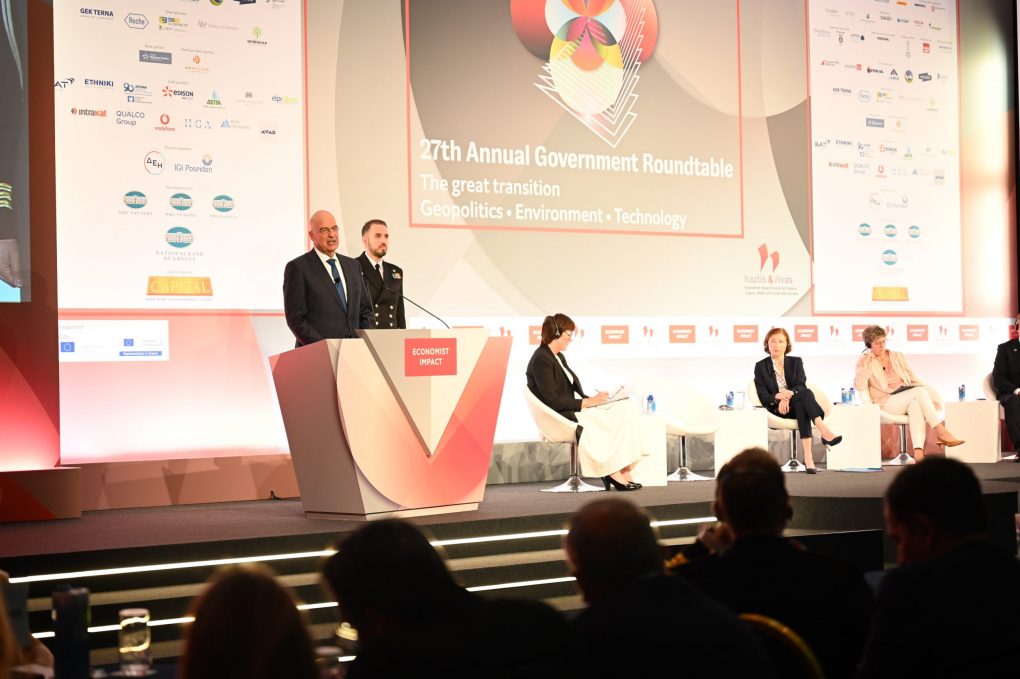
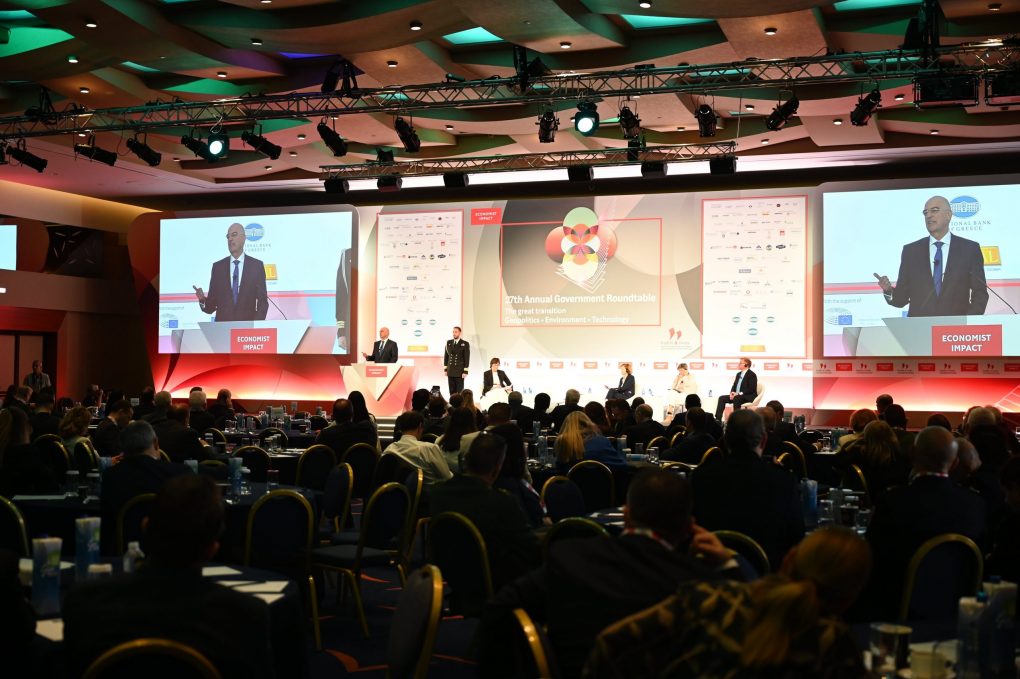
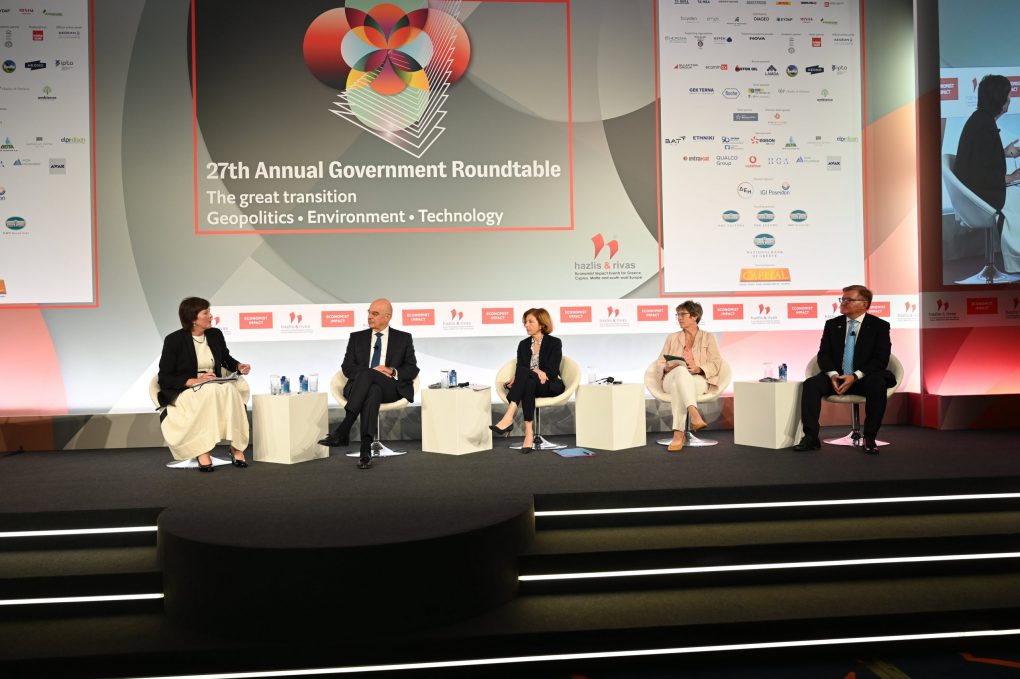
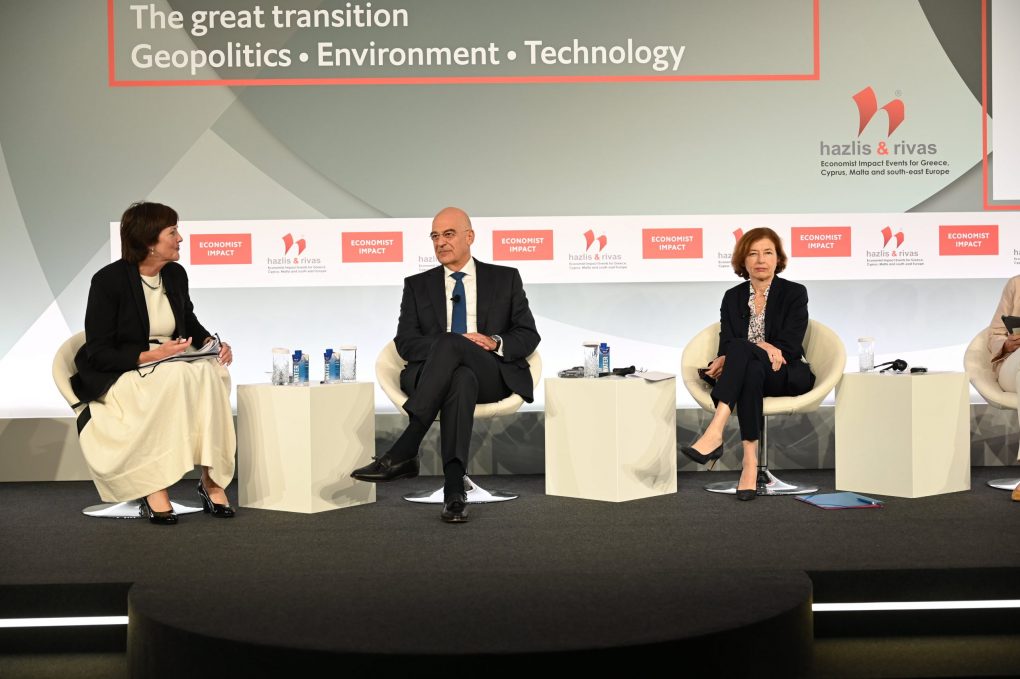
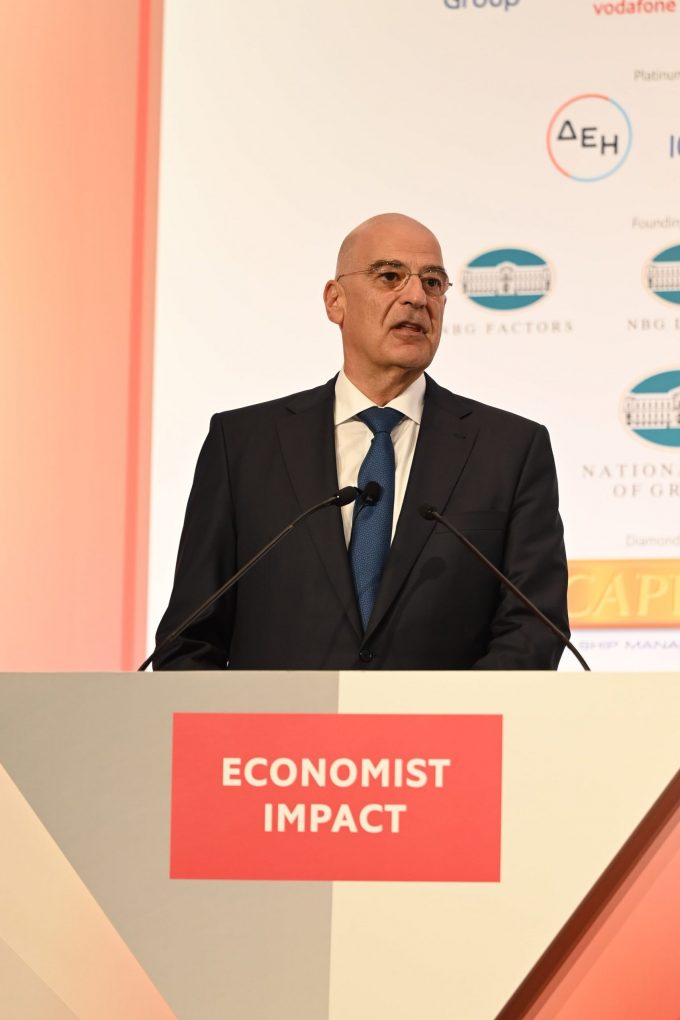
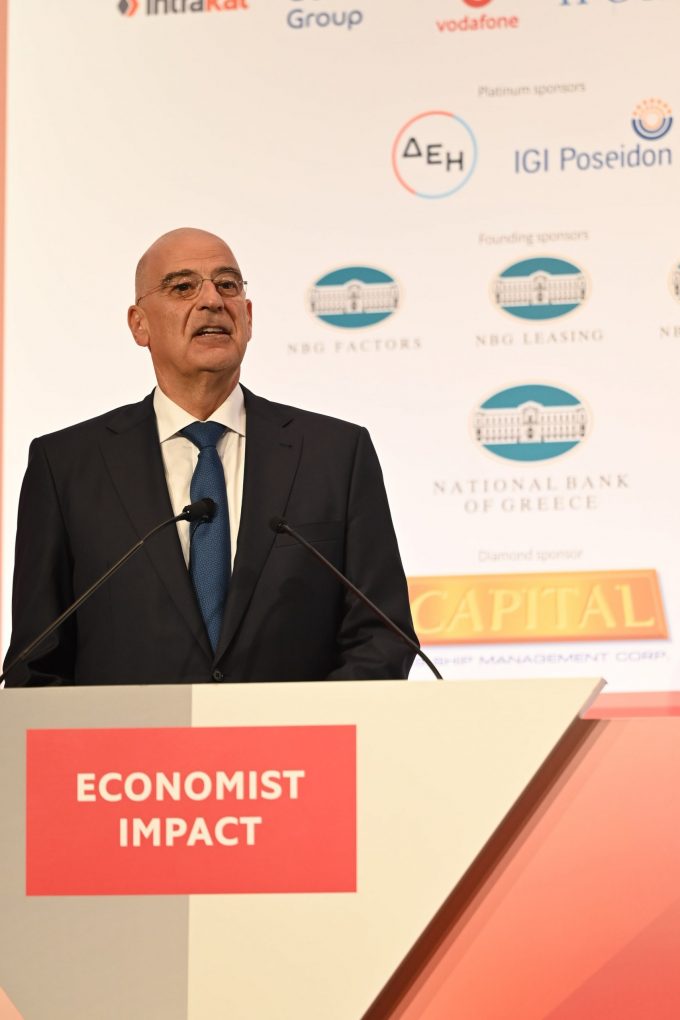
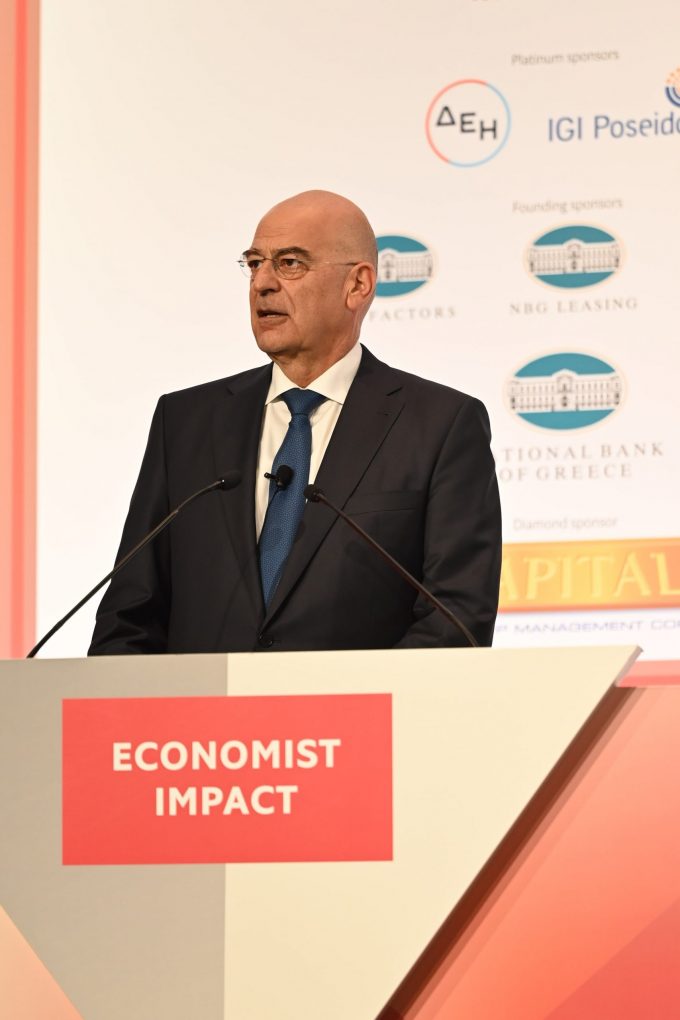
On Tuesday 24 October 2023, the Minister of National Defence Nikos Dendias, participated in the 27th Annual Economist Roundtable with the Greek Government, in Lagonissi, covering the subject “Defence and Security in the Eastern Mediterranean region”.
The Roundtable was also attended by Florence Parly (former Defence Minister of France), Annegret Kramp-Karrenbauer (former Defence Minister of Germany) and Hryhoriy Nemyria (Deputy Chairman of the Foreign Affairs Committee of the Parliament of Ukraine and former deputy Prime Minister).
The Roundtable was moderated by Joan Hoey (editor, The Democracy Index, & senior analyst for Greece, The Economist Group).
Mr. Dendias stated in his address:
“It is a great pleasure and honour for me to participate in the 27th annual Economist Conference, under the very timely title “Defence and Security in the Eastern Mediterranean”.
The very moment the International Community tries to deal with the likelihood of a new conflict, unfortunately we have two war conflicts in our wider region and, if we add Nagorno Karabakh and Yemen, we have four.
We also have a civil war in Soudan and a complete destabilization in the wider region of Sahel. As a tragic irony, today we celebrate the establishment of the United Nations Organisation.
It is the moment that we are distant than ever from implementing the principles and values of the United Nations Charter.
For us, for the Hellenic Republic, the defence of these principles always remains at the core of our policy. Besides, this is apparent in all three candidacies of our country, Greece, for the first time in our history, for the position of the non permanent member of the Security Council, for the Presidency of the General Assembly and also for being a member of the Human Rights Council.
Ladies and gentlemen,
Greece condemned directly and from the first moment the Hamas terrorist attacks. Actions of indiscriminate violence that cost, beyond other things, the lives of far too many civilians and which, on our judgement, weaken the legitimate expectations of the Palestinians. Yesterday, from Israel, the Greek Prime Minister referred to the issue of the protection of the civilians, among other things.
In the Eastern Mediterranean, Greece, a member of the European Union and NATO, tries to consolidate the stability and security, and to create conditions of economic growth.
The Greeks always considered the Mediterranean Sea to be a bridge, not a physical obstacle; a bridge that unites peoples, cultures, civilizations. Besides, the stabilising role of our country proves itself by the hundreds, more than 350 agreements we have concluded the last four years, with several countries across the world, with the two Agreements of Mutual Defence Cooperation between Greece and the United States taking the lead. Additionally, by the Defence Agreement with France, the Defence Agreement with the United Arab Emirates, the Strategic Agreement with Saudi Arabia and the two Demarcation Agreements for the Exclusive Economic Zones with Italy and Egypt, with which we also have a strategic relation, and also with the multiple multilateral and trilateral MOUs with the Republic of Cyprus.
It is nothing new in me saying that that our cooperation provides for the participation of everyone, without exceptions, with one basic prerequisite: the complete respect to International Law, the International Law of the Sea and the United Nations Charter.
We also believe in the presence of the United States and NATO in our region; we consider that they may function as a pillar of stability. We believe that NATO is not only a Defence Alliance, but an Alliance that defends values and principles, and that the Russian invasion in Ukraine made this role of NATO evident.
Taking this opportunity, I would like to say that I welcome the decision of President Erdoğan yesterday to promote Sweden’s NATO accession protocol to the Turkish National Assembly.
Ladies and gentlemen, as I told you before, in our region we face a geopolitical Gordian knot. Allow me to say that this has its reasons, which mostly refer. to the five false basic assumptions that the vast majority of us made in the beginning of the 21st century.
The first false assumption is that Democracy at last has prevailed in the planet and it will keep on expanding. On the contrary, all you need to see is what happens in countries of the Sahel.
The second false assumption was that, as China became richer and stronger, it would also be economically more open and more democratic.
The third false work assumption was that, despite the expansion of NATO to the East, Russia will become a member of the European security architecture, it will also assure the stability in South Caucasus and it will remain a steady supplier of cheap energy in Europe.
The forth false assumption was that the Palestinian issue can be sidelined and dealt with in a long-term future, when the dividing lines of Israel and the Arab world have ceased to exist.
The fifth false assumption, and probably the most catastrophic of the other four, is that the model of economic growth that we followed in the 21st century can keep on going in the 21st century, without us dealing with the consequences of climate change.
So, these consequences have already appeared and the signs for the future are fateful, should we not react. In addition, after many decades and with a lot of historic nerve, revisionism questions values and conditions on which the global security architecture is based.
For the signs of the environmental crisis there is no need to say much. A few hundred kilometers north, Thessaly has suffered, as well as Italy and Slovakia.
As you know, Greece has taken the presidency of ‘Our Ocean Conference’; a conference of special interest for the protection of the ecosystem of the Mediterranean and the seas.
Nevertheless, these are not the only challenges. Irregular migration from the East and the South to the North and the West has intensified. The democratic governments, like the Government of the Niger under President Bazoum, are overthrown. In this geopolitical environment, the reinforcement of the cooperation between NATO and the European Union is needed more than ever.
By adopting the strategic compass, the European Union projects its will to play an important geopolitical role and, by cooperating with NATO, it can assure security and stability in the Mediterranean and beyond.
However, I am obliged to say that there are problems: whereas regarding the Russian invasion, the European Union had a commendable unanimous and steady position, in the Middle East crisis it returned to its traditional polyphonic cacophony, and also in the West Balkans, it often goes back and forth.
On its side, NATO includes countries that omit imposing sanctions on Russia, or that forget to condemn the fatal attacks of Hamas against civilians.
The recent situation developing in the Middle East creates extra problems in the model we have chosen for our growth. It creates more risks regarding the issues of energy supply. Greece supports and serves the differentiation of sources, suppliers and energy routes. The facilities of liquefied natural gas in Alexandroupolis, Revithoussa (plus in Volos and Korinth in the future), the TAP, the vertical pipe corridor of Greece-Bulgaria and Greece-Northern Macedonia, the East Med, the EuroAsia and EuroAfrica electric interfaces are projects that serve Greece’s contribution in this differentiation.
In fact, a few days ago, along with my counterparts from Bulgaria and Romania, I signed a “Letter of Intent” for the expansion of NATO’s fuel supply pipe towards Bulgaria and Romania, ensuring their capability of having alternative energy sources.
Ladies and gentlemen, under the current conditions of questioning the fragile geopolitical balance in our region, we, the Hellenic Republic, consider that we remain a factor of geopolitical and energy stability, in the context of our capabilities and magnitude.
We are devoted in resolving the differences, based on the principles of International Law and the Law of the Sea. We remain active in regional initiatives regarding peace, away from fabricated arguments of past centuries, threats, and concepts from the times of yore.
We acknowledge the end of the era of doctrines and old ideas, that led societies to dead ends, but we are always ready to defend our sovereignty and sovereign rights, as they result from International Law and the Law of the Sea.
Thank you”.