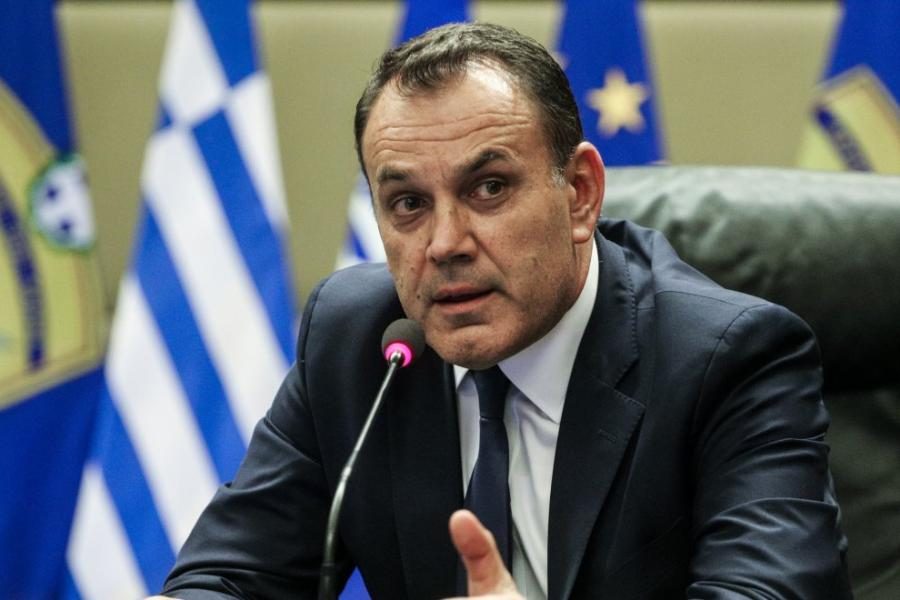
DIMITRIS KOTTARIDIS: Good morning Minister.
NIKOLAOS PANAGIOTOPOULOS: Good morning from the Ministry of National Defence.
DIMITRIS KOTTARIDIS: You obviously know that in Kavala city it is snowing, as we were just informed…
NIKOLAOS PANAGIOTOPOULOS: Yes, it is rather strange for the city of Kavala. It rarely snows, let alone in April, yet we saw that too. Obviously, this April will not be recorded as the month it snowed in Kavala, but as the month when it will show whether the dispersion of the coronavirus in our country got controlled or not.
This is why this month is critical and why the effort made so far, by both the experts who plan the confinement measures and the people who try, struggle, self-isolate and comply with the measures – albeit not all – should not stop or go to waste.
All what has been done so far, at an effort to limit the risk of dispersion to ourselves and those close to us, is very important.
DIMITRIS KOTTARIDIS: Minister, have you seen today’s frontpage of the newspaper “Avgi”? It refers to “accusations” made by the soldiers, concerning the coronavirus; that protective measures are inexistent in the Army, that the conscripts are stacked together in barracks and reception centres. They report that forty people are loaded within eighty square metres, in the context of “herd immunity”, and that half measures were taken even after the first coronavirus case was recorded at the Mechanised Infantry Battalion…
NIKOLAOS PANAGIOTOPOULOS: The first comment I would like to make is that the current circumstance is not appropriate for opposition, let alone irresponsible opposition, based on the “accusations” of certain networks who have –may I say– rather “uncharacteristic” views on the operation of the Army, or even on the Army’s very existence, they claim that the Army should not exist!
No matter what, the Army must exist; operational and effective Armed Forces! The Armed Forces’ personnel do not have the luxury to stay at home so as to be protected from the risk of the coronavirus dispersion; on the contrary, they have to work at any cost. And we, along with the Military Leadership of the Armed Forces, we have to take the measures necessary for both the protection and the operation of the Armed Forces.
We have already been doing that for some time now, before such “accusations” reached publicity and got reproduced by “certain someones” in the Armed Forces. If you wish so, we may see these measures in detail.
GIANNIS PITTARAS: As far as the training is concerned, where the conscript are first received, which were the measures taken?
NIKOLAOS PANAGIOTOPOULOS: All the necessary checks are being performed, their temperature is taken, cleanings and disinfections are carried out, all areas get aired out. I would also like to note that it is impossible to have zero cases. However, taking into consideration that the Armed Forces have more than a hundred thousand personnel at the moment, career and conscripts, he have had so far almost twenty cases and –I cannot stress this enough– in normal operation; the personnel of the Armed Forces are not under confinement. So, I find this a rather pleasing result which does not fully satisfy us of course, and we constantly try to see what more could be done.
As far as the conscripts are concerned, as I already said, the key direction is to fully control those who enter, as well as to isolate any case that might appear. For the next training series, we decided yesterday to delay enlistment; the following series’ conscript will enlist in early June and not in May as originally planned, so as to reduce the number of conscripts in our Units.
All conscripts will be given a special nylon package with some pairs of gloves, masks, disinfectant lotion, disinfectant soap and a leaflet with guidance for coronavirus infection protection. Our goal, if possible, given that enlistments will be made in June, is to also distribute this “Corona Kit”, if I may name it that way, to the conscripts currently serving in our Units. This is the directive that has been given and we are struggling so as to distribute this self-protective gear to the conscripts. Moreover, explicit instructions have been given to the Commanders of reception centres and units. It is also up to their skills and decisions, to take extra measures so as to protect their personnel and isolate suspected cases from the rest of the people.
The issue of Officers going in and out of units while the conscripts remain inside has also been discussed. Excuse me, but I do not see how things can be done differently. The Officers have received very specific instructions on how to move responsibly and take all necessary measures. The conscripts are self-confined, not because we wish to punish them but because we want to protect them, also given that the Units take care, are fully equipped and supplied with everything they need, in order to protect the personnel; I mean disinfectants and other things.
As I have said, controls are being made and temperatures are being taken. The general directive is to protect the personnel. I would like to remind you that in Military Schools, where we adopted this measure very early, not a single case has emerged so far, something that shows that this decision was in the right direction. I understand that it causes discontentment and some level of fatigue to the cadets. Let me remind you, though, that they are cadets in Military Schools, and that these preventive measures are working. We even managed to organize lessons via teleconference, thanks to the decisions taken, so as to disrupt to the minimum the life and the programme of Military Schools. So far, all that seems to work.
As Easter approaches, we shall see what can be done. As you can understand, any measures we are thinking of taking are connected to the general prevention and confinement measures taken by the Government. It could not be done differently. In any case, all of that is done for the protection of the personnel, and not because we want to confine, or constrain, let alone punish. And this is something that should be made clear.
GIANNIS PITTARAS: Just to laugh a little, what I understood, Dimitris, is that no “exit permits” are given. What we used to say “three days in, one out”…
NIKOLAOS PANAGIOTOPOULOS: As I said, this is only done for a certain purpose. For the ones currently serving at the units, the leave of absence after their oath-taking ceremony was also suspended. However, they will take all these days they were entitled to, at the end of their service, thus serving some days less.
GIANNIS PITTARAS: You mean that no leaves of absence will be granted?
NIKOLAOS PANAGIOTOPOULOS: We shall also see what will apply with the personnel’s holiday leave…
GIANNIS PITTARAS: You mean the Easter holidays?
NIKOLAOS PANAGIOTOPOULOS: As I already said, the decision was to suspend those too; however we also hear proposals on the opposite. We shall re-estimate the situation later in April, as we will have a view of how things go.
Furthermore, I would like to make reference to the contribution of the Armed Forces, with healthcare personnel allocated to the Ministry of Health, as well as to the General Secretariat for Civil Protection, for the areas that face the most coronavirus dispersion-related problems.
Personnel have been allocated to several infrastructures of the Ministry of Health, whenever asked. At least 24 cadets from the Military School of Combat Support Officers and the Nursing Officers School have been allocated to the HNPHO, and 10 more officers and army nurses to the GSCP GRC, so as to help with sample-takings.
In Xanthi, we have four officers and nurses to Smynthi and Myki and four more to the General Hospital. In Kastoria, we have nine to the benefit of the General Hospital, one officer to the Crisis Management Team and one to the Health Center of Tsotyli. Wherever we have the possibility to, we allocate healthcare personnel of the Armed Forces, always consulting with the Ministry of Health.
DIMITRIS KOTTARIDIS: Minister, is there a possibility for one of the military hospitals – in case the situation gets more difficult – to be fully or partly used as a centre for the COVID-19 patients?
NIKOLAOS PANAGIOTOPOULOS: The officers of the Medical Corps communicate with the pertinent personnel at the Ministry of Health, for coordination.
The Military Hospitals are at the disposal of the National Health System, with the facilitations they offer, and also given that Armed Forces’ personnel already are in the ICUs. Therefore, not all military Hospitals’ ICUs can be allocated; however, they will be offered, shall the need arise.
We have already agreed with the Ministry of Health, to temporarily allocate the Army Share Fund Hospital to the NHS, while this crisis lasts. A wing is being renovated, so that it can be used as a central infrastructure to the battle against the coronavirus. Naturally, after the end of this crisis, it will turn back to being used by its beneficiaries, the retired officers, and it will be renovated and equipped. Right now, it has entered the battle against the coronavirus.
We have planned to offer more.
We have activated the Army’s production infrastructure, such as the 441 Medical Materiel Base Depot, where the production of antiseptics has begun, to be distributed to the Armed Forces, the Ministry of Health and to anyone else upon request. We already agreed to distributing a thousand vials of antiseptic to the organisation “the Smile of the Child”, for its needs. All we need is alcohol stock, so as to produce.
The 700 Military Plant started to produce masks. Our goal is to produce 50 thousand masks by next week, to be followed by 100,000 – after consulting with the Ministry of Health – for the needs of the Ministry of Health, and of the Armed Forces of course. It is a conditio sine qua non that they will also be distributed to Armed Forces personnel. We agreed, we gained access to the special fabric stock and we have already started producing.
The Armed Forces enter the struggle to support the society, as they always do, they help with this great battle we have to fight and they take measures to protect their personnel, since three weeks ago. As I have already said, so far the cases have been few and sparse. There will be cases, it is only natural, we do not live in a shell outside society; yet I want to believe that we act in an organized way and take decisions based on structure and the chain of command.
GIANNIS PITTARAS: Minister, what is happening at Evros? Is the alarm over yet? Do we still take defence measures? Do you wish to comment on the former Chief/HNDGS Mr. Kostarakos’ proposal for an autonomous Greek border police…
NIKOLAOS PANAGIOTOPOULOS: Surely, the alarm is not over yet. Of course, the immigrants packed up and left or rather the Turkish forces made them pack up and leave.
Obviously the surprise failed. This attempt of an organized invasion, as I have defined it from the beginning, failed. But this, gentlemen, did not happen accidentally. It worked. The attempt of armoring Evros is developing through time. If you recall, in September, I stated somewhere that Evros will be shut off and some analysts mocked and spoke ironically of me, I must say.
I knew this was not a simple move, like, let’s say, when you close, lock the door, and that is all. A lot of things must be done, they should have been done, through time. But the decision was made, after the meetings we held with the Prime Minister and his Staff. We expressed our suggestions, discussed the issue, the Prime Minister made the decision and we were called on to implement it.
So, Evros, for a long time now, has been reinforced slowly and gradually. At an institutional level, I remind you – because not many people remember this – that in early September, we introduced the bill for the Unified Body of Borders’ Surveillance to the Parliament. The political discussion at that time was focused on the National coordinator, Deputy Minister Alkiviadis Stefanis, who “scours” the islands, in order to ensure deterrence in the sea as well, which is not an easy task. Whilst the discussion then focused on persons and not on operation institutions, the Unified Body of Borders’ Surveillance was created.
This institutional context allowed the Armed Forces to cooperate in the best, most effective and most organized possible manner, both with the Greek Police and the Port Police, so that deterrence is reinforced throughout the land and sea borders.
This system was called on to operate at Evros during the ‘surprise’, or rather the attempt of surprise, during the three-day holiday of Clean Monday. The Units had already been reinforced from the interior, so that there was sufficient personnel and equipment, along with a strengthening of the cooperation with the Police in receiving and using information, and finally instructions regarding the action to be taken in order to deal with this Crisis. That is why when the need arose, the Armed Forces and the Greek Police struggled in a superb manner and brought results. The alarm is not over.
DIMITRIS KOTTARIDIS: As I understand Minister, the fence will be further reinforced in the near future. Is that so?
NIKOLAOS PANAGIOTOPOULOS: Of course, the fence will be reinforced. It is already extended and reinforced even more, if possible, along every inch of the land borders. What must be done is already in process, so that the Forces guarding our borders, the sleepless guards of the Wall as I told you, are the most equipped, ready and prepared for any emergency.
GIANNIS PITTARAS: You have not answered about Mr. Kostarakos proposal though. Will it be discussed? Do you consider it?
NIKOLAOS PANAGIOTOPOULOS: I think I have partly answered. The thought of creating a separate body of borders’ guards has undoubtedly its own value, especially when it is presented by an experienced member and excellent army officer, as the former Chief of the Hellenic National Defence General Staff, Mr. Mihalis Kostarakos.
But essentially, this Body has already resulted from the institutional facilities that I described with the Unified Body of Borders’ Surveillance. Of course, everything is under consideration. The important is that the situation is manageable, the Police cooperates with the Armed Forces in a way that they never used before, and for this reason we have results. Everybody acted properly since Clean Monday and the days that followed, because the tension in Evros came to an end very recently, in a flawless manner, as one body, and of course, besides the thoughts regarding the planning and the further reinforcement, we offer many congratulations to all those who fought this struggle. Surely, finding ways of reinforcement, material reinforcement of the Armed Forces is under consideration, it is on the table, by the Prime Minister, provided that our financial status permits it, which is undoubtedly under pressure at this moment, due to the financial consequences of the coronavirus crisis.