

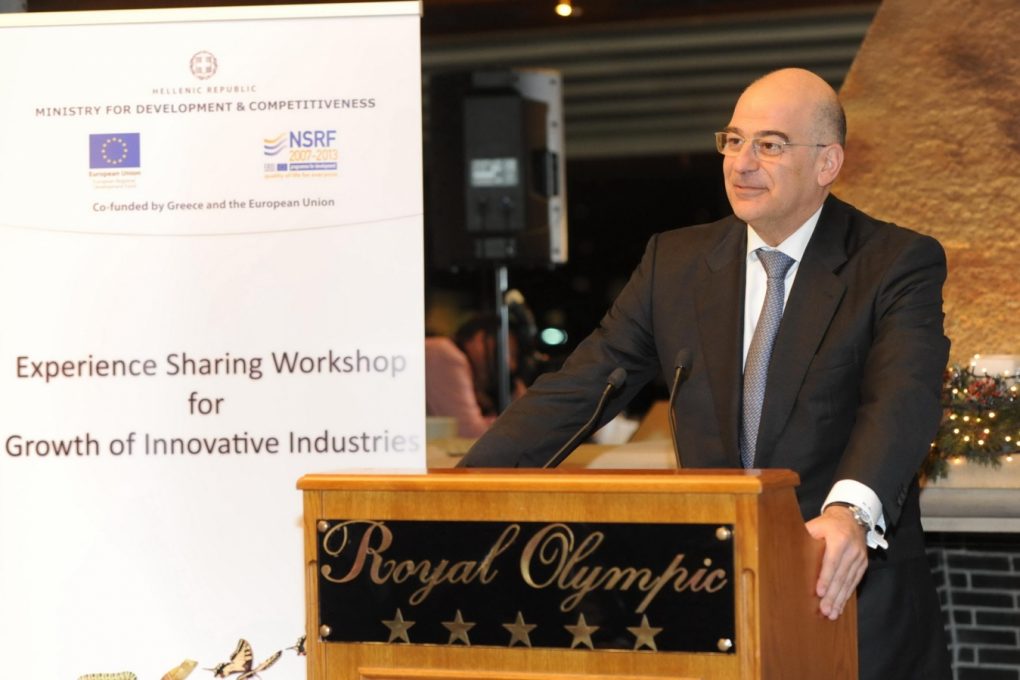
Key points from the statements addressed by the Minister of National Defence Nikos Dendias at the «Experience Sharing Workshop for Growth of Innovative Industries» which was organised by the Ministry of Development and Competitiveness, in cooperation with the Embassy of Israel, the StartUp Greece, the Hellenic Start-up Association and it was supported by the Hellenic Federation of Entreprises, on December 3, 2014.
“The failure of Greek economy, until today, to generate innovative products and services is, unfortunately, more than obvious. Data shows that the participation of innovation to the country’s Gross Domestic Product is hardly a percentage of 0.47% which, as I have underlined more than once, is inconsiderable, statistically-wise.
It is one more symptom that reveals the need for our country to change its model of production, in order to protect itself, in the long run, from the prospect of regressing into a new financial crisis. The model of statism, of the concept and hope of “our child working in Public Sector”, which belongs to the past, is one of the reasons that have led us to the massive crisis of the past six years.
I belong to the ones who believe that the answer to the problem of unemployment is the change of model, the creation of 100,000 new enterprises; that the country needs investments of about 100 billion Euros. This cannot be achieved when entrepreneurism remains blameworthy in the conscience of the average Greek citizen, or even of certain political parties in the Parliament.
As Minister of Development, I had the opportunity to visit two places that favoured the development of new enterprises (Orange Grove, EGG), and discuss with the new entrepreneurs on the issues they face in their effort to establish a startup, a fresh enterprise. With the honesty and straightforwardness that describe them, they told me that the greatest contribution the state could make would be to stop placing in their way bureaucratic barriers, and encumbering them with insurance and tax weights, before even starting their business.
The bases of improving our country’s relevant performance should be set in this direction; of gradually creating a new productive model, emphasizing on extroversion and the materialisation of new business ideas. The goal should be to improve the participation of innovation in the GDP, at least by 4% within the next four years.
Both the plan and the means for its implementation exist, and we do not need to invent them. We just need to copy the best international practices, as they have been recorded, on Greece’s account, by the globally renowned Israeli organisation Yozma, which was assigned with a study on the steps required so as to create an environment for new technologies and innovation, which will encourage their further evolution into a business action.
It is an organisation whose formula has been actually tested, by transforming the state of Israel, by the agricultural economy of the “Kibbutz” in the ’70s, to the modern, exporting, industrial economy it is today. Let me remind you that the agreement for Yozma to deliver know-how to Greece was a strategic choice by the Government, and it was signed during the Prime Minister Antonis Samaras’ official visit to Israel, in October 2013.
We should “push”, we should encourage young people towards entrepreneurship; we should give to every citizen of this country, who has an innovative idea for the establishment of a business, yet he lacks the necessary funds, the opportunity to obtain the necessary financing that will let him materialise it. The National Strategic Reference Framework is not the only funding source; there are also modern financial instruments (such as those of the IfG which I hope that will operate soon) that have nothing to do with the past logic of “grants”.
It is obvious that we cannot impose innovation on enterprises. However, we can establish a broad framework of institutions which will allow innovation to flourish. A framework which will include tools and concepts that were scarcely known in our country until recently, such as “incubators”, “business angels”, “pre-seed / seed capital”, as well as the introduction of technology transfer offices in every University that effects scientific research with state or –mostly– private funding (based on Harvard, MIT, Cambridge, Fraunhofer Gesellschaft standards), as well as the connection of scientific research to enterprises, aiming at transferring technology and attracting investments in Greece.
Finally, allow me to briefly refer to the country’s Armed Forces that encompass personnel with studies and experience, which compare very favourably to that of the greatest foreign companies active in the field of defence research and innovation. Few know that the Greek Army develops a remarkable activity in the relevant sector. My intention is to develop those capabilities as much as possible in order for the Greek Army to become a laboratory of Research and Development, a locomotive of development for innovation and economy. The Greek Armed Forces can produce a crucial part of the technology they use. I hope that I will have the time to draw a road map of transforming the Greek Armed Forces from a consumer to a producer of innovation, thus contributing once more to the State.
Ladies and Gentlemen,
The implementation of an efficient policy for the enhancement of enterprises for research and innovation actions can produce spectacular results for economy: increase of the GDP by 4 billion Euros, 32,000 direct or indirect new working posts, even the halting of brain drain and the return of scientists that left the country in the past years.
With the formation and implementation of the overall context of support for the new entrepreneurs’ effort, I am certain that these goals will be achieved. After all, we owe it to young citizens and to our country as well.”