

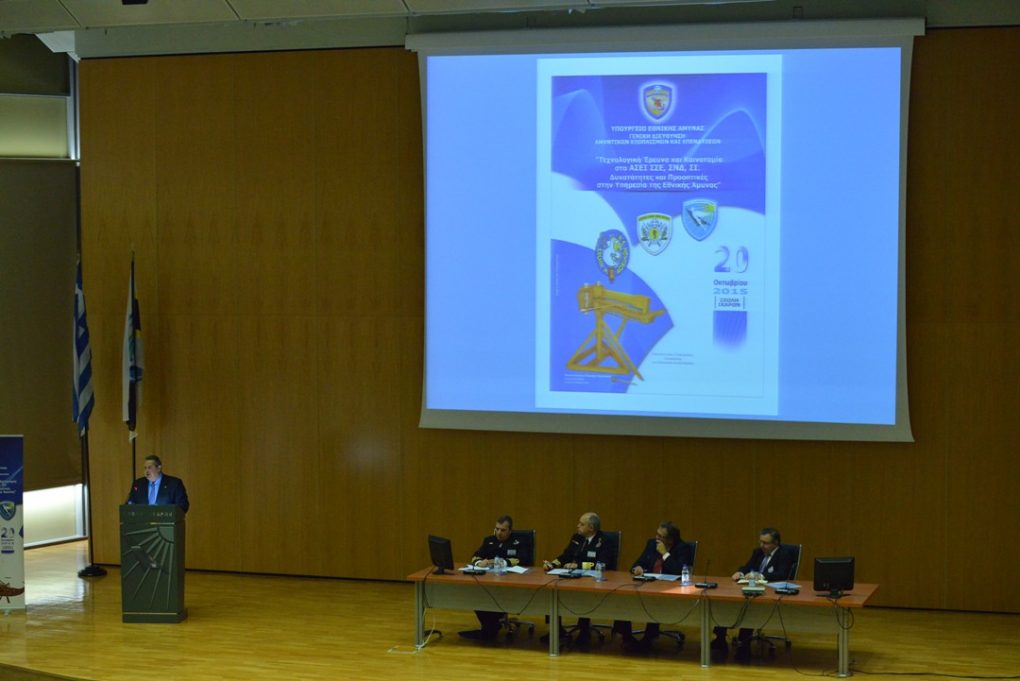
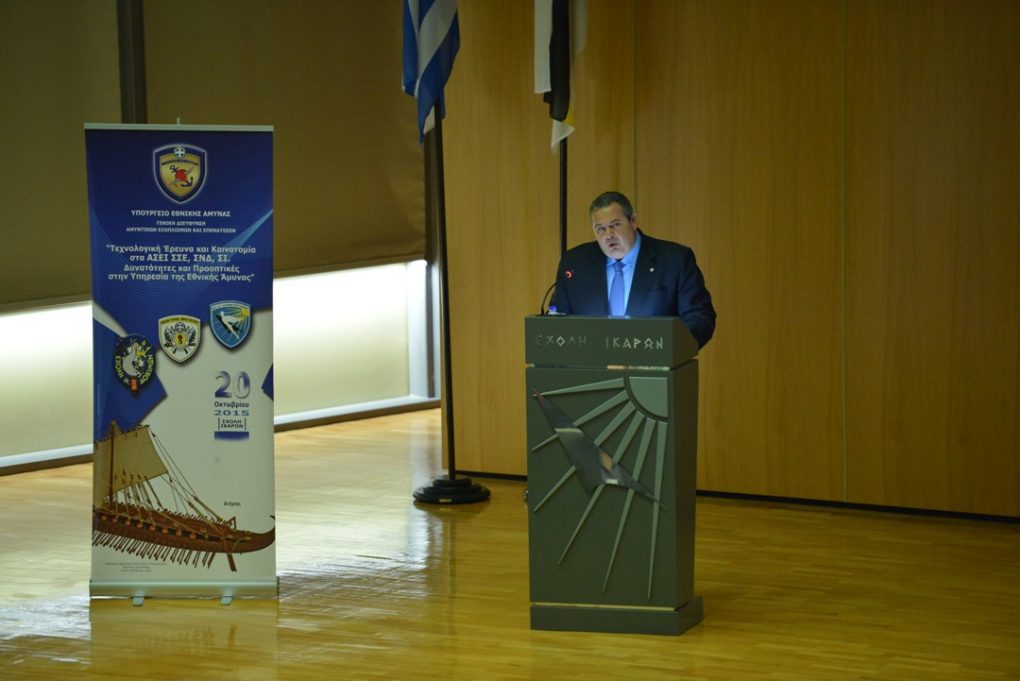
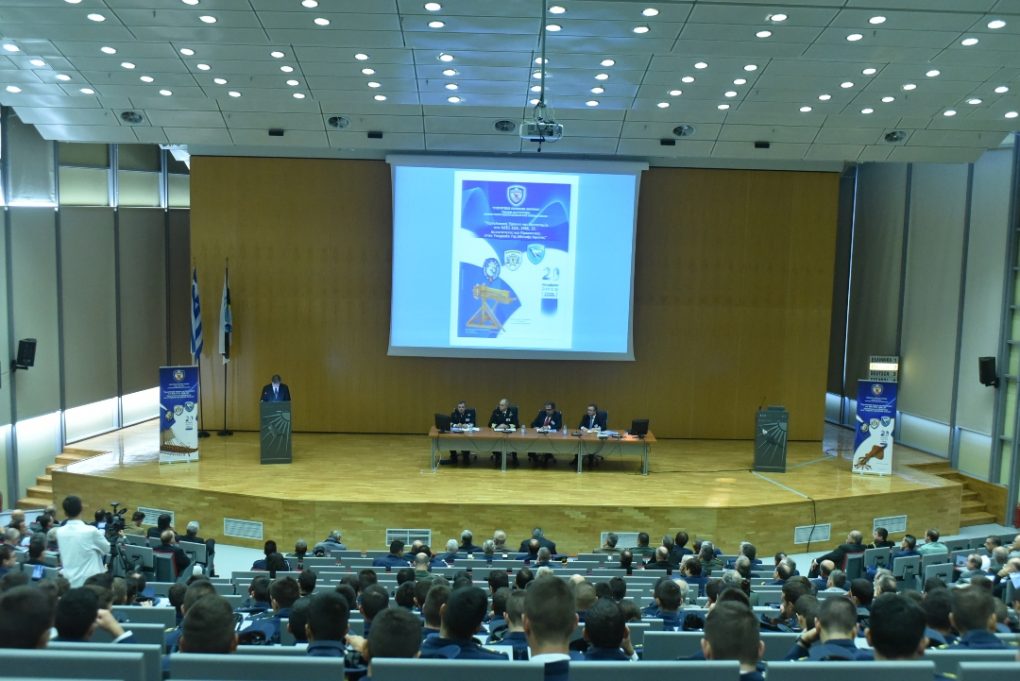
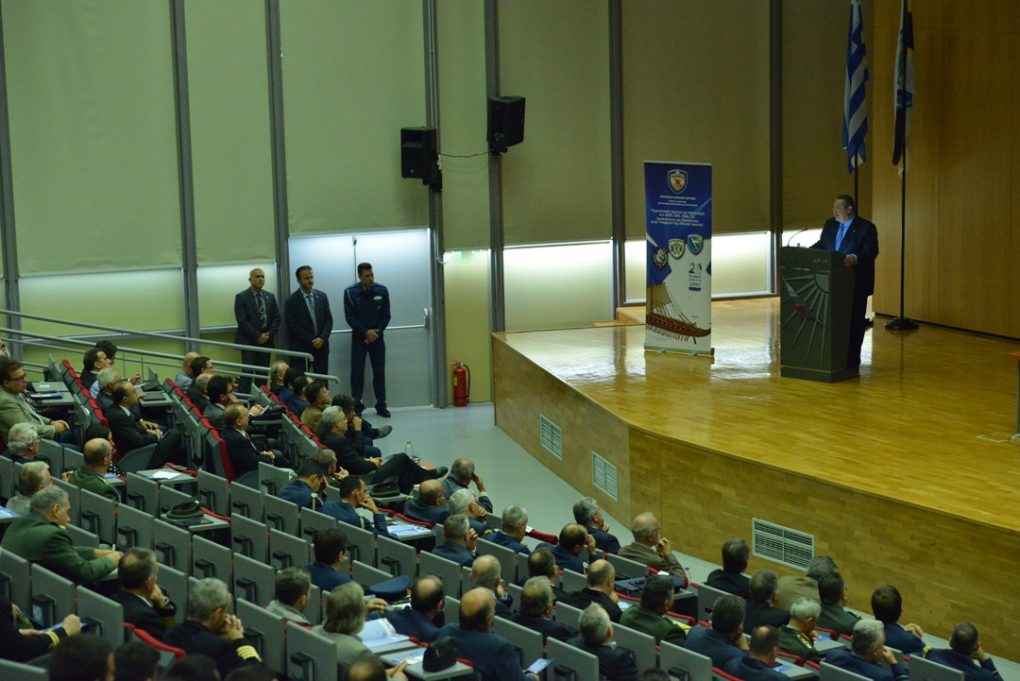
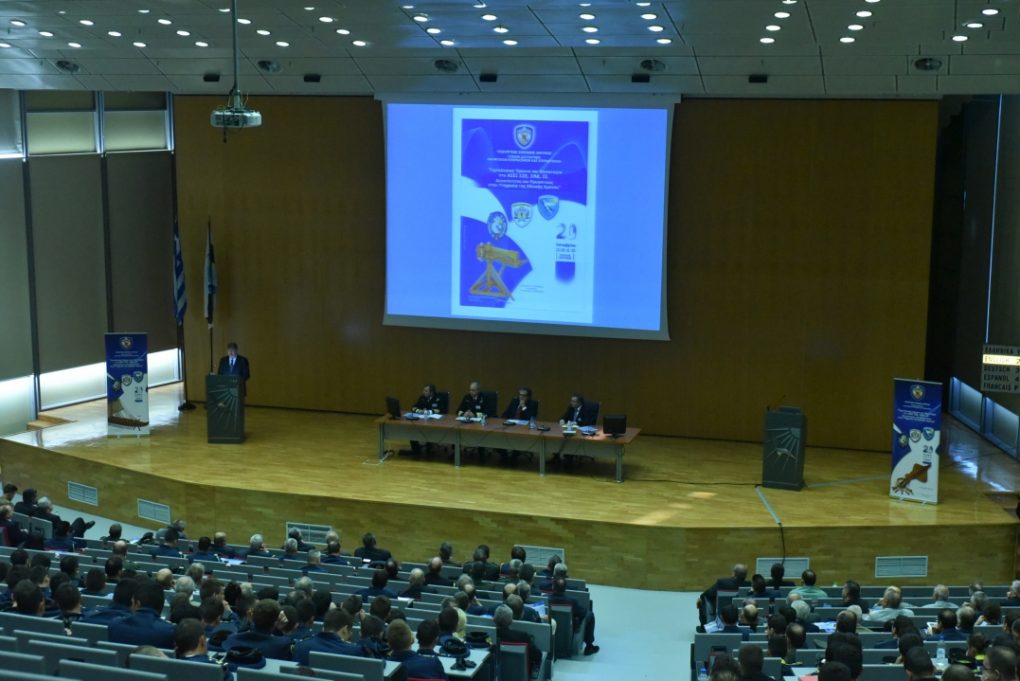
The Minister of National Defence Panos Kammenos declared the conference “Technological research and innovation in Military Higher Education Institutions – Capabilities and challenges in service of National Defence”, which took place at the Hellenic Air Force Academy, open.
The conference was attended by the Alternate Minister of National Defence Dimitris Vitsas, the Secretary General of the Ministry of National Defence Giannis Tafillis and the Chief of the Hellenic Air Force General Staff, Lieutenant General Christos Vaitsis.
The Minister of National Defence made the following address:
“Mister Alternate Minister of National Defence,
Mister Secretary General,
Chief of the Hellenic Air Force General Staff,
Dear colleague MP and member of the Committee on National Defence and Foreign Affairs,
Army and Air Force Generals, Admirals,
Officers,
Cadets of the Army, Navy and Air Force Academies,
Professors of the Military Academies,
Ladies and Gentlemen,
It is a special joy and honour for me to attend this conference concerning Technological research and innovation in Military Higher Education Institutions as Minister of National Defence. My presence here today, as well as the presence of the Alternate Minister and the Secretary General, testifies the political will for the development of research in the Armed Forces, through the Military Higher Education Institutions, utilising the high quality academic personnel, as well as the graduates and cadets.
During the present circumstances of the financial crisis experienced by our country, the importance of research and innovation is even more crucial for us. Research can uphold the country’s future, provide perspective and hope for new scientists and researchers.
The worst result of the financial and humanitarian crisis is that, during these five years, the majority of our youth who wanted to work on research, have left the country. Greece has lost more than 300 thousand young scientists, who are now in the United States of America, in Europe and the rest of the world. Young scientists are the greatest capital for the country’s future, and we should bring it back. If we do not manage to attract these 300 thousand new scientists and include them to the effort to restore the country, we will have failed.
The Ministry of National Defence and the Armed Forces will be present to this effort. As a first step, the CVs of young people who enlist for their military service and possess university degrees, and scientific qualifications, and have participated in researches, will be selected by the General Staffs and get sent to a strategic planning team we have created in the Ministry of National Defence and is also comprised of young scientists, and be immediately included in teams that will be at the disposal of our Military Academies, so as to give their best for the development and planning of the future, even throughout the short period of nine months of their military service.
We shall give to these young people, who have to face the day after the end of their military service, the opportunity to enlist as Short Term Re-enlisting Privates who, in cooperation with and under the guidance of the Military Academies, will be able to construct what we call Innovation and Research.
Innovation originating from research, along with the apposite policies, can produce wealth that will return to society. Achieving this goal is our big stake, not only for the present, but also for the future of this country. Moreover, high quality scientific research can be the country’s best ambassador at international level.
Research’s continuation and sustainable growth for the immediate and effective support of the country’s military capabilities is a key lever for the enhancement of the Armed Forces’ deterrence capability and for the preservation of their efficiency during the financial crisis. Future defence expenditures are based on emerging cutting-edge technologies, as well as on ensuring technological autonomy.
The ultimate goal, a difficult yet feasible one, is for Greece to become self-sufficient, capable of developing its own warships, aircraft and weapon systems.
At this point, I would like to present two examples. The Hellenic Navy is bright example as, after the adventure of the Skaramangas Shipyards, managed to lead its employees and complete the construction of the 214 submarines, as well as the upgrade of the 209 submarines. No one believed that this programme would be completed.
I would like to remind you that during the difficult times we experience, in most of our country’s airports, wherever there are technical bases, our mechanics, Officers and NCOs, as well as the civilian personnel, have managed to keep our aircraft at maximum availability, despite the lack of spare parts and resources.
We would like to encourage the interconnection of Military Higher Education Institutions with research centres and domestic defence industry. For us, domestic defence industry is more than the state defence industry, HAI, Hellenic Defence Systems ELVO S.A. and our shipyards, but also the private defence systems companies which we have now included to our planning, to the new policy designed by the Ministry of National Defence. Greek industries, public or private, are the pillar that the leadership of the Defence Ministry supports and, at the same time, we ask all Greek Defence Attaches to support them in the country they are.
Our country’s academic and research personnel are excellent; it must also become competitive to the respective European one and lead us to the production of new innovative procedures and product, with tangible results in the near future.
Funding should be ensured by exploiting all means available; not only from the public, but also from the private sector.
The money that has been lost during the past years is a crime committed against the Greek people. We are the ones who have paid for the most weapon systems in the world. The NH-90 Helos only existed in papers when they were ordered from Greece and, while our country made a 70% advance payment for a system that did not exist, finally instead of being able to enjoy the rights emerging from the funding of this technology, actually 90% of these Helos are on ground.
Greece funded the 214 submarines programme. Yesterday, the former Armaments Secretary General was sentenced for life. Why you might ask? Because the Greek people paid, from their few supplies, a 70% advance payment for a submarine that only existed in design. In effect, they paid for the research and design of this submarine. The Greek people paid for the design of new means, when this money could be allocated to Greek industries to produce our own weapon systems.
We have proved that we can do it. The new vessels designed and materialised by the Hellenic Navy are the most efficient currently at sea. I also remember an Air Force Lieutenant who here, at Dekeleia, designed by himself a prototype aircraft on the roof of a building, and made it fly.
Therefore, our intention is for research and innovation to become the pillar of the country’s development.
The expenditures for research and development are an investment for our future. A big percentage of the amendments we will demand and take from all those who have raided our country, once they return to the Ministry of National Defence, the General Staffs and GDDIA, will be allocated to research and innovation.
Having underlined these directions, I would like to declare the conference -organised by GDDIA and attended by the military Academies- open and I will be looking forward to your conclusions and suggestions, the fruit of your works today.
I congratulate you all and thank you for your participation”.