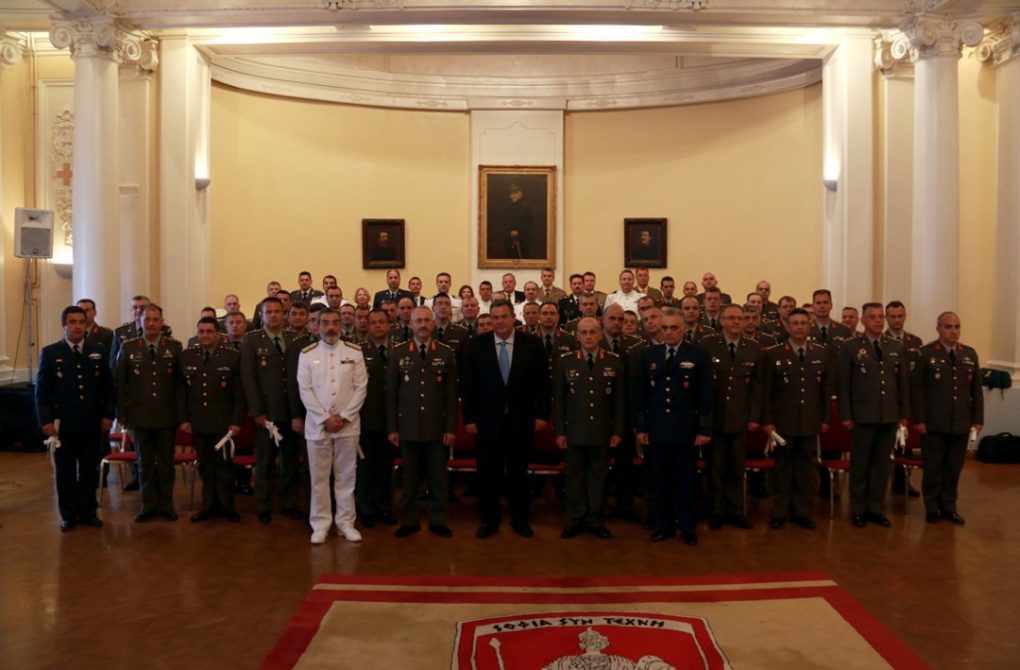
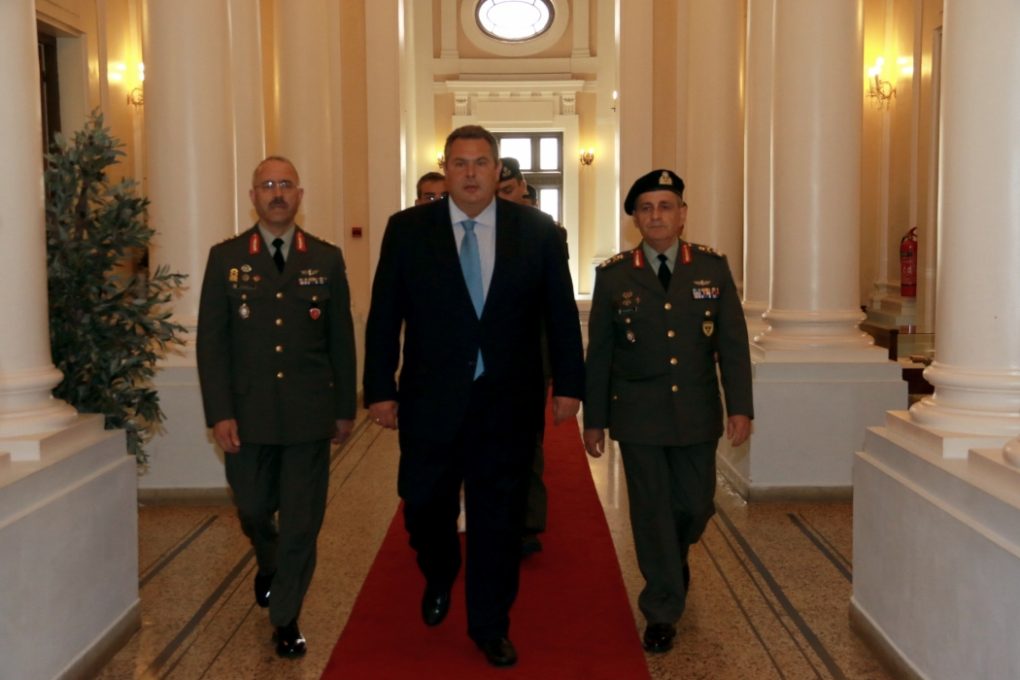
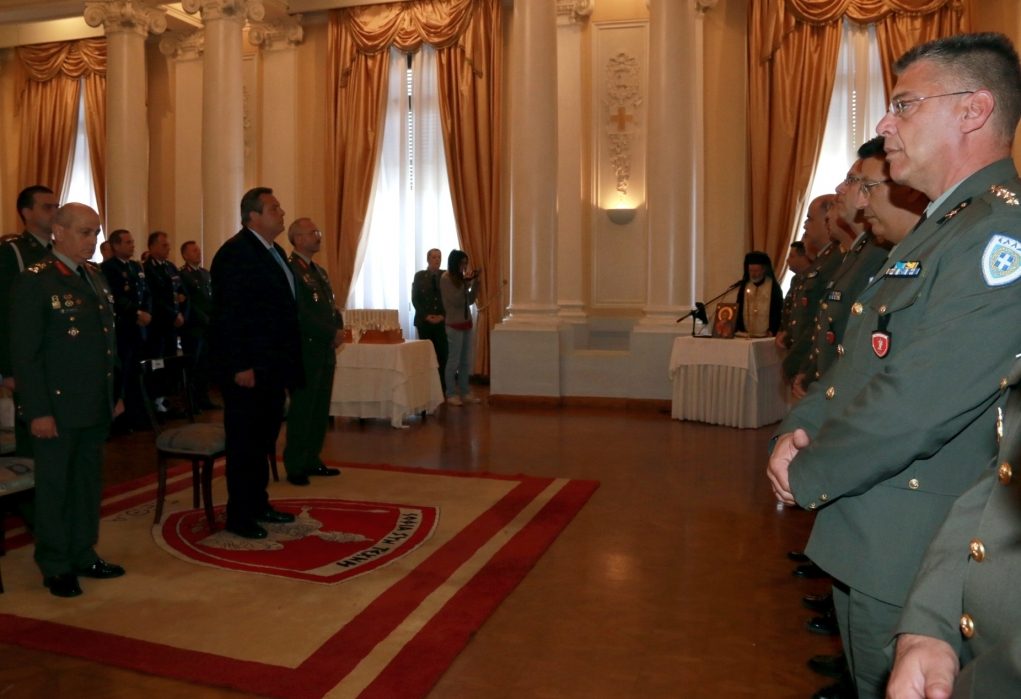
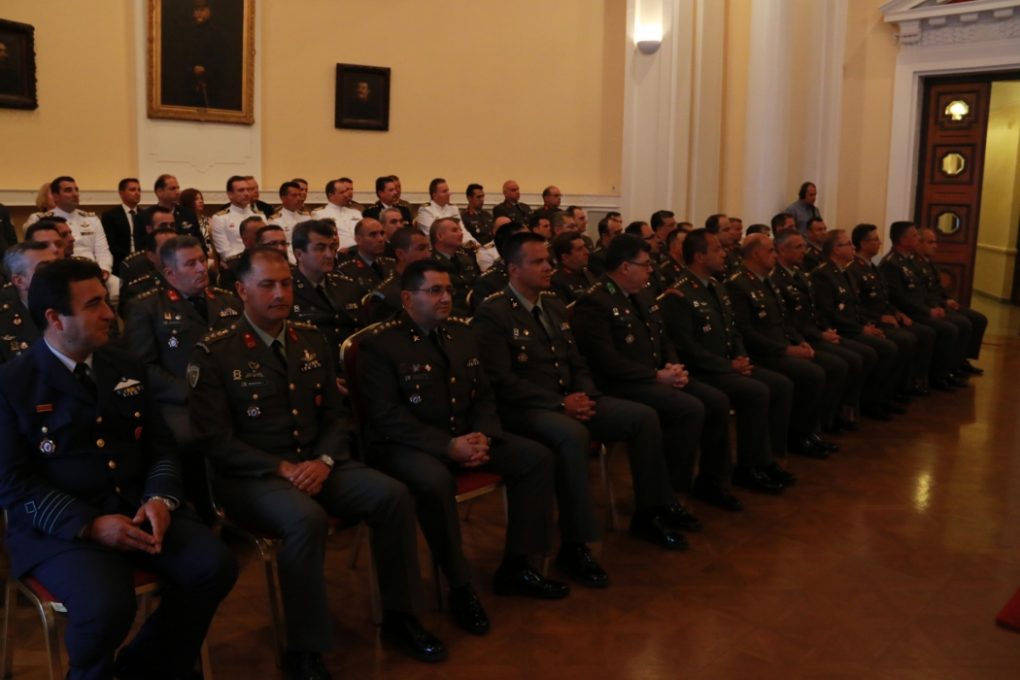
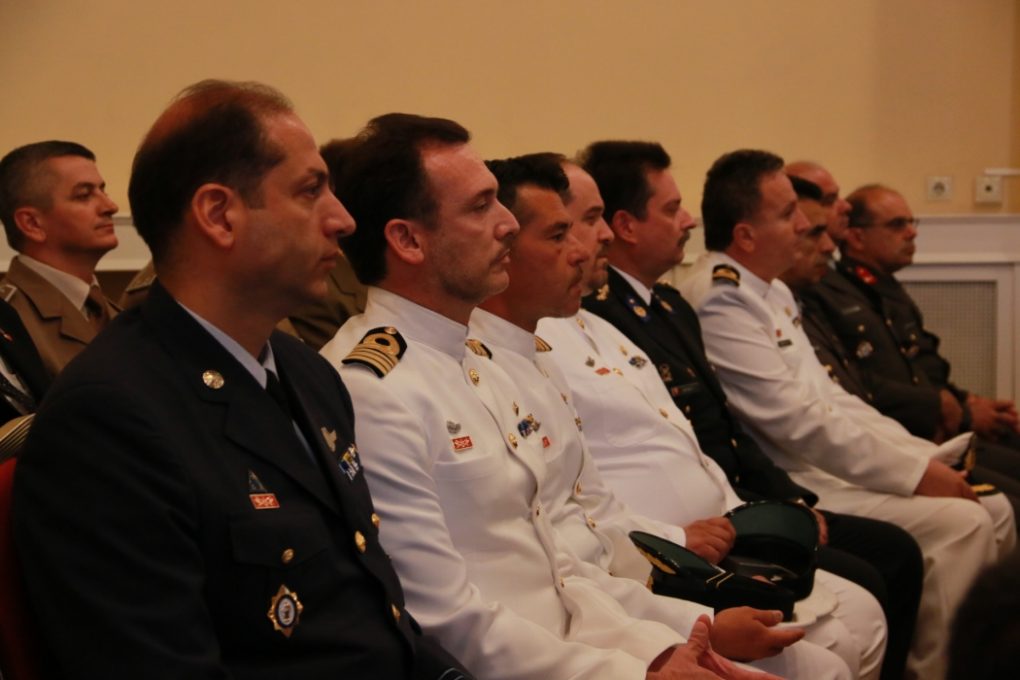
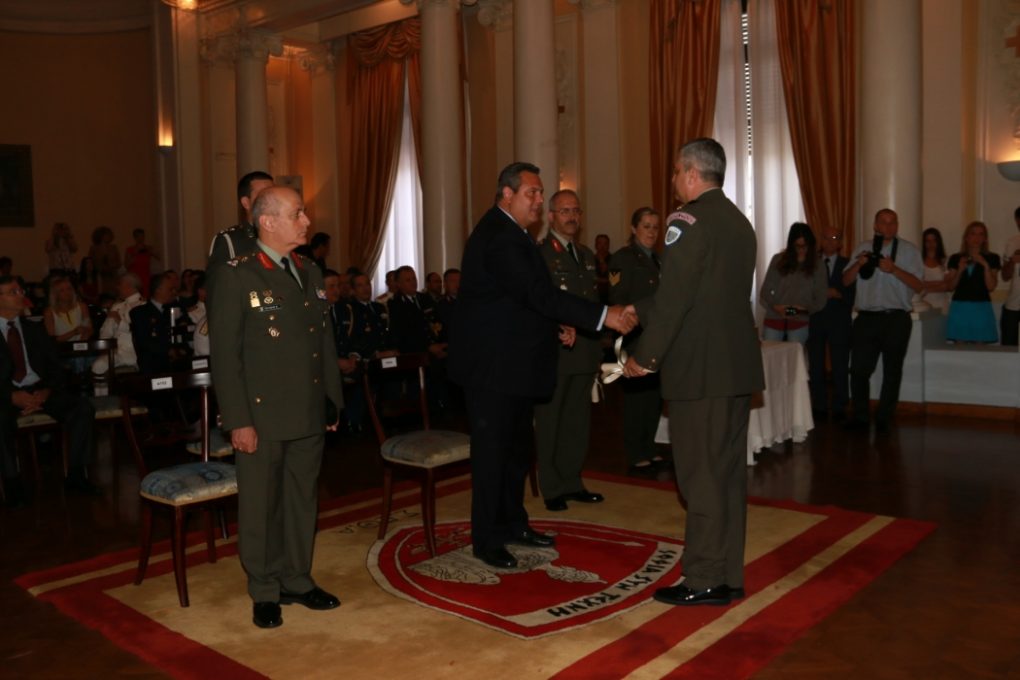
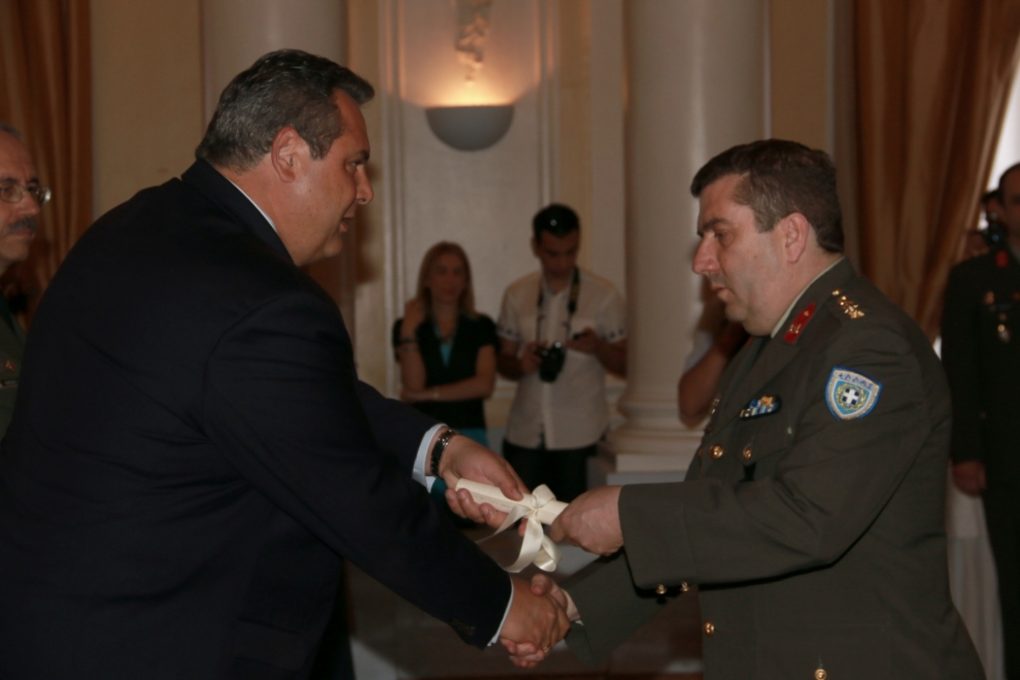
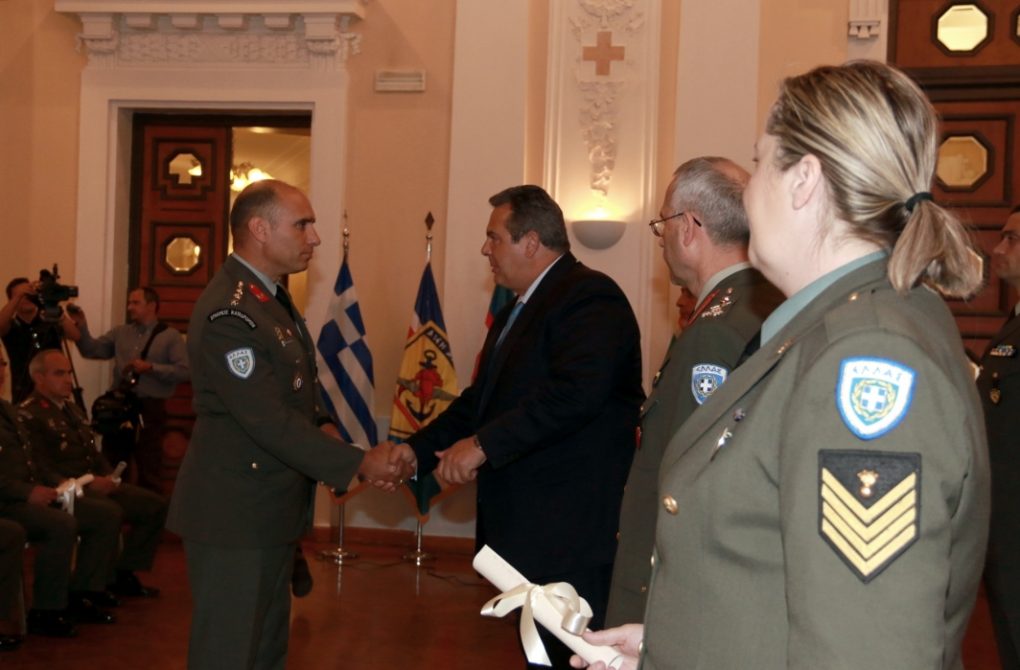
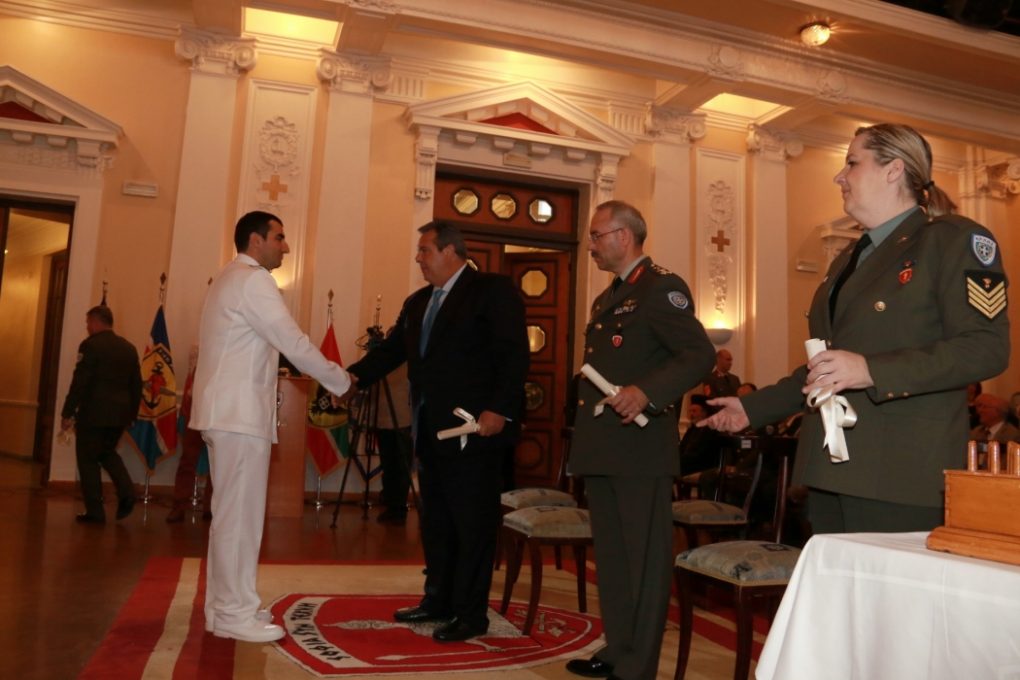
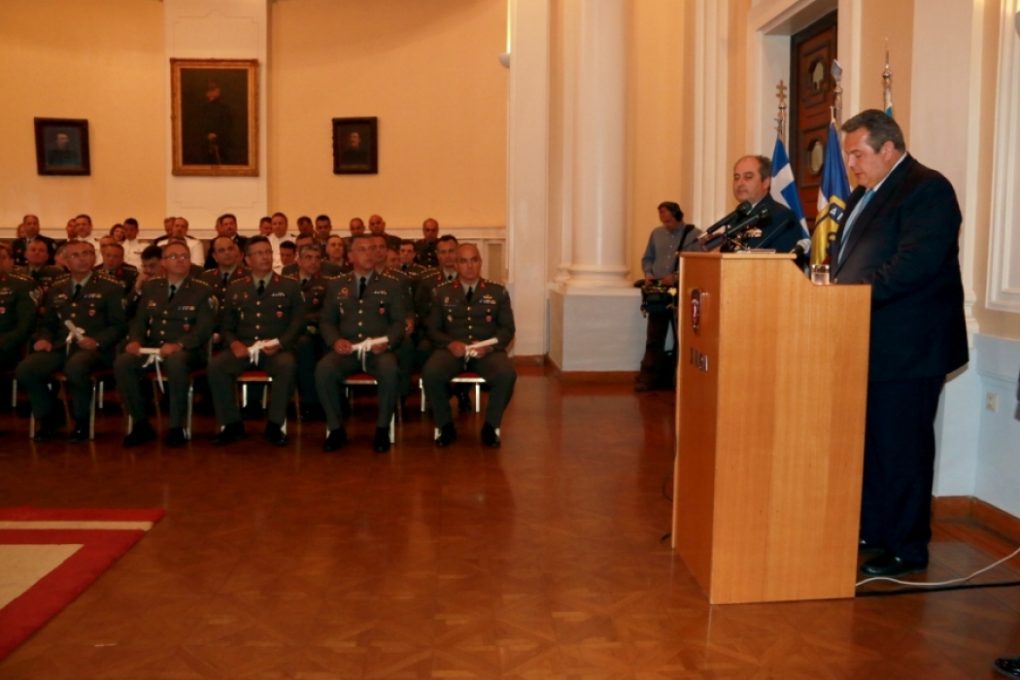
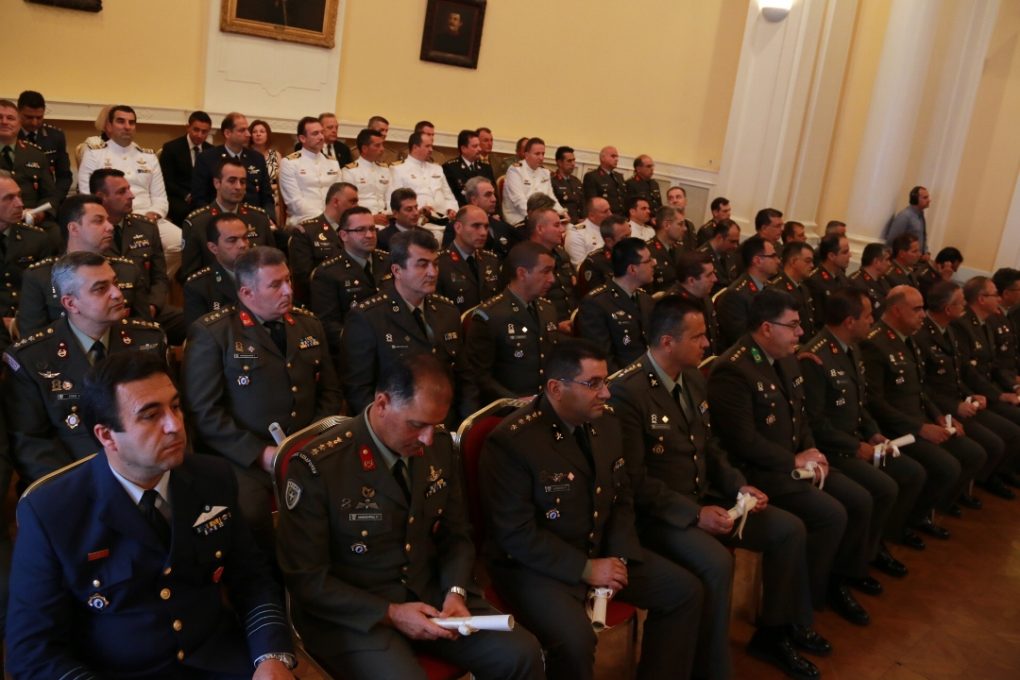
The Minister of National Defence Panos Kammenos accompanied by the Chief of HAGS Lieutenant General Vasileios Tellidis awarded the certificates to the 68 graduates of the 67th Class of the National Defence College. The award ceremony took place in the Armed Forces Officers’ Mess.
The Minister of National Defence addressed the following statement:
“Chief of the Hellenic Army General Staff,
Representatives of the Chiefs of Hellenic Navy and Hellenic Air Force General Staffs, of the Coast Guard, of the Hellenic Police, of the Fire Brigade, of the National Intelligence Service, of Ministries,
Commander of the National Defence College,
Deputy Commander,
Generals and Admirals,
Y.E. Ambassadors of friendly and allied countries who are here today,
Dear Guests,
Ladies and Gentlemen graduates of the National Defence College,
With the Church’s blessing, I congratulate you warmly on behalf of the government and the Greek state, the Greek people for your graduation from the National Defence College.
There is no doubt that this College provides high level academic knowledge on the wider field of Strategic Studies, Defence Policy and National Strategy. It is the highest level post-graduate studies within the Armed Forces.
Our steady and persistent instruction is to upgrade National Defence College as much as possible; to enhance its already existent bonds with foreign and Greek Universities and to promote its post-graduate studies, not only professionally, but academically as well. In this direction, already, during my last visits abroad, we have promoted some agreements with foreign universities in order to reinforce the post-graduate courses of the National Defence College.
I am saying this, because new knowledge is required which will reach an in-depth analysis, will decode and interpret the new rapidly developing geopolitical environment.
Today, military force is not mostly so much by the number of the fighters as by the scientific level of the troops and quantity should be replaced by quality. A good officer must be a high level scientist.
The modern, staff and operation officer must be a fighter and a scientist. He must follow a complex way of thinking. He must think in a manner that exploits fully every parameter – which, fortunately or not, are too many and complex nowadays – with an open mind, flexibility and with the rapidness and adaptability that is required.
He must be farsighted; able to foresee, to suspect what may happen, to compose. And the big challenge is for him to manage new situations successfully; to apply what he learns from his teachers and his papers, not as a scheme and theory, but operationally, in action.
I come back from a visit to Crete, to one of the most modernized vessels of the Hellenic Navy, where we followed the developments on the Aegean over the last 15 days. One should see the difference in how Officers of the Operations Centre of the vessel intervene compared to what the system itself proposes – a complex system which exists in modern vessels – which substantially gives priorities in using weapons and manoeuvres. This is where skilful knowledge and expertise matter most, along with the officer’s personal decisions that has followed this high level education course, yet remains also the final user, because it is a human that will be the final user.
I am particularly glad because with my contact with the Hellenic Armed Forces in the camps, on the battlefields, on vessels, in battle wings, I see that our officers are fully aware of how a modern officers should be, what an education course should include.
Shortly before, I contacted the Chief of the Hellenic National Defence General Staff who is in an official visit to Egypt. Greece has exemplary Armed Forces. We take over a great part of the training, of the new army of friendly and allied countries, such as Egypt.
Nowadays, we are going through changes and consequences in the geopolitics and geostrategics, as well as in geoeconomy. We realize that the issue of creating a contemporary and reliable defence and security system , at a national and collective level, is not only a technical, organization or financial issue, but it is a deeply political issue as well.
And this is not a choice. It is a bounding necessity, if one considers that the instability which today extends from Arctic to the shores of Northern Africa, which surrounds Europe, constitutes a threat to trade, energy roads, tourism, to the effort for a sustainable development.
We have new forms of threats. Terrorism is an asymmetric threat. The Islamic fundamentalism and the establishment of the so-called Islamic army, with the plan of the famous “Arab Spring” having failed and a whole region in Northern Africa and Middle East exploded, demonstrate that the issues of terrorism are will, from now on, be issues of defence and that the threat of migration, which is used many times for human smuggling among refugees, by exploiting the drama that refugees go through when they face a war threat in their homeland, makes us particularly careful in our planning by taking into account the existence of cells within the western societies, which in the future may be used, organized and join the organized crime and constitute a major threat.
Cyber terrorism, which develops day by day, correlations and funding of crime and common crime, drugs trafficking, money produces by fields such as piracy, drug and weapons trafficking, by trafficking illegal oil have brought – allow me the expression – dirty money in the market and much of it may be used in the future against organized nation-states, if they are not being already used.
As a consequence, what we must seek and it is very important is to define the trends every time, to trace them and to seek to keep the things in a relative balance, nationally and internationally.
The tremendous changes which took place over the last years created a series of new data that form an unstable security environment which affects Greece and Cyprus.
Greece lies in the middle of the war zones of Northern Africa and Middle East. We, unfortunately, see that some try to destabilize the Balkans, which Greece would not allow for with any force it has, and we also see new needs created within alliances, within NATO. Several northern countries see a danger from the North; we locate the real danger from the South.
Our country is still going through a financial crisis. This crisis, I want to assure you, will not affect the Armed Forces; or it will affect them as less as possible. The government’s decision is for the Armed Forces not to be affected from this crisis, if possible. And this is why, as you may know, from the very first moment, the decision of the government and the political leadership of the Ministry of National Defence was to restore immediately the pecuniary unfairness against the Armed Forces and their personnel.
The money for the restoration of salaries and pensions are already in the Ministry of Finance under unblocked codes, from the first moment the frontier service allowance was paid but I want to assure you that together with the National Defence Council, with the Chiefs of the General Staffs, we started to utilize the 32 billion euro worth property of the National Defence Fund. This means that not even a small part of the Armed Forces property will be sold. This property will be used; it will produce at least this 5% on the objective value which is provided for throughout the free market and the total amount of money will be used to the benefit of Armed Forces’ personnel.
We already began to consider the area of Malakasa for the construction of residences for the Armed Forces. Money will be spent for the construction of residential facilities in camps across Greece for all the three branches, and, in parallel, we will also provide money for the training and follow-on training of Armed Forces’ personnel.
All these are connected to each other through a determining concept and this is the policy of National Defence for security in the sense of national force. National force not only ensures the national integrity and independence, it is also our country’s international mark.
It is the manner in which our country characterizes itself and is characterized by others at all levels of international action, at a political, diplomatic, military, financial and cultural level. This same issue makes us develop jointness in cooperation with the other bodies’ personnel who are educated in the National Defence College, such as Civil Protection services, such as the Coast Guard.
We must obtain common engagement rules. The Fire Brigade, the Hellenic Air Force and the Army Aviation must have a common policy. And this will be the job of staff personnel of the Armed Forces like you who are awarded your certificates today.
All the things I spoke about earlier require for right professionals, well educated, aware of their mission, capable of understanding how things develop, not only within the wider region, but all over the world.
So, I would like you, all students, to consider your studies here, in the National Defence College, as a national investment which you must respect and reward your country for it, which has great expectations. Because each one of us is bound by a historical contract towards our country. And everybody, personally, must develop this sense of responsibility towards the benefit of our people and our nation whom we are obliged to protect.
I want to assure you that this political leadership of this government has decided not to involve in the work of the Armed Forces in the manner in which this happened until now. Promotions and retirements will be considered by the Armed Forces leadership, without any political interventions. We do not care what an individual’s political beliefs are. We want them to do their job properly. And at the level of the Political Leadership we want political decisions to be made. At the level of Military Leadership, the Army is commanded by its chain of command as it should be.
With these thoughts, I wish to congratulate each one of you; to wish you health, prosperity and a successful career. From now on, you will be commanding the leaderships of the branches in which you belong.
I would like to thank foreign officers, in particular, for being among us during all this period of time, to wish them a successful career, to have strength and Virgin Mary, the Champion General, as the Commander said, to have you all and your families well, at these difficult moments that our country goes through.
Congratulations”.