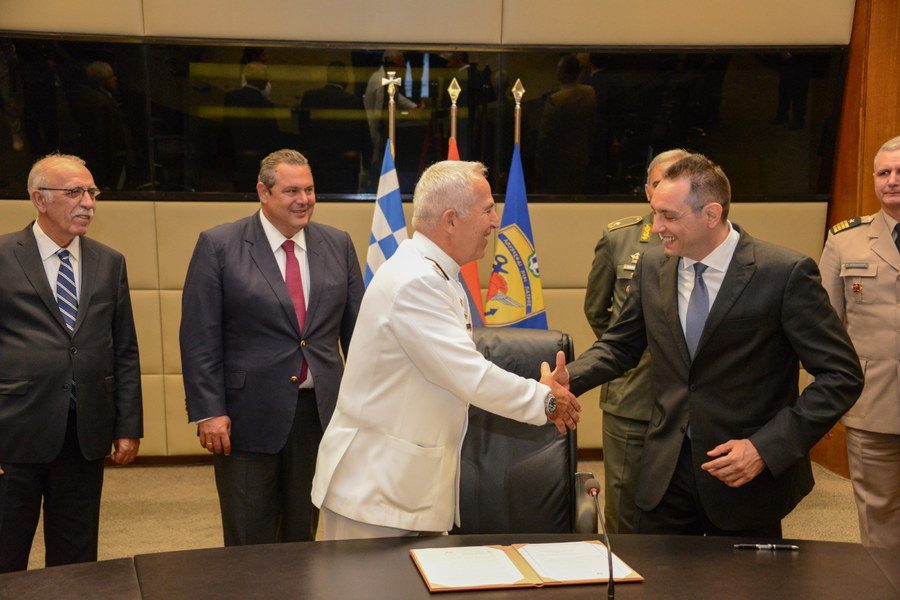
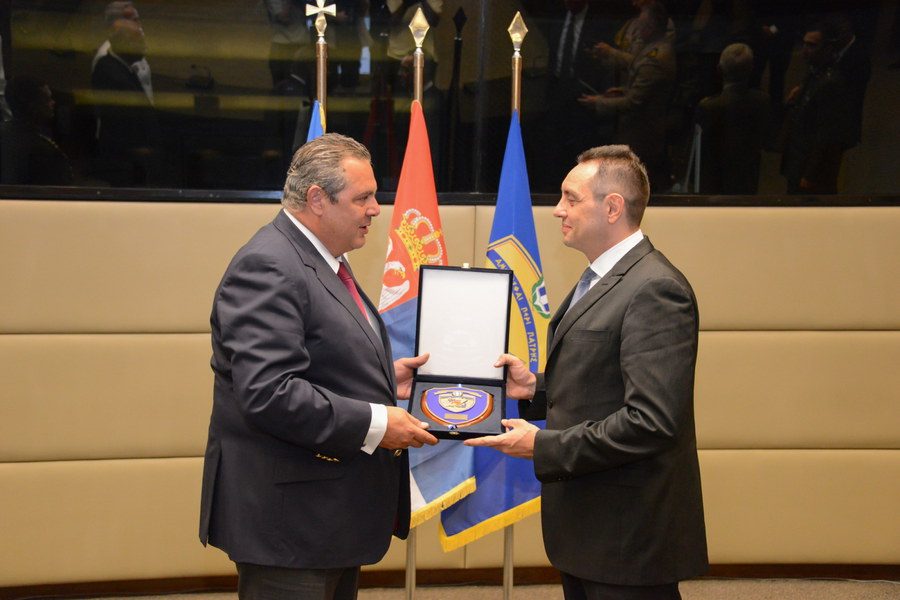
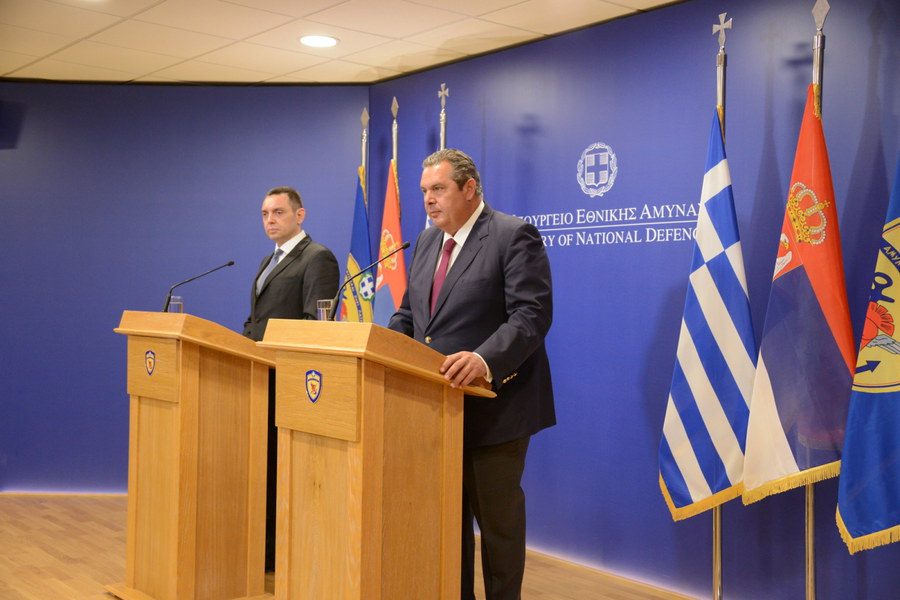
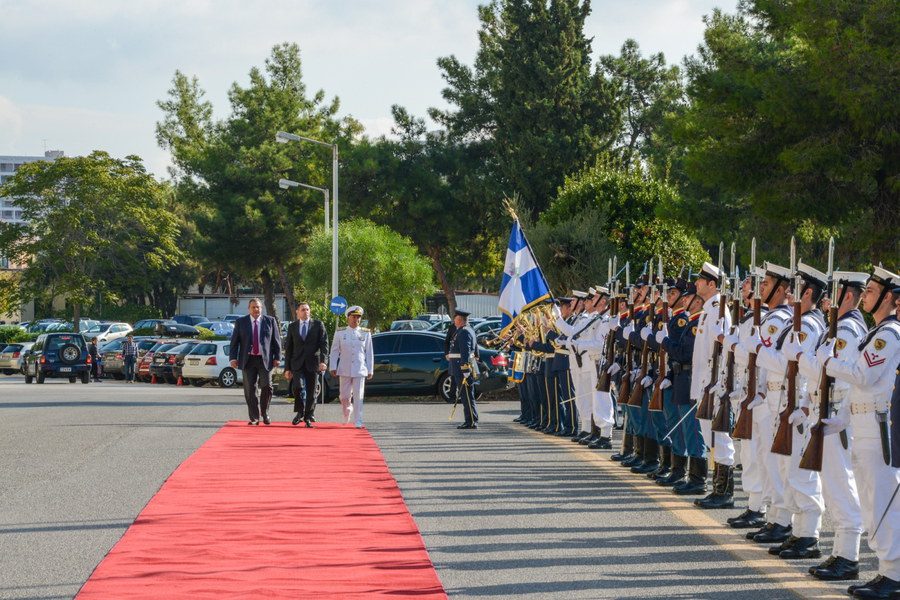
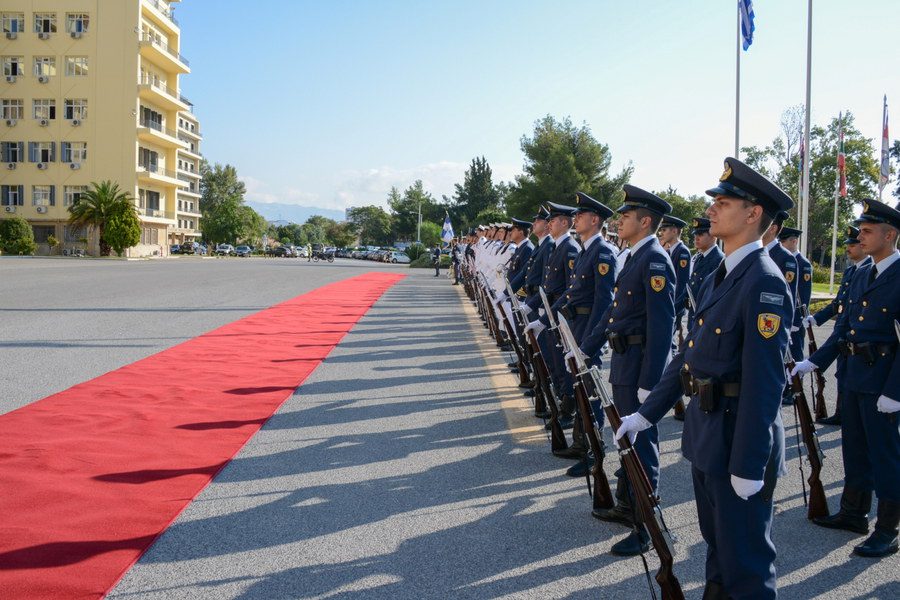
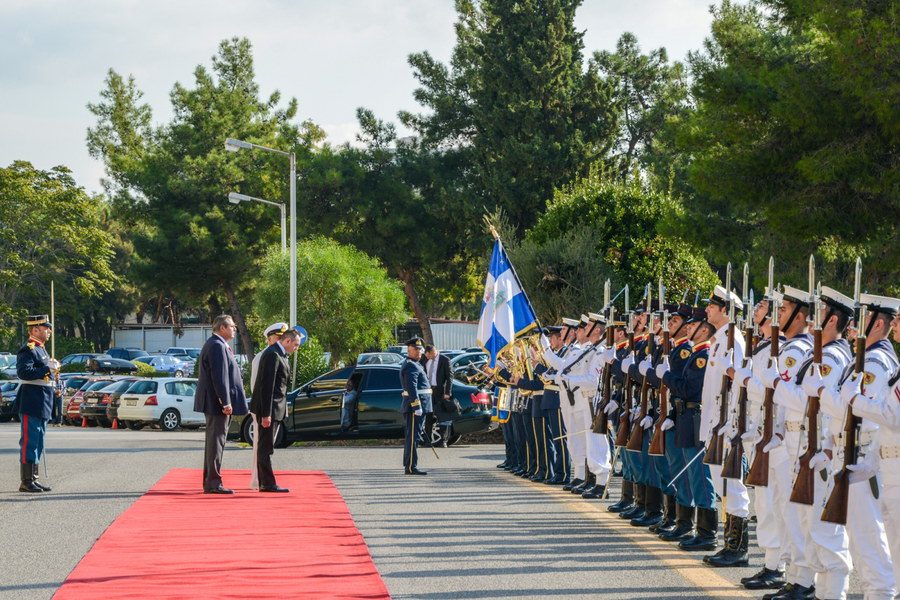
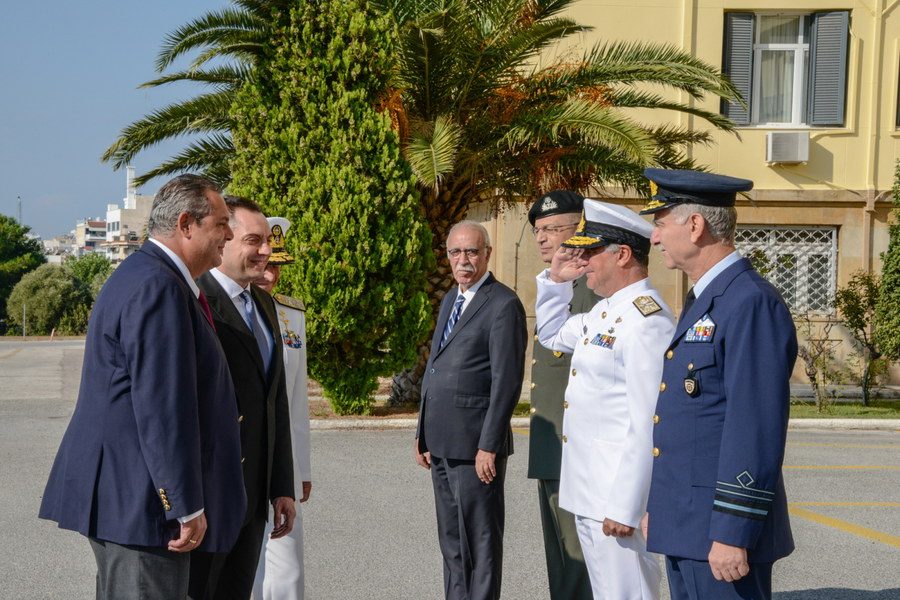
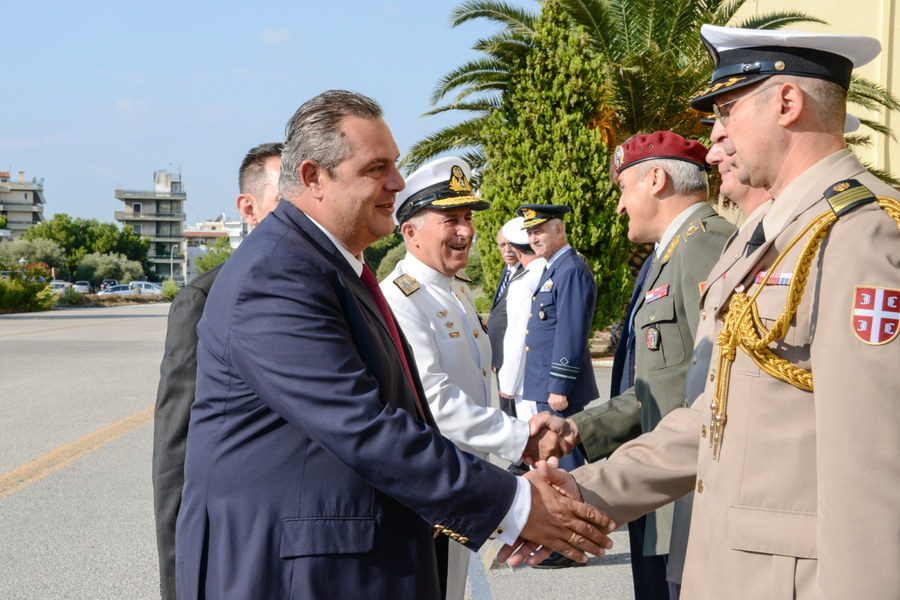
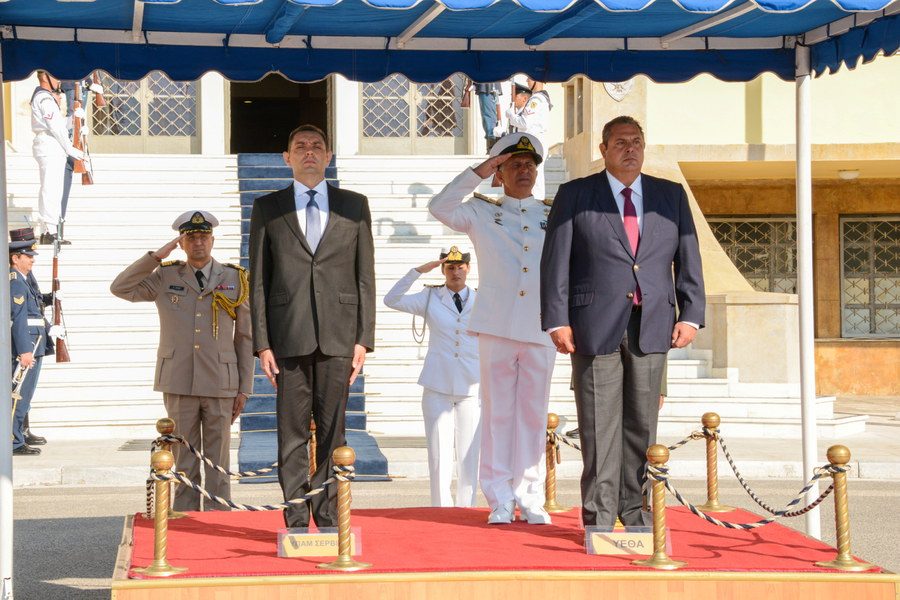
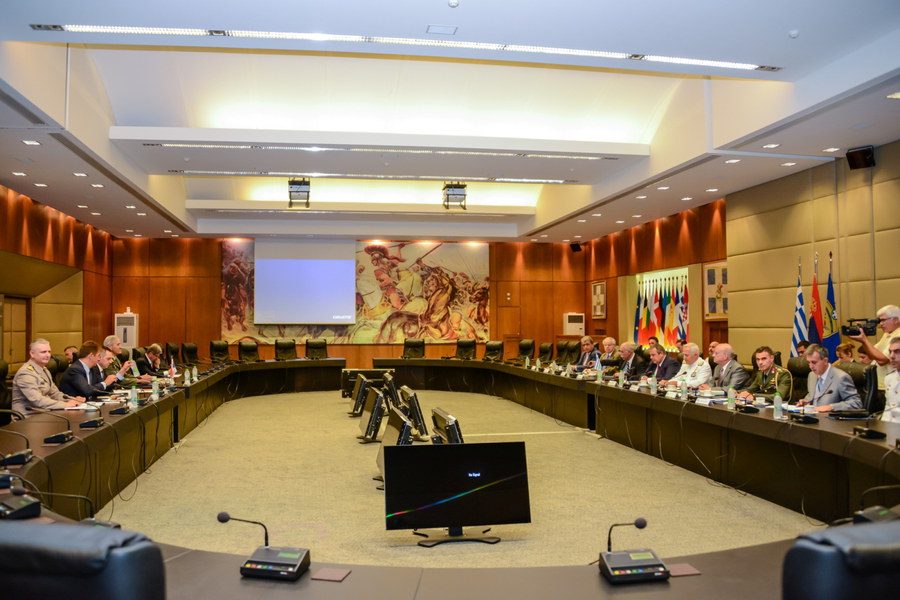
The Minister of National Defence Panos Kammenos met with the Minister of Defence of the Republic of Serbia Aleksandar Vulin who pays an official visit to Greece.
The Minister of National Defence stated the following:
“I had the pleasure to welcome the friend and Minister of Defence of Serbia Aleksandar Vulin and his associates to the Ministry of National Defence in Greece. As we all know, Greece and Serbia are not just two countries that belong to the wider area of the Balkans, but two brotherly people who have been together at hard times. We are connected by a common cultural course across centuries; we are united by Orthodox faith and by common principles.
I thank the Minister of Defence of Serbia and friend Alexander for reminding us in his address how the Serbian people in 1999 welcomed us, when we entered the stadium for the friendly football game (Partizan-AEK) right after the bombing in Belgrade.
After so many years, it is worth saying that back then too we were struggling for principles like the maintenance of the frontiers delimitation which is now a top principle that ensures peace, and for the respect of the international law and international treaties.
We ought to say that the Serbian people were the first victim of some who planned globalization without taking into account the peoples’ opinion. It is not a coincidence that the International Court of Justice in Hague found president Milosevic innocent after his death and after all this prosecution he had been undergoing for many years. This belongs to the past and I hope that everyone has learned a lesson. You cannot cooperate with terrorists who attack democratic states with democratically elected leaders.
Now we see some of them approaching forces of destabilization of religious organizations and hope that they will instigate again conflicts in the Balkans. But now they will have to confront the entire international public opinion and the United Nations, Europe, as well as NATO.
Greece and Serbia, apart from their common Orthodox faith, have also something else in common: their European course. In this context, the military cooperation between Greece and Serbia is of great importance for the stability in the Balkans and in the wider region.
Greece, as member of the European Union and of NATO, with the bilateral relations to the south, with Israel, Jordan, Egypt, the United Arab Emirates and, of course, with the trilateral relations we have developed with these countries and with Cyprus, but also to the north with Bulgaria and Romania, Greece can develop, together with Serbia, an axis of stability, peace and progress which will intercept some people’s efforts to import religious fanaticism, particularly in the Balkans and in Europe, and will also intercept terrorism and will bring stability and peace to our region.
Today was the second meeting after my official visit to Belgrade and in which the military agreement between Greece and Serbia takes its final form. The Chief of HNDGS Admiral Evangelos Apostolakis signed the act of accession of Serbia to the battle formation which Greece leads and in which Bulgaria, Romania, Cyprus and Ukraine also participate.
This fact has a double meaning. On one hand, it is a regional cooperation for the effective defence of our countries and, on the other hand, it reinforces the connection of the Republic of Serbia with the developments in the field of European Defence.
Greece, as always did, will continue to fight for the accession of Serbia to the big European family. In this effort, we will expand, as we agreed, the defence agreement in two more fields: the field of military training and academic education, and via the Military Cooperation Protocol which will be signed for 2018, the field of reinforcement of cooperation capabilities of the two countries’ defence industries.
Serbia has maintained an excellent defence industry with high technology, and through synergies and common projects with the Greek public and private defence industries, they can open the way to the markets via the certification of Greece as NATO and European Union member-state in products, member-states of the alliance, and in third countries, which will help the development of defence industry in the Balkans.
In parallel, let us not forget that after the latest developments in the field of energy and the extension of the pipeline from Egypt to the north, Greece and Serbia, together with other countries of the Balkans, can play an important role.
I would like, as a conclusion, to call on the other Balkan countries to move on together, away from nationalism and extremist statements, towards close cooperation and turning the Balkans into an area of peace, growth and cooperation; to isolate extremist views and see our people prosper together.
I am sure that people have realized that and this is why we see those who wish to restore hatred in this area being isolated through election procedures. Greece and Serbia will do their best for this objective to be achieved.
Finally, I would like to assure the Minister of Defence of Serbia that Greece will always be consistent to what it has publicly stated in relation to efforts of formations that violate the principle of maintenance of the frontier lines in the wider area. I thank him very much for his visit”.
In relation to the meetings of the two Ministers of Defence, the Chief of HNDGS Admiral Evangelos Apostolakis signed the Note of Accession which completed the procedure of the participation of Serbia in the Battle Formation HELBROC BG (Greece, Bulgaria, Romania, Cyprus, Ukraine) based in the 71st Air Borne Brigade, Kilkis, and it can be made available for missions of the European Union.