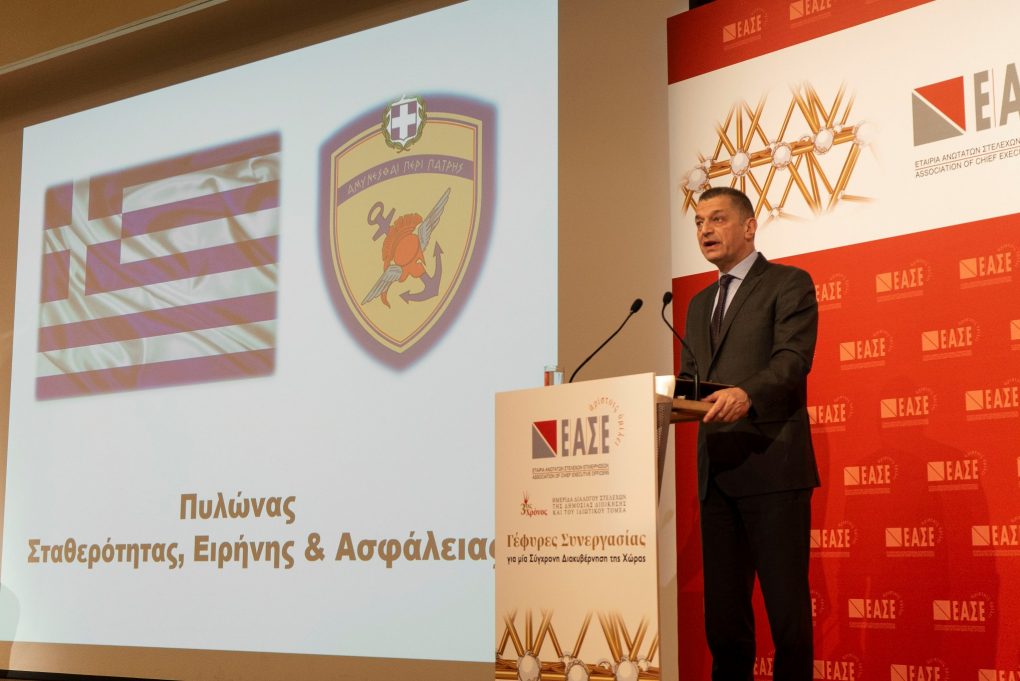
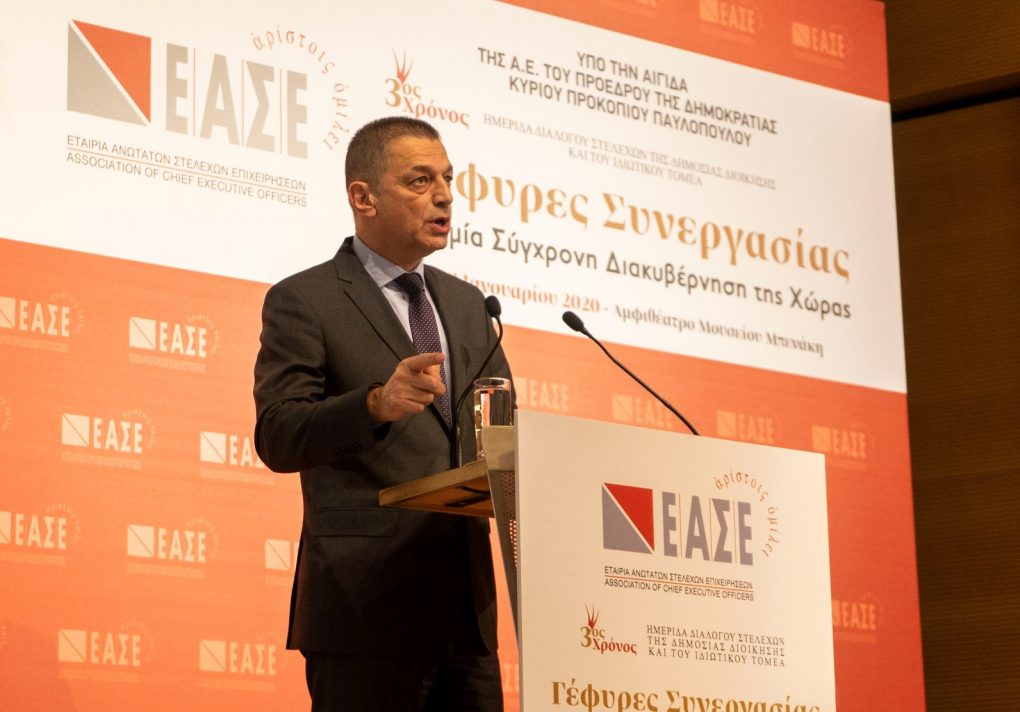
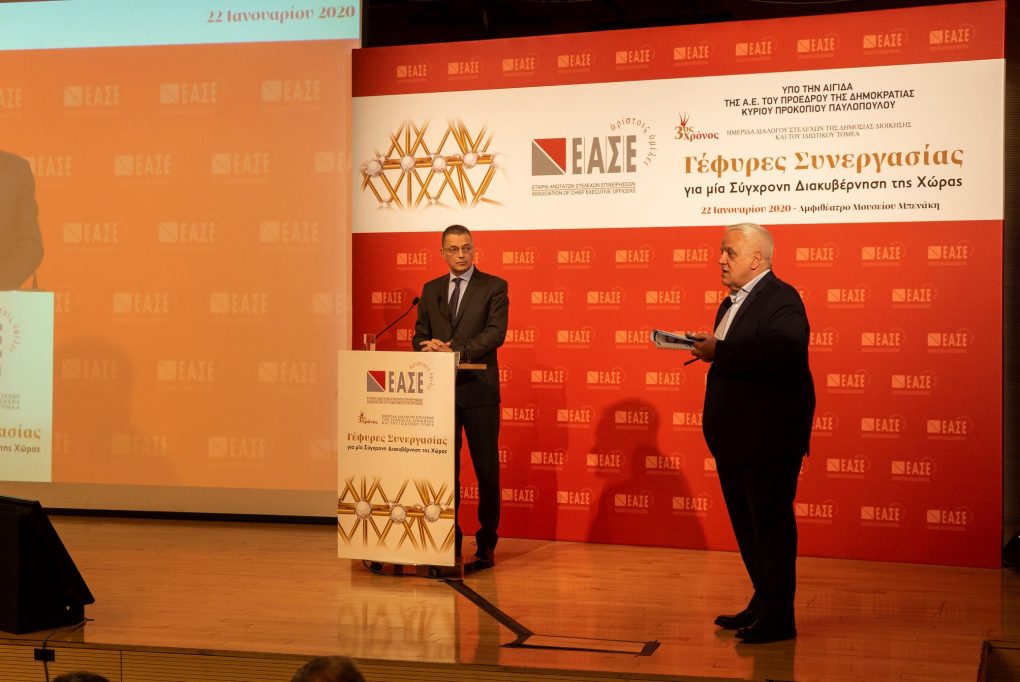
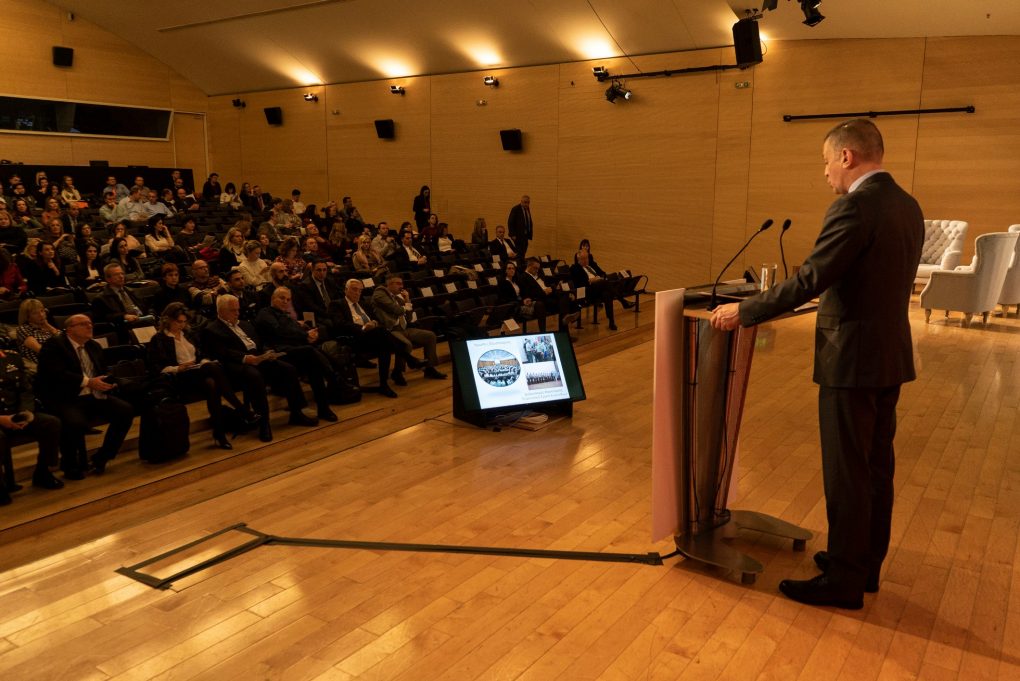
The Deputy Minister of National Defence Alkiviadis Stefanis participated, as a speaker, in the special One-day Conference on the subject of “Bridges of Cooperation for the Country’s Modern Governance”, hosted by the Association of Chief Executive Officers, on Wednesday 22 January 2020, in the amphitheatre of Benakis Museum, under the auspices of His Excellence the President of the Hellenic Republic Prokopios Pavlopoulos.
The Deputy Minister of National Defence, in the context of the Conference’s proceedings, gave a speech on the issue of “Outreach in the Operation of the Armed Forces”, where he mentioned the following:
“It is a particular honour and pleasure for me to be here today, before such an esteemed audience, including higher level executives, in the emblematic venue of the Benakis Museum, a unique museum supporting knowledge, research and culture.
It is an indisputable fact that at the first light of the 3rd decade of the 21st century, the shift of the global centres of power, the shift of traditional national traditions and the diffusion of human networks, mutates the international environment to a more connected environment, competitive and unforeseeable, resulting in the United Nations, the European Union, NATO, the other International Organisations and the Nations facing a plethora of asymmetric challenges and threats.
The modern international environment is characterised by intense phenomena of instability, fluidity, high interdependence and fragile balances and it is currently shaping a particular global agenda, which includes an array of challenges which become more and more pressing, such as war conflicts, natural disasters, immigration, religious fundamentalism, international terrorism, organised crime, dissemination of weapons of mass destruction, cultural, political and financial globalisation.
In the context of these occurring changes, all the actors, independently of magnitude, hasten to take their most appropriate stand in order to promote their interests and policies.
Western societies, in order to face these new hybrid challenges, require of their governments to meet the obligation of securing a sense of safety in an increasingly commanding tone, always respecting each constitutional restriction in force and the personal freedom of their citizens.
So at the national level, initiatives are being developed, with the common component of the necessary activation of the national Armed Forces, to assist the competent state bodies and to cover the security level gaps which we come across.
In this unstable international environment, characterised by high levels of complex interdependence, the Hellenic Armed Forces are called to preserve their high operational readiness and combative capability, shaping a modern organisation which will guarantee the deterrence of all possible challenges and the successful countering of all possible threats, maintaining the national honour and dignity of the Homeland intact.
For people to succeed, they necessarily have to leave the ways of the past behind, including idleness, complacency, misery and persistence to stereotypes, which have no place at a modern military structure, which must be imbued with a sense of renewal, optimism and hope.
In the age of internet, the surge of information and communication, outreach through the promotion of innovation, creativity and originality, constitute a priority for the Armed Forces, apart from everything else.
However, we should give the meaning of outreach, which can be characterised as the catalyst for the establishment of a modern military corps.
Outreach is the result of the modern global architecture, emanating from the surge of communication technologies, IT and social networking, globalisation of financial tools and commerce, internationalisation of the labour market and the regulatory role of the non-state actors at a national and international context.
In essence, it is the result of the interaction of an organisation with reality.
In general, we can say that a demonstration of outreach is when organisations or people are not abstracted from their surroundings but they are also energetically promoted outwards. Accordingly, the notion of outreach is of vital importance, because it constitutes the basic vehicle for an organisation to overcome a crisis or a situation of uncertainty.
The individual is the basic factor of outreach. The parent, the manager, the professor, the politician or the leader.
When a leadership demonstrates outreach then it cannot be modulated, restricted, determined by decisions, orders and maxims. It does not follow a prescription or particular models, it does not involve cognitive capabilities. It involves vision, the promotion of personality and character, the process of affecting thought, feelings, stance and attitude, the art of inspiration, the combination of paradigm, conviction and impulse. All of the above are established on the individual capabilities of the leader and on a plausible philosophy which also involves the substantial element of the moral dimension.
The familiarisation of the Members of the Armed Forces, throughout the corps levels, with the everlasting methods and theories pertaining to the art of leadership, in all Military Schools of Officers and NCOs, constitutes a basic priority and a dominant training option for the Armed Forces, clarifying the discernible difference between leadership and the management of everyday routine, by promoting outreach, innovation and the moral model of leadership as the most appropriate to bring a common vision and a field of goals into prominence, based, on one hand, on the notions of reciprocation, equality and respect of social liberties and, on the other hand, on the moral and intellectual virtues.
But how is outreach expressed in the Armed Forces today?
In order to materialise outreach, the Armed Forces’ activities are being developed through the following focal points:
Actions for the enhancement of knowledge and information, through synergies with training institutions in Greece and abroad. A simple example is the participation of military Schools students in military Erasmus programmes. The fact that a large part of our personnel have enriched their learning with postgraduate and doctoral diplomas is a result of outreach.
Actions for the operational upgrade of the combative capability through joint trainings with allied countries.
Actions for the invigoration of the command system, giving emphasis to the development of synergies between the Armed Forces and state but also private sector bodies operating in the field of technology.
Actions with an environmental imprint (utilisation of green development) through participation in NSRF programmes, Horizon 2020.
Interaction with civilian bodies (The Smile of the Child, Lycée des Femmes Grecques).
Solidification and integration actions for innovation, through cooperations with domestic and foreign Institutes and Educational Institutions.
Pertaining to outreach, the Ministry of National Defence is conducting the following activities:
a. It is cooperating with the Ministries of joint competency, supporting and encouraging the communicational promotion and endorsement of our country’s industrial capabilities in the field of defence and security, through participation in international exhibitions and national pavilions.
b. It is utilising defence attaches in cooperation with the Ministry of Foreign Affairs, promoting intergovernmental cooperations, in the context of Defence Diplomacy activation.
c. It is promoting cooperation with competent bodies of other ministries on development, by participating in synergies, so as to promote dual use actions.
At the same time, the meeting of operational obligations, through the development of appropriate technologies, constitutes an essential outreach parameter for the guidance of research and innovation in the field of defence. In this context the Ministry of National Defence:
a. Is cooperating with private and public bodies as well as universities.
b. Is conducting and developing technological research in the context of the Armed Forces operational requirements and participates along with bodies of the scientific community and other public bodies, in research programmes of International Organisations and International Synergy Schemes. Our participation in these synergy schemes imparts prestige, recognition, it establishes us domestically and abroad and our benefits are multiple (specialisation, innovation, revenue). Our participation in the Permanent Structured Cooperation (PESCO) programmes of the EU is a characteristic example, where Greece has the lead in five programmes and moreover programmes of high technology, like, for instance, the Cyber Defence. The same outreach strategy is being adopted in NATO, where, through the Centres of Excellence, we are establishing prestige and consolidating the international perception regarding our Armed Forces’ high operational readiness.
Hereupon, in the context of promoting innovative outreach actions, HMoND is hosting special one-day conferences, inviting specialised researchers of the scientific community from Greece and abroad, and executives of the Private and State Defence Industry aiming to present innovative ideas and technologies in the field of Defence and Security. Furthermore, it organises innovation competitions, aiming for the widest possible activation.
Ladies and gentlemen,
In the conclusion of my speech, I would like to stress that in a period of unchanging known threats against our Homeland’s national defence, we are required to stand together, in national unity and togetherness, to make clear to anyone who has malicious intents for our national sovereignty, that we are not willing to cede anything on land, at sea or in the air and if need be, we will face every provocation with high morale, caution and composure, no matter its source.
Greece, in the context of its undisputed geostrategic superiority, will continue to retain a powerful and vibrant presence in the international political scene, a fact which promotes it to a pillar of stability, peace and security in the wider region of the Southeastern Mediterranean.
I would like to assure you that our Homeland’s Armed Forces constitute a focal Pillar of National Power, capable of guaranteeing security, with constant operational readiness and capabilities, by transmitting the messages which characterise our nation, meaning messages of peace, friendship and cooperation, but also decisiveness when it comes to defending our national rights.
Thank you”.