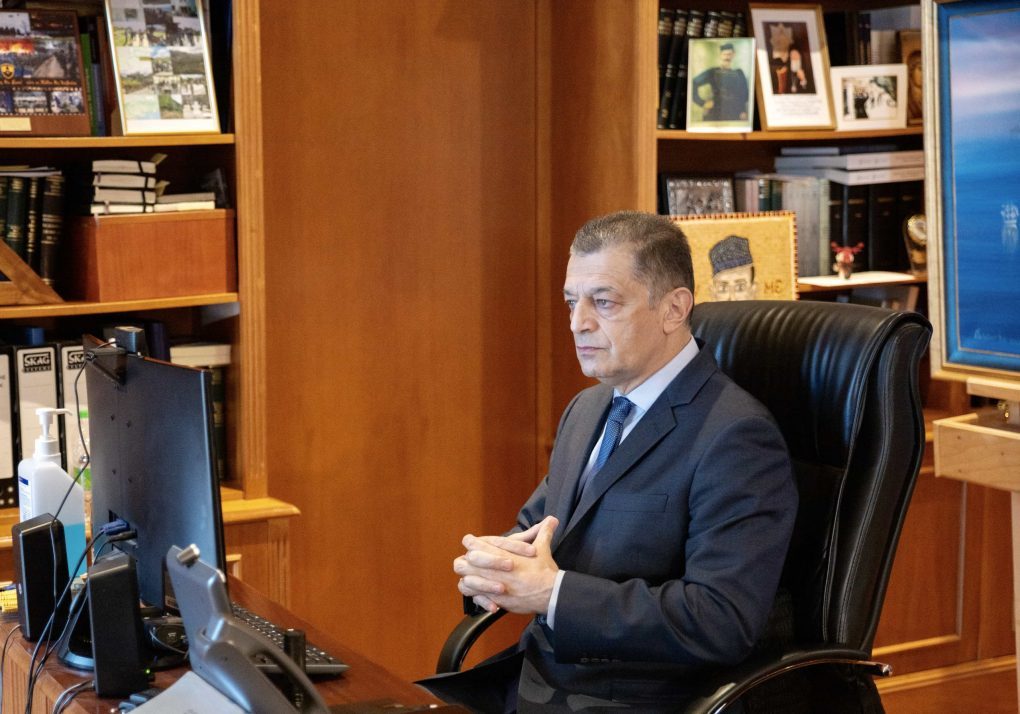
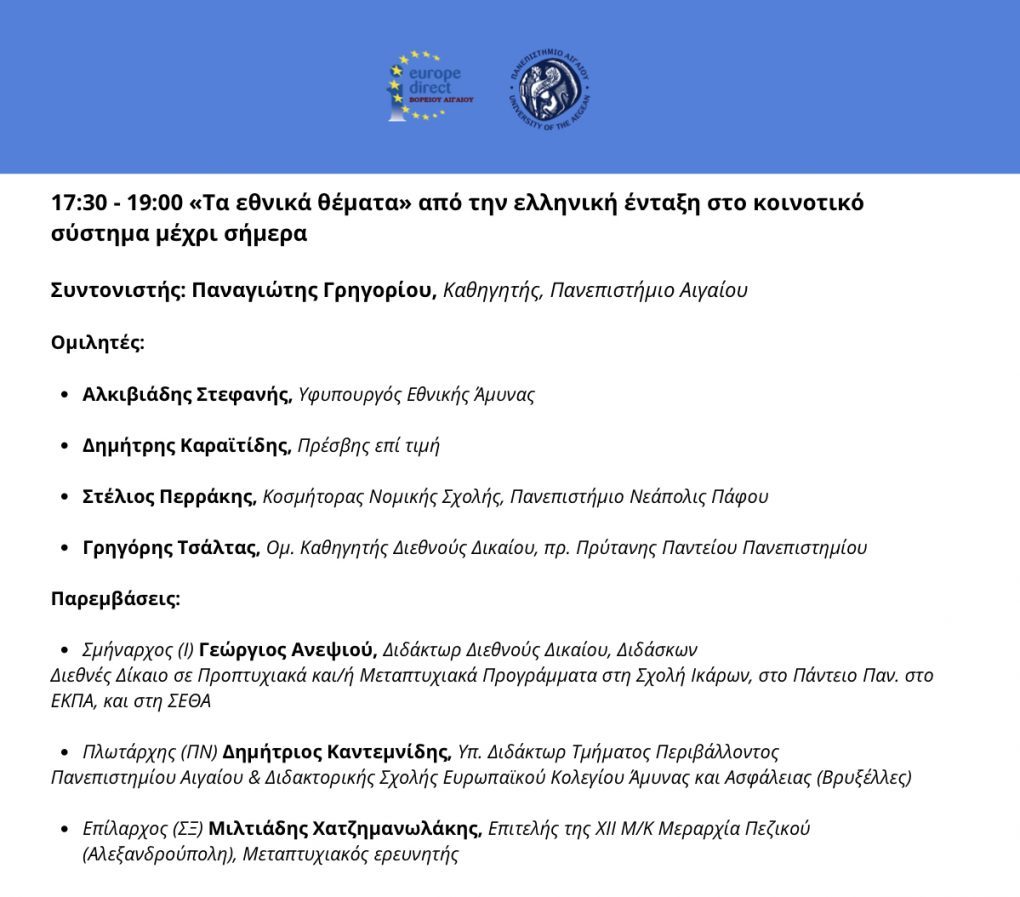
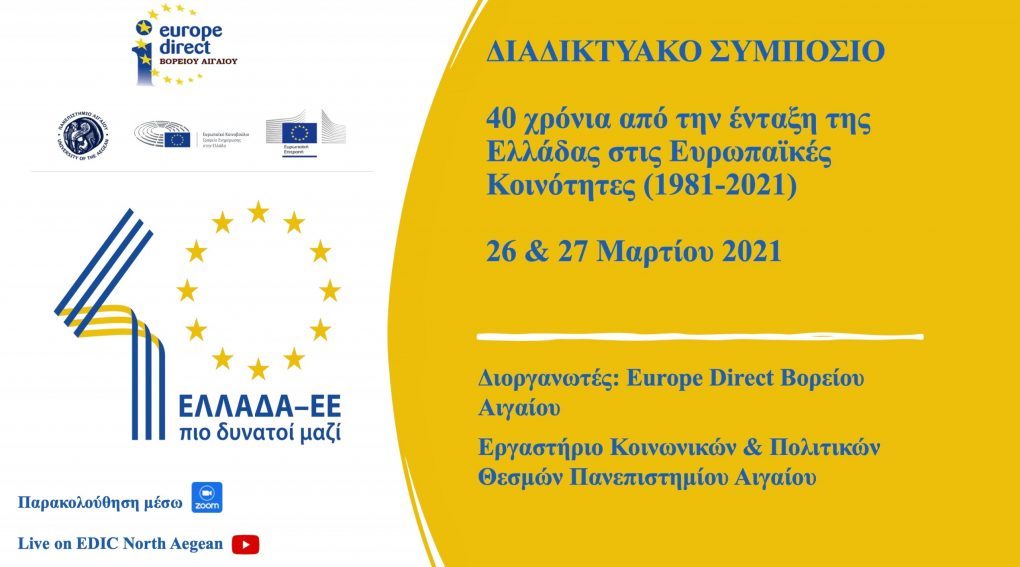
On Saturday, 27 March 2021, the Deputy Minister of National Defence Alkiviadis Stefanis made an address under the title “The national issues from the day of the Greek accession to the community system until today”, during a session of the two day online Symposium, in view of the 40 years since Greece’s accession to European Communities (1981-2021), organised by North Aegean Europe Direct, in cooperation with the Social and Political Institutions Laboratory of the Aegean University Sociology Department.
During the sessions, political, social and financial developments were projected, that took place in our country in the last four decades and at the same time the participants had the opportunity to imprint Greece’s present status vis-à-vis becoming a union and the future challenges of the European unification.
The Deputy Minister of National Defence stated the following:
“It is a great pleasure and honour to participate in the Online Symposium regarding the lapse of 40 years since Greece’s accession to the European Communities. The academic and research field of our interlocutors regarding this union completely covers the European history of integration and of course our country’s path of accession. So, I figured it would be more interesting, using my own experience and special knowledge as Deputy Minister of National Defence, to refer to two issues with regard to assuring the national and European borders, through the European Union’s contribution. The first issue concerns the handling of using the migratory crisis as a tool by Turkey and the second the way of dealing with the crisis caused by the exit of the research ship “Oruç Reis”, accompanied by war ships of the Turkish fleet. These two recent examples-among others in the past-prove our right choice to access the European Economic Community four decades ago.
The geopolitical developments in the Eastern Mediterranean, the Middle East and Africa countries have shaped a really dangerous and unstable landscape, they put international community at risk and contribute to the increase of the migratory flows.
Our country was called in 2020 to defend the Greek and European borders from a sudden, massive and organised migratory “invasion”, by developing and implementing the necessary policies and tactics that would allow Greece to preserve the sense of security, the social coherence and welfare of the Greek people and Europe by extension.
Turkey’s strategy to use this issue as a “tool” led to a significant increase of flows across the Greek-Turkish land and sea borders, from July 2019, at a disproportionately greater extent in relation to the past two years.
In order to face this dangerously developing threat, the Government immediately assessed the situation, thoroughly analysed all influence factors and planned its future actions, assuring timely preparation. The outcome of the above was:
• The decision making for the contribution of the Armed Forces to the work of the Security Forces to deal with the migratory flows.
• The appointment of a National Coordinator to deal and handle the migratory-refugees issue, who is subject directly to the Prime Minister.
• The formation of the Uniform Borders Surveillance Group, subject directly to the National Coordinator, whose mission is the control and surveillance of the land and sea borders of the Greek territory.
• The internationalisation of the situation in bilateral and multilateral level, by activating the European Union, NATO and our allies.
In the context of the responsibilities resulting from the aforementioned, we immediately activated, in the fall of 2019, the operational planning, that is the basic tool to deal with the arising challenges in the modern, multidimensional environment. A significant number of actions and activities was implemented in the interior and abroad, the main ones being the planning of conferences in a high governmental level, the upgrade of borders’ surveillance, the carrying out of visits to Evros region and the Eastern Aegean islands, the briefing of the European Union, of NATO, as well as their special services, like the FRONTEX. At the same time, the armament requirements of all Services involved were defined and prioritised and their funding was ensured, in cooperation with the Ministry of Finance, through the National Budget and mainly through the European one.
The result was our complete readiness and successful handling of the orchestrated hybrid attack launched during the evening hours of the 27th to 28th February 2020 by Turkey, both at Evros region, deterring the illegal entry of approximately 9,400 immigrants only during the first day, and at the Eastern Aegean region. This way we thwarted Turkey’s plans which-by consent of its leaders-aimed at the invasion of 143,000 immigrants in our country.
By assessing the facts of dealing with this hybrid attack, we conclude that many factors contributed to the final positive outcome. Especially, in a strategic level, the political leaders of our Country played a very important role in dealing with the crisis in a superb way, defining the clear strategic direction and making and implementing decisions with directness.
The immediate internationalisation of real facts played an equally important role, through targeted diplomatic interventions in international fora and organisations. This way the objective was achieved in a political, strategic, operational and tactical level; the objective was to defend our national and at the same time European borders. Greece’s image was altered worldwide, as it was proved that the battle fought did not only concern our national borders, but those of Europe as well.
An, initially and apparently, Greek-Turkish issue turned into a European-Turkish one and the outcome of this situation was the reinforcement of the security Greek forces operating in the field, by FRONTEX personnel and assets. This actually proves the solidarity among the member-states of the European Union. During the Evros attack, forces from 22 European states were lined up by the side of the Greek forces, while 14 states had dispatched personnel and assets to guard the sea borders. Greece’s stance changed the Europeans’ stance.
While dealing with the migratory crisis, our country was called to face the crisis in the summer of 2020, regarding the deployment of the research ship Oruç Reis, accompanied by war ships of the Turkish fleet, in the context of the revisionary policy and the firm maximised pursuits of our neighbors.
The immediate and decisive activation of the Armed Forces, in the context of the steady and continuous defence and security framework they provide, offered Greek diplomacy a very powerful tool of negotiations. Our country addressed the European Union, turning this Greek-Turkish issue as well to a European-Turkish one.
The result of these actions was the intervention not only of independent European countries for a peaceful settlement of the dispute, but of the European Union as well, as a uniform and self-sufficient organisation, through the decisions of the last Summits. Turkey’s infringing stance was established and condemned, both against our country and Cyprus, while, at the same time, imposition of sanctions was discussed, in case of Turkey’s non compliance. This fact resulted in Turkey’s withdrawal, the recall of the research ship Oruç Reis and the Turkish navy forces that accompanied the ship, leading to a restart of the dialogue between the two countries.
The Europeans supported Greece in these two crises for two important reasons. The first reason is that they realised that the existing risk is a threat to them as well and to their interests. The second reason is the steady and active participation of Greece in all European actions for many years. I indicatively refer to the participation in the Permanent Structured Cooperation (PESCO), the European Defence Fund (EDF), as well as the staffing of agencies, like the European Defence Agency (EDA) and the European Union Military Staff (EUMS). Our country has Larissa’s Headquarters to conduct autonomous military operations of the European Union, it leads the multinational Tactical Battle Formation (HELBROC Battlegroup) and participates in Althea and Irini (former Atalanta) Operations, as well as operations in Mali.
Assessing the outcome of these crises with Turkey, it is proven that our country, through the strategic choice of accessing the European Community, turned into an institutional international actor, a pillar of stability and security in the Balkans and Eastern Mediterranean region. Greece’s role in the diplomatic and geopolitical field was reinforced and upgraded, allowing it to face firm and arising challenges and threats.
Greece can and must be the corner-stone of the joint European effort for social and financial prosperity. For its distinguished position in the European Union, we fight united, with patience, persistence and optimism.
I consider these thoughts of mine a contribution to a free and open discussion, after the conclusion of talks and interventions”.