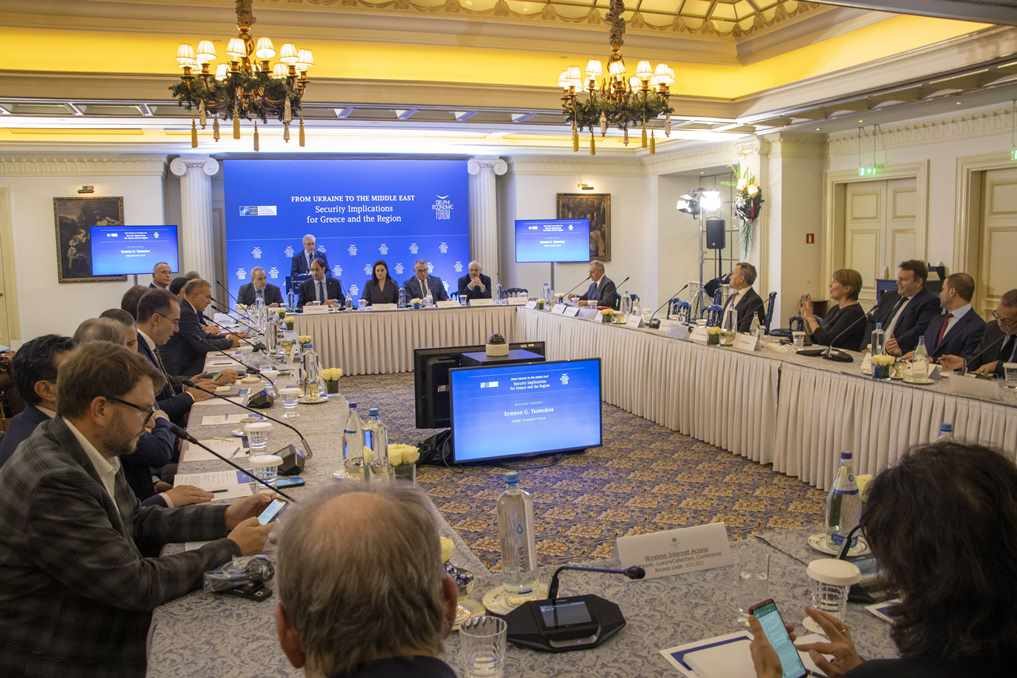
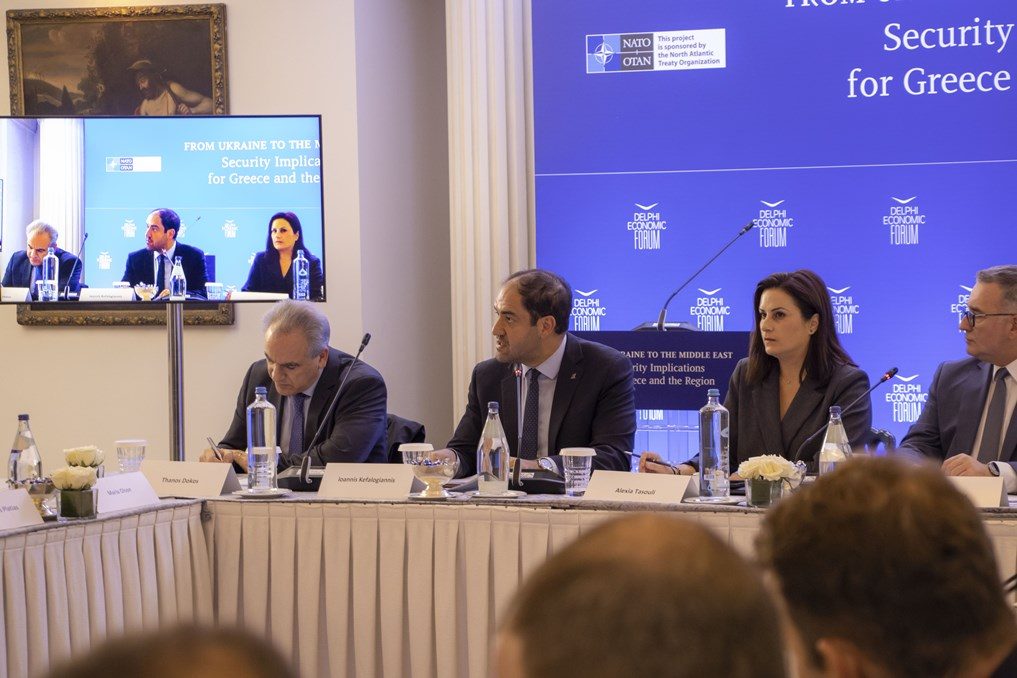
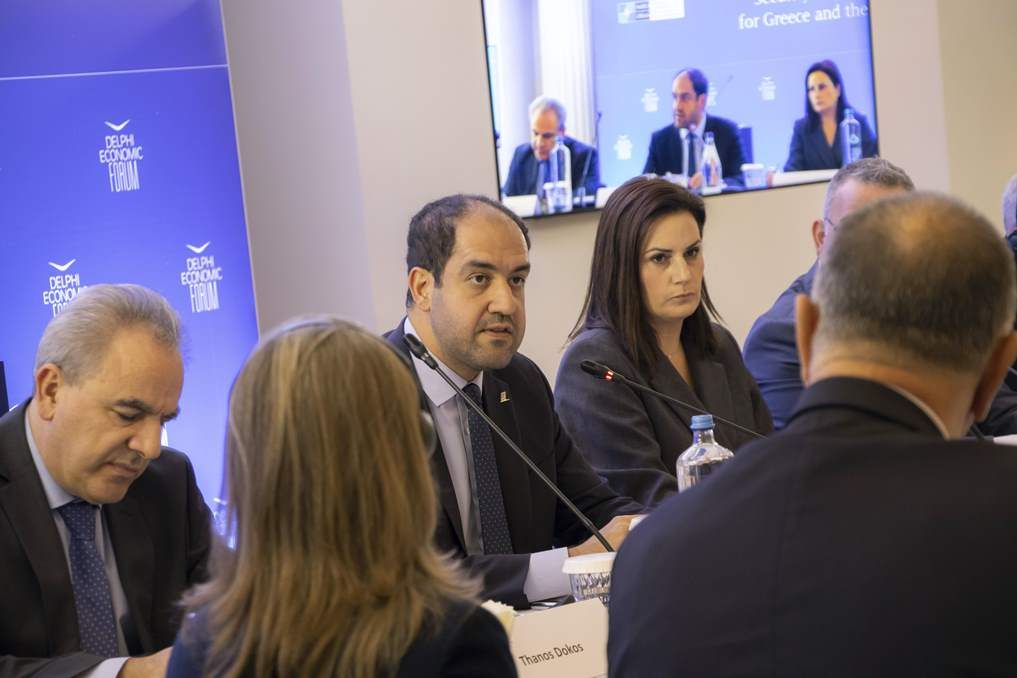
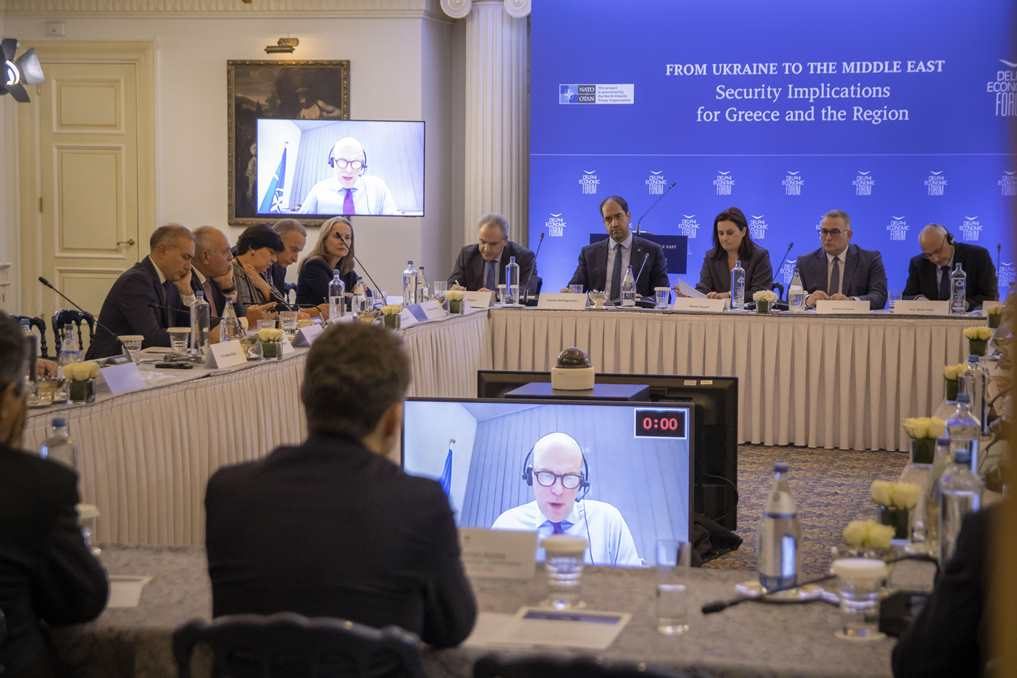
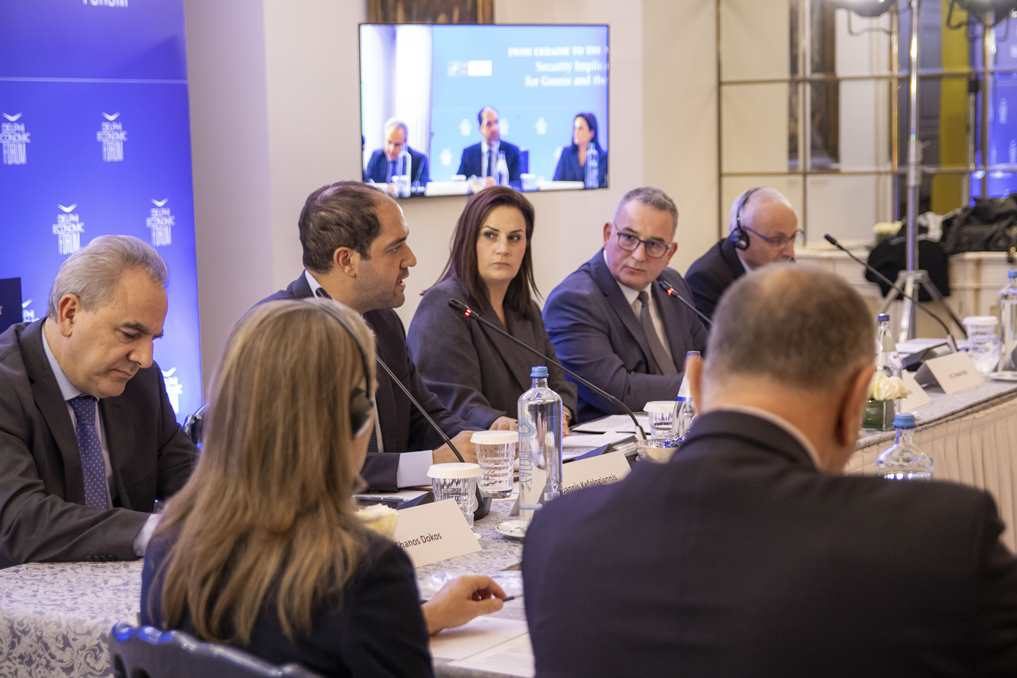
On Tuesday, 05 December 2023, the Deputy Minister of National Defence, Mr. Ioannis Kefalogiannis, attended the Delphi Economic Forum, where current security matters in the broader Eastern Mediterranean region were discussed, as well as developments in the war in Ukraine, the situation in the Middle East after the attack of Hamas against Israel, and potential refugee movements towards Europe.
In his address, the Deputy Minister underlined that Greece adheres to the principles of International Law and will continue to provide military, technical, defence, and humanitarian assistance to Ukraine against the Russian threat, on the one hand, and constitute a pillar of stability and a trusted party open to discussion with all sides in the Israeli – Palestinian conflict, on the other hand.
Among others, Mr. Kefalogiannis stated:
“I want to thank you for the honour of inviting me to participate in the Delphi Economic Forum and share with you my thoughts and concerns regarding the security situation in our region, as well as the challenges that it poses for us.
The European Union, NATO, and the West altogether are facing an unprecedented geopolitical reality, due to the Russian threat against many of its members. On top of this fluidity and geopolitical instability, sadly, the conflict between Israel and Hamas was added. There is no doubt that the heinous terrorist attack of Hamas has destabilised anew the broader region of the Eastern Mediterranean and the Middle East.
Greece is present in all the important issues of the region. It has supported Ukraine since the first days of the war as a matter of principle, doing so even more actively compared to some member-states of the European Union and NATO, and keeps on doing so without exceptions. Greece, committed to the principles of International Law, will keep on providing Ukraine with military, technical, defence, and humanitarian assistance. Our country’s stance sends a clear message to certain audiences that the clearly aggressive actions that breach International Law will not be tolerated by the global community of democratic countries. The same principles guide our country in the Israeli – Palestinian conflict. The standing position of our country is to find a fair, viable, and complete solution of two countries, within the borders of 1967, and with Jerusalem as the capital of both countries, according to the relevant Decisions of the United Nations and International Law. Hence, it is the duty of those who are currently involved in maintaining security in the region to proceed in that direction and broaden the spectrum of potential peaceful solutions. To this end, we must protect the right of a country to self-defence, in this case Israel. We cannot view a country in the same terms as a terrorist organisation such as Hamas. We need to differentiate between the Palestinian people and Hamas. Israel’s right to self-defence should be exercised within the boundaries defined by International Law, and, especially, jus in bello. Consequently, we must ensure that there will be no attacks against civilians and at the same time secure the creation of humanitarian corridors to aid those in danger. Additionally, we know that all people who have been kidnapped or taken hostage must be freed. The international community, and especially the Arab countries, should emphatically press in that direction.
This is the action plan with which our country enters international discussions to de-escalate violence in the region. In the midst of an objectively complicated situation, we are trying to play the role of a pillar of stability in the region, respecting our strategic alliances with Israel, but at the same time the alliances we have with important Arab countries, such as Egypt. Greece is one of the few countries in the world that has this privilege. Thanks to this principle-based foreign policy, we have accumulated important trustworthiness capital, which allows us to discuss with all involved parties, which know that there is no opportunistic diplomacy behind our position. This has undoubtedly contributed to our defence strategy as well.
It was been widely understood that the enhancement of the deterrent power of our country is a prerequisite for peace and the prosperity of citizens. At this point, I would like to remind you that the continuance of armaments programmes constitutes part of a multi-level national strategy to secure our country’s defence, centred around a series of multilateral or bilateral partnerships in the area of defence. Also, the defence bonds that we have developed mainly with Israel, but also with Arab countries such as Egypt, are primarily based on a common vision of security and stability in the Southeastern Mediterranean. This is what currently allows us to be a trustworthy discussion partner of all sides in the Israeli – Palestinian conflict. The last discussion, however, proved even to sceptics the usefulness of anot_her enhanced defence alliance – that with the United States. It wouldn’t be an exaggeration to say that after the outbreak of the war in the Middle East, Greece is practically the only trustworthy partner of the USA in a region that is in constant turmoil.
Additionally, we are making the greatest possible use of the tools that the European Union Common Security and Defence Policy provides us with, and especially the PESCO (Permanent Structured Cooperation) programmes, so that we can develop our defence capabilities in terms of structures, technology, armaments programmes, and human resources, in collaboration with our partners. Thanks to this strategy of the Hellenic Government and the operational planning followed by the Armed Forces, our country has enhanced its position within the alliance of NATO, making its voice and arguments stronger”.