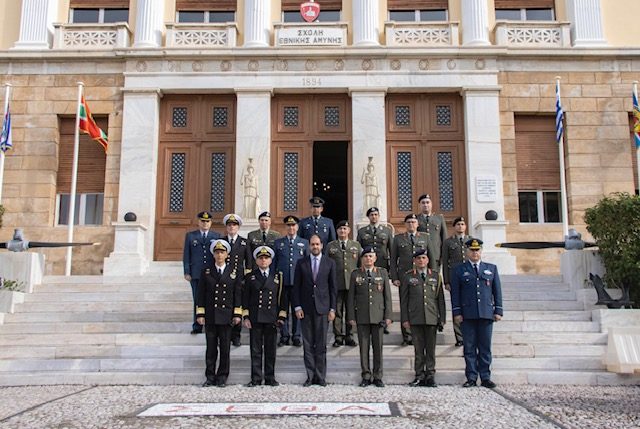
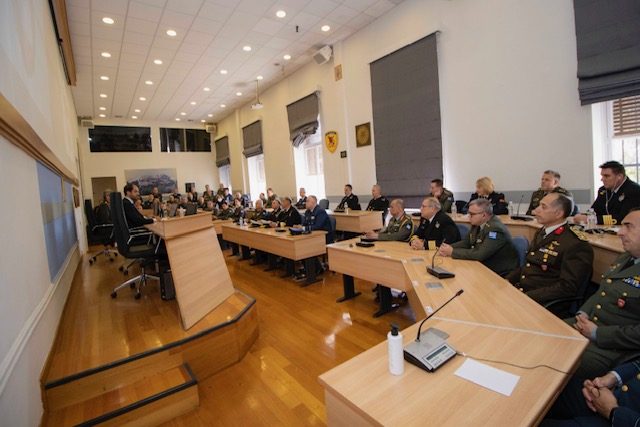
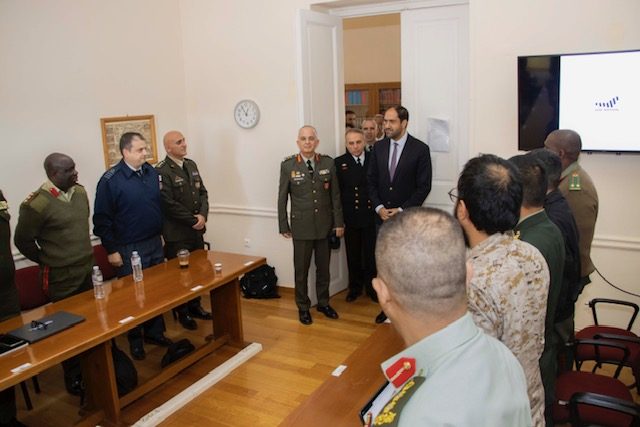
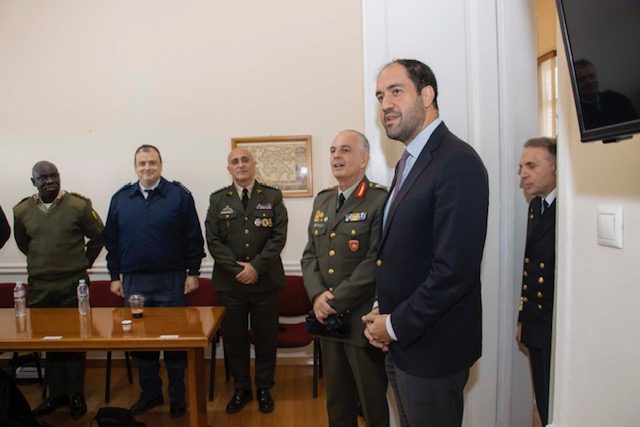
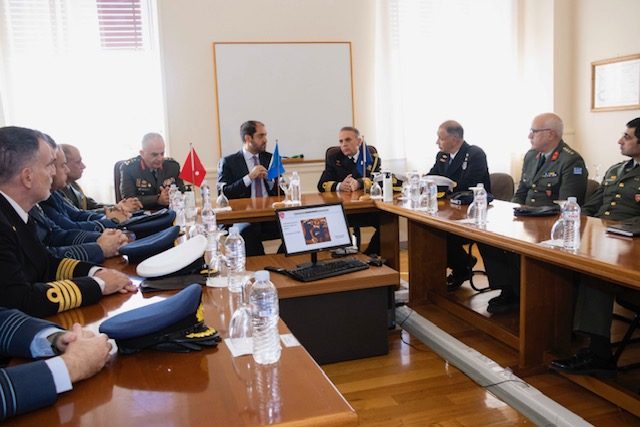
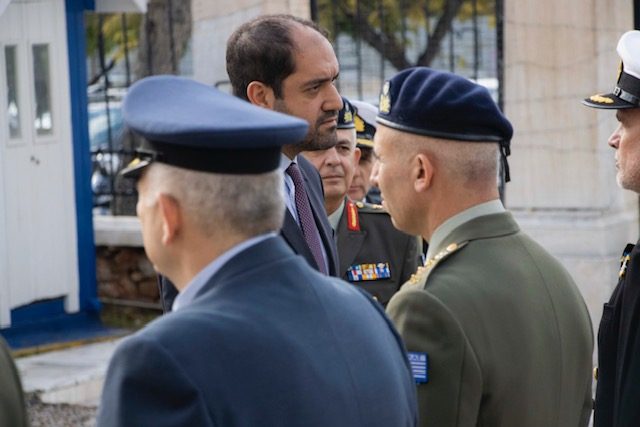
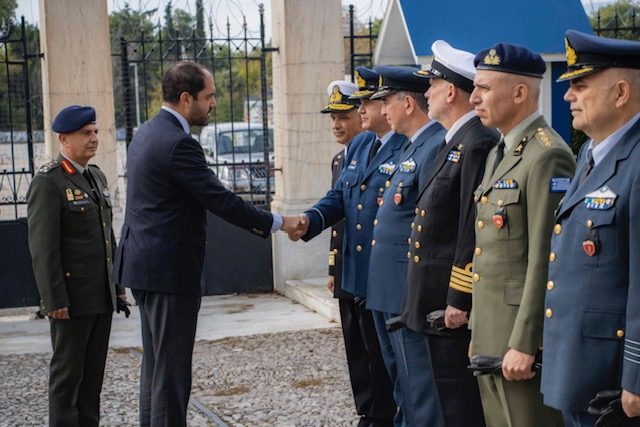
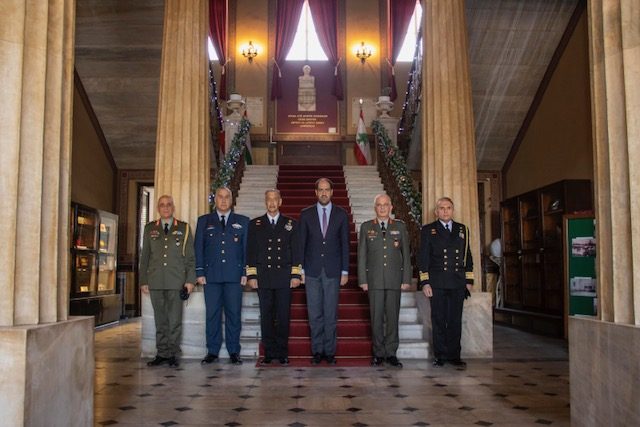
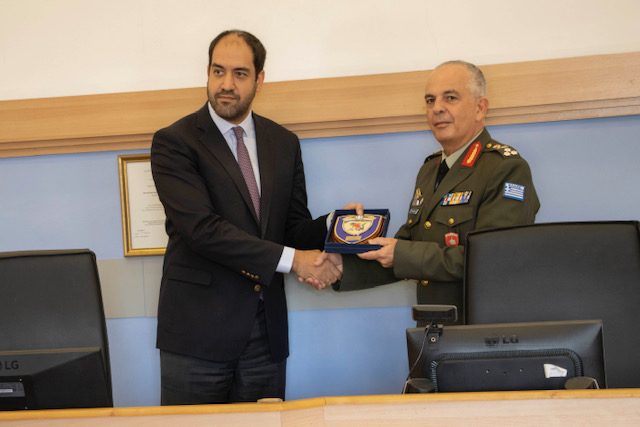
On Monday 11 December 2023, the Deputy Minister of National Defence, Mr Ioannis Kefalogiannis, visited the National Defence College, where he was greeted by the Commandant of the College, Lieutenant General Spiridon Alfantakis, the Director of the B Staff Directorate of the Hellenic National Defence General Staff, Rear Admiral Ioannis Pattas HN, the Deputy Commandant of the National Defence College, Rear Admiral Michail Demestihas HN, and the College’s Director of Studies, Brigadier General (HAF) Dimitrios Bitsis.
Mr Kefalogiannis was briefed on the organisation, mission, education, curricula, and seminars that Officers of the Armed and Security forces, and civilian staff of the Hellenic Public Sector follow, as well as the educational goals and potential development of the College.
In his brief address, the Deputy Minister of National Defence underlined the will of the Ministry’s Political Leadership for further qualitative upgrade of the education offered by the College, in a constantly more complex geopolitical and technological environment. At the same time, he announced a complete pack of measures and policies, aiming at enhancing the outreach potential of the College, mainly through the multiplication of cooperations with similar educational institutions abroad, as well as universities.
In his address the Deputy Minister stated:
“I have the special honour to be at the National Defence College today, at the historic headquarters of the old Hellenic Army Academy (Evelpidon). To be at the last career School that an Officer has to attend in order to be able to handle crucial matters of strategy, national defence, security and defence diplomacy. An academy with traditions and great contribution that is highly-esteemed both within the Armed Forces as well as the rest of the public sector. The mission of the College, apart from providing Officers with specific education, consists of the cooperation among Officers of different services, thus creating a common perception. At the same time, it also supports the building of synergies with the public sector, but also of outreach, as highly-esteemed personnel of public administration are given the chance to study here. It is evident that the requirements a modern Greek General Officer must meet, are directly related to the geopolitical environment, the balance between countries, the alterations in the nature of warfare, but also the development rate of defence technology.
Today, the security challenges in our general region are numerous and completely different than in the past. The unprovoked Russian attack in Ukraine overturned the widespread idea of a peaceful Europe ranging from the Atlantic to the Ural Mountains, thus producing uncertainty and enhancing security dilemmas. We also have to point out that various, mostly non-governmental, perpetrators prefer acting within the grey and uncertain area between peace and war, proceeding in hybrid and terrorist actions. Proxy war, as it is referred to in international bibliography gains momentum by hiding the real perpetrators. At the same time, it becomes possible to launch influence operations that aim at the manipulation of populations. It is also known, that the situation in the Middle East is beginning to run astray, something that creates concern regarding the future security situation in the Eastern Mediterranean, as well as the energy security of Europe. What needs to be co-evaluated in all of the above are the so-called instability factors, such as climate change, pandemics, the uncontrollable increase of population, social disturbances, as well as grand scale disasters. These factors are highly likely to trigger developments which will affect the security environment in our country, even in the case that those occur away from our area of interest. Even the modern field of operations has changed dramatically, as we have dynamically entered the age of multi-domain warfare. The three levels at which war traditionally took place have increased to five, with cyber- and space-warfare playing a determinative role in the conduct and outcome of operations. Additionally, developments in the field of technology impose violent changes in warfare, the character of conflicts, but also the doctrines which characterise them.
In the framework of the aforementioned developments, the role of the Officer, let alone of a General Officer, is crucial, while it becomes evident that their capabilities must not be limited to the field of operations. Indeed, the location of threats, and mainly of upcoming ones, is a painstaking and demanding process, which requires a serious educational background and lots of experience. It is a fact, that the political leadership expects the appropriate suggestions from Officers, so that the defence policy of the country can be determined. Heading towards that direction, the Officer Working Groups, in collaboration with governmental authorities, will evaluate all the available facts, in order to define the nature and scale of threats, and provide the political leadership with their finds. Those facts are not exclusively military of nature, but have to do with bilateral and multilateral relations, finances, social and technological data in the region of our vicinity, and even the consequences of climate change. Based on the conclusions, the Officer will proceed in estimations regarding the nature and scale of the threat, and suggestions about the scale, structure, coordination of forces and the required equipment, in order for the threat to be dealt with. So, it is understandable, that an Officer that is called upon to participate in this multifactorial process, needs to possess a very wide knowledge level, extensive operational experience and deep knowledge of the international environment. At the same time, the Officer that has graduated from the National Defence College will need to exercise defence diplomacy from the positions that they serve in, either in General Staffs or abroad. An activity that requires special skill and deep knowledge of the geopolitical environment, in order to be beneficial for our country. For that reason, the role of the National Defence College is to take advantage of the knowledge background of its students, their operational and staff experience and help them build a strategic way of thinking.
My visit today has a double purpose. On the one hand, to constitute a chance for me to contact and get to know the capabilities, problems and potential of the College. On the other hand, to create a communication channel, which will render the application of reforms easier, which will aim at the qualitative upgrade of the offered education. I have to admit, that the National Defence College has the respect of the political leadership of the Ministry, which aims at its upgrade. In this framework, the following prospects will be attempted, always with the cooperation of the military leadership, the command of the College, and also the students:
- Synergy creation with counterpart colleges from abroad, defence studies colleges, Greek and foreign university institutions, and Centres of Excellence of the Alliance, for the re-evaluation of curricula and the provision of modern knowledge. In this framework, the students of the National Defence College will be able to contact their foreign counterpart and the carrying out of common activities will be enhanced, for the creation of common perception.
-
In any case, the military character of the College must be retained, since its main aim is to contribute in the shaping of a strategic way of thinking. Hence, the cooperation with the General Staffs will be enhanced, in order for the particular characteristics of our area of interest to be taken into account and rendered a subject of research.
-
The continuance of the cooperation with Panteion and Plymouth Universities, for the provision of higher level knowledge and postgraduate degrees in international relationships, applied strategy and international security.
-
Also, some factors should be reviewed and re-evaluated, such as the duration of the studies, the point of on-line studies, the knowledge level, as well as the criteria required for admittance to the programmes.
-
Continuance and enhancement of study capabilities for Officers of the Security Forces and public administration personnel, for the enhancement of outreach and the creation of stable synergies.
-
Examination of whether some subjects can be taught in English.
-
Visits to the General Staffs, counterpart colleges of allied countries, Centres of Excellence and International Organisations, in order for students to be informed about the changes in the security environment and correlations of power.
-
Finally, the successful graduation should be established as criterion for the further development of an Officer, but also as requirement for them to undertake certain duties.
Closing, I would like to congratulate the students for their attempt to develop and improve themselves both strategically and professionally. A particularly commendable attempt, since it requires numerous sacrifices on a personal and family level. I would also like to congratulate the Command of the College for their attempts, so that the study level and the provided services are on a very high level. The instructors, for their eagerness to always be informed about the constant developments in their fields and their attempts to transfer their knowledge to other people. Lastly, the professors of Panteion and Plymouth Universities for the great work of upgrading the knowledge level of the students and providing them with quality education.
Thank you.”