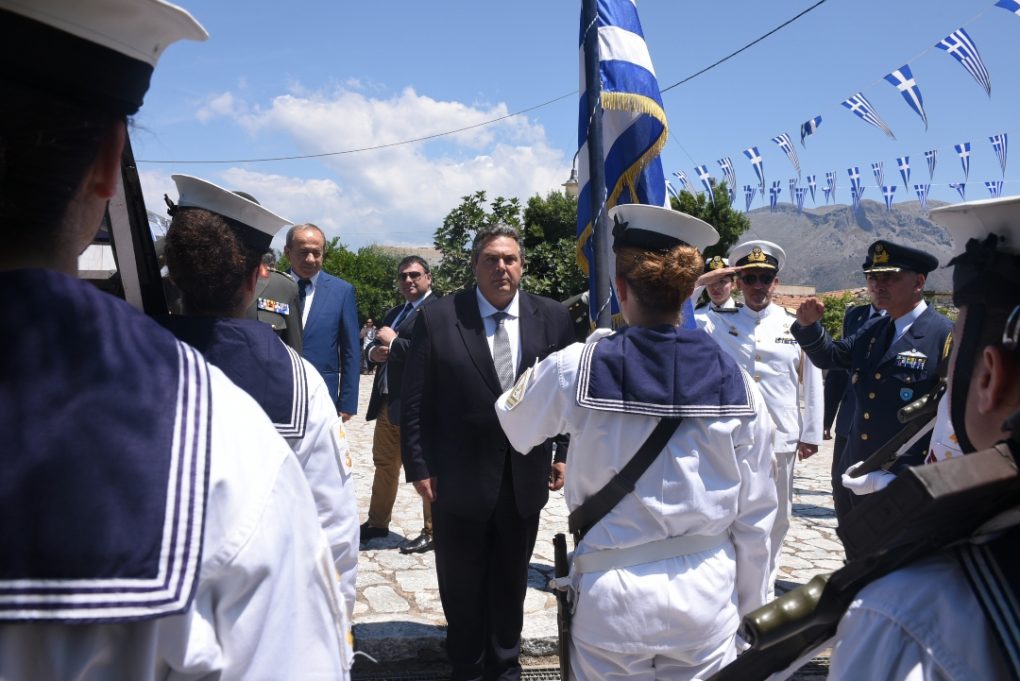
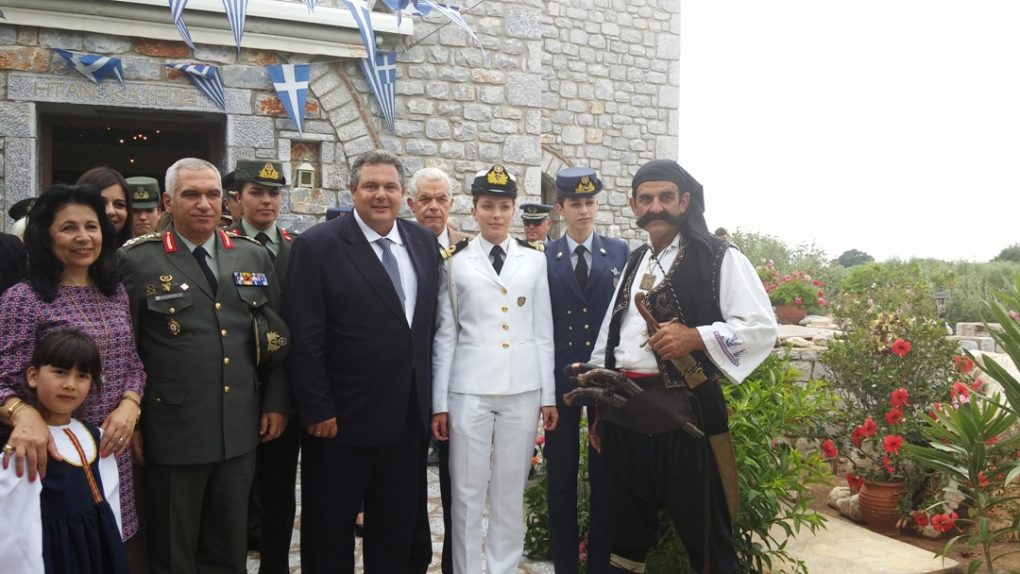
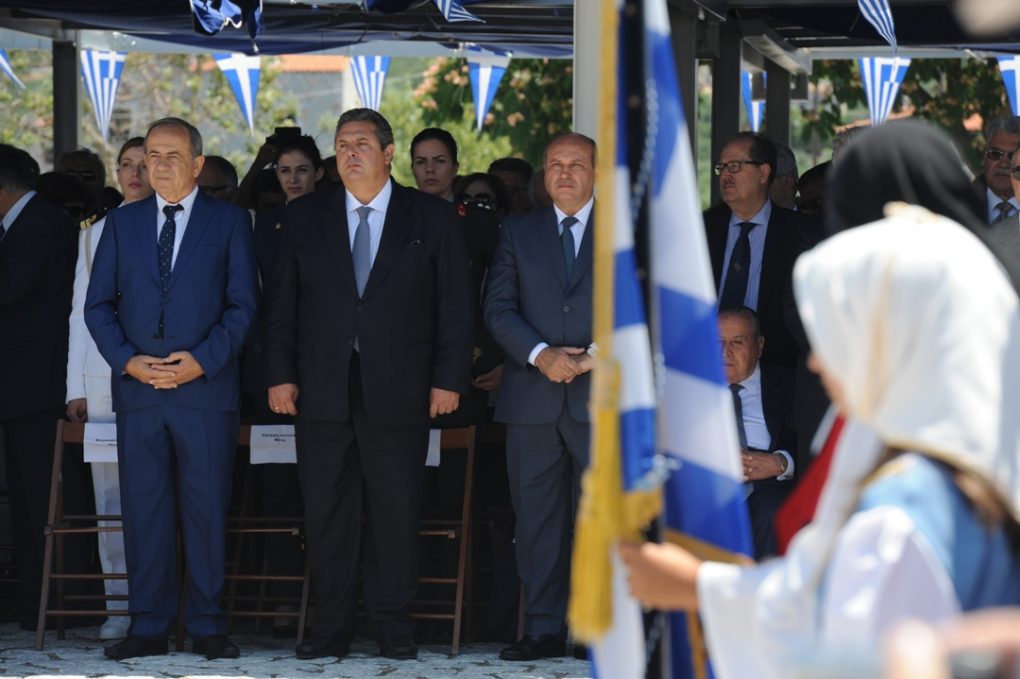
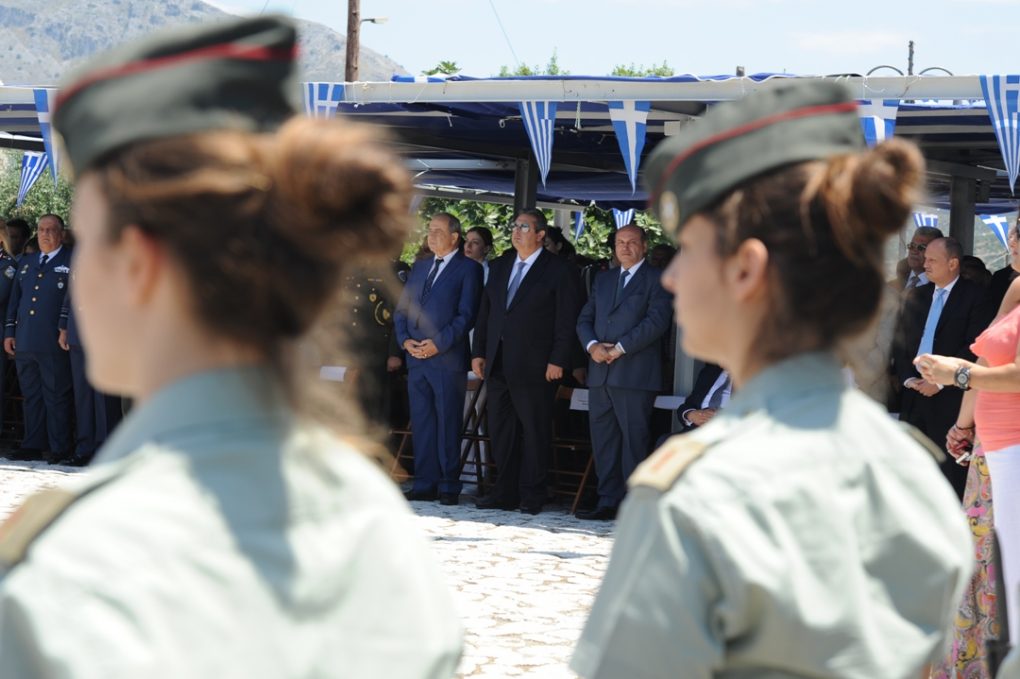
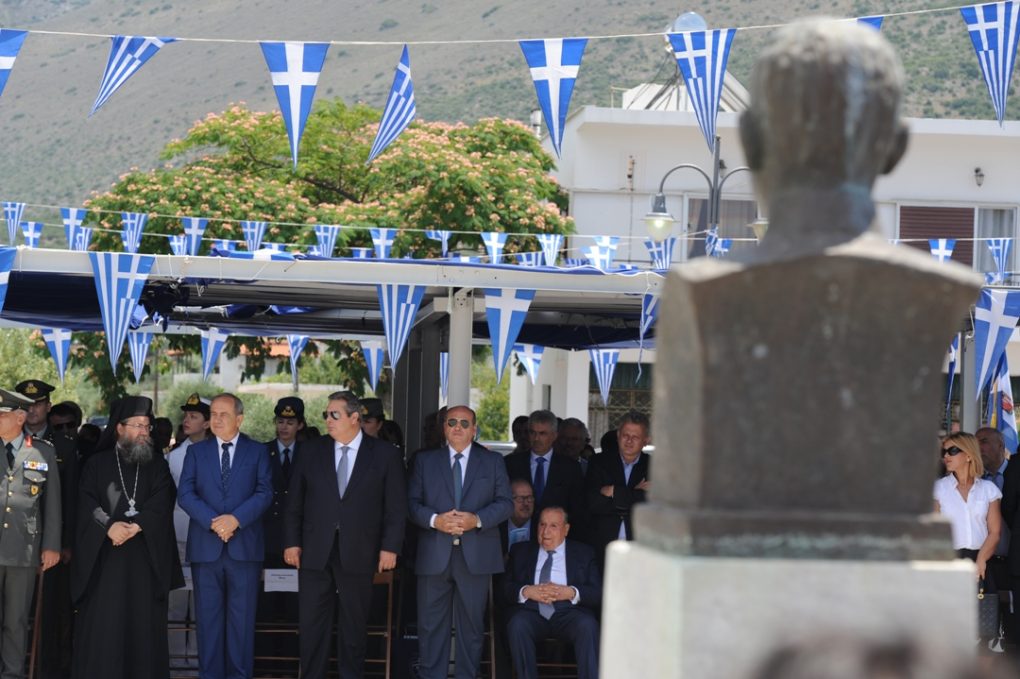
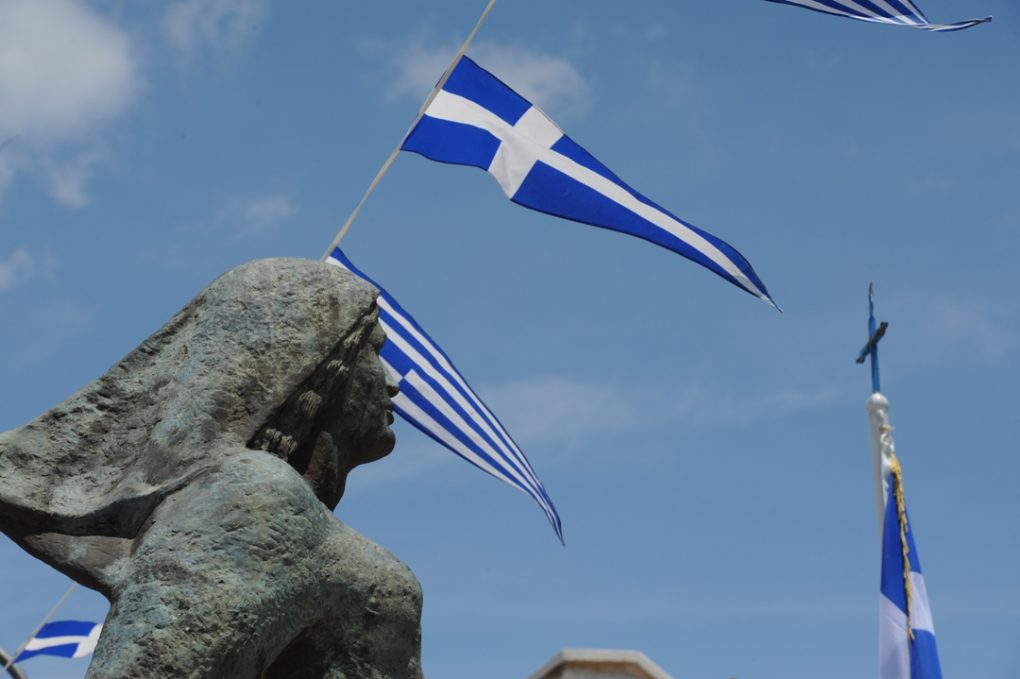
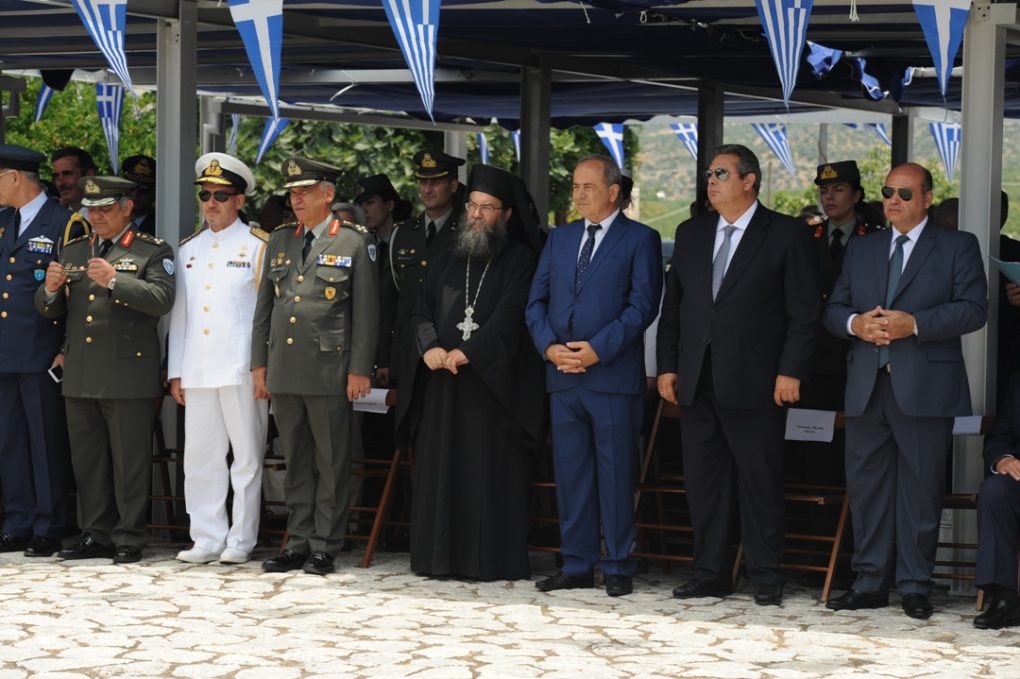
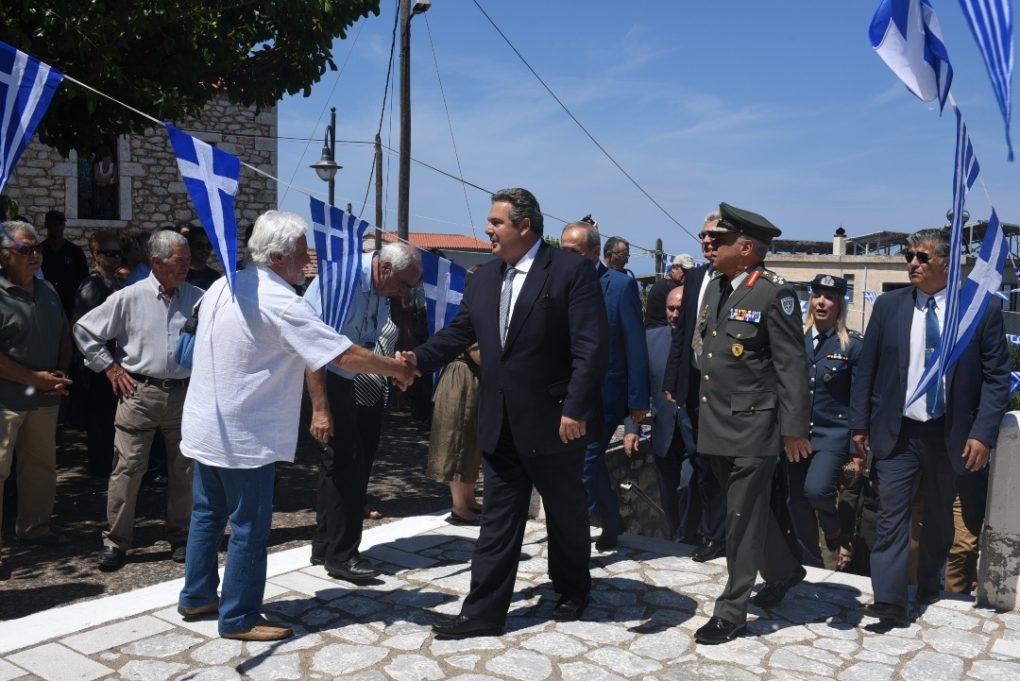
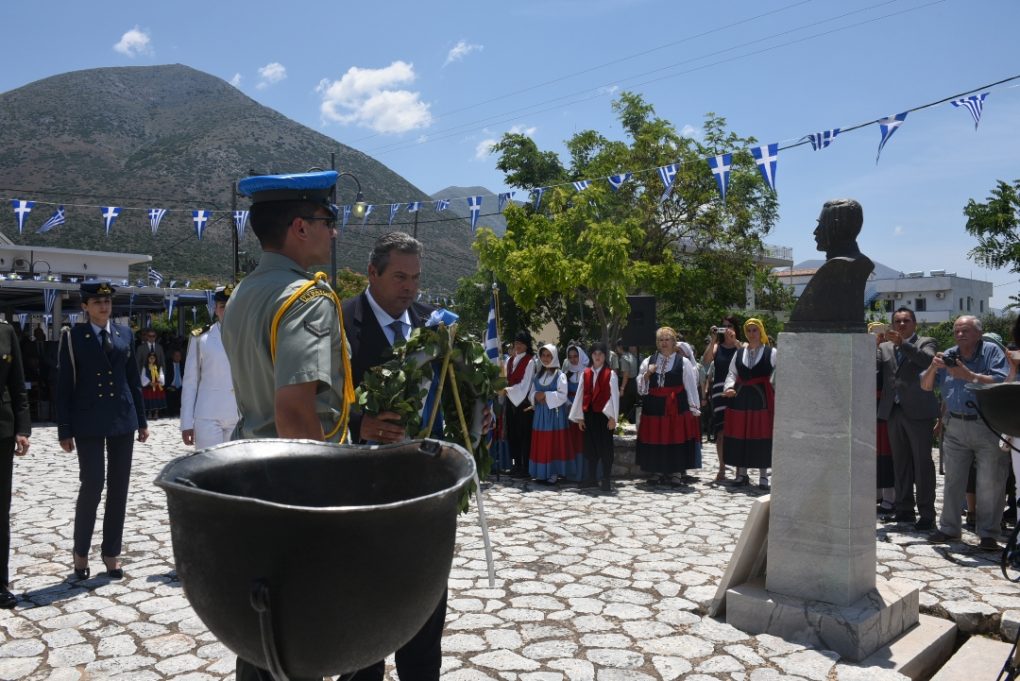
The Minister of National Defence Panos Kammenos, accompanied by the Chief of HNDGS General Michail Kostarakos attended today, Sunday June 28 2015, at Diros, in Mani, the celebration of the 189th anniversary of the homonymous heroic battle, which is characterised as a “Day of All People’s Defence”.
In the context of celebrating and commemorating the participation and heroic action of the women of Mani during the battle of Diros against the troops Ibrahim Pasha, this day is established as the “Greek Women’s Day in the Armed Forces”.
The Minister of National Defence made the following speech:
“Most Reverend delegate of the Right Reverend Metropolitan,
Venerable Fathers,
Chief of the Hellenic National Defence General Staff,
Regional Governor,
Fellow MPs,
Mister Mayor of Eastern Mani,
Dear Mayors attending this great celebration today,
Generals,
Representative of the Speaker of the Hellenic Parliament,
Representatives of the Armed Forces and the Security Corps,
Officers and NCOs, women and men of the Armed Forces and the Security Corps,
We are here today in order to honour the women fighters of Mani. For the first time the Ministry of National Defence, after a proposal made by the Chief of HNDGS and a decision taken by the Joint Chiefs of the General Staff Council, establishes this date as a “Day of All People’s Defence”, to honour all personnel, and the women in the Armed Forces.
For the first time today, the detachments present today at the celebration are the descendants of the women from Sparti and Mani who fought that battle here.
They are honour detachments composed exclusively of women from the Hellenic Army Academy, the Hellenic Naval Academy, the Hellenic Air Force Academy, the Military School of Nursing and the HAF Technical NCO Academy; they are the future leaders of the Armed Forces; equal leaders.
I would like to warmly hank Mr. Mayor for this great honour of inviting me as speaker to this important celebration.
It is a great pleasure to see at today’s meeting of remembrance and honour, familiar and dear faces, with whom I feel connected through mutual appreciation and long friendship.
Ladies and gentlemen,
It is not easy to put into words the traditional and national respect we owe to heroic Mani, to the stories of glory, blood and sacrifice which make this land a holy land.
I will not even attempt to praise them, since the hymn for the women and men of Mani was written by glory, it was set to music by the thousands of songs that carry their values and symbols from generation to generation and it was composed by history itself.
Besides, what would I add speaking for the Women and Men who raised the fame, the prestige and the glory of Mani, Verga, Poliaravas, Diros, Kastania, Mothokorona, Androuvista, Kitries, Vrontamas, Peta, Kremmasti, Tsesfina and the entire region of Mani.
How would I describe the awe we feel for those unarmed women we honour today who, in defiance of the innate desire to live, chose to die with honour, holding the reaphook in their arms , than to see and experience the disgrace of themselves, their children and their country.
All around and above this celebration the women fighters, such as Gerakari, Maria Venetsanaki, Panoria Voziki, Ioanna Giatrakou, Polixeni Kavakou, Dimitrakena, Pikolakena, Savvena, Xaharia, Patsourakena and all those women of Mani who gave here their fight and their example on fighting and winning, look at us; it is not by chance that in this region, the Greek Revolution was “victory or death”.
I often wonder if we have realised what we really owe to all these women. The complaint that this voluntary sacrifice here in Diros, at Mani, and the Greek woman’s fights in the course of history have not been perceived as a “sacred obligation” by the Hellenic State and they have not received the owed historical justification and national recognition, is often justified.
189 years after the heroic battle of Diros, I stand before you, in view of the words of the poet Andreas Kalvos: “Let those who feel heavy the cupreous hand of fear be under slavery; freedom needs virtue and mettle”.
The importance of the threefold legendary victory and the debacle of Ibrahim was a key military fact, which was fated to be determinative for the revival of the Hellenic Nation and the creation of Independent Greece. If the earth of Mani had not prepared first the tomb of Ibrahim, the sea of Navarino would not have engulfed him.
The victory came at a time when the fight was almost lost due to internal discords which deteriorated the troops and bent the warriors’ morale; however, they did not affect the morale of the women fighters, the women of Mani who managed, armed with their willpower and some reaphooks, to turn away Ibrahim’s army, restoring the fighters’ hopes and faith.
The lyrical words of the great historian, writer and scholar Dionissios Kokkinos are characteristic: “All those written for the women of Mani who run to the battle holding only reaphooks, clubs and rocks instead of weapons, surpass imagination; they are inconceivable as far as war glory is concerned. Mani provided us with new Amazons”.
These women fought armed with their brains, their souls and their hearts, they did not think as mothers, housewives or wives. They defied the risk and sacrificed their nature. They fought as true Greek women.
In every part of Greece that resisted, rose in revolt and fought armed or unarmed, body to body, there were Greek women who were tormented by the adversities and shortages caused by the foreign yoke. There were women who used everything they could find as weapons and took part in difficult and deadly combats, yet sacred and fair combats.
Those unknown women, of the Revolution, of the German occupation, of all the golden combats across the Greek history, they wrote their own brilliant history in every corner of our homeland.
Women, whose mind and heart strongly believed that they had the right to live free.
I consider myself lucky because I can every day confirm – what I always believed – that the Hellenic Armed Forces are an example worth to be followed.
I am among excellent personnel of the Armed Forces and among Greek women who do not just wear a uniform and insignia. They are women who deservedly won the role of fighter, who learnt how to defend themselves, how to fight and sacrifice their lives for their land if necessary.
They are trained, they are tested, and they exercise themselves during their careers in an equal manner, so that they have an operational and strategic perception, as well as a historical perception because, as we all know, history includes everything.
History seems like another “umbilical cord” that breeds us, connects us with fact which today may be indicated as solutions and become examples that we can follow. It can remind us that Greeks can win even when they are outnumbered or when their only weapons are stones and reaping hooks. It shows us that when in trouble Greeks put their disputes aside and they win.
Mani and its residents are a characteristic example of this. And I will agree with those who state that “people in Mani may be “stubborn” and hold grudges, yet nobody can deny that Mani never existed only for itself. Mani existed for the whole Greek nation”. There you find its people ready to help, wherever there is such need, wherever their country needs them.
At this point, I wish to tell you that after so many years in politics, following a certain course and principles, having expressed my views about the notion of country and about the religion and ideals and beliefs of this land, I have thought many times to give a definition of a national state. Today, here, in Mani, I would dare to say that a state exists mainly within the hearts and souls of its people. If its people do not believe that the state is present, that it exists, there are no political or diplomatic leverages, no military operations which can create or maintain it.
But, in parallel, there is no new order that can strike these war flags which are covered with blood, in the name of globalization. There is no new order that can make us surrender our country, our national sovereignty and our territorial integrity.
We are a small nation who lived under a yoke over centuries and many times had to face a disaster. But we always managed to stand alive and turn our tragedy into a resurgence and creation. Because we love and care about this land. Because this is what Greeks were taught by their ancestors, by mother, like the ones who fought here, in Diros, from our long tradition. What did they show us and what did they teach us? If anybody threatened their ideals, then they rose against him and they rebelled and won. And this struggle is morally acceptable, because it is a fair struggle, a combat of survival against the barbarians.
In the presence of the Deputy Chief of the Hellenic Navy, I wish to remind that it was amidst and after a financial crisis that Admiral Kountouriotis liberated the island of Eastern Aegean on his legendary vessel “Averof”.
The battle of Diros is one of the most significant examples of the same love, the same self-denial that saved our nation and land from certain annihilation.
The battle of Diros shows the hidden strength that our citizens may have and it is one of the most important examples of civil defence.
Mr. Mayor,
Dear citizens of this proud town,
I feel particularly touched for the decision that was made: to proclaim officially the anniversary of the big battle that was given not by soldiers, but by civilians, by women in Diros, as a day of Civil Defence, a day of honour to the women of the Armed Forces. From this year on, and every year this day will be recorded in history.
Civil Defence is based on earnestness, passion and the use of human mind for survival. Plain citizens turn into leaders, protectors, worthy assistants of the Armed Forces, contributing to their work.
In our need to anticipate the developments, to reinforce citizens’ sense of security it is essential for everybody to participate in our country’s defence. We must always be ready to manage a crisis or a tense situation; to believe in our strength and turn it into Defence, into Civil Defence.
There are so many examples in modern history in which civilians had to be active and ready for any case.
“Threat” is not a term that should frighten us. It should not frighten Greek people; as long as we are ready. This is what our history asks for; this is what our geostrategic and geographical position requires. We need training on how we must react, respond and how not to get caught unprepared.
Yet, over the last years, the gradual shift in the organization of the army towards a more semi-professional model and the depreciation of the reserve and of the mobilization system led civil defence too to an absolute idleness.
We bring the Reserve back to the front line of our Armed Forces. We bring Civil Defence back as an agent of reaction.
The importance of the Civil Defence, Civil mobilization – no matter what term one may use – is huge and its force is the civilians.
From the first moment that I took office as Minister of National Defence, we began, along with the military leadership, to engage the National Guard, starting from the National Guard of Evros and Dodekanisa regions. We tried to involve them in all exercises and parades. We will do the same with the Reserve and with new structures that we build, such as “DIDERGON”, which has left a work here unfinished, a work that regards this region. We will give young people who serve their service, the possibility to remain in the army for two or three years and gain professional experience.
We want the Greek people and the Armed Forces, in a democratic country, to cooperate closely, not only in war time, but in peace time as well.
It is government’s decision to bring people closer to the armed Forces. Greek people and the Armed Forces are inseparable.
Greece possesses a very well structured National Defence system. This is undoubted, but if the population is active too, this can create a strategic miracle and reverse the course of a battle.
Those who are responsible for Civil Defence have to implement an extremely difficult mission.
I personally trust the own initiative action taken by people and groups.
This is why I believe that everything is possible by reinforcing the role of Civil Defence, by reinforcing the fundaments of the structure that is called Defence and Civil Defence. As an example, I am giving the self-sacrifice of the women of Mani and their victory. I want you to know that these sacrifices define also our national strategy. What is this? It is the one that was defined by the unknown woman of Mani: “Tell him to sit there and guard the frontier”.
This woman’s order is also an order to us; to guard the frontier. This is where our doctrines are based on; this is how we train our skilful personnel. And the border is not just a geographical notion, it is mostly a moral, spiritual and historic notion.
I wish everybody health, strength and prosperity. I wish Virgin Mary and the Patron Saints of our Armed Forces, Saint George, Saint Barbara, Saint Nicholas and the Archangels to stand by you, women of the Armed Forces, who honour us today with your presence and who honour the Armed Forces with your participation.
Allow us to remind you that, here, where Greek women proved that the women of Mani were the continuators of the Spartan women, you too are the continuators of the female fighters of Diros.
Thank you very much.”