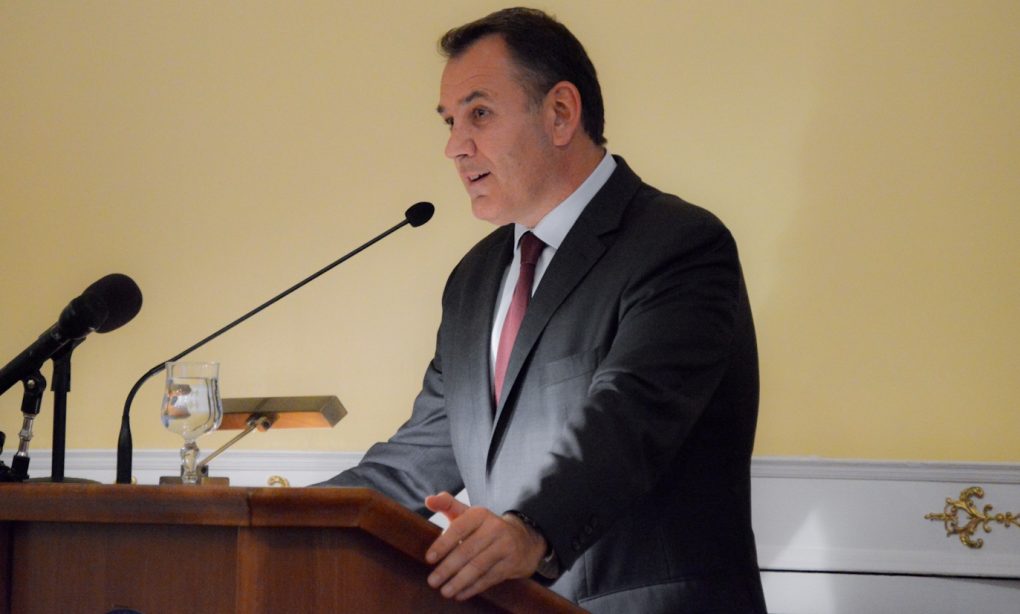
D. KOTTARIDIS: We have the Minister of National Defence, Mr. Nikos Panagiotopoulos on the phone, who was present at the meetings yesterday, and participated in the bilateral contacts. Good evening to you all, good morning Mr. Panagiotopoulos.
N. PANAGIOTOPOULOS: Good morning Greece. Here it is almost midnight; we are at a different time zone, at the end of a very long day. Tomorrow, one more meeting will follow, since contacts have been made with the Committee on Foreign Relations of the US Senate, and with the Congress; both are key branches of the United States’ governing system. Today, we held a meeting with the President of the United States, the main and leading branch of the Government, preceded by an exceptional discussion with the Atlantic Council.
Afterwards, the two delegations met, following the private meeting of the two Leaders. During President Trump’s discussion with Prime Minister Kyriakos Mitsotakis, we -the other members of the delegation- had a great opportunity to discuss with our counterparts, with actors of the White House, officials who are close to President Trump, members of the US National Security Council and policymakers of the current Government under President Trump.
G. PITTARAS: Mr. Minister, did we manage to get the support we wanted, after this visit to the US President? We all heard the statements, at least as they were transmitted live. The thing is, behind the closed doors, is your feeling after the meetings that we have a strong ally by our side, with everything that is happening in our region, in our neighbourhood, and involve Turkey?
N. PANAGIOTOPOULOS: My feeling is that the meeting went as good as possible, given the difficult circumstances, since the President was rather focused on what is happening with Iraq. A few hours later, we had that development with the attack against an American target in Iraq. Therefore, you can understand that we had to meet, and the Prime Minister had to discuss with him, under these conditions. We got the support from the President of the United States, and the positive view that something very good is happening in Greece and it is something that gets recognised. Even if many could be said, that man definitely knows about economy and the financial situation, and he gave credit to the Greek economy. It was important to see his reaction every time the Prime Minister mentioned that the stock exchange is doing great and that the stock prices are going up. It was the point when Trump’s expression showed that he understood a lot. Therefore, the strategic relationship between the United States and Greece was reaffirmed; henceforth, our goal is to broaden this relationship with investments, defence cooperation and many more.
D. KOTTARIDIS: I guess that Mr. Trump was content to see that we start a discussion and proceed to an agreement on armaments, the F-16 upgrade and the F-35 purchase…
N. PANAGIOTOPOULOS: The contract regarding the F-16 Viper upgrade is already underway. What we need to do now is to implement it practically, through the Hellenic Aerospace Industry.
The upgrade of the Hellenic Aerospace Industry will be the vehicle that will allow, more than the F-16 upgrade, the support for the 5th generation aircraft that Greece will acquire sooner or later, as sure as night follows day. Yes, we have discussed on the prospect of the F-35 purchase, given that the financial circumstances will allow it. This is what we could say, given that the perspectives for the Greek economy will improve. Naturally, it was a point that captured the US President’s interest.
I was impressed by the questions he asked concerning the F-35, as well as the F-16 upgrade. I had to join in and reply, giving him very specific answers on this programme and what it means to us. He seemed to comprehend that this is more than a financial transaction; it is an element that is integrated in the broader strategic relation between the two countries.
G. PITTARAS: Mr. Minister, besides combat aircraft – whether that concerned the F-16 or the F-35 – did you also discuss on the prospect of enhancing the Hellenic Navy, our fleet, with US frigates?
N. PANAGIOTOPOULOS: In the context of the discussions with President Trump, we only referred to aircraft, as far as our armaments are concerned. Other than that, we had an overall discussion with officials of the US Government, among which the leadership of the US Department of Defence, on matters concerning the enhancement of the Greek Armed Forces with US weapons, either by sales of US defence materiel, or by transfer of excess defence materiel which is no longer used by the US Armed Forces; we agreed that individual proposals, which are known to the American side and are also being processed by the Greek side, will be further discussed in the future with more details.
The President of the United States did not get technical about every issue, yet he showed interest in this crucial programme which will upgrade the Hellenic Air Force with US aircraft.
D. KOTTARIDIS: Mister Minister, one last thing. We expected a comment from Mr. Trump regarding the agreement between Ankara and Libya. Mr. Trump repeated the US position that is opposing to this agreement. Is there an estimate that Mr. Trump will either mediate, or push Ankara to not proceed with this agreement, or at least express a clearer position on this issue?
N. PANAGIOTOPOULOS: My feeling is that President Trump and the members of his team will move towards providing good services so as to deescalate the tension between Greece and Turkey, with everything that implies.
I believe that they understand Greece’s concerns; they understand Greece’s determination for a dynamic answer in case the basic Greek sovereign rights get further questioned by Turkey. I think it was something made very clear by us to the US officials.
I assume they can reach the Turkish side by different communication channels, so as to make it clear to them that escalation is not to anybody’s interest.
G. PITTARAS: In order to conclude, could you comment on what has happened since this dawn – Greece’s time – until now, in the area of Iran and the retaliation by the Iranian Government, which hit US targets?
N. PANAGIOTOPOULOS: I will simply say that the reason the bilateral meetings ended was that President Trump, as he explicitly explained, had to leave so as to work on the issue with Iran. After 45 minutes he left, as he had to carry on working towards managing this situation. Naturally, such developments create concern. Naturally, further escalation would be undesirable; nobody wants strikes which might put human lives in danger. I believe that Iran’s latest activity might be the escalation that will lead to de-escalation. I believe that this is where this issue will end, with this counterstroke; yet, this situation causes concern as we are in the area of interest which lies at the western frontier line to the Middle East. Obviously, we should be alert and observant.