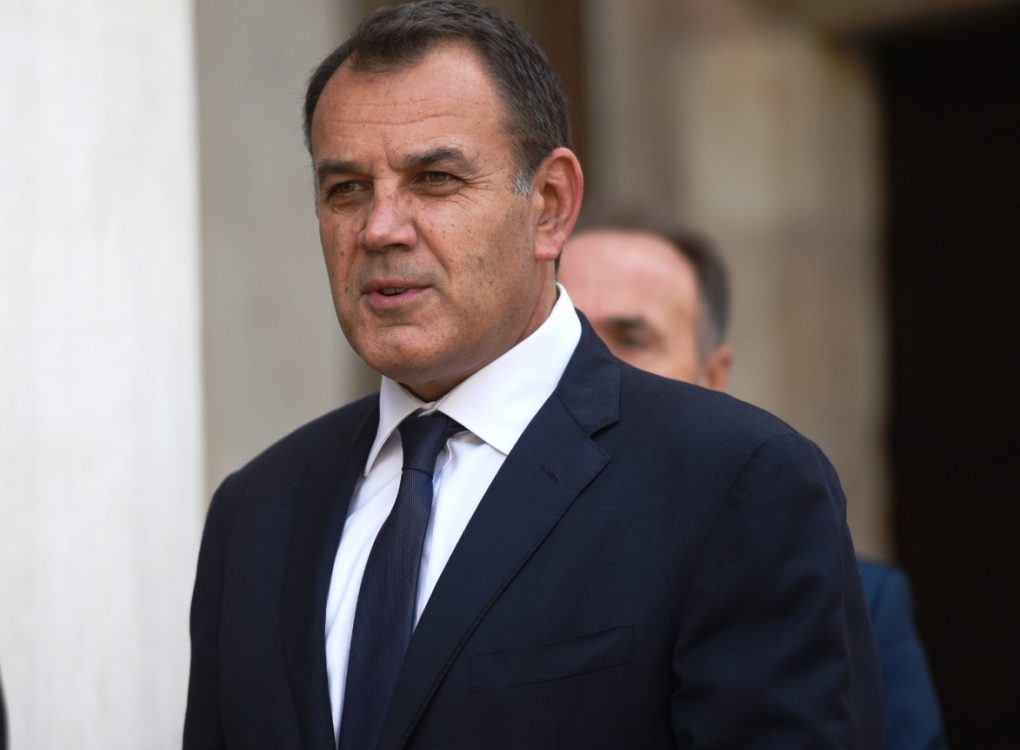
Giorgos Papadakis: You gave a clear message: “An area in threat cannot be demilitarised”.
Nikolaos Panagiotopoulos: Yes. I would say that it was rather laconic. Of course, the official answer was that of the Ministry of Foreign Affairs. Among others it said that this stance is exceptionally hypocritical. Appealing, on one hand, to the International Law, based on which 16 islands must be demilitarised, according to Turkey’s Minister of Defence Mr Akar. But on the other hand, violating, as a country, the International Law and the international legality numerous times. I was more laconic. I believe that such is the state of things and I spoke exactly as you described.
Giorgos Papadakis: You also mentioned something else yesterday In Kozani. You said that if we consider the “red lines” crossed, then we will examine all scenarios, including that of military engagement. Of course, we wouldn’t ask you to give us the plans of the Ministry of National Defence and of the Hellenic Government in detail.
Nikolaos Panagiotopoulos: There would be no point in such a discussion.
Giorgos Papadakis: These things cannot be discussed on live television.
Nikolaos Panagiotopoulos: I think that what I said is self-evident. The Prime Minister has also said it towards any direction. I believe that it is the duty of the organised Hellenic State and Political Leadership to clearly state that there are “red lines” and if they are crossed and vital sovereign rights of the country are negatively affected, then the country has got to react. It goes without saying that it shouldn’t stand carefree and idle.
In this context, all scenarios are examined, beginning naturally from diplomatic actions. One of these scenarios is that of military engagement. It is so simple. It doesn’t mean that this is the only and absolute way forward. We all hope that we will not resolve to such a solution. And that is the meaning of deterrence. However, we must state the existence of such an option.
G. Grigoriadis: Minister, is that scenario ready? I don’t want you to give us any details, just tell us if it is ready.
Nikolaos Panagiotopoulos: This isn’t a personal matter. The duty of the Armed Forces is to stand ready whenever the need arises. That is what they are doing and their effort is never-ending.
Like I said, it is everyone’s hope that the need will not arise. There are always problems in that stage of preparation in order for all the systems to be functional. There will always be problems. We will never be prefect regarding everything and everyone’s functional readiness at 100%.
However, this effort is conducted with consistency and professionalism by the Leadership of the Armed Forces, under our orders. That is their duty and they are fulfilling it successfully. They have been trained and they have this sense of duty which guides them to accomplish their mission.
Giorgos Papadakis: Minister, it was at a time like this when 24 years ago two journalist of “Hurriyet” landed on Imia from a helicopter. They then lowered the Greek flag. We broadcasted the video so that the public can remember that challenge which resulted in the tragic loss of two Lieutenants, Panagiotis Vlachakos and Christodoulos Karathanasis and the Chief Petty Officer Ektoras Gialopsos, on 31 January 1996, a few days from today.
Nikolaos Panagiotopoulos: Exactly. And it would be wise to avoid such actions which ignite tensions, if you will.
Greece then mourned for the loss of three members of our Armed Forces, in the line of duty, but it was also then that the issue of the “grey zones” in the Aegean emerged.
Like I said, we are dealing with these issues, throughout the array of Greco-Turkish relations, with composure and caution, but at the same time with decisiveness.