
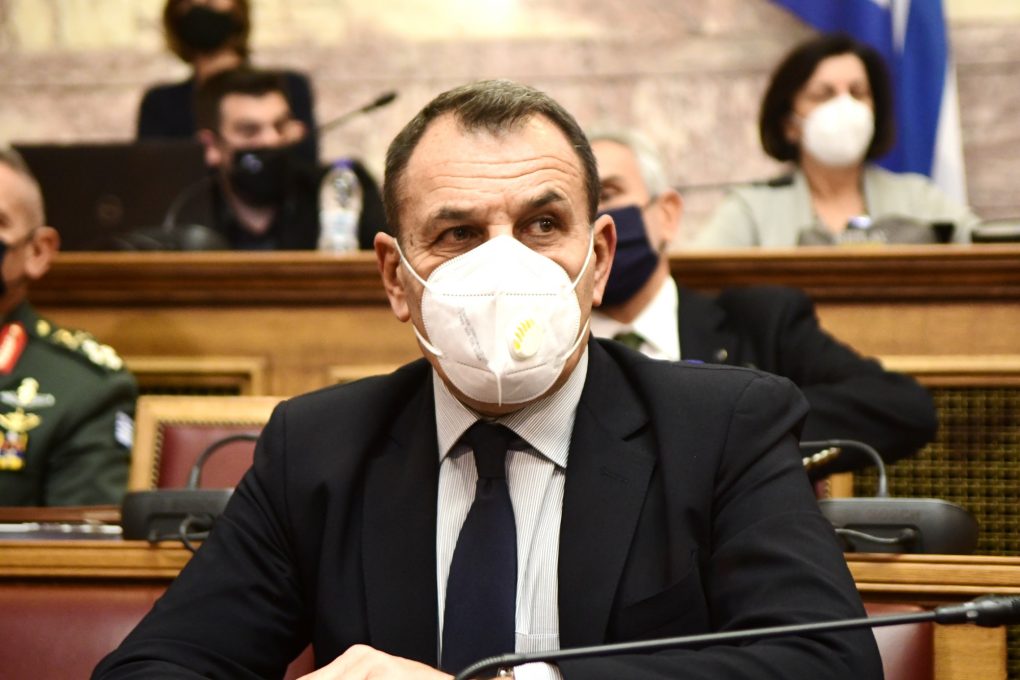
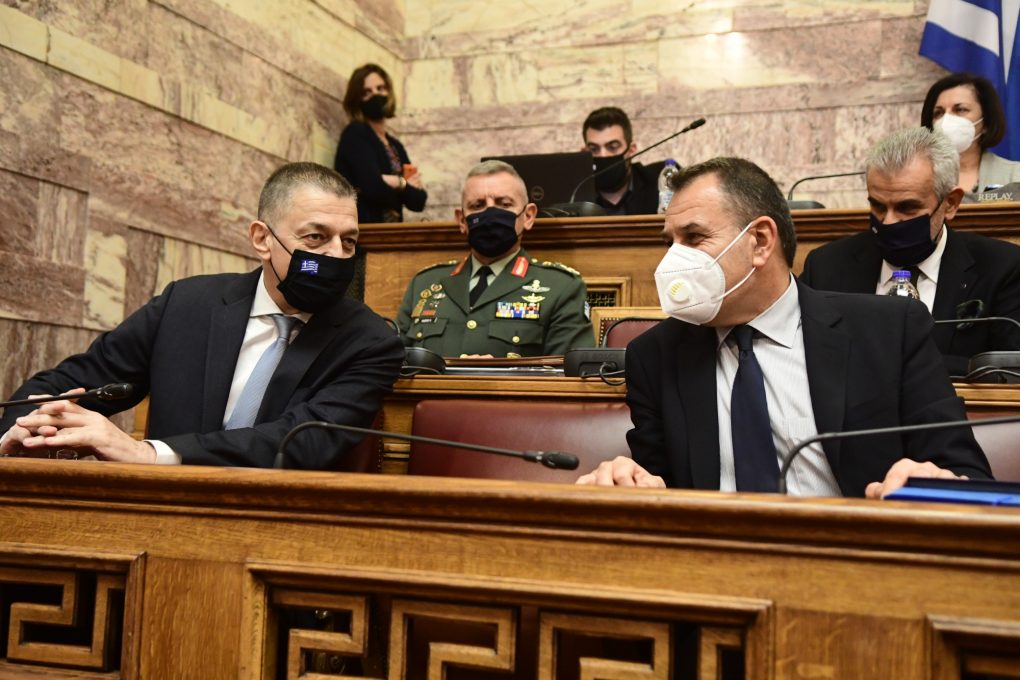
On Tuesday, 12 January 2021, the Minister of National Defence Mr. Nikolaos Panagiotopoulos stated the following during the presentation of the Bill “Approval of draft contracts in the area of Defence” to the Standing Committee for Foreign Affairs and Defence:
“These matters, we also explained them during the Committee on Armament Programs & Contracts meeting on 17 December where most fellow MPs were present and there was an extensive and in–depth discussion concerning the procurement of the ‘Rafale’ aircraft.
We think that this bill must be brought to Parliament under the urgent procedure, since it is urgent to upgrade the fighting capability and deterrent power of the Armed Forces, especially at a time characterised by tension and crisis with our neighbours. This was the justification to proceed rapidly to the acquisition of the eighteen aircraft. The roadmap for this procedure was extensively explained, i.e. the fact that the Armaments Committee of 17 December was intended as an extensive briefing on the substance concerning the acquisition of the aircraft. It was not intended as a subprogramme approval. I explained that clearly.
With the new year we would proceed, as we do today with the resumption of Parliamentary proceedings, to introduce to Parliament for voting the bill that constitutes the regulatory framework of this procurement. I.e. the three contracts that essentially comprise this procurement for the aircraft, their weapons, and follow–on support.
I understand the objections of some fellow MPs concerning the submission of the bill for approval of the three draft contracts yesterday. I understand that time is short, but – and I think we all agree – these legislative initiatives are urgent by nature and we can not afford to lose more time. I think we understand this, as well as the reasons of national interest for which we must rush. At least that was the focus of our effort and I am talking about a concerted effort at the level of Political and Military Leadership.
It couldn’t have been done otherwise, to complete essentially just four months after the start of the discussions three complex contracts, in terms of negotiations and final formulation, for the acquisition of these weapon systems which are certainly necessary and game–changing in terms of power, concerning the area and the balance of air power between Greece and Turkey.
I think that the conditions are met to discuss this bill under the urgent procedure. In December I referred to very urgent procedures, but these procedures, to which I do not object, will provide an additional opportunity for even more extensive discussion, since the procedure in the Committees includes three discussions until the Plenary Session on Thursday. So I think that there is time to examine the contracts which include a lot of technical information, much of which is confidential.
I would like to remind that we made the contracts available to the Hellenic Parliament in digital format last week, although the bill had not yet been finalised. But the contracts did come, hence they were made available to all fellow MPs and, of course, there is today and tomorrow for even more extensive scrutiny, despite the undoubtedly short time and time difficulties.
Given everything I described, I think the conditions for the urgent procedure are met and it would be good to proceed to the discussion; besides, once again, as they also were during the discussion in December, the relevant members of the Military Leadership are here to provide explanations for any question that may arise, particularly concerning technical matters. Despite the fact that many answers were provided, and I am sure that the fellow MPs remember, on these matters during the discussion in December”.
In his main address, Mr. Nikolaos Panagiotopoulos stressed the following:
“Ladies and Gentlemen, Members of Parliament,
first of all, allow me to extend once again to you my wishes for a happy New Year, strength to all, and good and productive legislative work. Allow me to say before my main address in principle on this Bill that it is reasonable that there have been some objections, which however were resolved in good spirit by all parties of the procedure.
It is reasonable because the approval procedure for this bill is fairly complex. It must combine effectiveness and transparency, speed, a goal that was achieved, as well as adherence to Parliamentary procedure. It certainly has to do with the Committee on Armament Programs, which, however, was briefed on 17 December not for a subprogramme approval, but on our intention to introduce a Bill, i.e. these three contracts, placing them in this institutional shell in order to become acceptable, given the deviations, as well as to provide comprehensive and in-depth information on the substance of the bill, i.e. what exactly the acquisition of the “Rafale” aircraft is about, and bring this matter today to the meeting of the Committee for Foreign Affairs and Defence.
I understand that the Parliament is not used to this kind of speed and tempo. It is certainly unusual. Furthermore, it is perhaps even more unusual in the case of the approval of great armament programs. It has been a long time since the Greek society last came before such a matter, let alone the Members of Parliament, but these things happen.
Allow me to add a few more points. Ms. Sakorafa left, but I’d like to say for her to know that the confidential parts of the contracts are available to the party representatives. They are available, they only have to contact the relevant competent authority of the Parliament, regardless of what we will say tomorrow during the closed session of the committee, when we will provide a few explanations on technical matters, matters of cost, etc., as we defined. However, any party representative can have access to the confidential parts in order to find answers to their questions.
The discussion on military service is also something that we will deal with in the future. But not at this point. We will come with a proposal, which is currently considered by the Political and Military Leadership. Of course we will provide solutions in this area too, but this is another discussion.
We will deal with this matter too, just as we did with many other matters during these 18 months, just as we arranged for the upgrade of the eighty-four F-16 aircraft to the Viper configuration. That was a stagnant matter, which was restarted and is now in progress. Just as we arranged for the follow-on support for the Mirage 2000-5 aircraft, which were almost at the point of being completely grounded due to the lack of spare parts since 2012. We also arranged for and brought before the Committee on Armament Programs for approval the follow-on support for our transport aircraft fleet, the C-27 and C-130. Now follow-on support will start running after a long time of inactivity.
We also arranged for the completion of the two Fast Patrol Boats at “Elefsis Shipyards”. I hope that our efforts for a new day for this productive shipbuilding plant, which constitutes a main element of our defence industry, succeed. But this is another matter, not a matter of the Ministry of National Defence. We just removed the obstacles for the completion of the two Fast Patrol Boats. One has already been delivered to the Hellenic Navy. A few final works remain, mainly on command and battle systems and weapons. The building of the seventh (and final) one is also well underway, and there is more to come. But this was also arranged, as were many others, and that is no small feat.
But today is another, I would say more important, day for the Armed Forces. A day when, somewhat symbolically, diplomacy goes hand in hand with deterrence. Just before, the Committee for Foreign Affairs and Defence met to work on the Ministry of Foreign Affairs’s Bill on the extension of the country’s territorial waters and immediately afterwards we will meet as Committee for Foreign Affairs and Defence again to discuss the procurement of the ‘Rafale’ aircraft.
The Hellenic Armed Forces are called to play a very critical and demanding role protecting our country’s national independence and territorial integrity, as well as ensuring stability in the broader East Mediterranean region, leaving a heavy footprint of their deterrent power.
The deterrent power of the Armed Forces consists, on one hand, in the power of its arms and, on the other hand, in the quality of their force multiplier, which is none other than its personnel. The effort to enhance the Armed Forces’ combat power and deterrent capability is a continuous and intensive one. It is now becoming imperative, in view of the current geopolitical situation with the multiple and complex security challenges in our broader environment, but mainly given the provocative, revisionist, and illegal behaviour of Turkey, which directly challenges our sovereign rights and threatens peace and stability in the East Mediterranean.
So the framework of this continuous and intensive effort, taking into consideration the proclamations of the Prime Minister from the Thessaloniki International Fair in September, based on the requirements of the current Force Structure 2015-2027 and the soon to be approved Force Structure 2020-2034 (which, I would like to remind, the Armaments Committee approved two months ago), and of course based on the overall organised, prioritised, and costed plan prepared and implemented concerning the country’s armaments, provides, among others, for the acquisition of forty modern fighters for the Air Force by 2025. Forty modern fighters overall! So based on these, we decided the procurement of the ‘Rafale’ in the ‘F3R’ configuration, the most advanced for this modern aircraft, whose special characteristics and weapons power clearly tip the scales in favour of our Air Force in the field, i.e. the Aegean and East Mediterranean, as well as shift the overall air power balance between Greece and Turkey.
Why we chose the ‘Rafale’: I can’t say much on the technical characteristics, some of which are confidential information. We could say more at the closed session, but what I can say is that the ‘Rafale’ by ‘Dassault’ is one of the most advanced modern aircraft, considered a 4+ generation fighter, and constitutes a platform with technological innovations that enable it to deal quickly and effectively with any mission across the Hellenic airspace, as well as in the East Mediterranean, carry out operations against technologically advanced adversaries, in a complex and threat-saturated battlefield. The above are achieved through information fusion and display to the pilot by all its systems, among which the well-known ‘Link16’, which also enables cooperation with the existing fleet, among other the F-16.
The aircraft to be procured are of the ‘F3R‘ configuration, the latest and most advanced version of the ‘Rafale‘ currently rolling out of the manufacturer‘s production line since early 2020. Among others, the ‘Rafale’ is equipped with an active electronically scanned array (AESA) radar, which detects, tracks, targets, and guides missiles against multiple targets. It also has a comprehensive self-protection system with five subsystems that warn, designate, jam, and protect against any potential threat and provide early warning to the pilot for incoming missiles. Of course, what makes this procurement ‘package’ attractive is the fact that these enhanced operational capabilities of the ‘Rafale’ is closely connected to the use of these weapons.
It is a ‘comprehensive approach’, because we are talking about the procurement of the platform of eighteen aircraft together with follow-on support, because it is not enough to only have the initial support in order to be delivered, deployed and supported during these stages in Greece. We also have to deal with their support during the next four year, because this is the case in similar procurements, because technology advances, systems change, that’s why follow-on support contracts for all systems are renewed, but mainly with the procurement of weapons. I would say that it is a big deal and it is very important that these are acquired as a package.
We proceeded to this procurement with a speed that is unusual in Greece. For that, please allow me to express my frustration. I am sure that the Deputy Minister and the Chiefs are equally frustrated when we hear about delays. What do you mean ‘delays’? Contracts are signed in just four months, complex contracts, not just for new aircraft, but also for used ones, with special matters that needed to be resolved. The first aircraft will arrive in a year! One year since the beginning of the negotiations, four months until the signing of the contract, and six months until the arrival of the first aircraft! And they will continue to arrive at a rate of six on the first year, six on the second year, and six on the third year.
It took other countries four years to negotiate and receive the first aircraft! Four years! We will talk about these tomorrow. And the weapons will be delivered in a few months. So what delay are you talking about? Because, in order to ensure total transparency, we chose to submit the matter for pre-contractual audit to the Court of Auditors? But this happened not just to protect us, but also for better consideration of the procurement by the Parliament.
You should be glad that the chose to submit the matter for pre-contractual audit to the Court of Auditors, thus ensuring legality. I would say that any doubts are cleared when you have pre-contractual audit by the Court of Auditors. It takes time and we will do our best. In any case, we have requested, because we can’t order an independent judicial authority, to proceed with speed. In any case, this matter will also proceed speedily. Because, as I said, the speed of implementation of this matter has nothing to do with what happened in the past.
To lighten the mood, because we are tired, especially those who attended the previous session for the previous bill, when I hear about ‘delays’ I feel a little (to put it this way) like the Dutch at the 1974 World Cup, who played in the final with West Germany; after the kick–off, they exchanged thirteen passes, got in the penalty area, won a penalty kick, and scored 1-0 on the second minute. When we hear about ‘delays’ I feel as if the Dutch are criticised because they exchanged thirteen passes and scored in two minutes when they should have exchanged five passes and scored immediately, without winning a penalty kick on the second minute! That’s how I feel really.
Four months are considered a delay? Who can remember similar speeds in the past for a similar contract? We had to meet the need. I think we are doing it in the best possible way. Negotiations were intensive and difficult, they were completed in three months, thanks to the hard work by all those involved, the Staffs (HNDGS, HAFGS), the GDDIA who is responsible for the negotiations with the French side, who already has a representative of the manufacturer in Greece since September, the Ministry’s General Directorate of Financial Planning and Support regarding the financial aspects and, of course, thanks to the good spirit of the French side. You might say “yes, but they are getting paid”. OK, but they also showed good spirit in a complex matter, the Minister of Defence intervened when there was an issue with the status of used aircraft. She asked the French Air Force to do whatever they could to help us Greeks. The French Air Force delivered, we selected the proper aircraft, I think we achieved the best possible result.
We chose to follow the procedure without tender notice because it was the fastest and the most beneficial given the emergency situation due to the crisis. Four months after the beginning of the negotiation we introduce this bill to Parliament for voting. It is the Single Special Regulatory Framework that governs this procurement. At the Armaments Committee session of 17 December I extensively and clearly described the roadmap for this procurement:
-
Committee Briefing, not opinion on a programme. There is no programme, the Parliament was simply briefed on matters of substance concerning the procurement of the ‘Rafale’.
-
Law passed by the Hellenic Parliament through the Committee for Foreign Affairs and Defence (what we are currently doing immediately after the resumption of works by the Parliament).
-
Pre–contractual audit by the Court of Auditors immediately after being passed by the Plenary session.
-
Contract signing by the authorized representative of the Ministry of National Defence, the General Director of the GDDIA, on one hand, and the manufacturers, on the other hand.
At the same time, the start of the training stage is arranged. The first pilots to be sent to France upon signing the contract for the first stage of training and the corresponding technicians have already been preselected. These have been decided between the Hellenic and French sides. The three contracts will be (as correctly detailed in his address by our rapporteur, the fellow MP Mr. Makarios Lazaridis): one between the Ministry and ‘Dassault’ for the procurement of the aircraft, one between the Ministry and ‘Dassault’, ‘Thales’, and ‘Safran’ for follow–on support, and one between the Ministry and the manufacturer of the weapons, i.e. the strategic strike missiles ‘Scalp’ and ‘Exocet’ and the anti–air missiles ‘Mika’ and ‘Meteor’. The ‘Meteor’ missile is a new weapon that will enhance the capabilities of our aircraft, very important. These will be further detailed tomorrow.
So three draft contracts were prepared and are brought today to be discussed.
1. Draft contract between the Ministry of National Defence and ‘Dassault’ for six new and twelve used aircraft, four of which two seaters for training, and relevant equipment and services for initial support – because initial and follow-on support are different things.
2. Draft Follow-On Support Contract for the ‘Rafale’ between the Ministry of National Defence and three manufacturers.
3. Draft contract for the procurement of weapons for the ‘Rafale’, as well as (and this is important) maintenance – modification of existing weapons for the ‘Mirage 2000-5’ so that these weapons can also be used by the ‘Rafale’. Annex 14 of this draft contract includes follow-on support for the ‘Rafale’ weapons and munitions. This third contract is concluded between the Ministry of National Defence and the manufacturer ‘MBDA France’.
During the negotiations, it was discovered that there are requirements by the companies on separate matters that can only be met by special regulatory framework. Deviations were discovered from applicable law, i.e. the laws that govern the implementation of Defence procurement contracts, provisions of L. 3978/11 that refer these matters to L. 3433/06. These deviations were detailed at the December session by the General Director of the GDDIA. Clarifications will also be provided tomorrow, but these are mainly related to payment terms. The companies had requested, in addition to the initial advance payment, additional payment pf 30% in six months as partial payment (i.e. 60% in total). This is indeed front-loading, but I would reply that front-loading is also the delivery of the aircraft and weapons. So we can’t say that they will receive the lion’s share, because the aircraft will also arrive soon. I described the times and I believe that they are really short.
Another matter are the letters of guarantee. It was finally agreed that a letter of guarantee for 5% of the total contractual value of the procurement would be requested instead of 10% provided by applicable law. I would like to remind, however, that this is a high-cost procurement, so 5% is a reasonable amount for the companies, especially during the pandemic when operations are not as they used to be and there are needs. We were able to meet this company’s demand, which originally requested no guarantee to be provided. In the end, it was agreed that some terms through negotiations can be satisfied entirely, some in part, and some not. This is what a negotiation is. So we agreed on a 5% guarantee. Don’t forget that when a large guarantee is requested, this ends up being paid by the buyer because companies will simply say ‘OK, you want a guarantee, you will pay this much extra’, so they would simply charge us several tens (or even a couple of hundreds of millions, 200 millions extra) if we made them pay a 10% guarantee. This is the reality of the negotiation and we choose where to be inflexible, where to be flexible, and where to meet some of the others’ requirements so that they can meet some of our own.
A third point is the contractual object acceptance procedure! The companies requested unilateral acceptance of the contractual object and the case of inaction or unjustified denial of acceptance by the Hellenic side. This, as you understand, will not happen. No one from the Hellenic side will say “I will not act, I do not accept this, I won’t take it”. On the contrary, we are all eager, and more so the pilots in Tanagra, to receive the object of this procurement, the aircraft.
A fourth point was the fine due to late delivery. In this case, we set a maximum fine limit in the amount of 6% of the value of the late delivered materials. According to law, the fine amount imposed was freely regulated. We agreed on this percentage.
A fifth point was the imposition of administrative penalties due to late delivery. It was finally agreed to grant a grace period of at least eight months before initiating this procedure, i.e. declaring the company as forfeited. I don’t think there will be such an issue, given the good spirit and work done so far.
A sixth point, liability against third parties. A maximum compensation limit was set at €15 m regarding the procurement and the follow-on support for the ‘Rafale’ and at €4 m regarding the procurement of the weapons. According to law, there was no limit, compensation for liability against third parties could be set freely. We agreed on a specific limit.
And the seventh term that completes the provisions that deviate from applicable law and led us to choose the Bill option for the contracts was the arbitration and dispute settlement limit. It was finally agreed that arbitration would be provided by the International Chamber of Commerce in Athens (and not a neutral country as proposed by the French, Switzerland) with three arbitrators, in accordance with Hellenic Law.
So, in order to protect public interest and proceed quickly, without forfeiting the limits we clearly defined from the beginning, we accepted these minimal deviations from applicable law, with the introduction of special regulations which are mainly technical and concern the implementation of the contracts. These terms, I am reminding you that we talked about these at the Armaments Committee in December, do not deviate from the provisions of EU law incorporated into national law by means of L. 3978/11, the well-known EU Directive.
The companies with whom we will conclude these contracts are the single manufacturers of the systems whose manufacture or support they will undertake. One manufactures. ‘Dassault’ makes the aircraft and the other companies, single manufacturers. This is also related to the participation of the domestic Defence Industry. It is not possible in a procurement where the object comes from a single manufacturer to discuss the participation of the domestic Defence Industry; however, this is included in the contract (it will be detailed tomorrow) so that, in the future, Hellenic Defence Industry companies can participate in projects related to follow-on support. But this could not be done initially for the reason that the contracting parties are ‘Dassault’ and the other two manufacturers, ‘Thales’ and ‘Safran’. It should be stressed, however, that without these special provisions, it would not have been possible to proceed with the procurement and follow-on support of the ‘Rafale’ fighter and the Hellenic Air Force would be deprived of the valuable operational capabilities of this aircraft.
Regarding the legislative version of the contracts prior to being signed. I should clarify the following: Given the incompatibilities and the discrepancies of certain contractual terms from the applicable legal framework, it would not be legally permissible for these draft contracts to be signed and then ratified, in order to strengthen their terms, since applicable law would not allow their conclusion and subsequent implementation, in particular given the fact that the implementation of the contracts would start immediately.
Furthermore, it is also obvious that the Court of Auditors would not provide permission to sign these drafts during the pre-contractual audit. This doesn’t mean that we have declared war on applicable law, as I heard being said here – I think by the rapporteur of “Diem25”, Ms. Sakorafa – because let me remind you that this procurement has to do with potentially two to three subprogrammes (aircraft procurement, follow-on support, weapons). So, upon taking office, we have passed 47 or 48 subprogrammes. Three subprogrammes that deviate from applicable law, 48 following the exact procedure provided by applicable law. One can’t call that “war”, that we don’t want to follow applicable law when we have passed 48 subprogrammes in accordance with the law and for these three, due to the critical nature and the particularly high financial object and for speed, we chose to bring a special law and not follow the procedures provided by applicable law.
So, the strengthening of these contractual terms that deviate from applicable law can only be allowed by law, through which the National Assembly will approve the draft contracts and authorise the competent authorities to proceed to their conclusion.
Approval of draft contracts by law has happened in the past, I should say. Draft framework agreements have been approved for the follow-on support of ‘Mirage 2000-5’ aircraft with the same manufacturers – another subprogramme for which the same procedure was followed, since there were deviations from applicable law – hence four subprogrammes, but 48 that followed the procedure provided by applicable law, but also others in the past.
Let me remind you another one, by means of L. 3885/10, ratification of contracts concerning the future of ‘Hellenic Shipyards’ (ENAE) and the Hellenic Navy Submarine programmes in 2010. Article […] paragraph 4 of this programme provided very specifically that the contracts ratified by means of that law also include all texts attached thereto, in particular protocols and statements, as well as the confidential technical annexes in reference, which have been initialled by the Hellenic Navy General Staff and the originals kept by it for reasons of confidentiality.
Moreover, by means of L. 4494/17 when Minister of National Defence was Mr. Panos Kammenos, the draft contract for the offsets between the company ‘Raytheon’ and the General Directorate for Defence Materiel/HMoND concerning the provision of materials and spare parts to the Armed Forces and the award of subcontracting work to Hellenic companies. Extract from the relevant law: ‘Article 29, Approval of draft contract in the area of Defence: The aforementioned annexes are not attached to the annex hereof for reasons of confidentiality’.
Despite the fact that I think that this matter has been resolved among us, as I said party representatives are free to access the confidential information of these contracts, which we have already submitted to Parliament since last week. I think it is good to clarify this because, as you understand, there are some points that impose that the originals of these approved drafts – i.e. the draft contracts – are kept at the GDDIA, since they include a lot of confidential information related to the organisation of the supply and the equipment of the Armed Forces and their publication would damage the country’s Defence and Security. So these are governed by confidentiality.
Additionally, they include information in the form of technical details, specifications, designs, etc. related to industrial confidentiality of the contracting companies, which as single manufacturers requested that they not be disclosed in order to protect their legal interests. The same was requested, and was of course provided, last year by ‘Dassault’ when the Parliament voted in December 2019 the framework agreement for the follow-on support of the ‘Mirage 2000-5’ aircraft.
In conclusion, ladies and gentlemen, the bill provides an enhancement of the Hellenic Air Force’s operational capabilities in order to effectively carry out its mission. We still have time until Thursday and the discussion at the Plenary Session. But I would prompt all parties to support it for many reasons. We all understand and admit, I heard it from the representatives of almost all parties here today, that this effort does enhance the Hellenic Air Force’s combat capability, does deepen the deterrent footprint of the Armed Forces. But we should prove this through our vote, we should do that. It’s up to us, the Hellenic Parliament, and especially the members of the Committee for Foreign Affairs and Defence meeting right now, to vote for this bill, thus sending a message of National consensus and support of this difficult and intensive effort to improve the country’s defence.
Thank you for your attention. Tomorrow, we will have the opportunity during the other two discussions that will follow with the procedure we will agree to reply to questions on other matters.
Mr. Speaker, in order to save time, I would propose – unless there is another proposal on this matter – that the Chief of Hellenic National Defence General Staff and the Chief of Hellenic Navy General Staff (if there are no questions) elaborate on the special technical matters, some of which are confidential, during tomorrow’s double discussion, both at ‘Kapodistrias’ hall, as well as during the afternoon discussion, which in essence is on the articles or the second reading, these are mostly technical matters related to the weapons, their capabilities, the self-protection systems, the aircraft radar, and of course some special information on cost, because I think we should discuss this as well.
I would just like to add something, another matter that came up in December. Please bear with me for just one more minute, Mr. Speaker. Except for the technical matters concerning the selection of the ‘Rafale’, the matter of the good condition of the used aircraft was brought to our attention and reasonably so.
I would like to make a couple of comments and touch upon a couple of points on that:
The first is that extensive negotiations took place on that matter, i.e. the selection of the aircraft best serving our interests within a short time, essentially from September to early December 2020.
The French side demonstrated extremely good spirit. There was at least one intervention by the French Minister of Defence, my counterpart Ms. Parly, to the French Air Force to do whatever they could for the Greeks. The system opted for and proposed by the French was completely satisfactory to the Hellenic side, i.e. the Hellenic Air Force.
The French devised an aircraft ‘fatigue index’ with some special parameters to identify how fatigued each aircraft offered was because, you know, there are different characteristics that play a role. For example, for the same number of flight hours, a Greek and a French fighter are not subjected to the same fatigue, since – and the Chief knows best – a Greek fighter will engage in a dogfight a couple of minutes after takeoff, often reaching its limits during the engagement of Turkish fighters during an intercept. This is not the case for French fighters. One flight hour for the French fighter can be a very comfortable flight without straining the aircraft with difficult and often dangerous manoeuvres.
These were all considered. The solution finally proposed by the French was deemed extremely satisfactory by the Hellenic Air Force; furthermore (and I would say this is a very important point) we ensure 70% of the operational life of an aircraft, i.e. the French side provides 3,500 out of the 5,000 flight hours that constitute the operational life of each ‘Rafale’. Three and a half thousand out of five thousand, with the option to upgrade it (if we choose to) to 7,000 hours in 2023 and 9,000 hours in 2025.
Consequently, the greatest part of the total lifetime of the ‘Rafale’ aircraft delivered is ahead of us. They have not reached even half that. That, as I said, is due to the successful negotiations and the good spirit showed by each side.
Finally, it should be noted that ‘Dassault’ guarantees for the rest of their lifetime. The French Air Force aircraft are delivered to ‘Dassault’. ‘Dassault’ will proceed to their inspection, some partial upgrade or replacement of come systems, and deliver them to the Hellenic side, since the latter is their contracting party.
That is all, ladies and gentlemen.
Thank you for bearing with me, Mr. Speaker. More on these matters tomorrow, especially the confidential parts.
Thank you very much”.