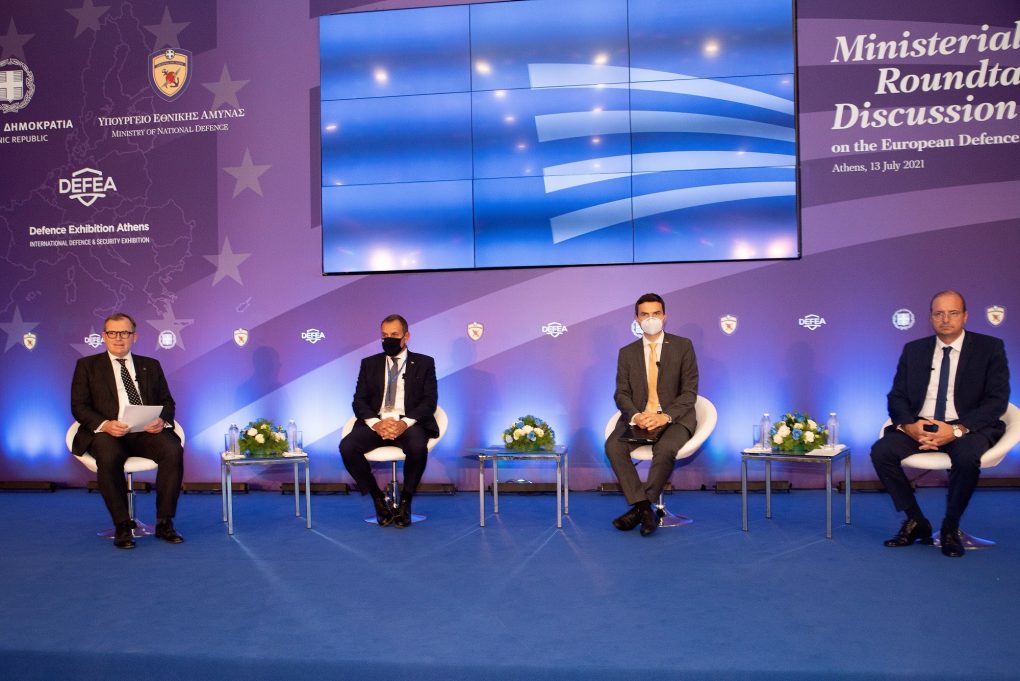
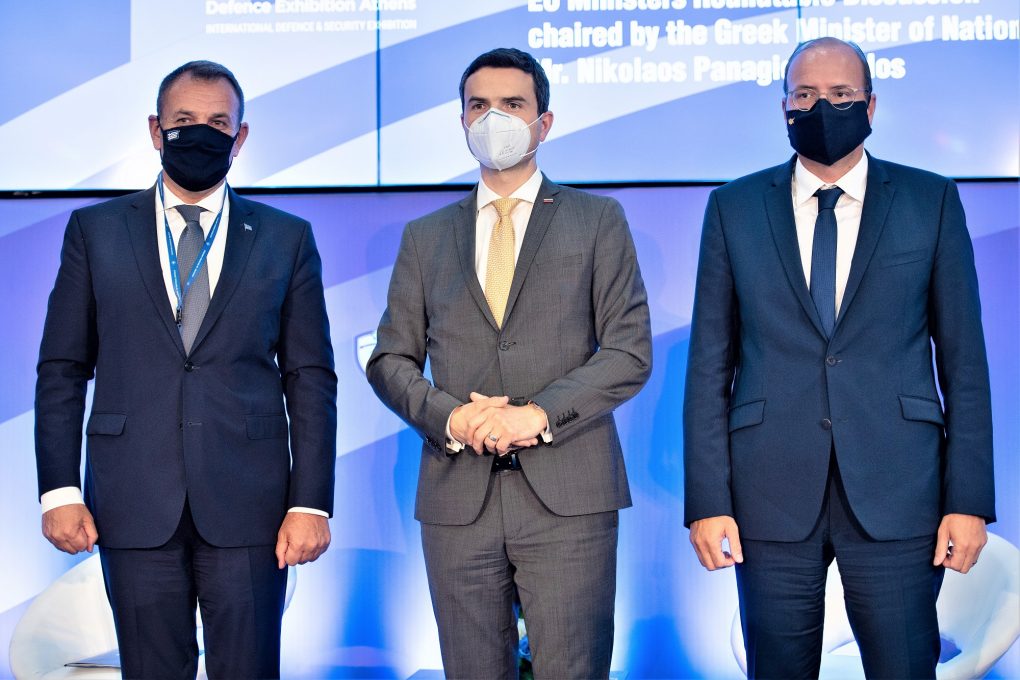
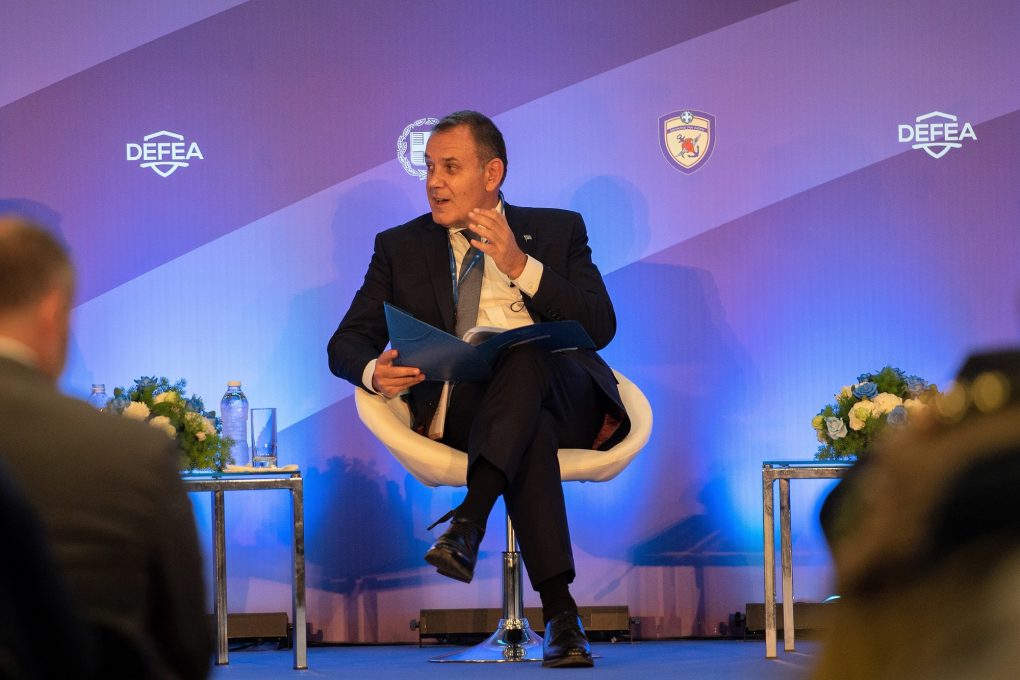
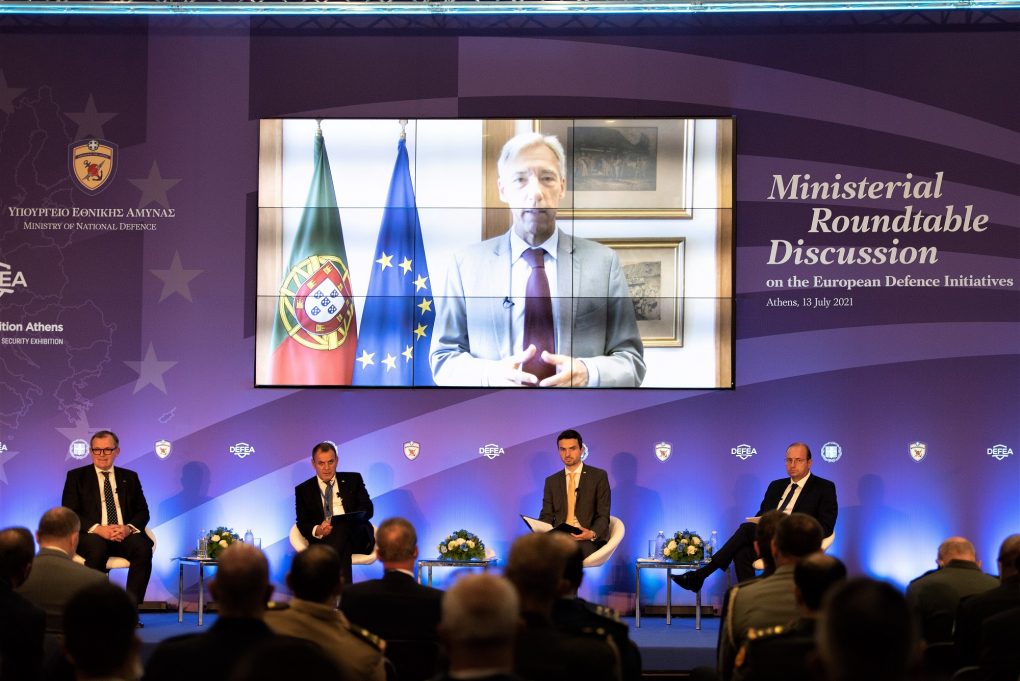
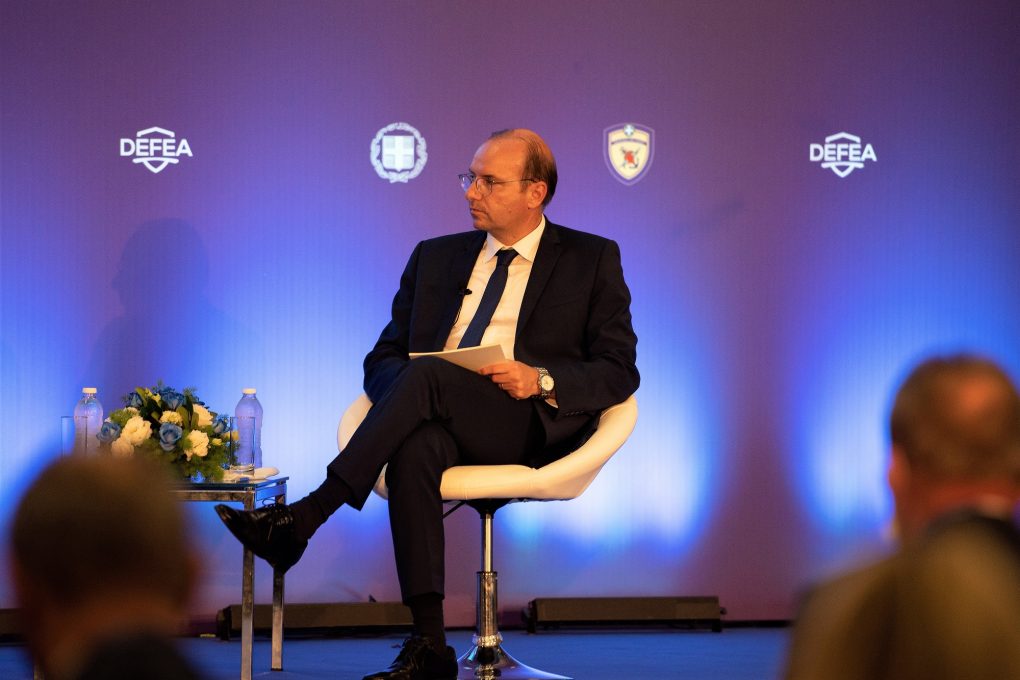
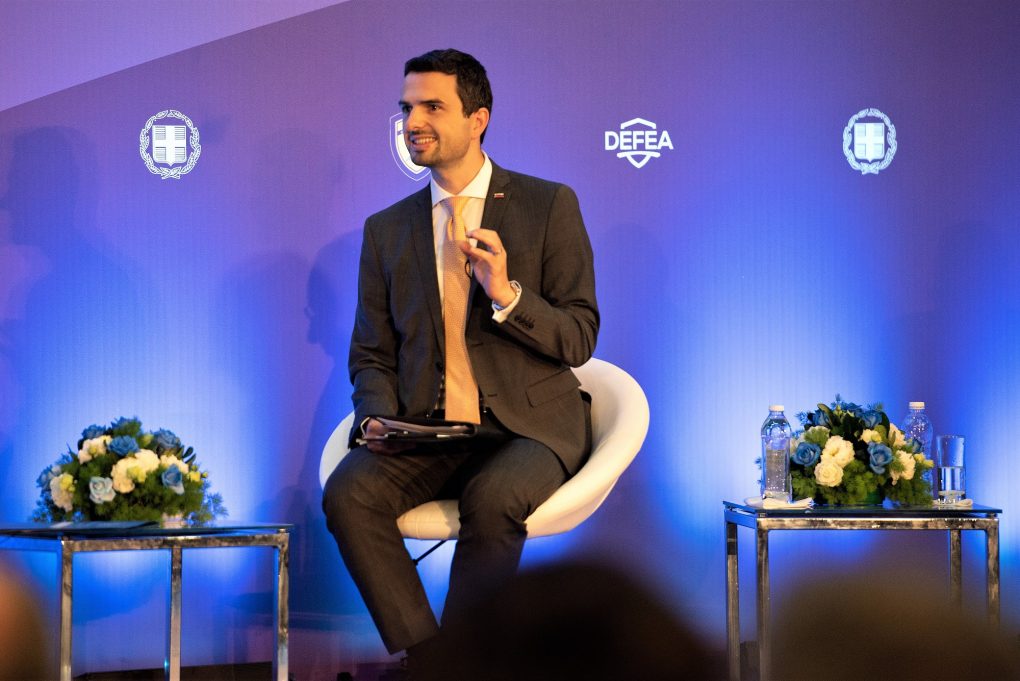
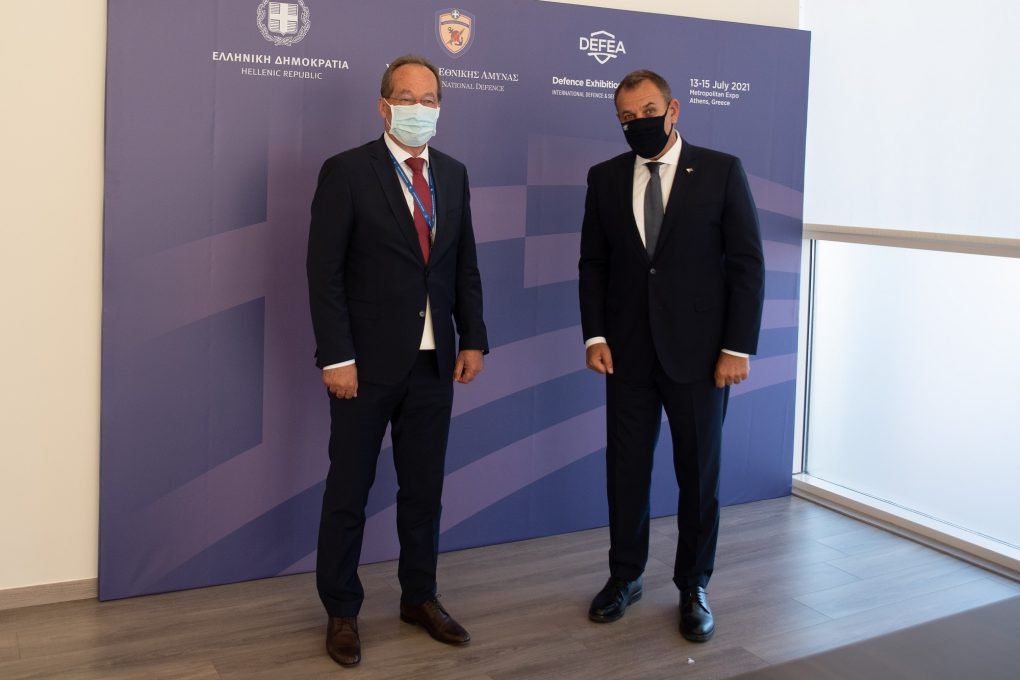
The Minister of National Defence Mr. Nikolaos Panagiotopoulos participated today, 13 July 2021, in the round table discussion regarding the EU initiatives for the Defence, in the context of the International Defence and Security Exhibition “DEFEA 2021”.
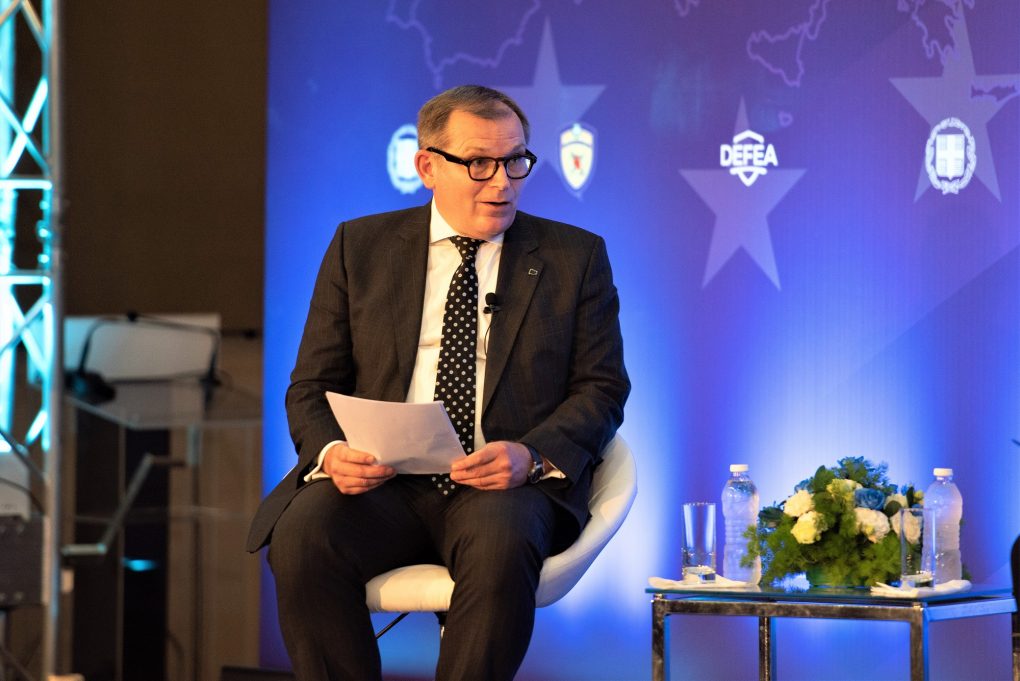
During the discussion, the Defence Minister of Cyprus Mr. Charalambos Petridis, the Defence Minister of Slovenia Mr. Matej Tonin, and the Defence Minister of Portugal Mr. Joao Gomes Cravinho, expressed their views through tele-conference. The coordination was performed by the the European Defence Agency (EDA) Executive Director Mr. Jiri Sedivy, whilst the Commissioner of the Local Market Mr. Thierry Breton made an address through a tele-recorded message. The discussion was broadcasted live through the Ministry of National Defence website and the social networks.
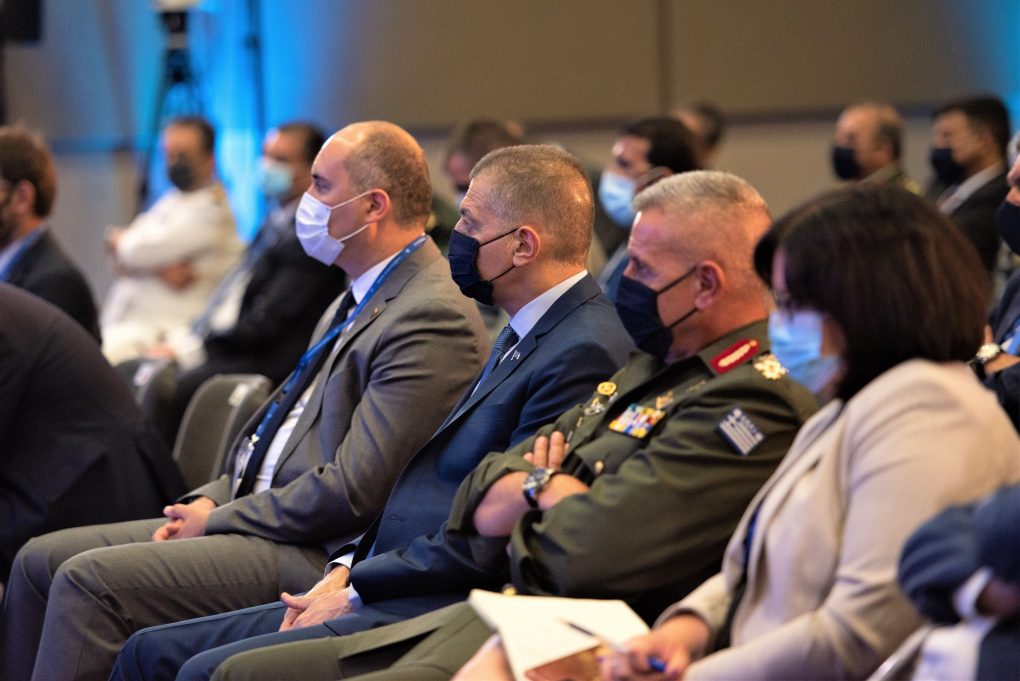
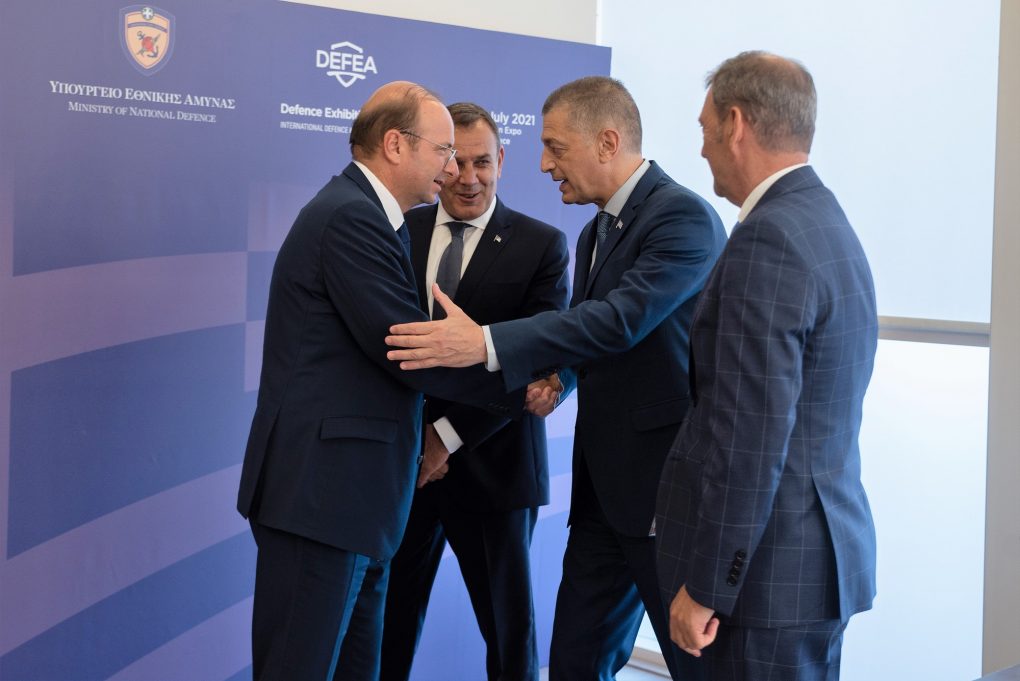
The event was attended by the Deputy Minister of National Defence Mr. Alkiviadis Stefanis, HNDGS/Chief General Konstantinos Floros, HAFGS/Chief Lieutenant General Georgios Blioumis, HAGS/Chief Lieutenant General Charalambos Laloussis and HNGSChief Vice Admiral Stylianos Petrakis.
The discussion was attended inside the room by seven foreign Defence Ministers, foreign diplomatic delegations members, Armed Forces Chiefs and foreign countries Defence Attachés, representatives of the Regional and Local Self-Administration, former Ministers, as well as retired Chiefs and senior officers of the Armed Forces. In addition, approximately 10,000 people watched the event online, according to the countable visits statistics, with a great percentage resulting from foreign countries.
During the discussion, initially views were expressed by the Ministers and then answers were given in four questions posed by Mr. Sedivy regarding initiatives, like PESCO, CARD and EDP, as well as their contribution to the defence cooperation among EU member states.
During his interventions, the Minister of National Defence pointed out:
–Today’s event has a symbolic nature, since it is combined with the lapse of 40 years since Greece’s accession to the EU, as well as the 200 year anniversary since the beginning of the Greek revolution for National Independence, during a period when we are examining the upgrade of our defence capabilities within the European framework.
-Allow me to wish every success to the Slovenian Defence Minister for undertaking the Presidency of the European Council, during the second semester of the year.
-The European Defence Cooperation constitutes the “key” to achieve EU’s ambition regarding Defence and Security, at a time when the idea of strategic autonomy is increasingly developing, a fact not compatible with NATO’s goals, but I believe it is absolutely supplementary.
-I express my thanks to the Portuguese Presidency, the term of which ended a month ago, because it promoted the goal of strategic autonomy and encouraged it. I am very optimistic regarding its evolution and I hope that the Slovenian Presidency and the friend Minister Matei Tonin will further promote this concept, so that a text will result, which will define the meaning of the strategic autonomy.
-The goal is to specify and describe the complexity of the security challenges affecting all of us. There are challenges and threats, even of hybrid nature, or from advanced technology systems throughout the EU. If we take all these under consideration, then we will reach the useful conclusion of how we can proceed next.
-Last November we took a very important decision in the European Council regarding the participation of third countries. This is progress, despite the fact that each country expressed its reservations, but this is the essence of the EU: to have cohesion through the disputes. Recently, the U.S.A., Norway and Canada were authorized to participate in military mobility programs. This way it is proven that cooperation can exist and partners can become reliable. The utter goal is to develop more effective capabilities at all Defence levels, succeeding in our ambitions.
-Greece has managed to receive funding regarding four projects of military nature in 2018 and another one this year. We place the emphasis on the production of attractive proposals, in the context of EDP, and I think this is what is required of the Member States, because we try to achieve synergies and move on.
-Since we want the EU to become a reliable security and defence provider, we must realize that we can be safe, we can protect EU’s citizens and guarantee security and stability in the wider region. Then, the Strategic Compass will be the corner-stone.
-There is an increasing importance of the European defence industry, which can operate as a catalyst for the improvement of the European Defence and help in the fulfillment of our ambitions at a European level. During yesterday’s dinner, we talked about the historic flagship of the Hellenic Fleet, the Battle Ship “Averof”. It is a ship that was built in Italian shipyards, carrying French engines and British weapon systems. In a “bizarre” way, I would say, it is an ancestor of the PESCO project, in a period of hard times.
-The times we endure today are very complex and with many challenges, especially with regard to the geopolitical field in the region. Challenges exist as a fact; there is no absolute safe environment. To the contrary, new challenges are ascertained, new fields of conflicts, especially during the recent period, which consists another NATO priority.
-The improvement of the European defence industry could be the catalyst to further understand the Common Defence and Security Policy, trying to reinforce the Strategic Cooperation.
-The strengthening of the industrial base at a European defence level, the conclusion of synergies at PESCO or EDIDP level, will allow us to develop capabilities within a competitive environment, like for example the Merchant Shipping safety in regions like the Mediterranean. These issues could constitute goals at a level of initiatives, like the Strategic Compass.
-We must be realists. I do not think it is feasible to form a “European Army” very soon, nevertheless, I estimate that many synergies will arise that will be developed by the Armed Forces and the industry. It is an achievable and realistic goal.
-In Greece there is a simple perception regarding the defence industry. We must maintain it, taking under consideration the prevailing special conditions, due to the challenges at a geopolitical level. We must maintain our Armed Forces with outstanding capabilities, wide disposition, good training, very active and present everywhere. To achieve this goal, we must support them, based on an absolute operational and competitive framework, with a very active defence industry.
-We, the Mitsotakis Government and the Political Leadership of the Ministry of National Defence, believe that we need to support the domestic defence industry. We have scientists of high qualifications and quality, but in order to have such quality we must support our own industry.
-We are about to buy four frigates and we believe it is necessary for some of these ships to be built in the Hellenic shipyards, and we, must work for that. Not only to be built in our shipyards, but other industries should participate in their manufacture as well. One of our two shipyards, the Skaramanga “Hellenic Shipyards” was bought by an entrepreneurs group, led by a Greek ship-owner. I think this will give a boost to the domestic shipbuilding industry, despite the problems of the past.
-The central idea is that it is necessary to offer opportunities to the national defence industry, in order to play a very important role at industry level, in general for the benefit of the Armed Forces, by using funding tools that the EDA can create regarding developing projects of cutting-edge technology, having a growth perspective and PESCO projects.
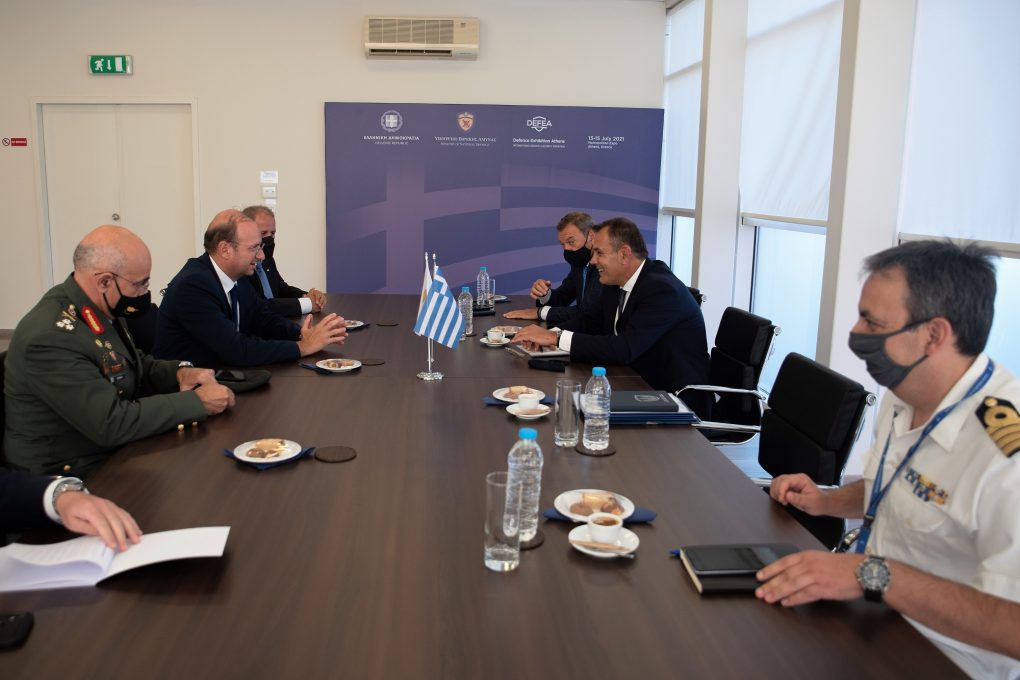
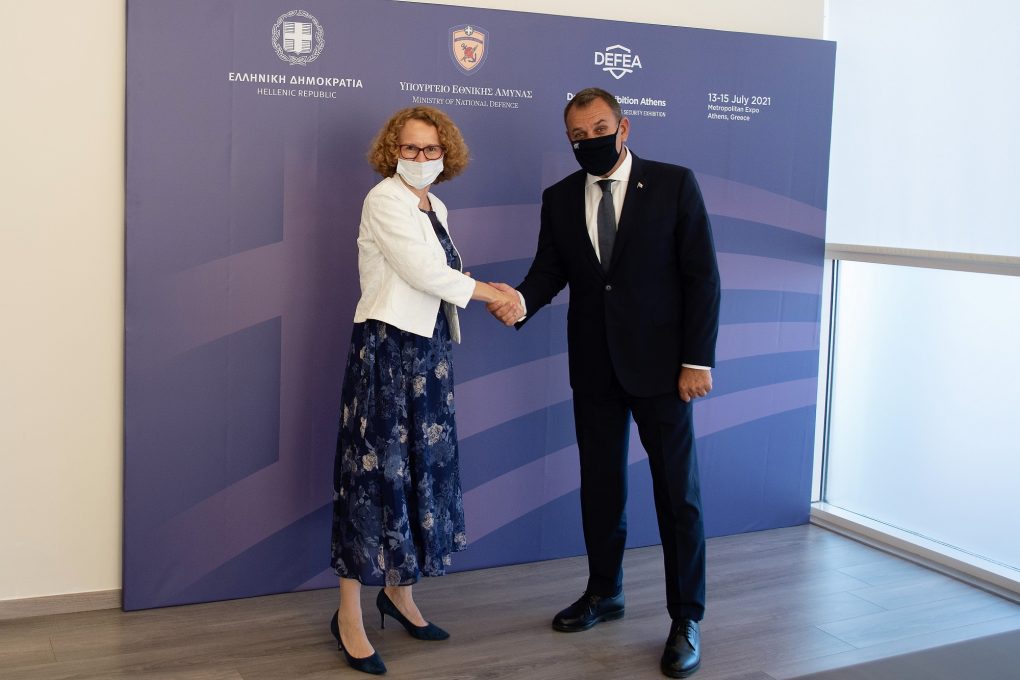
Then, Mr. Panagiotopoulos had bilateral meetings with the Defence Minister of Cyprus Mr. Charalambos Petridis, also attended by the Deputy Minister of National Defence. The Minister also met with his counterparts from Bosnia-Herzegovina Mr. Sifet Podzic and Northern Macedonia Ms Radmila Shekerinska.