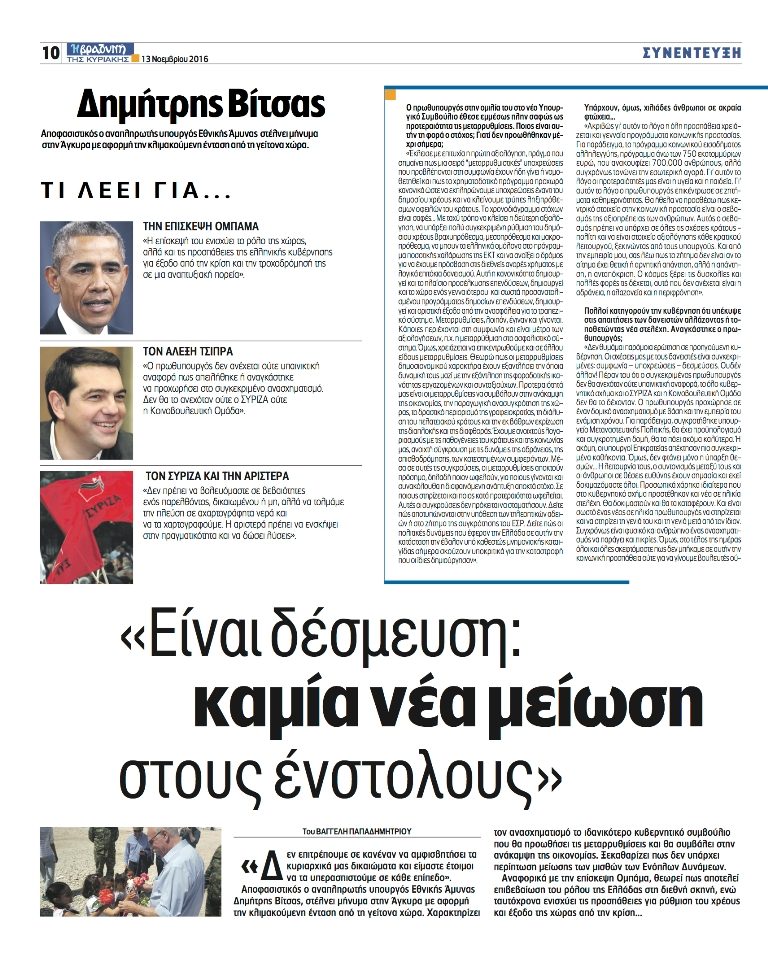
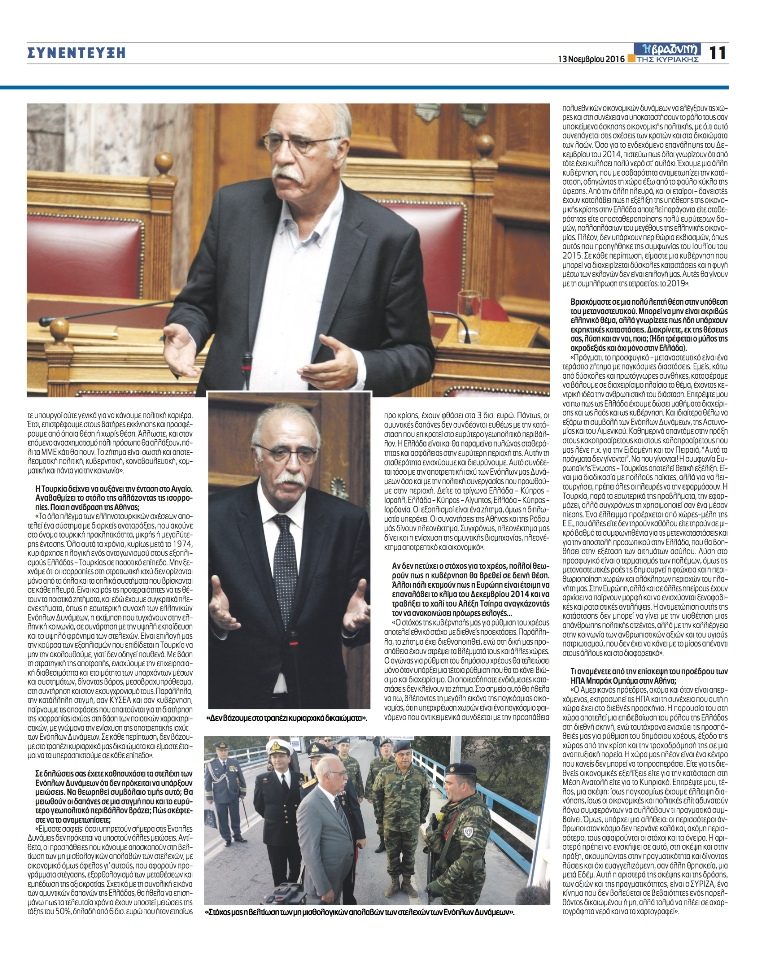
The Alternate Minister of National Defence, Dimitris Vitsas, in an interview with the “Vradyni” newspaper to the journalist Vangelis Papadimitriou, which was published on Sunday, 13 November 2016, made the following statements:
Q:The Prime Minister, in his speech to the new Cabinet, stated that reforms are a priority.What is the target this time? Why weren’t they launched before?
A:”The first evaluation was successfully completed, which means that a series of “reform obligations” provided by the agreement have already taken place or become law and that the financing programme continues smoothly, enabling us to meet our obligations regarding public debt servicing and paying overdue state debt.The target schedule is clear…The second evaluation must be completed swiftly, a specific public debt relief must be provided in the short, medium, and long run, and Greek bonds must be included in ECB’s qualitative easing programme in order to pave the way for access to international financing markets with reasonable borrowing interests.This normalisation will also create a framework to attract investments, space for a larger and properly oriented public investment programme, and put an end to the insecurity of the banking system.Some are part of the agreement and the evaluations, e.g. the social security system reform.However, we also have to focus on other kinds of reform.I believe that fiscal reforms have reached their limit due to the inability of employees and pensioners to pay any more taxes.Our priority is to bring reforms that will contribute to the recovery of the economy, the productive recovery of the country, the drastic reduction of bureaucracy, the dismantling of the clientelist state, and the eradication of conflicts of interest and corruption.We are at war with the vulnerabilities of the state and our society, as well as the forces of stagnancy, regression, and vested interests.Through these conflicts, the reforms become charged, based on who benefits from them, who they are intended for and, consequently, the emerging growth obtains a target.Based on whom it is based on and who benefits most from it.These conflicts will not stop.See how they unravelled in the case of the TV licenses or the establishment of the National Council for Radio and Television.See how the political forces who brought Greece to this situation, who brought the MoU regime, now hypocritically lament for the destruction they created”.
Q:However, there are thousands of people living in extreme poverty…
A:”This is exactly why the whole effort also needs large social protection programmes. For example, the social solidarity income programme, a programme of more than 750 million Euro, will provide relief to 700,000 people, as well as a boost to the market.That’s why our priorities are health and education.That’s why the PM focused on matters of everyday life.I would like to add that the main element of social protection is the respect of peoples’ dignity.This respect must be part of all relations between the state and the citizen and a measure for the evaluation of all state officials, starting with the ministers.And, in my experience, it is not the point if this request is met or not, the point is that there is a response.People know about the difficulties and sometimes they accept them, what they do not accept is stagnancy, arrogance, and contempt.
Q:any accuse the government of giving in to the demands of the creditors by replacing or appointing new ministers.Was the PM forced?
A:”I can not recall such a question being asked to any previous government.Our relationship with the creditors is this:agreement – obligations – commitments.Nothing more!Except for the fact that this PM would not tolerate any insinuation, the entire government coalition and SYRIZA and the Parliamentary Group would not accept it.The PM proceeded to a structural cabinet reshuffling having also in mind the experiences from one and a half years of government.For example, a Ministry of Migration Policy was established, which will have its own budget and a certain structure and will do even better.Or the Ministers of State, who will have more specific duties.However, the existence of institutions is not enough.Their operation, coordination, and the people holding offices are important and that’s where everyone is tested.Personally, I was very glad that the new cabinet included younger officials.They will be tested and they will succeed.It is right for a young PM to support and to be supported by his own generation, as well as the younger generation.At the same time, it is natural that a cabinet reshuffling may also cause resentment.However, at the end of the day, we all keep in mind that we did not start this social effort in order to become MPs, ministers, or to pursue a political career.So, we return to the starting point and contribute from some other position or without a specific position.Besides, the next cabinet reshuffling will also include changes, and the media will always have something to say on that.he point is to have proper and effective policy, both governmental, parliamentary, and party, and always for the society”.
Q:Turkey seems to increase the tension in the Aegean.It upgrades its fleet and shifts the balance.What is the reaction of Athens?
A:”The entire grid of Greek – Turkish relations is a system of constant tension of smaller or greater intensity, called Turkish provocativeness.ll these years, mainly since 1974, there has been an arms race between Greece and Turkey at the quantitative level.Let’s not forget that the balance of military power does not depend solely on the weapons and weapon systems of each side.It is time to take into consideration the qualitative matters, where we have the advantage, such as the internal cohesion of the Hellenic Armed Forces and their status in the Greek society, combined with the excellent training and high morale of the personnel.It is our choice not to join Turkey in this arms race, since it will get us nowhere.According to our deterrence strategy, we reinforce the operational availability and readiness of our existing assets and systems, focusing in the short and medium run on their maintenance and modernisation.At the same time, we, as the Governmental Council on Foreign Policy and National Defence and as a government, make the decisions required in order to maintain the balance of power based on qualitative characteristics, having in mind the reinforcement of the deterrent power of the Armed Forces.In any case, we will not negotiate any of our sovereign rights and we stand ready to defend them at any level”
Q:In your statements, you have assured the Armed Forces personnel that there will be no pay cuts.Will you stand by these statements? Will there be defence budget cuts while the broader geopolitical environment is on fire? How will you deal with this situation?
A:”We are clear there will be no further pay cuts for those currently serving in the Armed Forces.On the other side, our efforts aim at improving the intangible benefits for the personnel, which however make a difference, such as housing programmes, the rationalisation of reassignments, and the promotion of fairness.Regarding the overall picture of Greece’s defence expenditure, I would like to stress that in the past years, it has been reduced by 50%, i.e. it has come down to 3 bn Euro from 6 bn before the crisis. However, the defence expenditure is not directly connected to the situation in the broader geopolitical environment.Greece has been and will remain a pillar of stability and security in its broader region.We reinforce and enhance this stability.This has to do both with the deterrent power of our Armed Forces, as well as the co-operation policy we promote in the region.Look at the Greece – Cyprus – Israel, Greece – Cyprus – Egypt, and Greece – Cyprus – Jordan triangles.Armaments are an issue, but diplomacy prevails.The Athens and Rhodes meetings give us an advantage.Another advantage comes from supporting the defence industry; this is an advantage in terms of both deterrence, as well as economy”.
Q:If the debt relief card does not work, many believe that the government will be in a tough spot.Others believe that Europe is ready to bring back the climate of December 2014 and pull the carpet from under Alexis Tsipras’ feet, forcing him to call for a snap election…
A:”Our government’s target for a debt relief is a national target with international implications.At the same time, the matter has been internationalised, while our efforts have attracted attention from other countries as well.The struggle for debt relief will end only when such relief is provided, rendering it sustainable and manageable.Anything less than that will not be enough.At this point, I would like to say that, seeing the big picture of global economy, excessive public debt is a global phenomenon that is linked to the efforts of multinational economic forces to control the countries and then substitute them as economic policy makers, with all the relevant implications this would have for interstate relations and the rights of the people.As to the possibility of returning to the climate of December 2014, I believe that everyone knows that a lot has changed since then.We have a different government that actually deals with the situation, leading the country out of the vicious circle of depression.On the other hand, the partners-creditors have understood that the development of the financial crisis in Greece can be a factor of either stability, or destabilisation of much broader structures, many times the size of the Greek economy.There is now no more room for blackmail, such as the one that took place prior to the agreement of July 2015. In any case, we are a government that can manage difficult situations and looking for a way out through elections is not our choice.The election will take place at the end of the 4 year term in 2019″
Q:We are in a very delicate position with regard to the migration issue.It may not be an exclusively Greek issue, but you are aware that the situation is already critical.From your side, can you see a solution to this and, if yes, when? (The extreme right is already being reinforced due to this, and not just in Greece)
A:”Indeed, the refugee-migration issue is a huge issue with global implications.We, under difficult and unprecedented conditions, have managed to make it manageable, having in mind its humanitarian dimension.Allow me to say that, as a country, we have managed the issue in an excellent manner, as a people and as a government.I would like to stress in particular the contribution of the Armed Forces, the Police and the Coast Guard.Everyday we respond with actions to those who say e.g. about Idomeni and Piraeus, in good or bad faith, that “These things can’t happen”Well, they do happen!The EU-Turkey agreement is a positive development.It is a multi-actor process, but in order to work, all sides must implement it.Turkey, despite its internal problems, does implement it, but also uses it as a means to exercise pressure.Another disadvantage comes from EU member states who either do not implement it or implement a small part of it regarding the relocation and the assignment of personnel to Greece to help with the examination of asylum applications.The solution to the refugee issue is to end the wars, however the migration flows are created by poverty and the marginalisation of countries and entire regions of our world.n Europe, as well as elsewhere, xenophobic and racist ideas have started to rise and gain momentum.This situation can not be dealt with an inhumane political agenda, but rather by imbuing the society with the humanitarian ideals and healthy patriotism, which has nothing to do with hatred towards others”.
Q:What do you expect from the visit of US President Barack Obama to Athens
A:The US President, even at the end of his term, represents the United States and the continuity of this country in the international scene.His presence in the country is a confirmation of the role of Greece in the international scene, while at the same time it will reinforce our efforts for a public debt relief, to put an end to the crisis and put the country on a path of growth.Our country is now at the foreground and no one can walk past it.Either with regard to the economic developments, or the situation in the Middle East or the Cyprus issue.Allow me one final thought:perhaps there is a global lack of intellect, perhaps the economic and political elites, due to their interests, fail to understand what is really going on.But there is one truth:most people in the world do not do well and, even more so, they are stripped of their goals and dreams.The left must deal with this, in mind and in action, in touch with reality and by providing solutions and not by preaching on an afterlife like a new religion.This is the left of thought and actions, of values and reality, this is SYRIZA, a movement that does not settle on certainties of the past, justified or not, but rather dares to sail in unchartered waters and charter them itself”