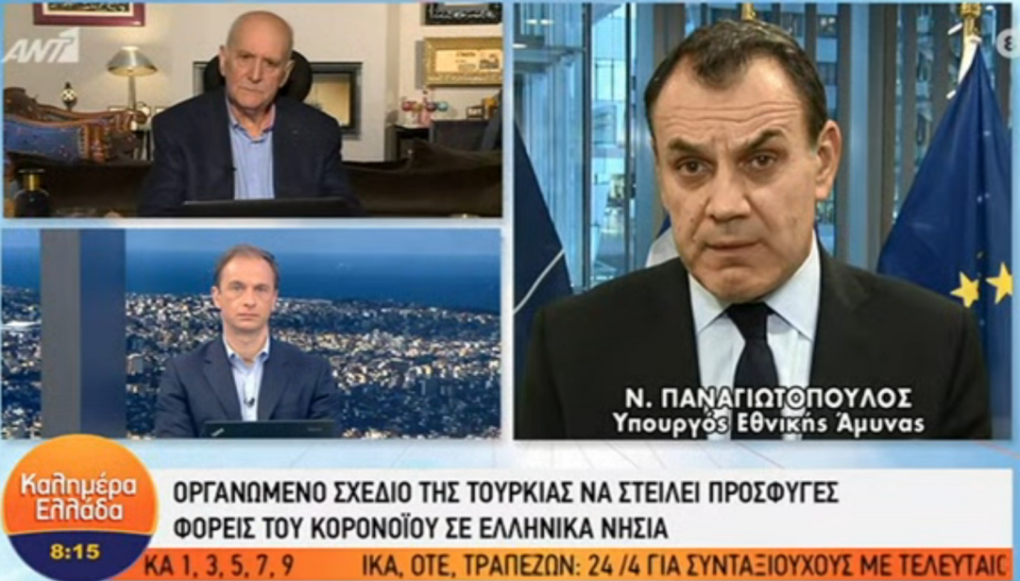
G. PAPADAKIS: Good morning Minister.
N. PANAGIOTOPOULOS: Good morning to Greece and I wish everyone a pleasant Holy Week!
G. PAPADAKIS: Minister, are we ready to counter a Turkish plan?
N. PANAGIOTOPOULOS: Please allow me to make an introductory comment, since we are entering Holy Week and let me say that each person’s faith is a private matter and I fully understand the anxiety of the faithful to look for shelter for their faith during these days, but we also have to understand that the cause of this situation isn’t the intention of some individuals to suddenly become enemies of the Church, but everything is done simply to protect the Public Health and the human life, which I think is something which absolutely comports with the Christian values and that is all. Consequently, we shouldn’t create additional enemies and additional causes for even more infighting.
We must simply adjust to these rules since we are entering a critical turning point for this whole affair.
If we stay focused and disciplined – despite the Holy Week, despite the probably good weather – then we will get through this and we will progressively proceed to the lift of the lockout as early as possible. However, we are currently focusing on retaining our successful course against this misfortune. That was just an introductory comment.
G. PAPADAKIS: It was good of you to say this. We are in complete agreement and we have nothing else to add.
N. PANAGIOTOPOULOS: Thereafter, you posed some essential questions, regarding our neighbours and the various circulating scenarios. It is a fact that after the admittedly successful countering of the surprise effort in Evros, during the weekend before and on Clean Monday, we are examining other scenarios, such as an influx of immigrants from the islands and with any means necessary. I would like to stress that during national holidays or during similar festive periods, the situation seems ripe for surprises.
After the incidents in Evros we are still in readiness, as I repeatedly stress wherever I stand. The alarm goes on and the Armed Forces are still in readiness, at all fronts, throughout our land and sea boundaries. On this basis we are examining other scenarios, which pertain to our neighbours’ use of people as tools, meaning individuals who wish to move illegally, because when you try to force your way into a country, as they did on Clean Monday, then your effort can in no way be characterised as legal.
In any case, based on these facts we stand ready, we are gathering information, we are interpreting these information and we are preparing to counter these phenomena. Everything points to the fact that because Turkey has hit a snag due to the coronavirus and not solely due to its failure in Evros, it is considering what we mentioned earlier as a way to exercise further pressure on Greece and by extension the EU. I would also like to stress that we never exulted over our success in Evros nor will we ever do so.
G. PAPADAKIS: Minister, are these information at your disposal? Apart from the news reports like the one by Ch. Mazanitis, where a lady from an NGO reported the exact movements conducted by Turkey, does the Ministry have information that the Turks are indeed gathering numerous refugees and immigrants, especially opposite the islands of the Northeastern Aegean?
Ν. PANAGIOTOPOULOS: We are executing our duties. We have such information, they are hazy but these are just the data which we must receive, examine, estimate and conclude on how to move forward.
G. GRIGORIADIS: Minister, what are our next movements?
Ν. PANAGIOTOPOULOS: We will enforce, enhance the Forces operating throughout the frontier line. In Evros, the fence is currently being fortified and extended to points previously unprotected. Everything is conducted rapidly.
At sea, we utilise floating assets, always in cooperation with the Port Authority – Coastguard, which has the primary role in surveying the sea frontiers, assisted by vessels of the Hellenic Navy. We are present in the area and we will continue to do so. I have repeatedly said that the conditions at sea are certainly harsher than on land, but thereafter we have no other option than to continue with the same intensity and to issue instructions regarding deterrence.
G. PAPADAKIS: Minister, a final question regarding the young men serving in the Armed Forces. As you can understand, it stands to reason that their parents and all of the Greek people are interested in their well-being. Have you taken any measures for the protection of these young men? It is certain that we wouldn’t like to discover coronavirus cases in the military facilities.
N. PANAGIOTOPOULOS: You are absolutely correct. The Armed Forces cannot stop operating and stay at home, as can be done with a great portion of the populace. The Armed Forces must continue to operate.
It must be stressed that on 11 March the first coronavirus case was announced in Turkey. I believe that the situation here developed quite differently. We proceeded to the first announcement of measures regarding the Armed Forces, after a lot of deliberation with HNDGS and the Chief of HNDGS, the Generals of the General Staffs, the directors of the Armed Forces medical services and of course the political leadership, the Deputy Minister and the Secretary General.
Following that, the first measures were announced, as for example the isolation of the students in the Military Academies, in order to be protected by the danger of spreading the virus in the premises (with everything that entails), to cancel the parades, the detachments, the festivities, to take the first medical measures within the units, to try to limit crowding within the units, to supply the necessary medical materials (antiseptic materials, masks etc).
The first measures where announced on 11 March. No measures were imposed after 25 March, despite the great amount of criticism during the following days. We listened to the first critical voices regarding the lack of appropriate measures. But we had already done our job. As days passed we were reconsidering all these measures, depending on the shaping situation from the various reviews, so as to secure the health of the Members of the Armed Forces. And I am referring to the Conscripts, the career Members of the Armed Forces and the students of the Military Academies (Hellenic Army Academy, Hellenic Air Force Academy, Hellenic Navy Academy etc).
I believe that, based on the result, the situation developed really well. I would like to remind you that throughout the Armed Forces we had 30 cases in total and 3 of them were critical. Unfortunately we also had one death, but it pertained to a member with a very bad health condition.
Naturally we cannot say that we are satisfied, but on the other hand, I believe that based on the total, these figures are very low.
G. GRIGORIADIS: Minister, does this mean that no leave of absence will be granted in Easter?
N. PANAGIOTOPOULOS: We will continue on the same course. I have to remind you that we had not even a single case within the Military Academies. I think that a lot of people overlook this fact. Not even a single case in the Military Academies. So, allow me to say that it was an absolutely successful measure. Not relatively successful but absolutely successful!
The children were protected. We cannot break up a system, stop utilising a measure which was absolutely successful and risk everything during the Easter. We cannot send the children away from the Academies and then have them return. Even if one person contracts the virus then everyone in the Academy will be in danger.
We will stand fast a little longer. I call for patience so that the academic year is not lost and the Academies are not closed, even at this period. We will give a leave of absence to the students, when the measures are restricted. Let us not forget that these measures are imposed throughout the country and not only on the students of the Military Academies.
We will give a leave of absence so as to balance this isolation which creates a level of vexation. But it is better to stay in and be vexed, but also healthy and protected, instead of being out and in danger. This is our decision and I think that the parents, who of course love their children more than us who also care for them, will understand.