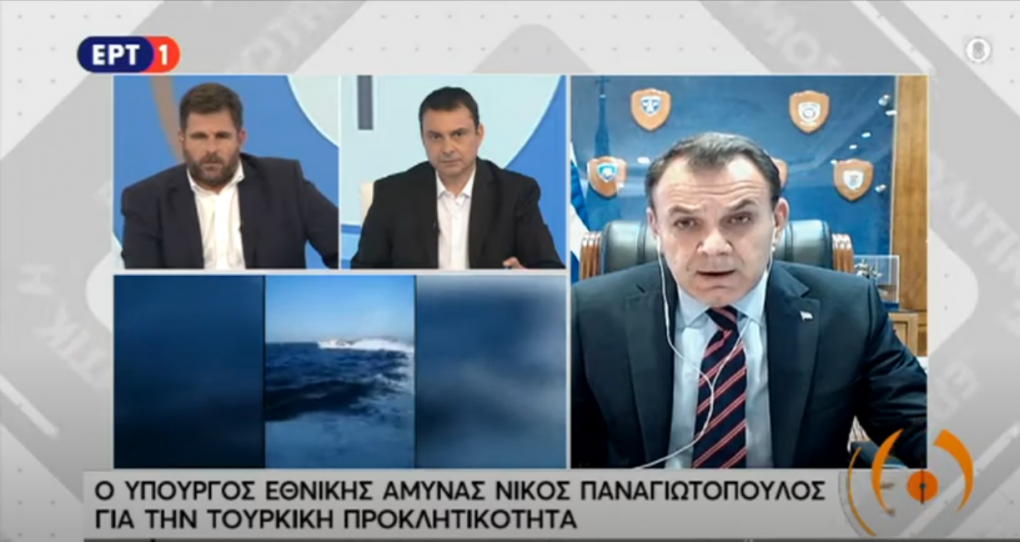
DIMITRIS KOTTARIDIS: The Minister of National Defence, Mr. Nikolaos Panagiotopoulos is with us. Good morning, Minister!
NIKOLAOS PANAGIOTOPOULOS: Good morning to you and our viewers. The big news came the day before yesterday, when there were no illegal entries, violations, overflights etc, and not today! So, this is what I meant when I talked about “blowing hot and cold” in a recent interview of mine, referring to the everyday developments in the Greek-Turkish relations.
Some days, there is an intense activity and great tension is caused by this activity and other days things are quiet and we wonder what is going on. Unfortunately, we have this alternation…
GIANNIS PITTARAS: You said something about “blowing hot and cold”, but the point is that the Turks are the ones who seem to define this particular agenda and to provoke according to their judgment, by choosing either the dates or the intensity of these provocations. For the time being, we seem to follow another strategy and obviously everybody agrees that we do not follow a strategy of provocations. But the big question is where this may end up and everybody’s fear is that in cases of so big and frequent tension there is always the fear of an accident…
NIKOLAOS PANAGIOTOPOULOS: It is exactly what you say. We have, obviously, contacted the other side and said that this increased activity, these dangerous manoeuvres, manoeuvres of vessels in a very small area – such as Panagia near Oinousses opposite the Turkish coasts, in the sea area near which yesterday’s harassment took place, is a tiny space of sea.
I heard that this happened at a distance of one and a half mile off the Greek coast. I am sure that if this happened one and a half mile off the Greek coast, it happened much closer to the Turkish coast. This sea area between Panaghia and Turkey is so small that you can clearly see the Turkish coast opposite. I recently visited this area. This is how I know what is going on. Too many vessels are gathered there, patrol boats of the Hellenic Coast Guard, respective Turkish boats, smaller war vessels, “Frontex” vessels as well, and sometimes vessels which probably transfer various people there who try to enter our waters and our territory – admittedly at a smaller frequency now – but there is an intense activity in a small sea space.
So there is a higher probability for harassments to happen there or for dangerous manoeuvres by vessels sailing too close to each other. We see the whole picture which, indeed, indicates an increased activity in the air, at sea and on land. I have told you that things have not gone quiet yet in Evros region.
There have been some cases in which Gendarmerie forces which are now on our land borders are involved in some minor incidents, shots in the air, for example, which were not towards our forces or patrols, to make it clear. But these are actions which definitely do not indicate a period of calmness and an easing of tension. This is happening repeatedly although we have some periods of interruption in the meanwhile. This is the “hot and cold” I was talking about. We ought to take this into account and be ready for every contingency.
Our forces are there, every aircraft that enters our airspace is immediately intercepted; the patrol boats of the Coast Guard which operate in terms of deterrence, where anything enters, are also there. The vessels of the Navy are nearby. We are watching and we react to every activity when we consider that it crosses some lines. Of course, tension and yet in small areas can increase the danger of an incident taking place.
We have made the respective démarches to organizations, to NATO, and we are waiting for the other side to adopt a better attitude in good faith, an intention to ease tensions. Only then we will be able to speak of an improvement in the bilateral relations. This is a condition for good neighbourly relations. It does not exist at this moment and this behaviour is preoccupying, but, nevertheless, we do our jobs.
The Minister of Foreign Affairs does it job, it proceeds to every necessary démarche, it asks and gives explanations when it is required and the Armed Forces are in an operational readiness, as always.
DIMITRIS KOTTARIDIS: Minister, regarding the coronavirus crisis and the new financial situation it created, will this affect the armament programmes which you have planned for the upgrade of aircraft and the reinforcement of the Armed Forces in the next period?
NIKOLAOS PANAGIOTOPOULOS: The armament programmes of the Armed Forces are, of course, affected by the budget funds allocated to the Armed Forces. Over the last years, this budget is stable. It is undoubtedly lower than in the previous years, amounting to 530 million per year. The budget may include programmes which are already being implemented, which means that a respective agreement has already been signed and the programmes are pending from previous years and they may probably be extended over the following years, depending on the instalments to be paid for these particular systems. It may also include future programmes which are introduced to the planning for the current and for future years, according to the suggestions of the military leaders.
I will remind you that a permanent request of the political and military leaders over the last years is that more resources be assigned to the Armed Forces. Undoubtedly, the assignment of additional funds is affected by the amounts allocated to face the very serious consequences caused to our economy by the coronavirus. We are not unaffected by what happens in the world and we are aware of that.
Apart from that, however, I think that the requirements are covered. Of course, the Branches and the General Staffs need resources to proceed to their planning, to renovate and modernize the existent systems, or probably to consider other options for the future, because this is how our Armed Forces and, by extension, our country will be protected. It is, though, more difficult than it seemed to be a few months ago. I remind you also that during the discussion of the budget, an increase of the Armed Forces budget had been announced. From our side, we do what we must. We define our priorities and the final coordination is conducted by the Hellenic National Defence General Staff, and, in cooperation with the Military Leadership, we present them to the Prime Minister in order to proceed to our planning.
We have observed our planning so far. A few days ago, I had the chance to go to the Committee on Armament Programmes of the Hellenic Parliament in order to ask for their approval of five subprogrammes regarding critical matters of armament for the Air Force, the Navy and the Land Forces. They regard the maintenance of certain parts of F16 aircraft, the replacement of engines in Land Forces helicopters and the acquirement of new American helicopters of anti-submarine warfare to supplement the Frigates of the Hellenic Navy (these helicopters operate from frigates), and, of course, the Mid-life Modernisation programme of MEKO type frigates, the newest frigates we possess and are now at this stage of their lifecycle. Hence, various armament programmes are underway at this moment. Of course, we are considering solutions that can emerge, we have alternatives on the table, but we have to do our job in an organized, systematic and smart manner. Greece’s financial resources are not unlimited, her economy has been hit by the coronavirus, just like every economy on the planet.
I realize that the government’s main effort is focused on boosting the economy after the coronavirus shock. There wouldn’t be any other solution. But, in this context, we do our planning as well, in order for our Armed Forces to remain operational to the benefit of our country’s deterrence force.
GIANNIS PITTARAS: I would like to come back to (these tension issues in the Aegean Sea) because we saw footage of them too. You said that what is happening there is very dangerous and you yourself have been a victim of this provocativeness. Your helicopter was harassed when you were in that area. Have you ever felt the need to pick up this famous “red phone” and speak directly to your Turkish counterpart and say “What do we do now? Should we put an end to this story?” and be treated with responsiveness? Because I heard you earlier saying that we are waiting for the Turks to show good faith which will not happen by any means, as we all have realized…
NIKOLAOS PANAGIOTOPOULOS: We always try to keep an open channel of communication, to talk with the other side, to explain that our intentions are good, but, if we do not see equally good intentions from the other side, we have to set our limits.
In any case, it would be good for both countries to find a manner of understanding. Of course, the Ministry of National Defence does not have the first word in this effort. It is the Prime Minister and the Ministry of Foreign Affairs, the Minister of Foreign Affairs that have the first word in bilateral relations; because they implement international diplomacy and try to do their best in matters of bilateral relations. However, because of the nature of these disputes, we are also deeply involved. I have spoken several times with my counterpart in order to discuss particular issues and particular situations.
GIANNIS PITTARAS: When was the last time that you contacted him?
NIKOLAOS PANAGIOTOPOULOS: It must have been about 15-20 days ago…
GIANNIS PITTARAS: In the meantime, however – it is interesting that you define how long it lasted – we have seen a crescendo of Turkish provocations on the Aegean Sea, at sea and in the air…
NIKOLAOS PANAGIOTOPOULOS: It’s what I said before. Not exactly a crescendo! We spent some days of absolute calmness and some days of big tension. It is this… “increase and decrease” of the tension. We try to explain what causes it.
The other side has its explanations. It gives us some of them. We listen to all of them calmly and I might also say reasonably in any case. Beyond that, we consider that many times this situation may become too tense and there is no reason to raise the tension.
DIMITRIS KOTTARIDIS: Minister, what probable explanation could the Turks give when they fly over Patmos, for example? What explanation could the Turkish Minister or a Turkish officer give?
NIKOLAOS PANAGIOTOPOULOS: Every incident is investigated separately. There is one explanation for an increased activity in at Evros, a different explanation for too many overflights conducted over an island and a different explanation for the harassment of a vessel of the Hellenic Coast Guard. They do their job and we do ours.
Our job is to deter them, intercept them and explain, as far as the land borders are concerned that because of what happened in February we will fortify even more our frontier, we will increase the obstacles and we will always be there to guard with our Armed Forces as vigilant guard. This does not need any different interpretation or explanation.
It would be good, at this time, since Turkey faces its own problems caused by the coronavirus, to focus our efforts on boosting the economy and not on causing or increasing tension at the borders. This would be good. This is what we would like. We are showing good will and this is what we would like for the other side to do, and the channels of communication should remain open. I do not think that what Turkey wants is to sharply increase tensions to the dangerous extent of probably causing other situations.
On the other hand, the behaviour we have seen makes us, as Government, consider every probability and prepare ourselves.
GIANNIS PITTARAS: Is there a problem with coronavirus in the army? Is everything under control? Regarding the exercises which had been scheduled, were they postponed due to the need to protect the participants?
NIKOLAOS PANAGIOTOPOULOS: Let me tell you something. Of course, the postponement of the exercise has to do with our support to the general effort of the government – the Prime Minister has referred to it several times – to end the emergency situation caused by the coronavirus and go back to normal in an organized manner.
GIANNIS PITTARAS: So, you are saying that it was due to the circumstances…
NIKOLAOS PANAGIOTOPOULOS: When measures are taken gradually, we cannot except the Forces of the Hellenic Navy, while there is still a risk of contamination. Many think that there was no danger of coronavirus contamination and that we can act as if it had never existed. We had done a huge effort. We achieved a very good result. Greece became an exemplary model worldwide, although this would seem very strange a few years ago and it gets positive comments. We try to keep up this preparedness and have a smooth return to normality.
Exercises were conducted over the last days. The day before yesterday, four-five vessels of the Hellenic Navy conducted an operational test with submarines, maritime surveillance aircraft and other assets, on Myrtoan Sea. There were no large-scale aero-naval exercises, like “Kataigis” in the past, but small-scale exercises were conducted in certain areas.
Our vessels are operational, as well as our forces. I think that many times too much rumour is caused by an action which is not so “dramatic” in the first place. The Armed Forces have their own planning. Things happen suddenly and changes of the entire planning are required, but, in general, there are not too many changes. They remain active and operational.