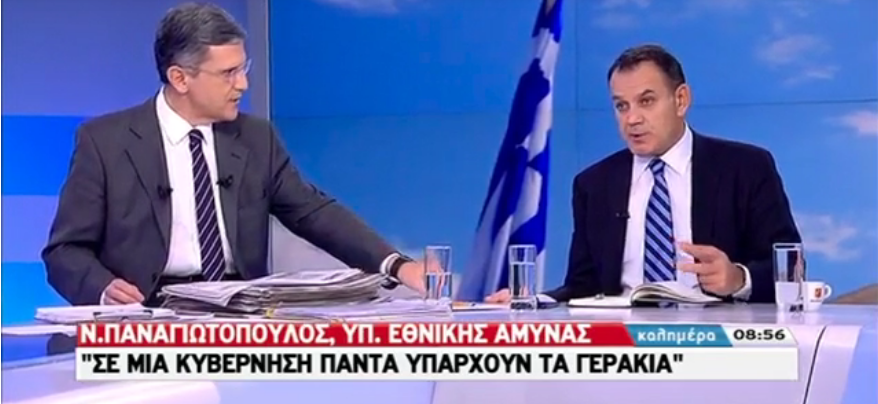
G. AFTIAS: What was your impression when you sat at the table? Who started talking first? How was the climate?
N. PANAGIOTOPOULOS: It was a good discussion. When I say good, I mean it took place in a positive climate, a proper climate, a most respectable climate. Each leader said the things he wanted to say, he responded to everything the other side claimed, sometimes the conversation became vivid, as it should be. These talks are not a demonstration of smart or bullying behaviour. They are composed speech, on the basis of the national law of each side. Turkey wanted to develop its own arguments and so did we.
Our Prime Minister dealt with the Turkish leader as an equal, in a proud and spirited fashion – to disprove any rumours claiming compliance, retreat, etc. Each leader stated his arguments. There was agreement on some points and disagreement on many others, but from then on, the climate during the talks was that of a constructive exchange. We didn’t have illusions about agreeing on everything and leaving satisfied. I imagine that the same stands for the other side as well, but we had to submit our views.
The Greek Prime Minister repeated that although Greece has fulfilled its undertaken obligations, as far back as the previous September meeting of the two leaders in New York, Turkey has not “fulfilled” its own, because first, it did not check the migration flows going through the traffickers’ channels in its territory and second, it moved forward with the sea zones’ mapping “agreement” with Libya.
G. AFTIAS: At some point, the Prime Minister told him: “of the twenty calls your Coast Guard receives from us, it answers only one”.
N. PANAGIOTOPOULOS: Precisely.
G. AFTIAS: How did Erdogan react?
N. PANAGIOTOPOULOS: Erdogan disregarded this and blamed Europe, which does not fulfil its obligations, meaning to give money (the “para” as he said – “para” is a well-known word, the “money”) to Turkey. We said that we too can point out the issue to Europe, we can provide these services, in order to resolve the issue.
The Greek Prime Minister, Mr Mitsotakis answered that Mr Margaritis Schoinas, who is a high ranking official and Vice President of the Commission, responsible for the Migration issue, is expected to visit – Ankara as well – in order to help in finding a solution regarding Turkey’s relation with Europe, with regard to funding issues. Nevertheless, Turkey must bear the “burden” as well, because Greece cannot afford to bear any more burden by itself.
G. AFTIAS: There was a dispute regarding this “agreement”. Mr Dendias stated yesterday, through an official announcement of the Ministry of Foreign Affairs, that it is null and void. How did Erdogan react at this point, when the Greek Prime Minister told him that what he did with Libya amounted to nothing?
N. PANAGIOTOPOULOS: We did not argue on a legal basis regarding the validity of this “agreement”, which is actually lacking. It is just a statement of intensions by both sides, the Libyan government on one side – as it is represented today by Mr Sarrajj, and Turkey on the other, in order for the sea zones to be demarcated between the two countries.
However, you later saw that this agreement was rapidly ratified yesterday by the Turkish National Assembly, for which we had no doubt, but I do not think that it will be so easily and swiftly ratified by the Libyan Parliament, which is not under governmental control, and agreed on by the Libyan side.
G. AFTIAS: Minister, what changes are being made regarding the protection of the borders? I am asking because the Prime Minister was absolutely clear that many things are changing. Allow me, as a resident of Samos, to report that I have witnessed Frontex personnel enjoying their coffee at Samos square. I am not mincing words, they were lounging completely unconcerned, wearing sunglasses and caps. What changes regarding the protection of the borders, what will Nikos Panagiotopoulos, as Minister of Defence, along with his friends do, since they operate as a group?
N. PANAGIOTOPOULOS: Indeed it is a group, it is team work. No doubt, the Ministry of National Defence is involved and the Deputy Minister Mr Stefanis has also undertaken a big burden regarding the administrative coordination of this effort. The Ministry of Citizen Protection is involved too, which is responsible for the domestic security, according to the law.
I stated in September that we will “seal” Evros and a lot of people were sarcastic with me. It is not as simple as a filling by the dentist, done in one afternoon and then you move on with your life. A plan is required, which will be drafted, will be discussed, verified and finally implemented. Time is required for that.
The goal is, first of all, to control Evros. Because let’s face it, the land borders can be better controlled than the sea borders, which are a completely different matter. So, we are drafting a plan which I believe will be announced presently, the Prime Minister has already been informed, so that controls at Evros will become stricter. What do we need to achieve that? We need a stronger presence of both police forces and Army troops at the borders, we need more and better surveillance assets. Proposals have already been submitted for purchase, through funding from the Ministry of Citizen Protection, of technical assets, better cameras, more advanced technological surveillance assets, in order to deploy them along the 220 kilometres Evros borderline.
We need more assets for deterrence at Evros, like more fences (this has also been raised, pending the last decisions), patrol assets, helicopters, floating assets. They will be announced presently. No doubt, the borders protection and safeguarding system will be stricter and obviously rooms are required, confined rooms, where those arrested for illegal trespassing in our country will be transferred. I do not refer to the refugees, the distinction between refugees and immigrants who act against the rules is, after all, visible. The majority of those entering our country are not refugees from warzones in other countries. They come for different reasons, being a part of a major migration flow from the East to the West.
They must be controlled and distinguished from one another. Mr Mitsotakis fulfilled his September commitment in New York, that is to pass the law which expedites the procedures for providing asylum to those who apply for it, mostly refugees, but from then on, we must distinguish one category from the other.
G. AFTIAS: Minister, last night an unbelievable statement was made by the Turkish Ministry of Foreign Affairs, an answer to the Prime Minister’s address. They go too far. I want our Homeland’s Minister of National Defence to send his own message as well. The Prime Minister was absolutely clear in everything he said in his address. Of course, I realise that Greece, as a proponent of peace and a supporter of International Law, will face Erdogan through isolation.
N. PANAGIOTOPOULOS: Regarding the publication of the Turkish newspaper, it is done in the context of a wider framework of provocative and offensive statements. Exiting the meeting, Mr Erdogan stated that it would be better not to bang the fist on the table, meaning that it would be better to reduce tension, if we intend to follow a path of communication. Later another statement was added, referring to war victories, the crushing of the Greeks, etc.
I have said repeatedly that if they don’t change their stance, we can not talk about Confidence Building Measures, since we have to deal with this barrage of provocative and offensive statements and their aggressive rhetoric.
It is like taking one step forward and two steps backwards – I would say three steps now – after the agreement with Libya, which questions directly Greece’s sovereign rights. I think we are fooling ourselves. This is what I said once more in the October meeting with Mr Akar in Brussels. He nodded his head showing approval, but unfortunately the same rhetoric continues, using not only words, but actions like over-flights, air space violations etc, as well.
G. AFTIAS: When Erdogan told us to not bang the fist on the table, did the Prime Minister respond or did he let it go in a diplomatic way? What happened exactly? Do you remember that moment?
N. PANAGIOTOPOULOS: He just told him that this concerns both of us, not one side only. We have not banged the fist on the table, making provocative and aggressive statements against Turkey, that we will enter war, that we will do this or that. I do not know if the same newspaper falsely informs the Turkish public, for reasons of domestic propaganda, which we should understand, that the Greeks are prepared for war, that they want war, etc.
In every government, every administration, there are always the so-called “hawks” who in these cases adopt a more aggressive rhetoric. These “hawks” are everywhere.
The Greek Pentagon, the Ministry of National Defence, is not a pigeon-loft and it should not give the impression that it is one. You may meet some “hawks” there as well, but they express a valid point of view. There are many different ways to express one’s views.
The Government adopts, through its political speech, the final decisions and without doubt, the Military Leadership follows the political decisions of the Political Leadership. That is the Government. But still, this kind of expression must also exist. What does it say? It says that we will do what we must to defend our sovereign rights. We will do what we must to defend our national law.
The Pontian Greeks’ Genocide is a historically established fact. We must not pretend that it never happened and project that it never occurred. Besides, memories are fresh, still vivid, in elements of the Pontian Hellenism, which I share as well, in North Greece.
G. AFTIAS: We have a lot to talk about with the Minister. You have competent Leaders and you have Alkiviadis Stefanis, who actively manages major issues.
N. PANAGIOTOPOULOS: It is a team that operates with a sense of duty, Patriotism, mutual respect. There are and there will always be different opinions, but what matters is the final outcome and the common effort, and this is apparent in the Ministry of National Defence.
G. AFTIAS: As you understand Minister, there are a lot of questions. People thank you for mentioning the Leaders and the Deputy Minister of National Defence, that is the team which manages all these developments. Why did the “Times” write that they are reinforced etc? It is the usual, everyday policy of the Armed Forces, as I found out from the Leaders.
N. PANAGIOTOPOULOS: The array of forces is conducted according to planning. People should not have the impression, due to fake news, that nowadays we transfer troops from one place to another for various reasons. The situation is still the same as before and of course if such decision was made, I should have known about it and I would know about it. It would be made along with the Military Leadership. The Military Leadership suggests and the Political Leadership makes the final decision.
By concealing things, there is no gain and no gain should exist. Regarding hard, complex or major issues, it is undoubtedly the Prime Minister who is briefed and makes the decision. This is how we decide and not by concealing things, hiding situations from one another. So, I characterise this publication as another systematic propaganda against the Greek stance.
Why should we transfer troops to Crete? There are troops in Crete. There are the ones under a command, the specific planning and the assigned Units with all weapon systems. There is no need for more, nor should this be considered a kind of response, based on the new developments, that is the agreement between Turkey and Libya. Alas and it is a pity to circulate such fake news.
G. AFTIAS: You are absolutely clear and I really thank you for this statement. The Generals ask for an increase in defence expenditure.
N. PANAGIOTOPOULOS: And not only the Generals…
G. AFTIAS: Anyway, all interested parties. And some say, if this does not happen now, when will it happen? Also, regarding the upgrade of the F-16, Mr. Panagiotopoulos…
N. PANAGIOTOPOULOS: For many years the budget of the Ministry of National Defence, that is the expenditure for Defence, has been dramatically reduced in relation to the needs. As time passes by and due to the geopolitical conjunctures, as well as Turkey’s stance, and due to the wearing out of the armament and the systems’ aging, interventions are absolutely necessary. I supported this point of view in the Parliament, which I totally believe in. This is the time to upgrade the weapon systems, in total, for the Armed Forces, for reasons we all understand.
This point of view is also approved by the people. They see Turkey equipping itself, they see Greece unable to follow due to financial difficulty and they understand that now is the time for the situation to be reversed, given that we slowly come out of the crisis, without being absolutely safe. We come out of the crisis, being responsible and financially disciplined. It is not an easy task.
I believe we must have a long discussion – the Prime Minister is aware of the needs in armaments as well as others – with the Ministry of Finance as well, in order to consider our actions regarding the Armed Forces. Because both the financial growth and prosperity and the social peace are subject to one basic precondition, that security exists. The powerful Armed Forces are those which ensure the security in the country, defending our sovereign rights and our borders, inch by inch.
G. AFTIAS: What about those brave men Minister, whose salary is 1200 Euros and yet they fly risking their lives?
N. PANAGIOTOPOULOS: The need for expenditure’s increase in the Armed Forces does not concern only the weapon systems and the platforms, more technologically advanced aircrafts, new ships, etc. It concerns the personnel as well. The personnel, the Armed Forces’ members have “put their shoulders to the wheel” all these years, under really hard conditions. We acknowledge and we sincerely appreciate this, as a Political Leadership as well. Some injustices though must be gradually removed.
G. AFTIAS: For example, the flying allowance…
N. PANAGIOTOPOULOS: Regarding the flying allowance, we cannot pretend that we do not understand. It is one of our goals, among others, with regard to personnel, to restore the flying allowance for the young men, the Captains, the Majors, who every day fly their war-machine called F-16, to intercept Turkish fighters, in order to defend the integrity of our air space.
We are aware of the situation, we have estimated it, we started some basic interventions regarding weapon systems’ upgrading, the F-16, which we will present to the Parliament this week. I believe it is an important and essential intervention, but we pay attention to the personnel’s needs in all three Services, not only the Air Force.
G. AFTIAS: Alexis Papachelas writes in the “Kathimerini” newspaper: “Athens worries about a Turkish intervention, by means of a research ship’s mission in an area east of Crete, south of Rhodes or Kastelorizo, a move that would directly question Greece’s sovereign rights at the shelf. This ship will be under a French flag”. Do we conduct exercises east of Ierapetra, south of Rhodes and have control on our space? I am just saying that nicely and simply Mr Panagiotopoulos.
N. PANAGIOTOPOULOS: One of the ways Greece uses to defend its national laws is the reinforcement and expansion of alliances that exist at a strategic level, both in NATO and in the European Union, as well as in the wider region.
One of Greece’s basic, ever-lasting allies, and I would say the only country which spoke straightforward through its leader, President Macron, in favour of Greece, in the recent NATO’s conference in London, is France.
So, there is a historic and strategically structured alliance with France. France is a big European country, with deployed army and navy forces in the Mediterranean, it has special interests in East Mediterranean, it participates in the big game of exploiting natural resources, hydrocarbons in the Eastern Mediterranean as well, with companies that serve its interests.
When I met the French Defence Minister in Paris, in early October, and talked about the Mirage and the frigates, among others, I asked her if and how France intends to respond to the Turkish provocations in the Eastern Mediterranean. She then told me straightforward – and it was at that time that it came to the surface as news – that she intends to send ships to the region. The next day, she dispatched a frigate and a submarine to the site where companies of French interests operate to their advantage, in the Exclusive Economic Zone of Cyprus.
G. AFTIAS: If the Turks dispatch a research ship under a French flag, will you meet the lady once again to tell her that there is a “problem” here?
N. PANAGIOTOPOULOS: I do not think it would be necessary to remind her of anything. I think France gets the meaning and makes its moves. There is no doubt that the game in the Eastern Mediterranean has to do with the utilisation of hydrocarbons and Turkey claims its share too, using its own arguments. However, the International Law, the international contracts, the international treaties exist, and the request of each member-state of the international community is to respect the laws of the international community, that is the International Law.
Finally, I would say that after all, since Turkey seems to function under the rule of the powerful one, its interlocutors must reinforce their position, including us, Greece.
This is the effort of upgrading the Armed Forces. It is the effort for our country to be reinforced. When you want to talk with someone at the table and he points a “gun” at you, then you will point your “gun” at him too, you will have it “lubricated” and “loaded” and you will talk like gentlemen.
G. AFTIAS: Did Erdogan keep on saying “para, para, para” all the time? What was Mr Mitsotakis telling him?
N. PANAGIOTOPOULOS: “Para” is a Turkish word. Erdogan used it on purpose, when he raised the issue of the European Union’s contribution, meaning to finance the ways of handling the migration flows.
The Greek Prime Minister stated that “of course this is an issue and we too can present it as such to Europe, because we also want to manage the problem of migration flows”. From then on, as you understand, the final conclusion is that everything is about “para”. Regarding the Armed Forces’ reinforcement and especially in times of financial difficulty, it is also an issue of providing the necessary sum of money.
I believe though that if we are to provide this sum of money, we must draft a smart plan, on the basis of the great needs and the always limited resources and from then on to take decisions. And the proper time to take decisions for the future is now.
It will not be tomorrow, it is now, because we are talking about technologically advanced ships, exquisite complete weapon systems which we are going to receive, if we agree on everything, in 2025, but I want the capabilities of our Navy to be the ones they should be in 2020 and in 2021 and not wait until 2025 to achieve that.
G. AFTIAS: Thank you for today’s conversation and what matters most is that our Homeland is a proponent of peace, and as you said, when the other person points the “gun” at you, you too have the guts to point your own “gun” at him.
N. PANAGIOTOPOULOS: Greece never wanted tensions. It does not offend other countries and it does not want to be offended as well. If offended, an issue arises and we must consider and plan our response.