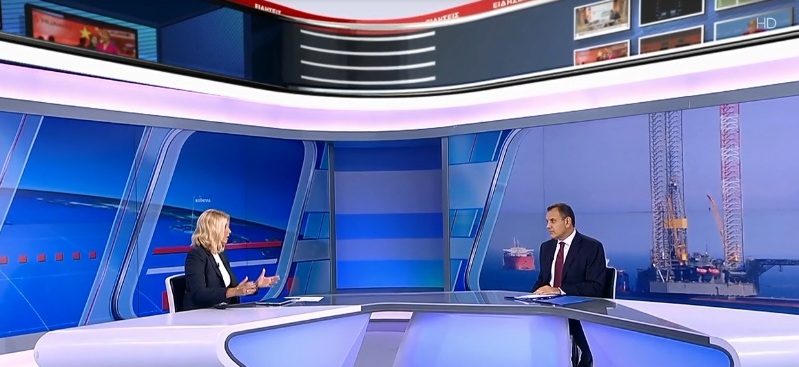
S. KOSIONI: Before focusing on the issues of our region, I would like us to take a look at what is happening in the wider region. There is great turmoil at the Syria-Aegean-Cyprus triangle. How worrisome is the situation? How much do the developments at the Turkish-Syrian borderline involve us, the Greek Pentagon, in combination with all other developments?
N. PANAGIOTOPOULOS: It is worrisome and the cause of great concern, at the level of multiple points of tension and unending instability, for which the Eastern Mediterranean is know for lately. All modern security challenges literally occur in this region. Hence, we must not be unheeding but we must remain vigilant, we must react to the developments and of course retain our Armed Forces at a high level of readiness.
Greece is present in the Eastern Mediterranean and so is Europe. Yesterday morning I was in Paris, at a very useful working meeting with my French counterpart and we discussed exactly that.
S. KOSIONI: You signed a document regarding frigates.
N. PANAGIOTOPOULOS: We signed a Letter of Intent regarding the shipbuilding of two frigates by the French. However, we have a long way to go until this effort produces something substantial. What happened yesterday was just the first step. Much more steps must be taken, particularly concerning the arming of this craft, which is a modern warship. Further meeting and collaboration will take place between the Hellenic Navy and the French General Directorate for Armaments.
The Hellenic Navy will certainly submit its requirements regarding this craft’s operational capabilities and the French will tell us if they can satisfy them or not. This will be the basis for our agreement.
S. KOSIONI: Minister, is our country entering an era of armament enhancement?
N. PANAGIOTOPOULOS: One of the basic strategic directions on which the Ministry of National Defence has to work is the upgrade of the country’s defence materials. In the context of this upgrade, our Fleet is also being modernised.
It is necessary to modernise our Fleet, because our ships -especially frigates- are quite old and in need of gradual renewal. The Belharra are state of the art frigates. However, I must insist that we have a long way to go until we finalise the armament and equipment of the particular craft. Like I said, the Greek side is helping the French. And the other equally important issue is to find funding for this shipbuilding. But if we do not resolve the first issue then we cannot proceed to the second.
S. KOSIONI: Let us regard our own developments. Before examining what is happening at the Cyprus Exclusive Economic Zone, I would like to reexamine the situation in Syria from the American point of view. Minister, I would like to ask you directly if you are worried by the stance of the Americans. Mr Pompeo did not openly condemn the Turkish provocative stance while visiting Athens nor during his meeting with you. He appeared to be trying to maintain the balance and on the next day, a few hours after his visit in Athens, his President gave the “green light” to Erdogan for his war operations. How do you interpret the situation?
N. PANAGIOTOPOULOS: First of all, State Secretary Pompeo made quite clear statements regarding the role and importance of Greece for the strategy and its relations to the USA. At that point we heard what we wished to hear. The next day our expectations regarding the Kurds and our American allies were not fulfilled due to the President himself. This of course pertains to the developments in Syria. From our point of view, I believe that we must state and feel satisfied from the American stance, especially through the expansion of the special strategic relation of Greece and USA, where the contribution of the Ministry of National Defence was appreciable.
S. KOTSIONI: Does the fact that this relation is expanding, this strategic cooperation between the two countries, practically mean that Greece has an American shield against any possible hostile act by our neighbours?
N. PANAGIOTOPOULOS: First of all it means that due to the Turkish stance, this instability, the fact that they have become a factor of instability in the wider region, that they give the sense that they are not a reliable ally in the ranks of NATO or directly to the Americans, we are here to cover this gap, because the Americans now acknowledge that the most reliable ally and strategic partner has always been Greece and only Greece. Greece is the undisputed security provider. This is acknowledged.
S. KOSIONI: NATO Secretary General seems to support the Turkish operations, as can be concluded by his statements, a fact which was decried by the Prime Minister himself.
N. PANAGIOTOPOULOS: It is the equal distance policy.
S. KOSIONI: Precisely! He remained faithful to the equal distance policy, a fact regarded as unfair by Mr Mitsotakis.
N. PANAGIOTOPOULOS: Yes, the Prime Minister was clear on this issue. I was present in this discussion.
Equal distance policy is not good when one of the two sides exercises a policy of revisionism, aggressiveness and provocation. That is the truth of the matter.
We would prefer a neutrality policy. Neutrality is a different thing than equal distance. Because equal distance wrongs the one who acts properly and benefits the one who does not.
S. KOSIONI: Minister, let us take a look at the Cyprus Exclusive Economic Zone. Here the matters have grown worse. A Turkish drill is already in the area. Some say that it is drilling and others say that it is not. What is your information on the matter?
N. PANAGIOTOPOULOS: There are conflicting views. Some say that the depth of that area makes it impossible for Yavuz to drill there. But the essence of the matter is not the research and drilling activity of Yavuz but its mere presence in the area, accompanied by Turkish warships.
Of course we consider it another provocative action by Turkey, which repeatedly conducts research and drillings within the Cyprus Exclusive Economic Zone which is a member-state of the European Union. I discussed the matter yesterday with the French.
S. KOSIONI: How can we respond in practice? It would be interesting to hear what the French told you. To conclude my question: How can we respond? We keep hearing you say “We are ready”, “We are determined”.
N. PANAGIOTOPOULOS: We are ready indeed.
S. KOSIONI: Yes but what does that mean in practice? You were saying previously “they should not dare to come because we are determined”. Now that they came we keep saying “We are determined”. What does it mean?
N. PANAGIOTOPOULOS: They came to the Cyprus Exclusive Economic Zone, in Gas Field Block 7, an area assigned to French and Italian companies. I discussed this yesterday with my French counterpart.
First of all, I believe that this is a stress test, concerning not only France but also the European Union. It is conducted by President Erdogan and the Turks against the Allies.
S. KOSIONI: What is the response of the French, since they have great financial interests in the area? And please clarify if you asked of them to have military presence in the area or not.
N. PANAGIOTOPOULOS: I will not ask for military presence with ships in the area. This will certainly be done by my Cypriot counterpart or more so by the Cypriot President. I am not in a position to make such a request.
I just asked -probed their intentions- if they are going to respond with some kind of military presence in the area and they answered that they are sending a frigate. I have a similar impression regarding the Italians. I am not certain, but I think that they are going to send something too.
S. KOSIONI: To Gas Field Block 7…
N. PANAGIOTOPOULOS: Block 7 is the one where the French and Italian companies have direct interests. It is a symbolic gesture, which in a way sets off the Turkish presence.
S. KOSIONI: It is not just symbolic but substantial, in the sense that there will be a great concentration of forces, if all of the above are materialised.
N. PANAGIOTOPOULOS: That is so! The concentration of many forces in a limited area is not a positive development.
This area is enormous. From what I understand, the Turks will operate on a certain spot of Block 7, for which there is ambiguity whether it lies within their national waters or within their Exclusive Economic Zone, which they are announcing based on their own criteria.
The French operate in another area. There is a great distance between them. Thereafter, the presence of both in this area means that each of them tries to consolidate its potential interests. And that has a meaning of its own.
S. KOSIONI: Are there concerns about a hot incident in the area?
N. PANAGIOTOPOULOS: When military forces are present in a limited area, especially when this presence is escalated with the addition of more crafts, the probability of a hot incident increases. So do the concerns.
But we register the initial presence. I do not think that anyone is willing to cause a hot incident between a Turkish and a French ship. I certainly do not think so. However, it is important for every actor in the area to consolidate its presence and the fact that it is here protecting its interests.
S. KOSIONI: Do you know when will the French forces reach the area?
N. PANAGIOTOPOULOS: No. A frigate is already patrolling the area. They may have already reached the area or they may reach it soon.
S. KOSIONI: If supposedly a hot incident occurs in the area, what will be the role of Greece? Will our country engage or not?
N. PANAGIOTOPOULOS: Like Mr Pompeo, I will say that it is difficult to answer to hypothetical questions. But in any case, what we have to do, what mu duty is, what my mission and that of my associates in the Ministry of National Defence is, along with the rest of the Political and Military Leadership, is to preserve our readiness and the high degree of combativeness of the Armed Forces. What we call deterrent force.
Deterrence means that you establish a conviction that if someone attacks you then the cost of this action will be far greater than the gains. So you guide the other towards a decision to not dare to try anything against you. That is deterrence. That is the deterrent force of the Armed Forces.
S. KOSIONI: At a diplomatic level, we understand that the Government is taking the initiative at the forthcoming Summit. Tell us what you know Minister. Will we ask for the activation of the Sanctions Plan against Ankara, due to the tension of the provocations within the Cyprus Exclusive Economic Zone?
N. PANAGIOTOPOULOS: We are always asking for the activation of sanctions against Ankara when it demonstrates this kind of challenges and violations.
S. KOSIONI: All of the European member-states have agreed in a certain framework of actions and sanctions, if things get out of hand. So if the leaders agree that things have got out of hand because Turkey has crossed the “red line”, something that we believe has already been done, then a response has to be given.
N. PANAGIOTOPOULOS: Obviously, they will proceed to the enforcement of sanctions.
S. KOSIONI: Will that be our request?
N. PANAGIOTOPOULOS: Rhetoric of sanctions has already been conducted. But it has not deterred Turkey thus far.
I would not propose a total war. I do not wish to be misinterpreted! But, thereafter, I believe that Europe must in some way demonstrate its unwillingness to accept the crossing of “red lines”. The presence of French and Italian ships in the contested Block will be a first step. We will see what will be the end result of this kind of deterrence.
Thereafter, I agree with the Romans: “If you want peace, prepare for war”. That is the way to operate, not due to your bellicose nature, but because you want to deter war.
We must preserve the high level of readiness of our Armed Forces. This is a constant effort, to renew our arsenal, to make it more modern, capable and conducive so as to meet the modern security challenges. We must always be based on the Armed Forces personnel, which in my opinion is of the highest quality.