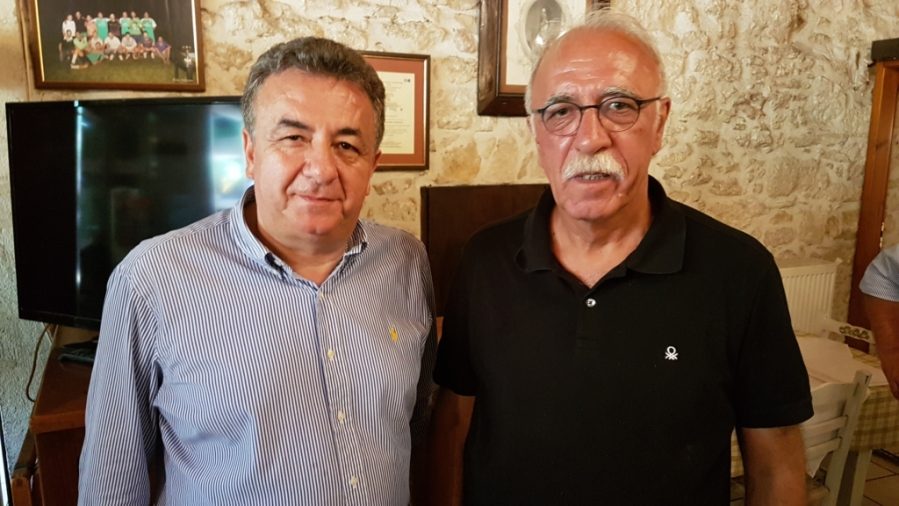
The Alternate Minister of National Defence Dimitris Vitsas, in the context of his visit to Crete, on Friday 5 August visited 133 Combat Wing in Kastelli Heraklion and met today, Sunday 7 August 2016, at Archanes Heraklion with the Regional Governor of Crete Stavros Arnaoutakis, in the presence of HNDGS Chief Admiral Evangelos Apostolakis HN.
The Alternate Minister among others, stated:
On the Heraklion Airport:
The procedure concerning the expansion of the Heraklion Airport has been completed, so pretty soon it will be at full disposal for expansion, since this July, as I have been informed by the Airport Master, we have had a record of arrivals. The proposal by the National Defence Fund and Hellenic Army General Staff is positive, while the Hellenic Air Force one, has been positive for some time now. So, the project may proceed swiftly.
On the developments in Turkey:
The situation in Turkey- anyone may realise – is not smooth. When the going gets tough in your neighbour’s house, you should not turn a blind eye. In other words, you should be alert. We are at full alertness, as HNDGS Chief may assure you as well. We feel reserved, decisive and certain, because the Armed Forces capabilities are at the highest possible level.
On the impact of the economic crisis on the Armed Forces:
The economic crisis may have changed our way of thinking as far as Armed Forces matters are concerned, in the sense that we are now following a more reasonable path. Reconstruction itself, the organisation of the Armed Forces, along with the upgrade and the modernisation of our assets, prove to be more necessary than ever. The days of unreasonable spending are over.
I have to stress at this point that the force multiplier of the Armed Forces has always been its people, its personnel. We are keen on them acquiring new levels of knowledge, being at full operational readiness and, of course, we are especially interested into their welfare. Recently, we have introduced some changes that facilitate and empower our operational capability, jointness and cooperation organisation. This became evident with the recent crisis in Turkey, as far as swiftness and cooperation was concerned.
On refugee flows:
The refugee flows this year are pretty reduced compared to the ones we had last year. We have an average of 100 people per day. However, this is a significant number because the borders are closed. In the near future the following developments are expected: for those who have their political asylum request examined, the procedure will be completed and based on the agreement those who are today on the islands will relocate to continental Greece. We are ready, we have empty hospitality posts and with the contribution of the UNHCR, which hosts refugees at houses, we can deliver.
Of course we are concerned, in the sense that we are working and preparing on the possibility of future increase of flows. Two parts of the agreement are very important, one concerns the resettlement of legal refugees to other European countries – I do not see why some countries deny these decisions – and the second one concerns returning the illegal refugees who have arrived to the islands. These developments will show in the future, and we must insist politically on them, because they constitute two parts of the agreement that lag behind.