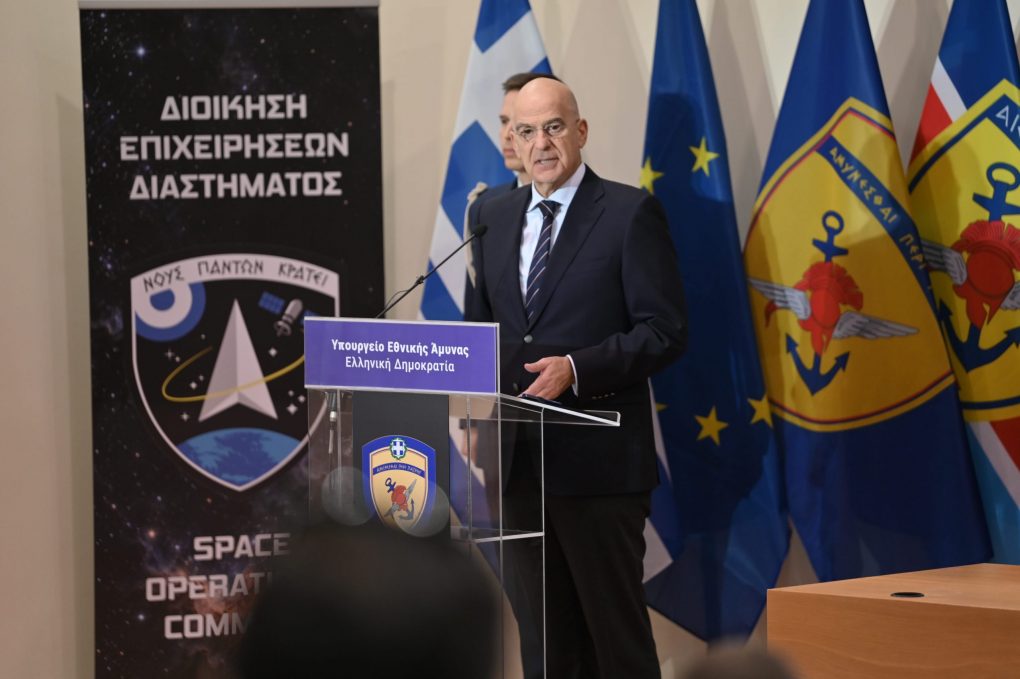


The Minister of National Defence, Nikos Dendias, attended today, Monday 9 November 2026, the inauguration ceremony of the Space Operations Command, at Dekelia Air Force Base. The ceremony was officiated by His Eminence, the Metropolitan of Ilion, Acharnes, and Petroupoli Athinagoras.
Afterwards, the Minister of National Defence was briefed on the mission of the Space Operations Command and watched relevant audiovisual material. In addition, he visited the Command’s facilities, where he had the opportunity to attend a demonstration of the function of the Space Operations Centre.
The Space Operations Command is part of the “Agenda 2030” for the complete development of the space architecture of the Armed Forces through the enhancement of already existing capabilities and infrastructure and the acquisition of new ones. The vision behind the Space Operations Command is for our country to become a significant actor in this particular area, thus securing our national interests.
In his address, Mr. Dendias stated the following:
“Today’s inauguration of the Hellenic Air Force’s Space Operations Command Centre, is, if I may say so, a very essential step towards the transition of the Armed Forces into the new era.
During the recent presentation of the third phase of the New Force Structure 2024-2035, I stressed the need for the Armed Forces to adapt to the modern, joint framework of multi-domain operations; a new reality that is already here, where Space, Cyberspace, and the Electromagnetic Spectrum are combined with the traditional domains of operations: sea, air, and land.
The lessons learned already show that space is the crucial domain for the conduct of military operations. Please, note what happened to Ukrainian communications recently when they lost access to their space capabilities.
So, the creation of the Centre we are inaugurating today is an answer to this new reality that is already upon us. Its mission, as its Commander and the Chief stated, is the systematic utilisation of satellite capabilities and their integration into the operational planning and operations of our Armed Forces.
Until today, we have been buying these services from abroad and that is, of course, not enough. We absolutely need satellite information to be owned by Greece and integrated into our command and control systems, so that it can be timely used on every level of operations.
This is exactly the logic behind the transition from the old “C4I” model to the new “C5 ISRT” architecture, which unifies Command, Control, Computer Processing, Communications, Cyberspace, Intelligence, Surveillance, Reconnaissance, and Targeting. That is a unified operational and vertical architecture.
Through that, the information from satellites and numerous sensors, such as the helmet-mounted display on each individual soldier’s helmet, will be available for use by ships, aircraft, land-based units, and the Armed Forces altogether.
In other words, we are making up for a big, existing gap. We are not innovating. We are bridging an enormous gap that was already there. I want this to be understood by everyone, especially given that there are other countries – even here, in our region – which already have a strong presence in space.
Of course, you understand that having the communications of our Country during crisis, for example, rely on a third country’s private company and its satellite, with “beneficial ownership” of a third country, is not an acceptable solution in the 21st century.
For this reason, we are creating a multi-layered system that is absolutely necessary. Firstly, we are utilising, modernising, and incorporating our already existing assets. As you know, the satellite ground station of the “HELIOS-II” European Military Programme has already been established at the 114th Combat Wing in Tanagra
There is also the satellite communications ground station in Atalanti.
Let us see now what has been created during the past months. We have already acquired 16 dual-use, Low Earth Orbit optical satellites in cooperation with the Ministry of Digital Governance. I would like to thank the Minister, Mr. Papastergiou, for that. However, those capabilities are not even remotely enough. For their further enhancement, the planning, which you saw before, includes the development of 6 optical observation satellites, 3 SIGINT electronic signal collection satellites, and 3 Synthetic Aperture Radar Satellites.
All these must sound strange, perhaps not to you, as most of you are experts on the subject. “Why both optical and radar satellites?”, one might ask. When there is fog, an optical satellite is unable to do much. Nowadays, at times we must theoretically have absolute knowledge of what is going on in our broader region; which Minister can wait for 24 hours in order to purchase a photograph of our broader region from a foreign provider?
Ladies and gentlemen, the planning aims to create a complete Low Earth Orbit satellite surveillance and information collection system, which will immediately ensure operational perception.
Nevertheless, that requires safe and reliable information sharing capability. Consequently, the development of military communications satellites is an additional and equally crucial necessity for our national planning.
The hosting of one out of two hubs of the European “GOVSATCOM” programme in Attica has been decided and that is also very important. It will support secure government communications, the protection of critical infrastructure, crisis management, and, of course, that gives us a role to play in the European security architecture.
Also, there is our participation in the EU’s “IRIS2” Secure Satellite Connectivity Programme. That is linked to the planning for the acquisition of three Medium Earth Orbit communications satellites. We always try to take advantage of the capabilities offered to us through our participation in the European construct.
However, we need an independent presence, a national system of military satellite communications. That is why our Long-Term Defence Armaments Programme includes the rapid acquisition of a military grade geostationary communications satellite.
That is an absolute national necessity. Without it, our country will face immense problems in times of crisis.
So, with that mindset, the MILSATCOM National Programme aims to form a complete, Greek-owned system, with a completely national operational control of the satellite, the ground stations, and the communications network.
Its strategic significance, which I do not need to explain to Officers, revolves around ensuring our Country’s capability to control its crucial military communications without depending on third-party services, especially during crisis.
A necessary addition to the national space capabilities is the creation of a national technological base, which will be able to ensure the support and development of the satellites.
This includes the Greek infrastructure for the assembly, integration, and testing of space equipment that is already up and running at the Hellenic Aerospace Industry, which I visited last week for this particular reason. It offers us the opportunity to carry out projects within our country, enhance our know-how, and have the Greek industry participate in space programmes. That is also part of our self-sufficiency.
Therefore, ladies and gentlemen, you were presented with an overall demonstration of the activities supporting our presence in space.
I would like to reiterate that this is not a step towards the future. Rather, it is about bridging gaps carried over from the past.
The capabilities of our Armed Forces must always address the requirements of our time. All that is for them to be able to guarantee the security and independence of our Country and the right of the Greek society, the Greek people, to make decisions for their future independently.
Thank you very much”.
The inauguration ceremony was also attended by the Chief HNDGS, General Dimitrios Choupis, the Secretary General of National Security Thanos Dokos, the Chief HAGS, Lieutenant General Georgios Kostidis, the Chief HNGS, Vice Admiral Dimitrios – Eleftherios Kataras HN, the Chief HAFGS, Lieutenant General (HAF) Dimosthenis Grigoriadis, the Director of the HNDGS F Branch (Transformation, Innovation, and Defence Technology), Major General Georgios Panousis, Honorary Chiefs, General and Senior Officers of the Armed Forces, and students of the Hellenic Air Force Academy.