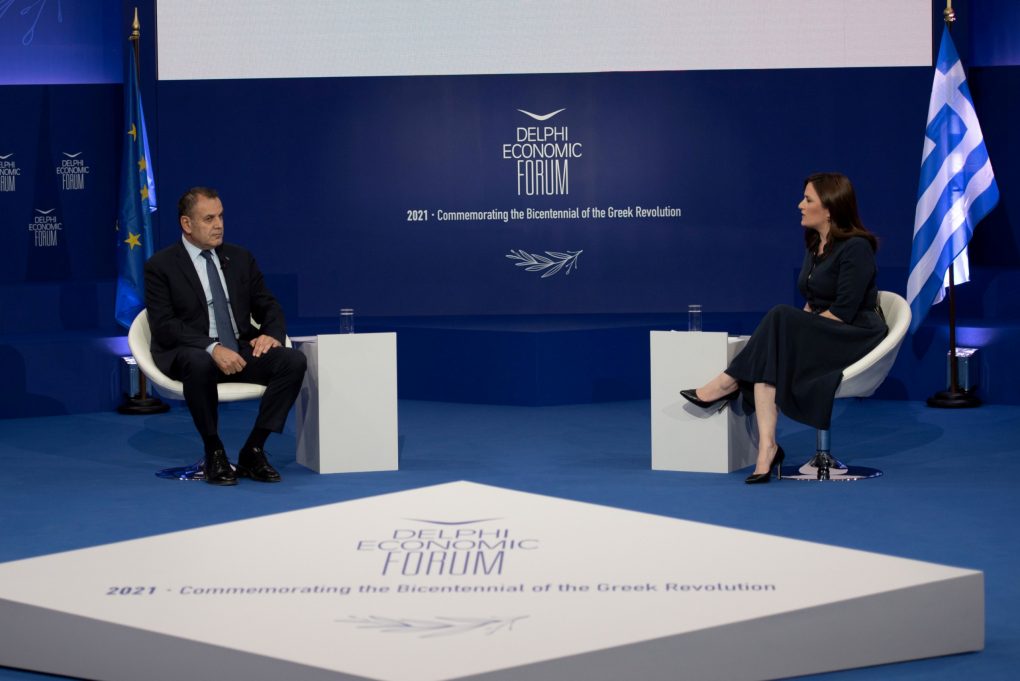
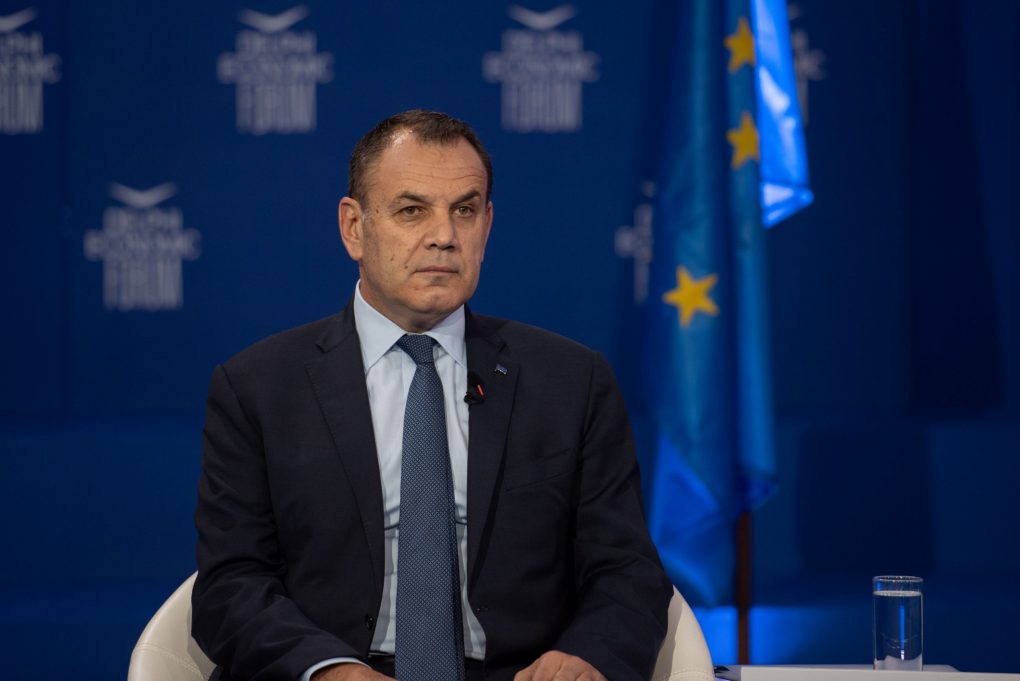
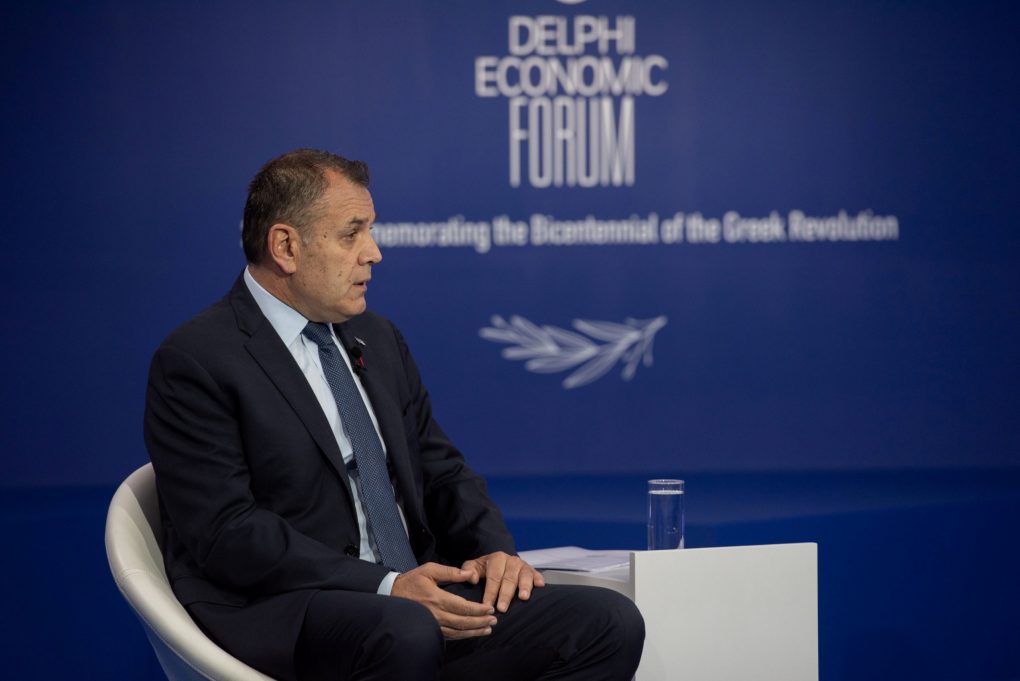
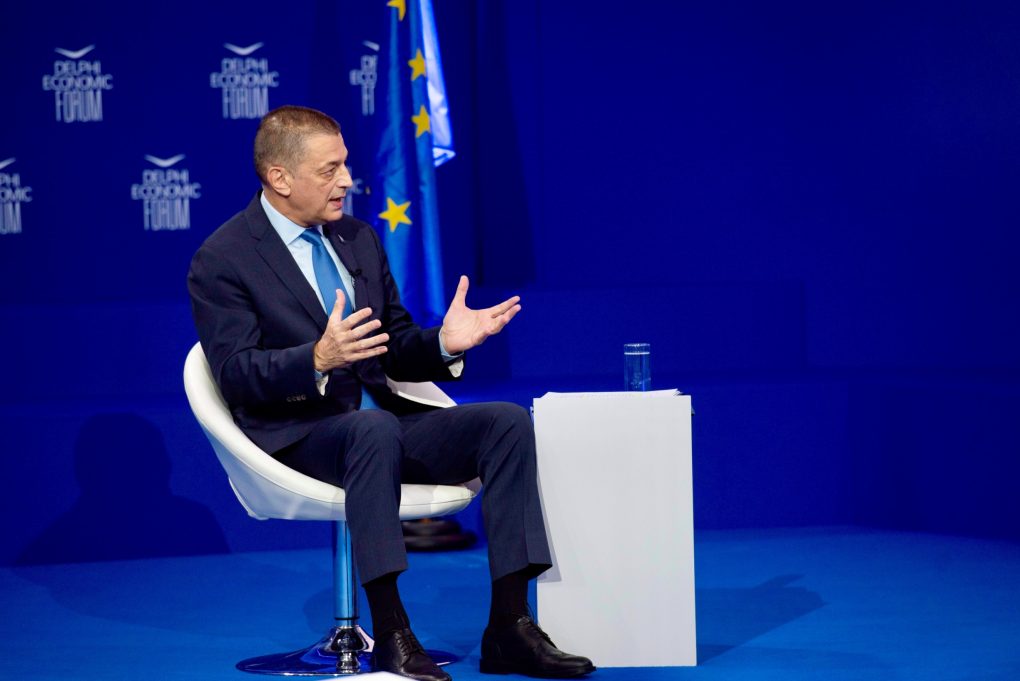
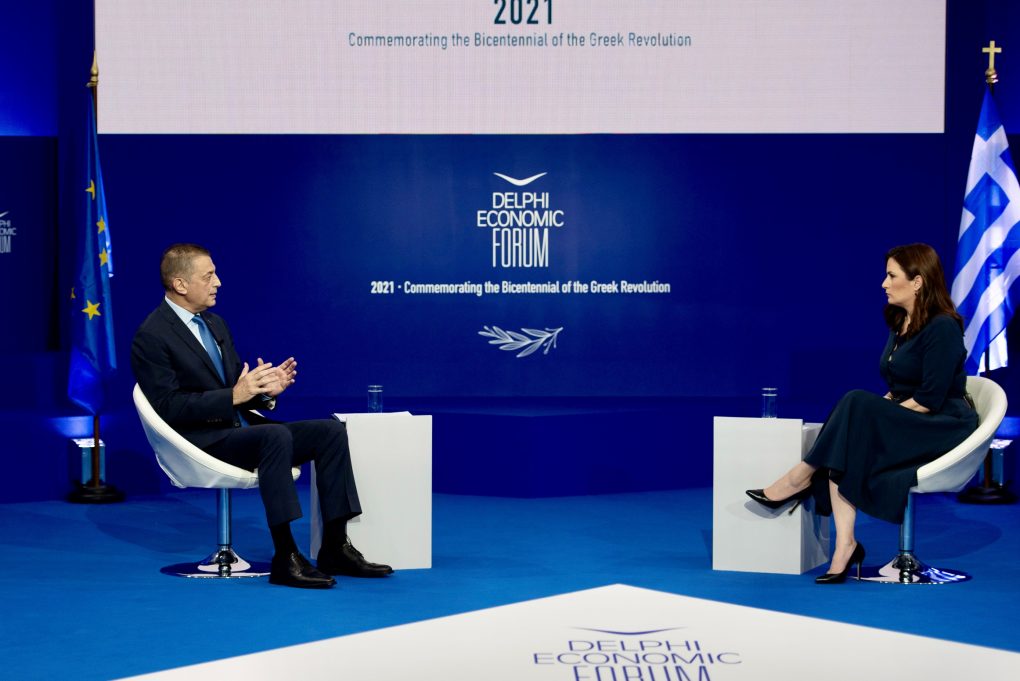
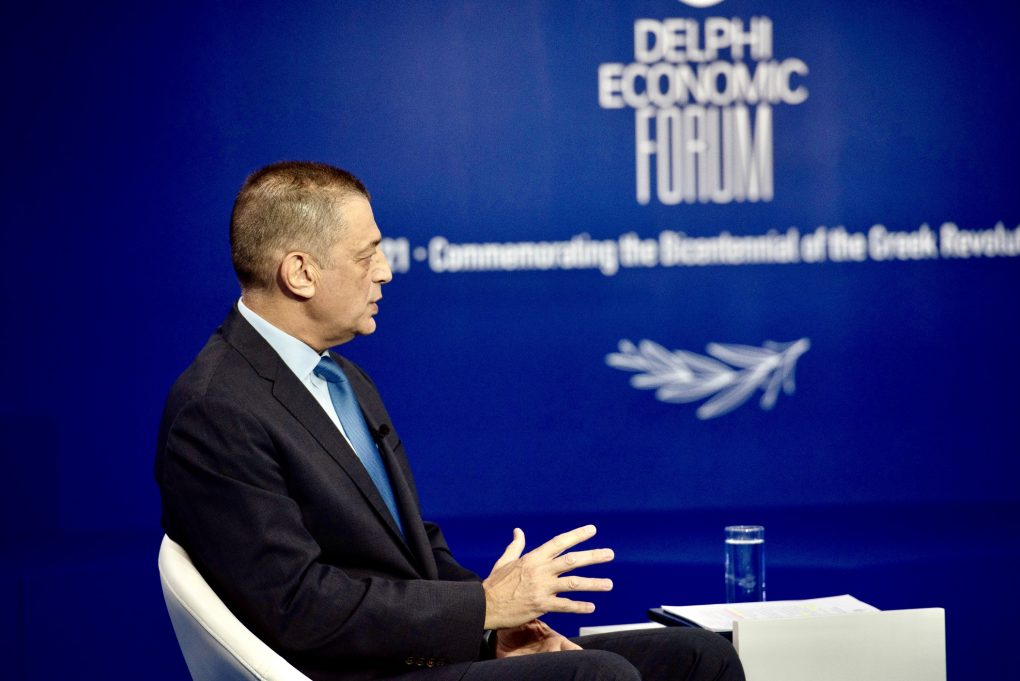
Today, Saturday 15 May 2021, the Minister of National Defence Mr. Nikolaos Panagiotopoulos and the Deputy Minister of National Defence Mr. Alkiviadis Stefanis attended the works of the Delphi Financial Forum and discussed with journalist Mrs. Alexia Tasouli the current developments, the military objectives of the country relating to Defence and Security matters, as well as the social contribution of the Armed Forces.
Here follows the complete text from the Minister’s participation:
ALEXIA TASOULI: During such circumstances Mr. Minister when the developments in the Middle East are quite significant at military and diplomatic level, allow me to highlight the importnant role you have recently undertaken by chairing at European level, the Ministers of Defence Meeting, of the European People’s Party. At this point I would like to point out that defence diplomacy within the EU and NATO is equally important with military power.
Please tell us what is the importance of this post assumed for the first time by a Greek Minister of Defence.
NIKOLAOS PANAGIOTOPOULOS: It is always a good thing of utter importance each time a Greek official assumes an international role in a forum such is the EU, the great European family. It was quite an honour for me which I gladly accepted.
The presence, the readiness, the quality of the Armed Forces of the country is reflected in my face. This was proved in 2020 through the successful management (not only by the Armed Forces but also by the Security Corps etc.) of the Evros crisis and later on by the successful management of the extended crisis and tension with the neighbouring country in the Aegean and SE Mediterranean.
Europe acknowledges that Greece has highly deterring and impeccably functional Armed Forces, hence the Greek Minister of National Defence can assume the Presidency of the Body of the Ministers of Defence and the EPP. This also promotes the significance of the defence diplomacy for our country. Over the past years he have demonstrated a specific activity in the field of defence diplomacy, of course in Foreign Affairs as well, a field mapped out by the Prime Minister himself and the Minister of Foreign Affairs. We, in the Ministry of National Defence have our role to play.
We have chosen multiple and multi-dimensional approaches with our partners and Allies in the region, countries which share the same concerns and views on security and stability issues in the Eastern Mediterranean. We have developed multi-partied cooperations, for example the two trilateral partnerships with Cyprus-Israel-Greece and Cyprus- Egypt- Greece or the four-partied partnership with Cyprus- Greece-France-Italy, as well as bilateral relations with Arabic countries sharing with us the same views on peace, security and stability in the wider region (e.g. Egypt- the UAE- Saudi Arabia).
Of course there are also relations with our European partners, especially with Southern Europe countries, initially with France, as well as with Italy and other countries, as well as northern Europe partners, with whom are always in close contact and exchange views, trying to find the balance which will safeguard peace and stability in the wider region.
They are all willing to listen to our views and this demonstrates the fact that defence diplomacy is a rather beneficial vehicle for us to promote our national laws.
ALEXIA TASOULI: Recently, NATO Secretary General Mr. Jens Stoltenberg stated that he would like a compromise between the two Allies, that is between Greece and Turkey, in order to avoid a “hot incident” . He has publicly stated this and I assume that he has expressed it to you in person.
What is Greece’s reply within the Alliance?
NIKOLAOS PANAGIOTOPOULOS: Certainly NATO being a military Alliance is an organization which does not desire tensions within its interior, that is among its Allies. My position, which for quite some time now have been openly expressing at NATO level, is that Turkey’s stance during our days is a destabilizing factor for peace and stability in the Eastern Mediterranean, as well as for the internal cohesion of NATO. Hence, something needs to be done
Following last summer’s crisis Secretary General Mr. Jens Stoltenberg, took the initiative to impose the so-called “de-escalation mechanism” in order to avoid the recurrence of situations we were faced with last summer between Greece and Turkey, with both their fleets deployed in a rather constrained area, posing the risk of an accident, an escalation of the tension etc.
It is good to have such mechanisms. That said, however, the other side should comply with some internal NATO rules, rules of solidarity among Allies and above all with International Law and the rules that govern it.
This is our solid position as far as Turkey’s stance is concerned, and we will come to the table of negotiation in good faith and guided by good-neighborly relations among Allies. Of course this mechanism has mainly to do with the existence of a 24/7 line of communication between the Operations HQs of the Armed Forces of the two countries.
ALEXIA TASOULI : Is there such a line Mr. Minister?
NIKOLAOS PANAGIOTOPOULOS: Yes, there is. We will see how it will actually work. The good think is that it is there and it will help to avoid escalations or accidents. However, it is important to know the limits of this mechanism. The limit is that it is just a channel of communication among the military members of both countries and that the total of the differences can only be resolved at political-diplomatic level, since these differences concern this field.
However, it is a good thing –in order to avoid escalation or further tensions –to have this de-escalation mechanism established by NATO, which will prevent further tensions which undermine the internal cohesion of the Alliance. This is the whole point.
ALEXIA TASOULI : I imagine that the Confidence Building Measures shall move along these lines as well, another mechanism aiming to de-escalate tensions between the two countries. We are waiting for the next round of CBMs. Can you elaborate on this? When is it expected and do we after all expect something from the CBMs?
NIKOLAOS PANAGIOTOPOULOS: It is a general principle that it is always good to have channels of communication between the two countries. We know the CBMs. They are a channel of communication between the Armed Forces of the two countries, that is at military level. I would say they include low tension measures, but their serious added value lies in the establishment of a confidence climate between the two countries. This dialogue needs to be continued.
The next round of dialogue will probably be at the end of May. The two sides have exchanged their views regarding the possible dates. We have had major religious celebrations, Easter for us, which hindered us from setting a definite date. The next round of the CBMs dialogue will probably be at the end of May. Another thing which remains to be determined is whether there will be a meeting in person of via teleconference due to the pandemic problems in Turkey, which is expected to host the next round of CBMs talks.
ALEXIA TASOULI : It is a good think that they will take place, however don’t expect much to come out it…
NIKOLAOS PANAGIOTOPOULOS: I have delivered a statement on this but obviously it has been misunderstood. I have said that it is a good thing to have a dialogue on CBMs. I said that it is a good thing to have a dialogue on CBMs but it does not bear fruits when simultaneously we have provocative attitudes, such as the overflights above Greek territory which undermine the point of conduct of this dialogue. That is all and I believe it is clear.
ALEXIA TASOULI : Stetements delivered by Turkish officials are also undermining. For example, the Turkish Minister of Defence Mr. Hulusi Akar, has many times criticized the fact that the President of the Hellenic Republic, the Prime Minister, the MoD keep visiting the Greek islands, implying that this shouldn’t be happening since they should be demilitarized.
What is your answer to the Turkish Minister of Defence, Mr Hulusi Akar?
NIKOLAOS PANAGIOTOPOULOS: I can not provide a lengthy answer to this question. The only thing I can say is that no Turkish official can indicate to a Greek official –whether it be the Prime Minister-the President of the Hellenic Republic –any official – where they will travel within Greece. Quite simply, this cannot happen.
I think this applies the other way round as well. Who am I to indicate to Mr. Akar or any Turkish official where they will travel within Turkey. You realise that we do not accept any indications or recommendations. Now what lies behind all this, intensely demonstrated by the Turkish Minister of Defence is the demilitarization issue of certain parts of the Greek territory, mainly the islands.
ALEXIA TASOULI: That’s because Mr. Akar invokes the treaties.
NIKOLAOS PANAGIOTOPOULOS: My answer on this will be laconic, as before: What is threatened will not be demilitarized. Here we have an underlying threat against parts of the Greek territory and based on our sovereign right we can, and we are indebted to, take measures to defend the Greek territory. That’s all I had to say about this.
ALEXIA TASOULI : Now let’s move on to the armaments issue. What is there to expect from the frigate program? How close is the Hellenic Navy to presenting its final proposal to you? Will the final choice be based on clearly financial criteria, geopolitical ones? Or maybe both? Will there be an involvement of Greek companies in the final program?
NIKOLAOS PANAGIOTOPOULOS: A great undertaking has been underway over the past two years to upgrade the total capability of the country’s Armed Forces. We have the financial background to do so. We have a prioritization plan and we must apply it, because our weapons systems are becoming obsolete, they are technologically behind and as time passes more advanced ones are emerging. So, based on our prioritization we have to move on to the procurement of new frigates.
They are the most expensive of all assets, however the most necessary part of our armaments program right now, since our fleet is aging. The older frigates are 50 years old, while the younger ones are 40 years old. Even if we didn’t have this tension situation with Turkey we would have been faced with this decision. Hence, this decision isn’t being taken in the context of an armaments competition with Turkey. It is being taken in the context of upgrading and supporting our weapons systems., mainly the Hellenic Navy ones which need it the most.
So, we will procure four frigates. Right now the Hellenic Navy is considering the very interesting proposals it has accepted. The Hellenic Navy should evaluate them one by one and choose the best ones, or the unique best one. What I expect is a pre-choice- if I may call it so – of the three potentially most attractive choices, despite the fact that the differences are quite insignificant, the offers are very good based on the vessels, depending on the needs defined by the Hellenic Navy.
This will happen any time now, since we have no time on our hands for delays. This decision needs to be taken soon. Simultaneously we have expressed some other issues that should be satisfied, such as the involvement of the domestic Defence Industry. Certainly, we want to build some of these vessels in Greece, in Greek Shipyards with the participation of Greek companies for obvious reasons.
Of course, since the shipbuilding period will be quite lengthy (it will take some years), we are seeking an “Interim Solution”, meaning some vessels that will be delivered much sooner and will be made operationally available to the Hellenic Navy until these new four frigates have been built.
This is the “full package” that needs to be evaluated accordingly given on the offers we have on our hands. The main core of it will certainly be the best possible new vessels that can be delivered to the Hellenic Navy. This decision is theirs to take, having first evaluated the offers.
ALEXIA TASOULI: Thank you Mr. Minister. May I wish a peaceful summer for the Armed Forces, because last summer wasn’t so peaceful with the Armed Forces being on alert because of the Oruc Reis. Let’s hope that this summer will be a better one.
NIKOLAOS PANAGIOTOPOULOS: I will also wish a calm summer as well. It is for the benefit of both countries to have a peaceful summer, to allow for the growth of their economies through the tourist industries and spare the tensions between the two Fleets in the Aegean or the Eastern Mediterranean. Additionally, I would like to stress that our job is to maintain and enhance the deterring power of the Armed Forces, and render them ready at any given time.
Everybody knows that the Armed Forces are ready to defend the sovereign rights of the country, this is our primal duty and we are working toward this direction, so that we help the Armed Forces do their job. This is our duty.
The intervention of the Deputy Minister of National Defence Mr. Alkiviadis Stefanis included the following points:
The National Defence armours the future of the country and is based on four fundamental elements :
o Its personnel guided by a stalwart principles system
o Weapons Systems of a joint perception
o Procedures guided by the principle of decision-making
o Innovative mentality
The Armed Forces have a winner’s mentality, and act effectively with extroversion
The social contribution of the Armed Forces , during this health crisis, has been of defining significance
The National Defence of the country is a tool which produces policies of deterrence – security and extroversion
The holistic approach is considered the new concept of planning in the Armed Forces
The National Defence Planning is drafted through innovation tools.
While facing any problem we have to options: fully negating it or aiming to its improvement and change. We only choose the second option!