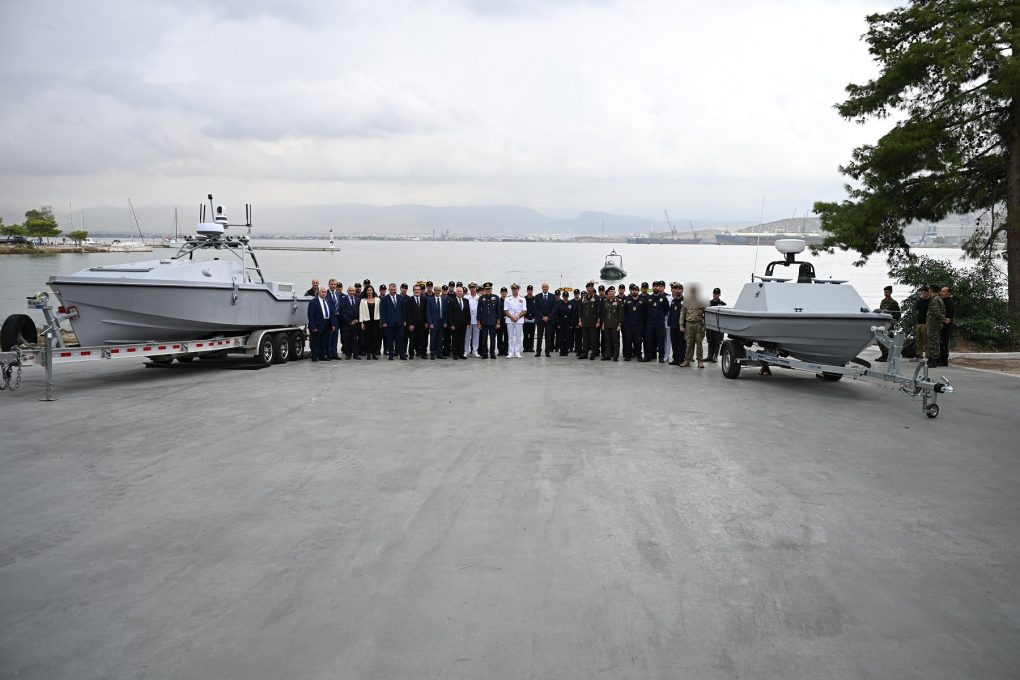
The Minister of National Defence, Nikos Dendias, attended today, 13 October 2026, the inauguration ceremony of the Joint Unmanned and Autonomous Maritime Systems Training Centre, which took place at Skaramagas Naval Fort (KANELLOPOULOS Naval Base) and, in particular, at the PALASKAS Training Centre of the Naval Training Command.
The ceremony commenced with a blessing officiated by Father Nikolaos Krassas, as representative of His Eminence, the Metropolitan of Nikea Alexios.
In his address during the inauguration ceremony, Mr. Dendias stated the following:
“Honorary Chiefs, allow me to stress how moving your presence at all the events of the Hellenic Navy is.
Ladies and gentlemen,
The “Agenda 2030” is just a title, which acquires its meaning when the foundations that can support the transition to the New Era are built.
As I have repeatedly said, we are reforming organisation, training, and jointness.
We are incorporating new technologies so that the Armed Forces can always fulfil their mission.
There is an order in all those things. In June we laid the foundation stone for the 309th Unmanned Systems Manufacturing Plant. In July we inaugurated the Joint UAS Training Centre in Tripoli.
Today, we are inaugurating the Joint Unmanned and Autonomous Maritime Systems Training Centre. Please note the distinction: Unmanned and Autonomous. Autonomous systems are one step beyond Unmanned ones, in the direction we must proceed. They are systems that utilise artificial intelligence, naturally under the control of human personnel, which nevertheless grants enormous capabilities to our Navy, particularly in archipelagic regions, such as the Aegean.
I will not hide my firm belief that, along with the Hellenic Navy’s new platforms, of course, after all in a few days we are flying our colours on “Nearchos” in France, the future at sea also demands the new platforms behind me, despite the shortages that we have. A few days ago in Venice, we reached an initial understanding with my Italian counterpart and the Chief of the Italian Navy regarding the grant of some minesweeper assets to Greece, so that we can overcome those shortages. Also, when I say “at sea” I mean both on the surface and underwater.
This new Navy can protect not only our sovereignty and sovereign rights, but also the underwater energy and communication grids, which are equally necessary for the Country’s security.
In addition, the autonomous systems can offer limitless potential to surveillance, recognition, the protection of ports, mine warfare, and, as I said before, the security of infrastructure. All those can be of great service to the personnel of our Fleet. Part of the surveillance missions and patrols of the Fleet can be carried out by the Autonomous and Unmanned Systems, helping our personnel rest and significantly reducing the days they remain at sea.
If we take the broader picture into consideration, for Greece, all these are necessary.
Of course, this new mindset, which I have been describing for a long time, acquires a more feasible, clear, and visible – I dare say – meaning. To my right, you can see an Autonomous Surface Vehicle with surveillance, reconnaissance, and autonomous and cooperative swarming capabilities, which was evaluated by the Hellenic Navy for the past weeks. However, I have to tell you that we cannot limit ourselves to the systems that we can acquire, even if our logic is that of acquisition of code and production within Greece.
We must also develop the capability to design and produce systems ourselves. Once again, to my right, you can see an example of that: the “Pyrpolitis” system is an Unmanned Surface Vehicle of Greek design and a project of the Hellenic Navy General Staff, naturally constituting a project of Greek development and design.
We built it. It has built-in autonomous function capabilities, which are currently at their final stage of trials.
A vehicle, which can gather information, provide surveillance, reconnaissance, and function, as its name indicates, as an attack vessel against floating targets, while generally incorporating all action capabilities. Of course, the next step is the production of the “Pyrpolitis” in great numbers, in order to enhance the Hellenic Navy, as well as the gradual design of larger Autonomous and Unmanned marine vessels.
All these initiatives are a part of a unified plan, which is on track, linking innovation with training, the production of systems, and their operational use, so that our Country can be the strongest power in the European Union by 2030 in terms of operational use of autonomous systems.
I would also like to reiterate that the Hellenic Navy will be the leading Navy in Europe in terms of autonomous platform development.
Apart from the Hellenic Navy, this applies to the Hellenic Armed Forces altogether. It applies to land, sea, and air. All these efforts have the same goal: the operational effectiveness and deterrent power of our Armed Forces.
We do not threaten anybody. We are only defending the constitutional and legal rights of our Country.
In order to achieve this goal, we need personnel with knowledge, skills, willpower, and capabilities.
We, the State, must provide them with the appropriate training. That is our duty. That is what the centre we are inaugurating today will achieve.
Thank you very much”.
After the cutting of the ribbon, the Minister of National Defence attended a static demonstration of Unmanned and Autonomous Maritime Surface Systems, with the most emblematic ones being the “PYRPOLITIS”, which was designed, developed, and built entirely by the Hellenic Navy and the “CORSAIR”, as well as a demonstration of Submarine Systems “PLUTO PLUS” and “PLUTINO”.
Afterwards, he was given a tour of the facilities of the Training Centre, where he was briefed by the Commander of the Naval Training Command, Rear Admiral Stefanos Sarris HN, and the Commander of the PALASKAS Training Centre, Captain Eleftherios Zervas HN, on the joint training provided and the competent officers for the maintenance and basic level repair of the Unmanned and Autonomous Systems, as well as on the manner of conduct, procedures, and assets utilised during practical training.
Then, the Minister attended a demonstration of basic simulators, as well as an operational scenario for Unmanned Surface and Underwater Vehicles at the Sea Trial Field of the Naval Training Command.
The inauguration ceremony was also attended by MPs Nikolaos Vlachakos, Georgios Vrettakos, Michail Livanos, the former Minister of National Defence, Honorary Chief HNDGS, and Independent MP, Retired Admiral Evangelos Apostolakis HN, Sophia – Haido Asimakopoulou, the Special National Security Consultant for matters of Defence and Armaments, Retired Vice Admiral Athanasios Nasopoulos HN, the Deputy Head of Region for Piraeus Stavros Voidonikolas, as representative of the Head of Region for Attica, the Alternate Head of Region for Attica Christina Kefalogianni, the Deputy Head of Region for Western Attica Charalambos Alexandratos, as well as other representatives of Local Government.
On behalf of the military leadership, the ceremony was attended by the Chief HNDGS, General Dimitrios Choupis, the Chief HAGS, Lieutenant General Georgios Kostidis, the Chief HNGS, Vice Admiral Dimitrios – Eleftherios Kataras HN, the Chief HAFGS, Lieutenant General (HAF) Dimosthenis Grigoriadis, the First Deputy Chief of Hellenic Coast Guard, Vice Admiral Fotios Kiamos, as representative of the Chief Hellenic Coast Guard, former Deputy Minister of National Defence, Honorary Chief HNGS, Retired Admiral Dimitrios Elefsiniotis HN, Honorary Chiefs HNGS, Retired Admiral Georgios Giakoumakis HN, Retired Admiral Nikolaos Tsounis HN, Retired Admiral Stylianos Petrakis HN, as well as General Officers of the Hellenic Navy.