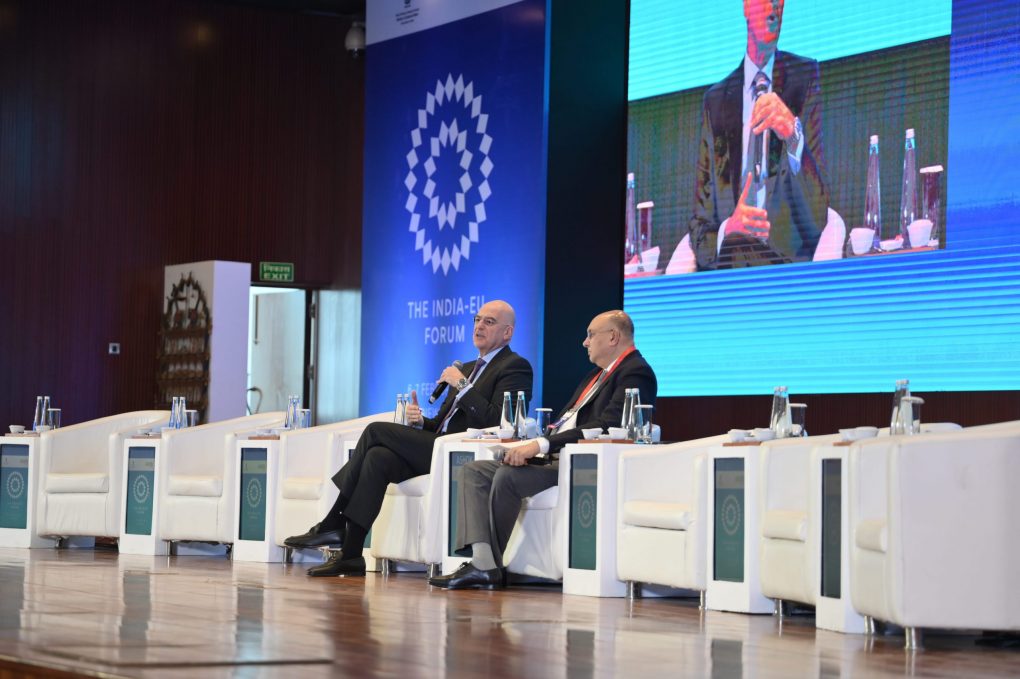
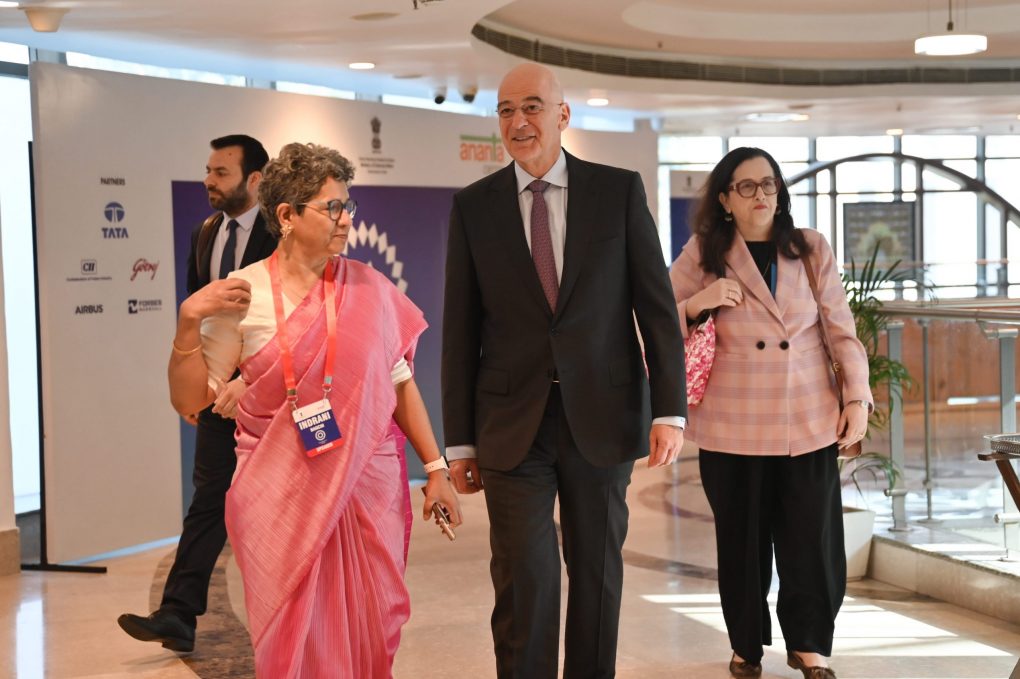
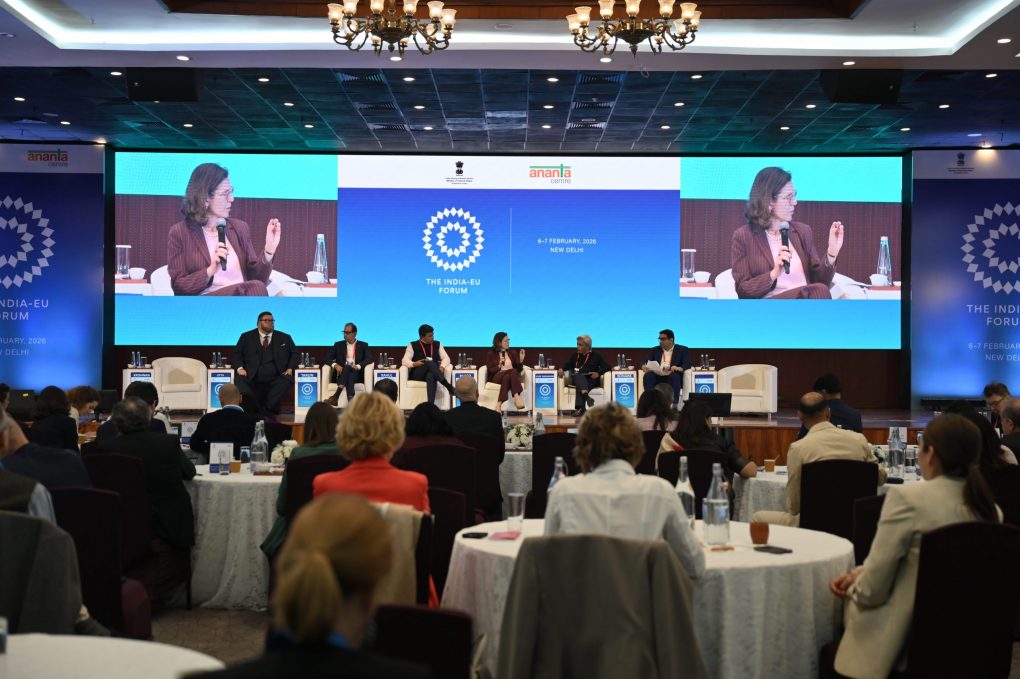
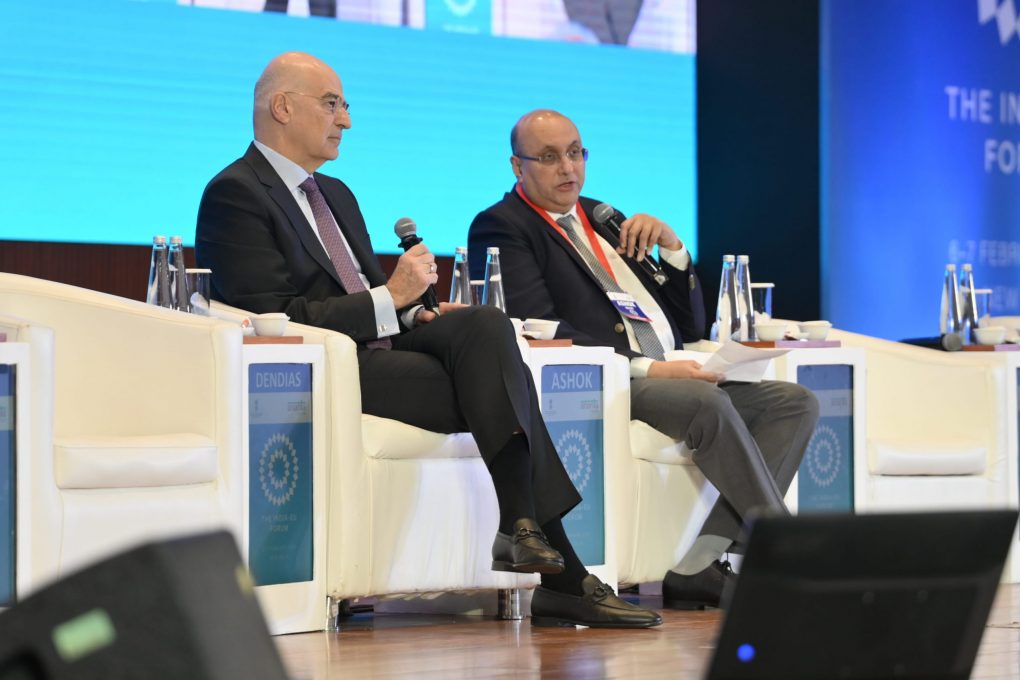
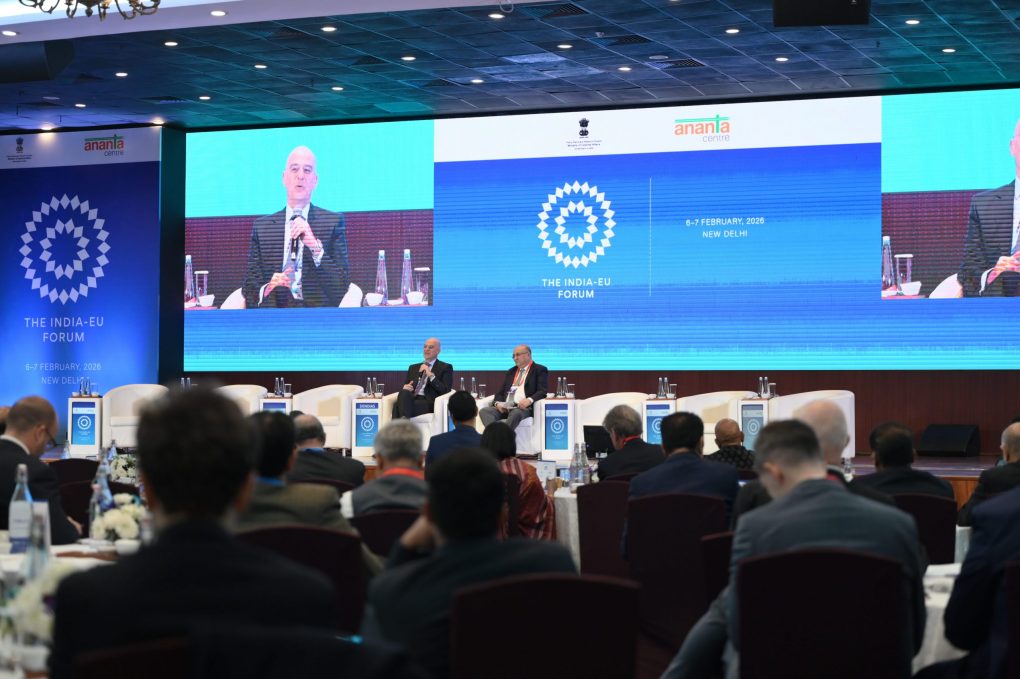
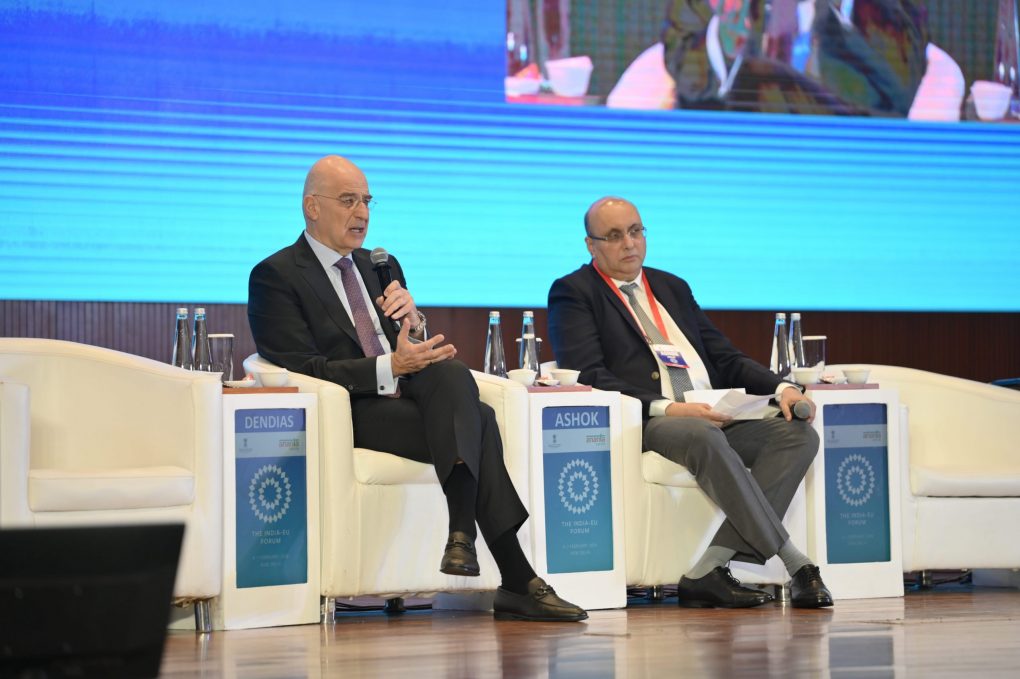
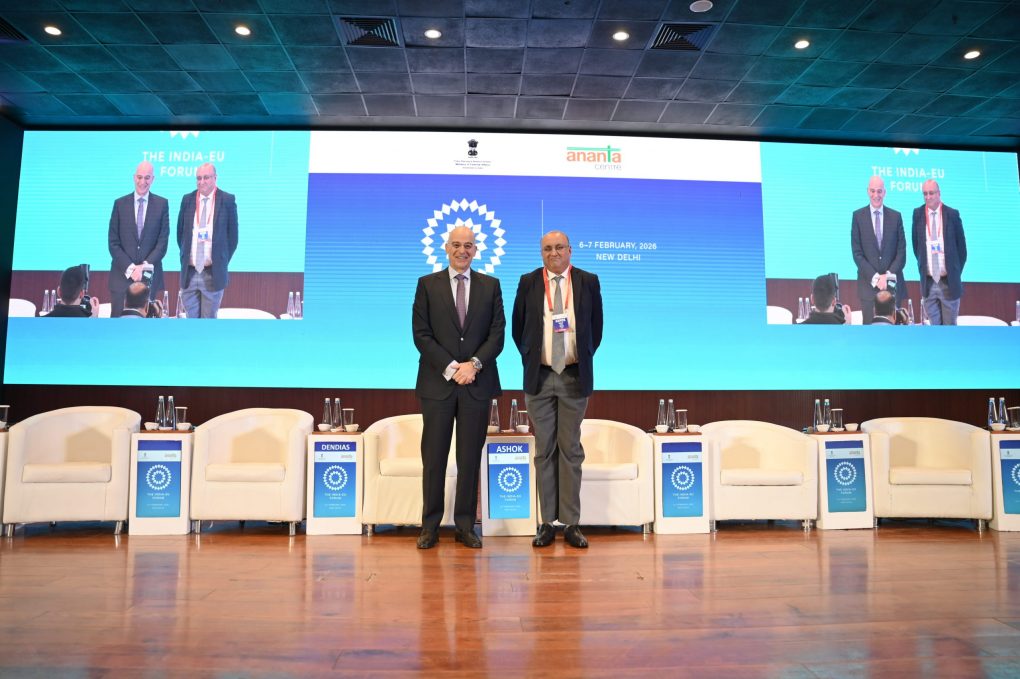
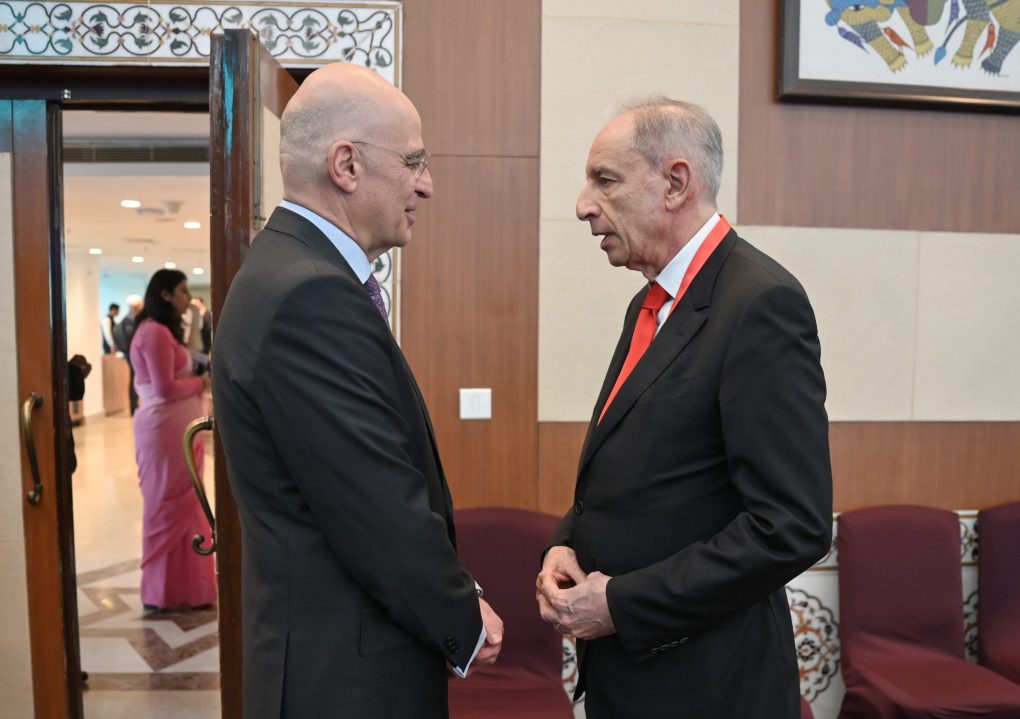
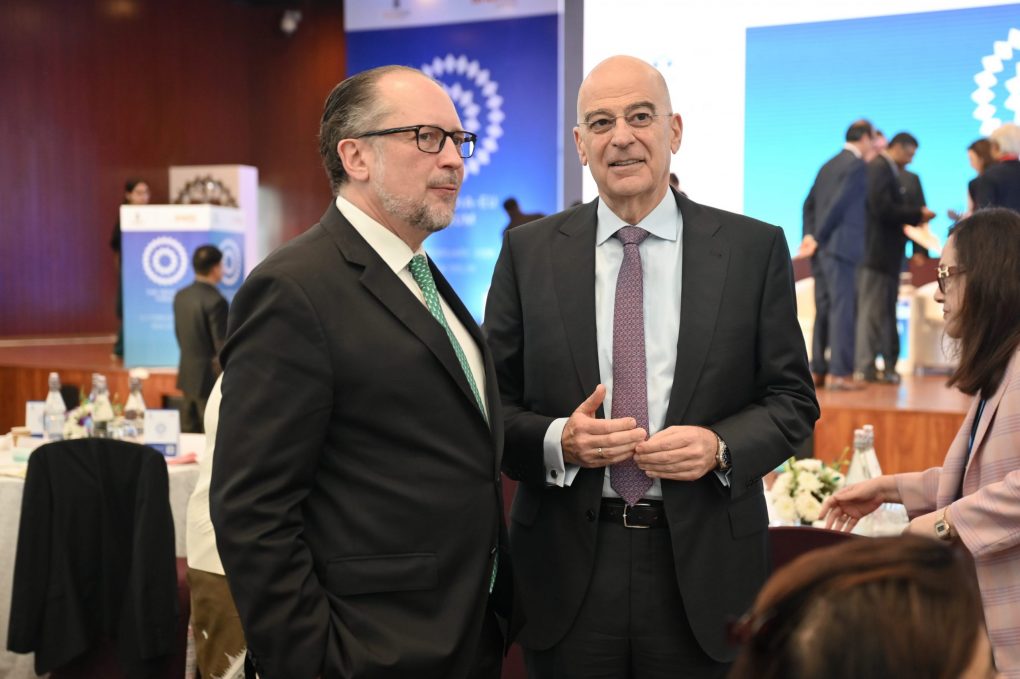
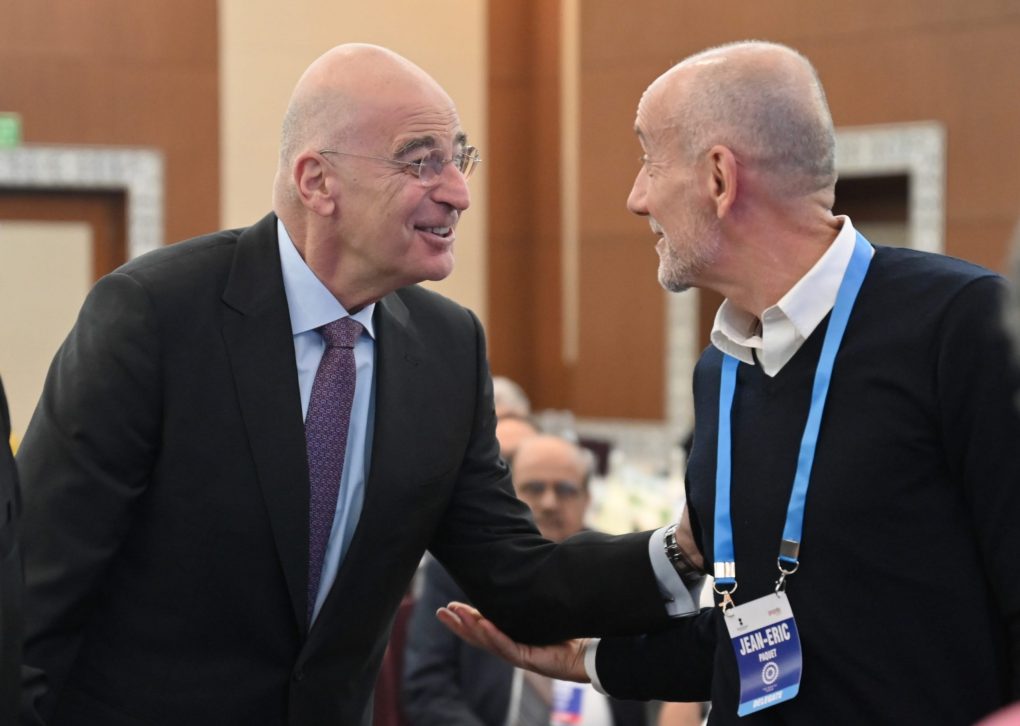
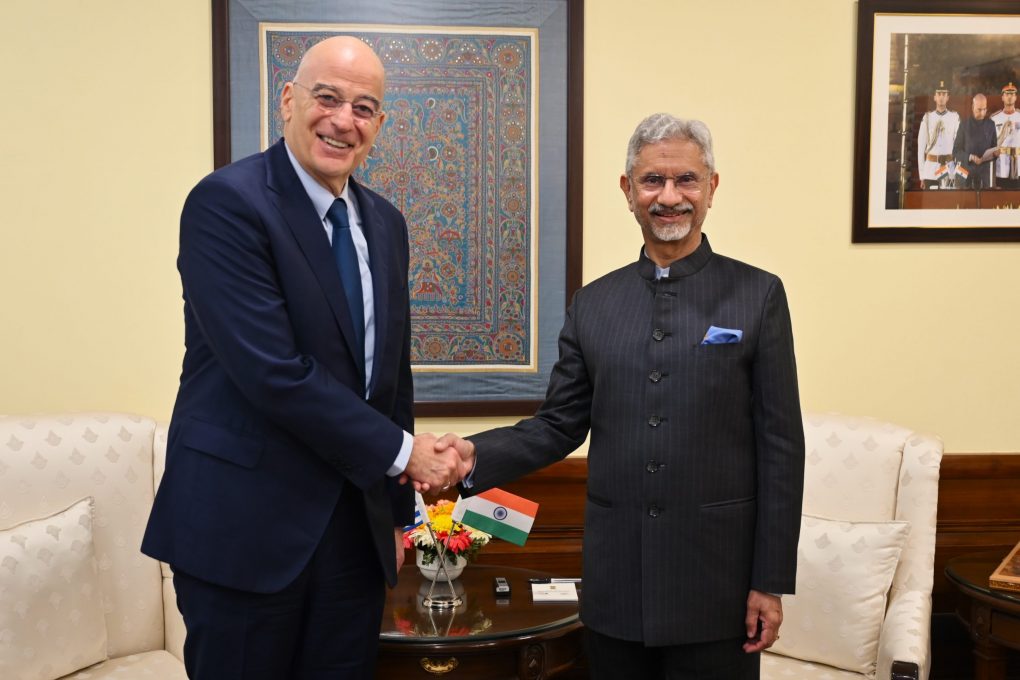
On Saturday, 7 February 2026, the Minister of National Defence, Nikos Dendias, participated in a discussion at the 1st “India – EU Forum”. Mr. Dendias was invited to participate in the Forum, which was co-hosted in New Delhi by the Ministry of External Affairs of India and the “Ananta Centre” think tank, in the context of his visit to India.
During the conversation with the Chair of the “India Practice”, Ashok Malik, and other participants of the Forum, the Minister of National Defence discussed European Defence comprehensively, and among others, pointed out the role India could play in the Hellenic defence ecosystem of innovation and technology.
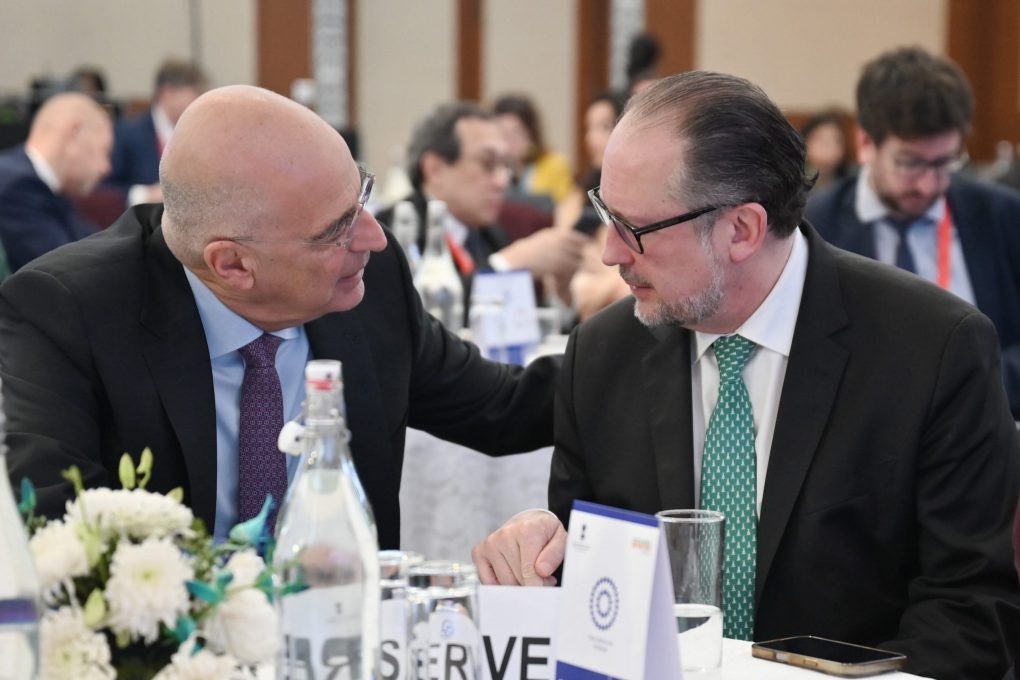
On the margins of the Forum, Mr. Dendias had meetings with the Secretary of State for Foreign Affairs of Poland, Władysław Bartoszewski, former Chancellor and former Minister of Foreign Affairs of Austria Alexander Schallenberg, and the Ambassador of the EU to Japan, Jean-Eric Paquet.
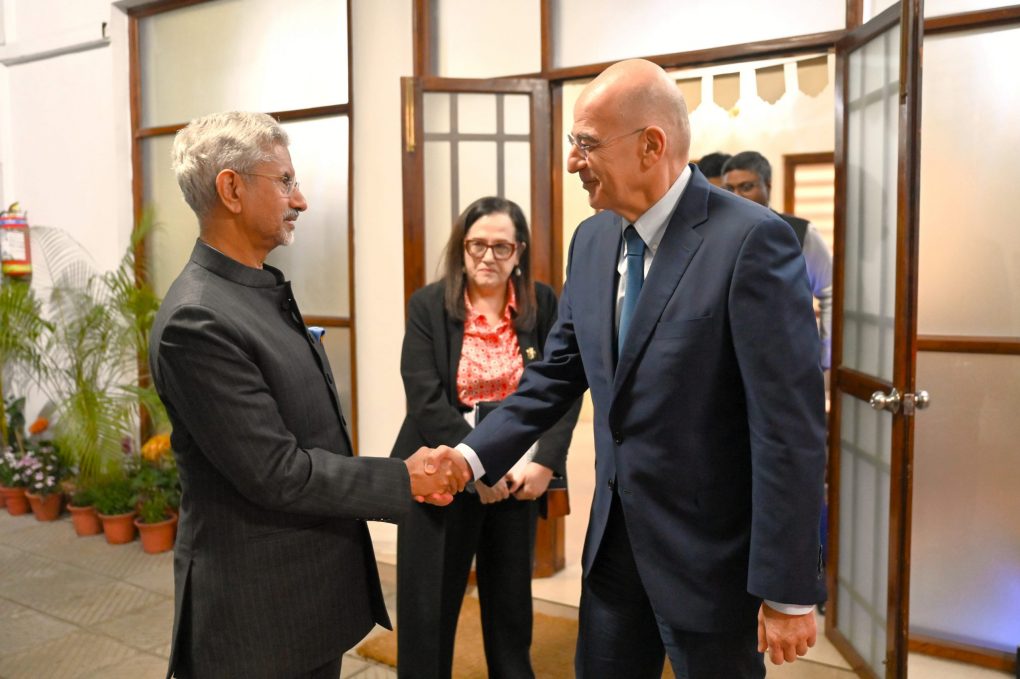
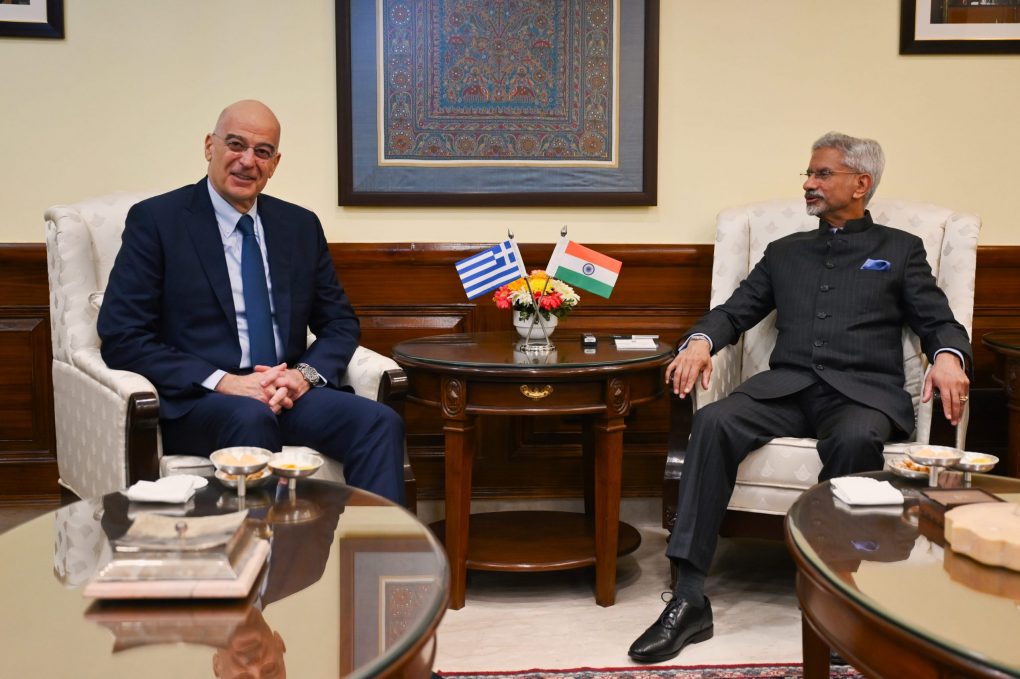
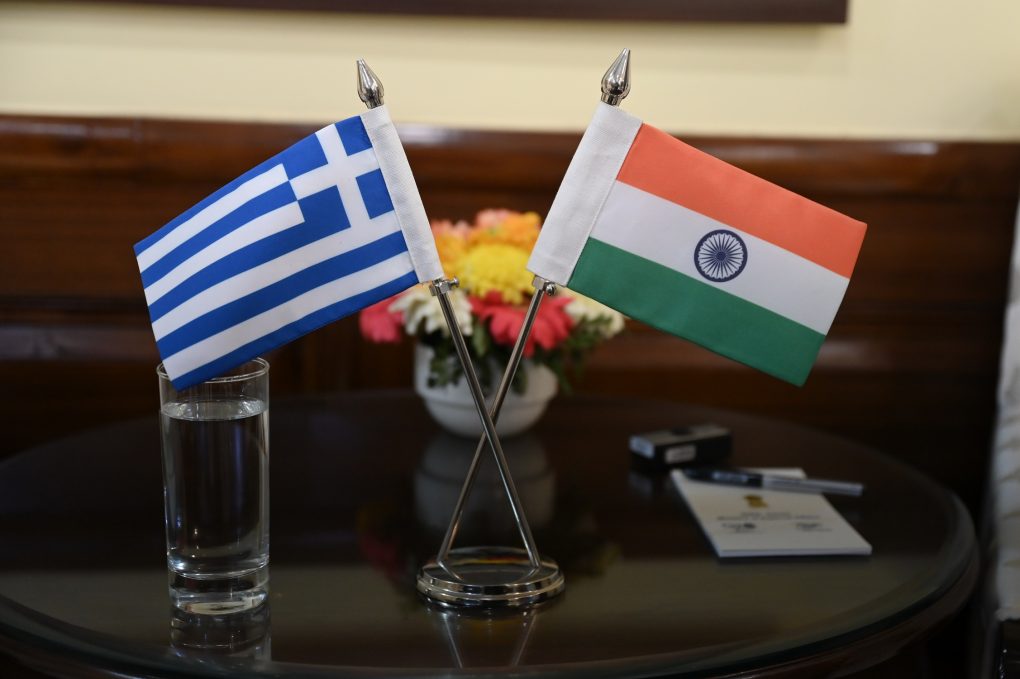
On Friday, 6 February 2026, the Minister of National Defence met with the Minister of External Affairs of India, Dr. Subrahmanyam Jaishankar, at his residence. During the meeting, the two Ministers exchanged views on regional and international developments, while Mr. Dendias thanked Dr. Jaishankar for the invitation he extended to him to participate and be a speaker at the “India – EU Forum”.
Below is today’s discussion at the “India – EU Forum”:
Ashok Malik: Minister, you wear multiple hats as Defence Minister of Greece, because Greece itself is a country with multiple identities. It is in a sense, a gateway from Asia into Europe, it is a member of the EU, it is a member of NATO. As such, any conversation with you will cover a grand sweep; will be limited to one aspect of the relationship. Let me begin right away, with an issue that came into global focus headlines only a few days ago. It seems to have gone away for the moment, but I am sure it will come back. Have we reached the floor in terms of the Trans-Atlantic relationship, and particularly the issue of Greenland? Is there still potential for volatility or do you think it has sorted itself out?
Nikos Dendias: First of all, let us agree on something obvious, that NATO is an alliance, a long-time enduring alliance, which guarantees the sovereignty, the territorial integrity of the countries that are members of NATO. There was a really big discussion concerning Greenland. We can all agree that Greenland is very important for the Trans-Atlantic Alliance. But the existing frame of treaties, especially between Greenland, Denmark, and the United States allows considerable freedom to the United States in Greenland, and a few years ago the United States had a huge number of bases in Greenland. I cannot remember the names by heart and sometimes I mispronounce them, for example, there was one in the high north, Pituffik if I remember right. And then the United States downgraded their presence in Greenland, by their own free will. So, it is quite easy for the United States, if they wish so, to upgrade their presence in Greenland again, and that will be important for the Trans-Atlantic alliance, it will be important for the US, it will be important for Europe. There is no need for all this extreme sort of discussions on sovereignty, hard power etc. I think that, most probably, this discussion served other political considerations, and not actually defence. So, we will be very happy if we don’t see this matter reappear in the internal line of dialogue within NATO or between the EU and the US. We all, and by all I mean both the US, the EU, and the countries members of NATO, are seeking a very strong alignment, and frank and sincere discussions and relations. I think Greenland is behind us now.
Ashok Malik: Let’s move to something slightly wider, which is Europe’s reinvestment in its own defence. That is certainly something we have seen some advance on, it is a slow moving engine, but there is a determination to proceed. Nobody doubts the determination, as I said, to invest in the European defence in terms of military augmentation and manufacturing capacity. But how will this bear out in practice? Quite honestly, there is intent, but intent needs to overcome a legacy of inertia.
Nikos Dendias: Thank you for that. And thank you, first of all, for not doubting the commitment, which is important. I will be stating the obvious, that Europe, and by Europe, I mostly mean the EU countries, have left their defence behind. After the end of the Cold War, after the division in Berlin went away, Europe has been happy to believe that there is no need for defence, and that the American umbrella is enough. Let me give you an example of how much Europe has let its defence down: we, Greece, are a mid-sized, maybe small country. Yet again, the number of tanks we have is more than the tanks of the United Kingdom, France, Germany, Luxemburg, Belgium and the Netherlands combined. So, Europe has a lot to do if it wants to address the defence challenges in the modern environment. I have to say, it is not just a question of production lines or armaments, or a question of the size of the armed forces or the number of fighter planes. There is something much more substantial, that will take time, and that is culture. The young generation of Europeans do not yet comprehend the need to serve their country, to serve an ideal. To serve the defence of what has been created by the EU, which is a space of democracy, human rights, rule of law, rights of women. So, we have to work very hard. Just investing money very quickly will not provide an answer. Even this sort of raising investments, let us be honest, will take years before creating production lines. The existing EU SAFE mechanism has a clause in it, which says, that whatever you invest in should be finish and receive it by 2030. There is no way of creating new production lines by 2030, and have the final object. So, in the sense of what it does, it raises the prices of existing items, as well as the stock value of existing companies. But it takes years to create, as I said before new companies, which will produce dual-use items, or items that are useful for defence. Yet again, what is important, is that at least the European elites and governments have realized the need for investing in defence, and they have realized the need to create a defence umbrella for Europe, and not just rely on the US. Of course, a huge item remains, and that is nuclear weapons. The only nuclear power in the EU is France, whose force is quite limited. The other nuclear power in Europe, geographically and culturally is the UK, again, with limited power, so Europe has to have a huge discussion as to what it does with its nuclear umbrella. Of course, in Europe, we all agree that we see the European Defence capacity as complementary to NATO. What we want is to work together with NATO and the US. I just returned from Washington, DC, and I think that an important part of the American establishment would subscribe to that, a huge bi-partisan majority, both parties. Yet again, to conclude, the purchase or production of armaments is not enough. We have to do more. But we are on the right path.
Ashok Malik: Thank you. To return to your initial remarks at the beginning of your presentation, there is a question, besides EU defence capacities, of cultural consciousness. Where does the EU – India partnership come into this? I ask in the context of the EU – India Security and Defence Partnership, as well as more generally.
Nikos Dendias: It is extremely good that this has been agreed, and I am speaking about the security partnership, also, of extreme importance, is the free trade agreement, as we concluded recently. It is clear to me that there is an alignment of values, but as my dear friend Alexander Schallenberg just whispered to me before, there is also an alignment of interests between the EU and India. So, there is fertile ground for us to enhance our cooperation. The fact, also, that both areas are democracies, functional democracies, allows this common understanding to flourish. But, again, a lot of work needs to be done. Prior to my present capacity, of Defence Minister, I was Foreign Minister of the Hellenic Republic, and one of my top priorities in that period was to create a close relationship and understanding between Greece and India. Please do not get me wrong, I clearly understand the difference in our sizes, we do not punch above our weight. But please also understand, that, for us Greeks, India, is, in a way part of Greek Mythology, like the Garden of Eden. Alexander the Great came to the borders of India, and then his troops revolted, and he had to return to Macedonia. In a way, the relationship with India is a promise never fulfilled. I see the current challenge, therefore, as a possibility for fulfilling that promise of 2,500 years ago, to create a close relationship, a close understanding, to communicate and to bring India to the Mediterranean, closer to Europe. Help India understand the security challenges we face in Europe. As I mentioned previously, if we add, we are 2 billion people, we are by far the biggest economic power globally, so I think there is a promise remaining to be fulfilled. And we can see it happening in this generation even.
Ashok Malik: Let us move on to another agreement arrived at with the EU leadership, the Mobility Agreement. Greece is at the heart of the connecting corridors in the Mediterranean Region, where immigration, legitimate, as well as illegitimate, is a reality and constitutes a challenge. How do countries like Greece view the Mobility Agreement? Do you have any cautionary advice for India?
Nikos Dendias: How can I presume to advise such a big country with such a great tradition? I can only express my thoughts out aloud. Let us begin with migration. Migration is a global phenomenon. It existed in the past, and it will exist in the future. The greatest challenge for Europe is to configure migratory flows in a manner beneficial to both countries of origin and Europe. As you know, the population growth of Europe is almost negative. Thus, it is clear that we need young people to fill the vacuum. I think that the Indian subcontinent, with its current population structure, would be one of the best choices for legal migration. This, however, is something which should be configured, in order to address a particularly disruptive phenomenon, and I mean irregular or illegal migration. We are currently facing the economic phenomenon of people smuggling, which has huge proportions. This has to be addressed. It is a violation of human rights, even those of the irregular migrant. We have to face the smugglers. Yet, we must first create corridors, through which young and ambitious people, who want to come and work in Europe may come and profit from the European environment. While, at the same time, create the economic dynamism in Europe, which the continent needs in order to survive. As you know, we call Europe “The Old World”, but, unfortunately, Europe is indeed, constantly growing old. And I mean the population. We need young people, but in a legal way.
Ashok Malik: My final question, Minister, is a deep dive into the business relationship and the business dynamic between Greece and India. I have worked as a business consultant in The Asia Group businesses and we have actually worked a lot on the India – Greece corridor. When the Greek Prime Minister was here a couple of years ago, I think 2024, I travelled to Greece with a couple of my colleagues, to try and interest Greek companies in India. There was a lot of interest in theory, people had conversations, and we discovered an interest for manufacture, logistics, shipbuilding, even defence manufacturing. The potential for partnerships was there. There was also inertia, because Greek companies, the big Greek conglomerates did not really want to abandon the comfort zone, that is, Southern Europe, Eastern Europe, the Mediterranean, and parts of the Middle East. India was an asset to have, but not a must have. We came away with the feeling, and we discussed it in the framework of The Asia Group, that governments were keener than businesses. Will this agreement change that?
Nikos Dendias: This is a very interesting question. You will allow for a small disagreement. Maybe in the past India was nice to have but not necessary, now India is a necessary to have. And the Free Trade Agreement between the EU and India will likely serve this purpose, both for Europe more broadly, and individually for Greece. Greece is not a big economy. It is a smaller than $250 bn per year economy. And also India’s exporting to Greece more than €1 bn per year, while Greece, unfortunately exports, maybe less than €100 mil. So, the balance is abysmal for Greece. I believe that, with the Free Trade Agreement, Greek Companies and Greek entrepreneurs will be encouraged to come to the subcontinent. We Greeks have been traders for the whole of history. That is what we do, we trade. By a historical oxymoron, for it cannot be explained, we have the world’s biggest merchant fleet, by far. I do not know how it happened. This shows that, for us, trading with foreign countries and societies is in our DNA. But India has always seemed “out of reach”, exactly because of the regulatory environment. I am very optimistic now, and let me use my visit as an example. As part of my visit tomorrow, I am going to Bangalore, in order to see the defence establishment and defence ecosystem of India. Foremost in my mind is the creation of deep synergies and partnerships with the small but ambitious Greek ecosystem and startup system. So, I believe this is the way that Greek entrepreneurs will follow. There is a number of examples of successful cooperation. Let me give you one. I do not know how familiar you are with European geography, but Greece’s biggest island is Crete, where we are building a very important airport, Kastelli. This is a cooperation between a Greek construction company and an Indian company. Thus, there are already successful examples, but we have to enhance that cooperation. Yet again, I believe that the Free Trade Agreement will help us, by creating a regulatory environment, which will make it easy for entrepreneurs to communicate easily within the huge possibility provided by the Indian and European economies.
Ashok Malik: Thank you Minister, we certainly look forward to the implementation of the Free Trade Agreement, and I must tell you, that at least some of us in this room, on that fundamental principle for Greek sovereignty, consider the Greek olive oil to be the best in the world, and certainly the best in Europe, and we support the Greek side.
Nikos Dendias: Thank you so much. I am a small producer myself, you know. I have 32 olive trees, but I believe the Indian market is rather massive for me to be able to export! Thank you so much.
Ashok Malik: I have just been told that we have time for a couple of questions. So, two questions. You, sir. If you would like to tell us who you are.
Davide Cucino: Good morning and thank you. I am Davide Cucino, from Fincantieri, a large shipping company active in Europe and the world. Minister, you expressed some concern and doubts about some European instruments, in terms of how these instruments could enhance the capacity for production in Europe because of some deadline such as 2030. So, do you think that potentially opening those instruments to non-EU countries (there are ongoing discussions with the UK, but India could be a potential partner) could help to fill these capability and capacity for production gaps? Thank you.
Nikos Dendias: Thank you for the question. In my humble opinion, it has to work in two ways. First of all, allow third countries to also use those mechanisms, but, under a very strict conditionality. What is that conditionality? That those third countries do not create any kind of threat for the EU, or for any EU member. Because, let me say, it would be quite awkward for the EU, to create threats out of its own budget, that is from the budget created from the European citizens, to create threats for the citizens. It is, I think, clear to all of us in this room that India does not, in any way, qualify as a threat for the EU or any EU country. But that is not the rule for all the countries that aspire to use the SAFE mechanism. The other thing is that I see SAFE as an opening salvo. So, in my humble opinion, I believe that a second regulation has to be enacted, whereby, not only the time limit is extended, but also the amount of money which needs to be invested. In a way, ladies and gentlemen, defence is different than what it used to be. In the past, defence was tanks, fighter planes, maybe warships. It is not like that anymore. Defence is much more a knowledge machine, and most elements in defence are dual usage elements. So by financing defence, you do not only finance articles that can be used in war. It is quite different nowadays. I think you have read my mind.
Ashok Malik: A very wise answer. Any other questions, please?
Nikos Kyriakidis: Good morning Minister. Nikos Kyriakidis from the Cyprus Forum. Greece has been investing in startups in the Defence industry. I would like to ask whether you think that the potential cooperation between the companies in the defence industry will create more opportunities.
Nikos Dendias: Thank you. Of course I do, that’s why I am here. That’s why I had the huge pleasure of meeting with the Indian Foreign Minister, my friend, Dr. Jaishankar, yesterday, in order to profit from his wisdom, and I am meeting my counterpart, Defence Minister Singh on Monday. However, one of the main reasons I am in Delhi, and going to Bangalore tomorrow, is to create a corridor, which both the Greek and Indian ecosystems can use to cooperate with each other. In the defence area, again, the main thing now is ideas, new ideas. And new ideas are being mostly expressed mostly by young, ambitious people, who create startups, create new products, and help us move towards a different environment. It is wielding the culture of information, and that is what we are trying to do. So, creating a cooperation between the two ecosystems is most important.
Ashok Malik: Thank you, Minister. I think we have a final question here.
Małgorzata Bonikowska: From the “Centre for International Relations” think tank in Poland. Minister, I was following what you were saying, and I just want you to comment on two things. One is that Commissioner Kubilius, responsible for Defence and Space recently started to talk about the possibility of using this critical momentum of the EU to go further in defence and create, for example, the basis for the future navy, maybe even the European Army or a deeper cooperation of the country members in defence, not only industries, but also defence structures. I want you to comment on that, if this is realistic at some time, obviously not immediately. The second is about the Indo-Pacific and our region. Do you think that, if this is happening, what could be the way not only for France to be present in the Indo-Pacific region, but the EU to be more engaged, and share our concerns for the European perspective for the future security architecture.
Nikos Dendias: Thank you. Of course, I know Commissioner Kubilius, I have worked closely with him in his efforts to enhance the existing capacities. As we all know, in the European Union, defence is the realm of individual countries. Yet again, it is becoming clearer by the day, that unless we create common structures, we cannot go forward. So, I totally subscribe to the creation of common structures, and even a European Army. I think this is needed. Now, as we speak, there is only one Brigade between Germany and France, and I do not know if it is a paper brigade or an actual brigade. But for the EU to be able to fulfil the promises of the European experiment, a common Army, common Armed Forces, common structures need to be created. Even a common European Defence Staff, with a General and a real Staff in Brussels, we cannot speak about common defence without common structures in defence. About the Indo-Pacific, let us be frank. In the modern age, the geographical differences of the past make no sense. I see the world as a common security environment, and Europe cannot survive if, for example, the maritime routes in the Indian Ocean are not open. Let me give a small example of how the quality of life of the European citizens can be affected from something happening far away. The Houthis were able to interrupt the approach to the Suez Canal just last year and the year before. Now, you will say that does not affect the European citizen. That is not right. In my own electorate, in Athens, when I preach for the presence of the Greek Armed Forces in the Red Sea, you know, we cannot be spendthrifts, so for me, keeping a fleet south of the Suez is very expensive, I have to explain myself to my Greek audience. I will give you one example. Go to a Greek supermarket, and watch the price of a plastic cup after the interruption of the communications in the Suez. The price of the plastic cup went 10 times up, because the ship that carried that cup had to go around Africa to come to Greece. I am using that small example, to show that happen in the Indian Ocean or in the Pacific Ocean affect us all in Europe. So, understanding that our security needs are not limited to the European geographical space, but go far beyond, I think, is absolutely essential. And, if I may say so, not even the Earth is the limit. We have to watch the space as well. Because threats may come from space in the near future. So we have to understand, we have to comprehend, that the world as we knew it is no more. And vast areas now, have to be understood as challenges. Thank you.