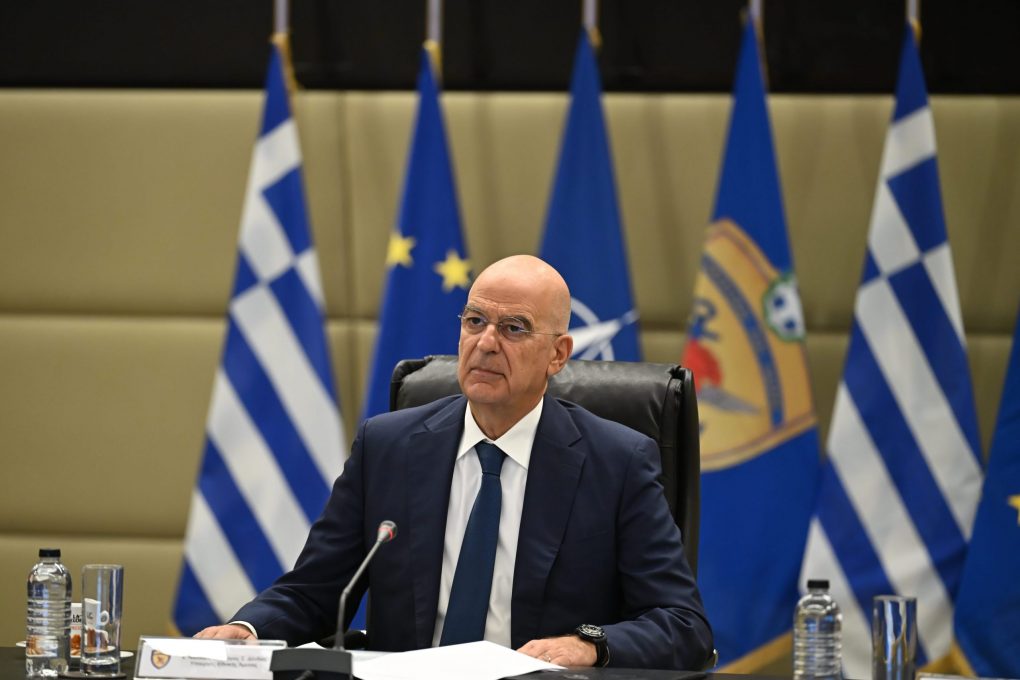
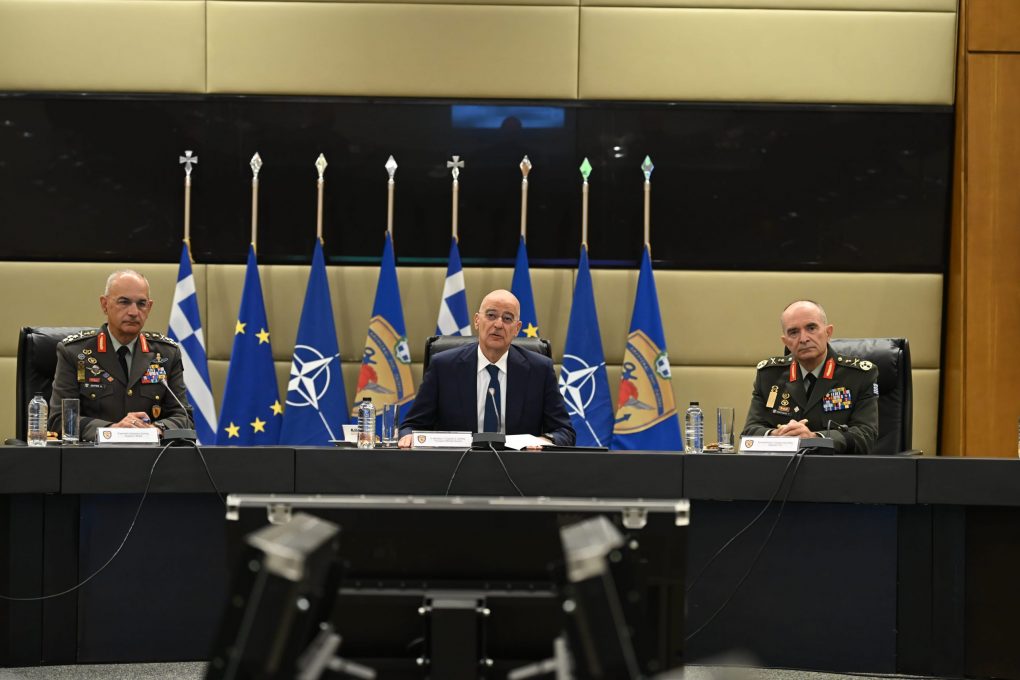
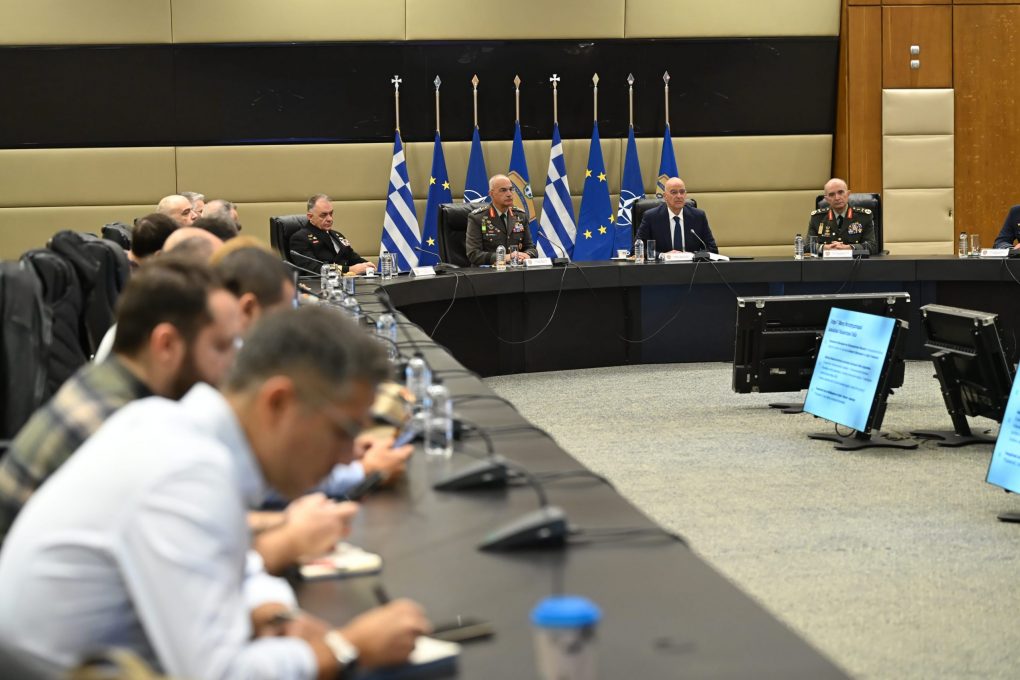
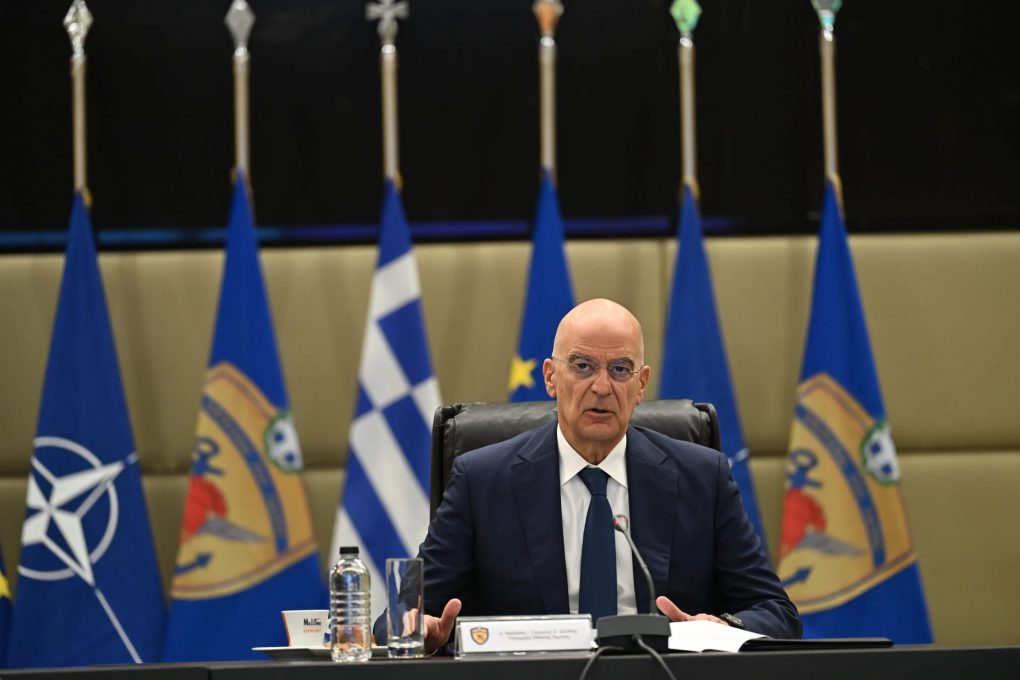
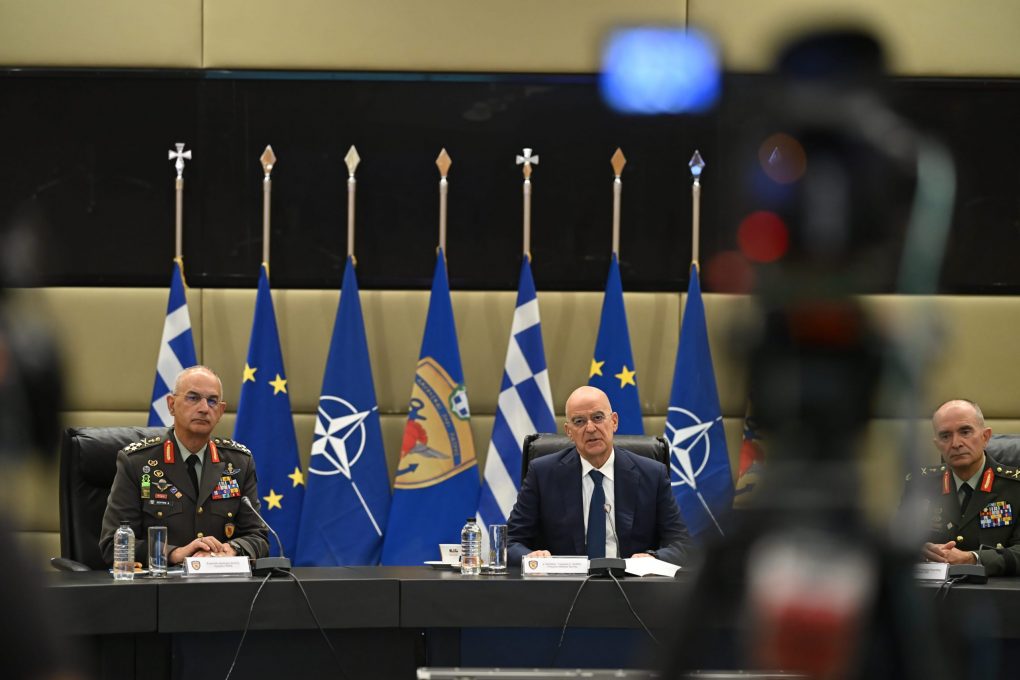
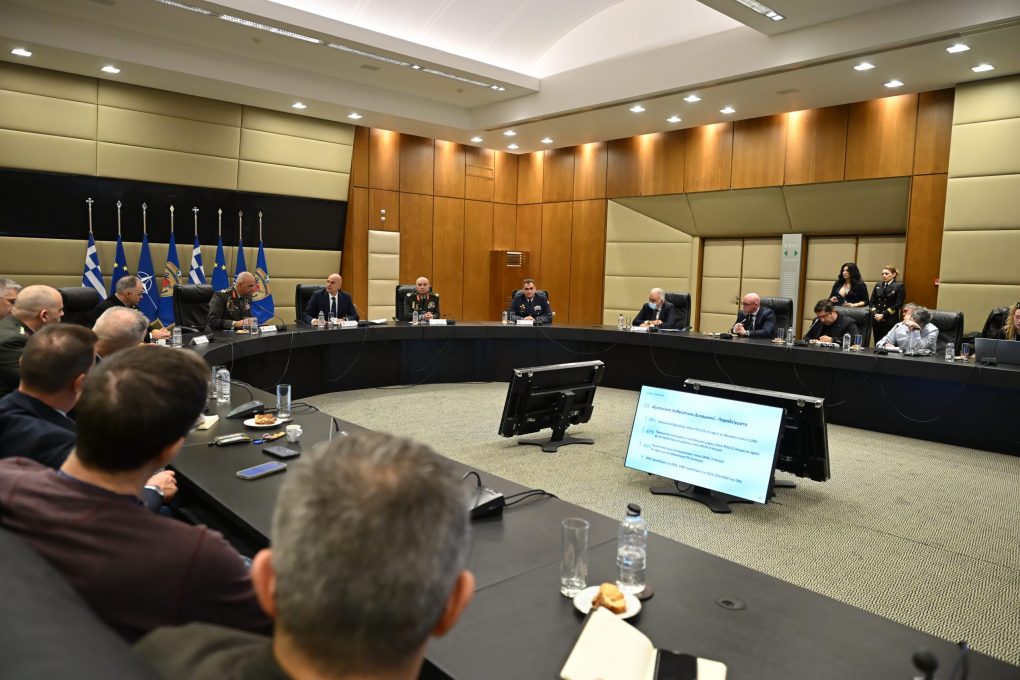
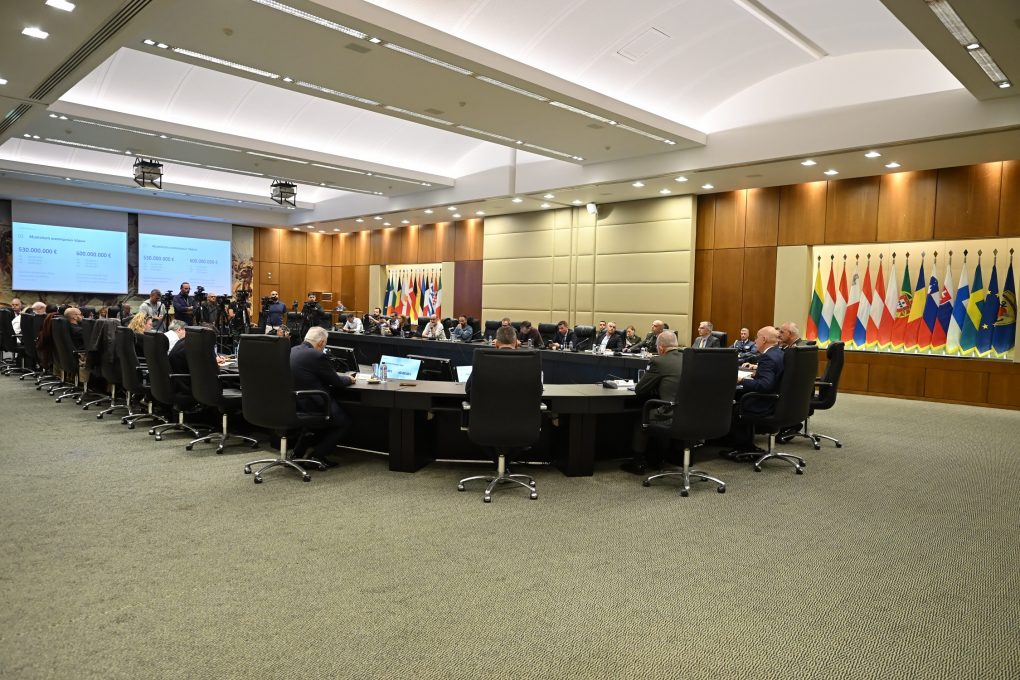

The Minister of National Defence, Nikos Dendias, presented today, Tuesday 20 October 2026, the Third Phase of the New Structure of the Armed Forces 2024-2035, within the framework of the “Agenda 2030” reform.
The presentation took place at “Ioannis Kapodistrias” hall of the Ministry of National Defence and was attended by the Chief of Hellenic National Defence General Staff, General Dimitrios Choupis, the Chief of Hellenic Army General Staff, Lieutenant General Georgios Kostidis, the Chief of Hellenic Navy General Staff, Vice Admiral Dimitrios – Eleftherios Kataras HN, and the Deputy Chief of Hellenic Air Force General Staff, Lieutenant General (HAF) Vasilios Broumas, as representative of the Chief of Hellenic Air Force General Staff.
During the presentation, the Minister of National Defence stated the following:
“Yesterday I, essentially the Chief of Hellenic National Defence General Staff, briefed the competent Committee on National Defence and Foreign Affairs of the Hellenic Parliament on the Third Phase of the transformation and New Structure of the Armed Forces.
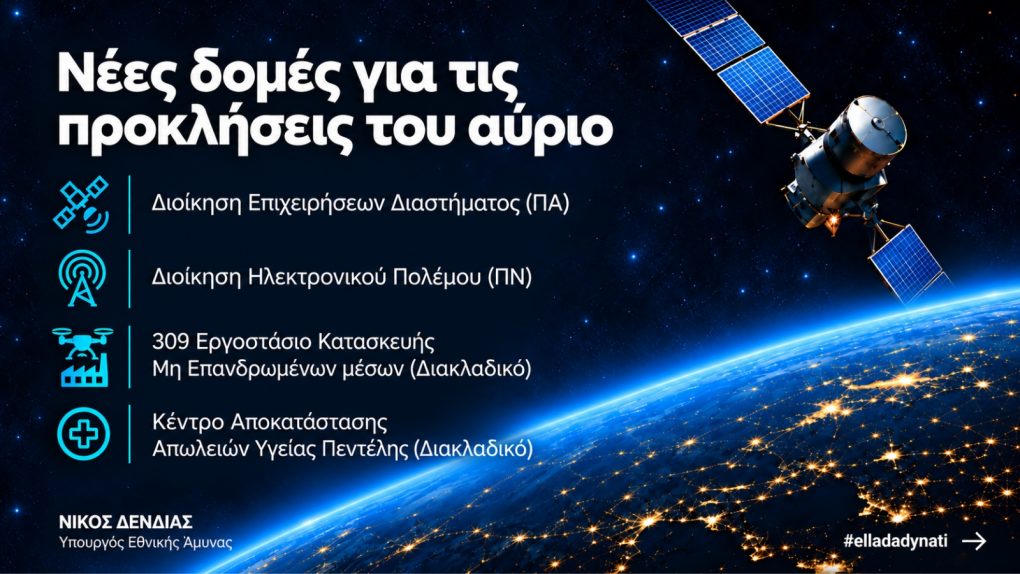
What necessitated this Third Phase and the overall reform within the framework of the “Agenda 2030” was the need to transition to the joint multi-domain field where operations are conducted today. This means that we must integrate Space, Cyber, and the Electromagnetic Spectrum into the existing three domains, i.e. sea, air, and land.
We must also transition to an automated command and control function, the so-called C5ISR-T, as well as integrate Unmanned and Autonomous systems structurally into the services of the Armed Forces.
Concerning the integration of Cyber and the Electromagnetic Spectrum, a few months ago we inaugurated, as you know, the building of the Cyberspace Command. Of course, this is only the shell. We have also created the relevant School to support these activities.
Moving on to the now extremely important space domain. Yesterday, I gave a quite extensive address at the Parliament. Until recently, our country had virtually no presence in space – currently we have a constellation of microsatellites; for this, we cooperated with the Ministry of Digital Governance and for this I am grateful to them. But this is in no way enough. It gives us photographic material.
The Long-Term Defence Armaments Programme includes provisions for a geostationary satellite, a large satellite, in orbit at a high altitude.
Furthermore, the planning also includes the acquisition, through the European IRIS programme, in which we participate, of three medium altitude satellites and, through the cooperation we have with Poland, a number of SAR satellites, i.e. radar, also low-orbit.
This, together with a future acquisition of additional observation microsatellites, will provide our country, for the first time in its history, with a Space presence capability and the ability to secure our communications.
Currently, we largely depend on services provided through armaments programmes by satellites of other countries. As you know, the main communications satellite we have is Hellas Sat, which however is not Greek-owned, despite the name.
Moving on to the integration of Unmanned and Autonomous systems into the Army, Navy, and Air Force. In the Army, we are proceeding, among others, to a reorganisation of the Logistics system with the integration of Unmanned and Autonomous systems. To put it in practical terms, until now we had the concept of transportation by truck or train. In any case, the last stretch to the battlefield was covered by trucks. This is changing. The Hellenic Army General Staff and the Hellenic National Defence General Staff have prepared plans, based on which the so-called “last mile”, i.e. the last stretch to the combat unit or individual will be covered by Autonomous vehicles, either in Evros or on the islands.
Now moving on to the Navy. As you know, the Hellenic Navy has achieved, in its own labs, the construction of an Unmanned System which is capable of becoming Autonomous, “PYRPOLITIS”. Furthermore, the Hellenic Navy has studied and conducted trials with SARONIC type Autonomous systems, which are also used by the US Navy.
The Hellenic Navy now has an Autonomous and Unmanned Systems Command and, as you know, a few days ago, we inaugurated the Hellenic Navy’s Autonomous and Unmanned Systems School. The Hellenic Navy will be the first Navy in Europe to integrate Unmanned and Autonomous Systems. There is a difference between the two, you understand, in terms of power.
Moving on to the Hellenic Air Force, in addition to the Unmanned Systems, which you are well aware of through the Armaments Programmes, we are also proceeding to the creation of a Collaborative Aircraft Structure. Collaborative aircraft are planned to collaborate with the F-35, when we acquire them. This is also a choice of the new reality.
Concerning electronic warfare, we enhance the Hellenic Navy’s capabilities.
I would also like to tell you that, through all this, we will have mergers and abolitions of 56 units and 126 structures. I will address the economic footprint in a while.
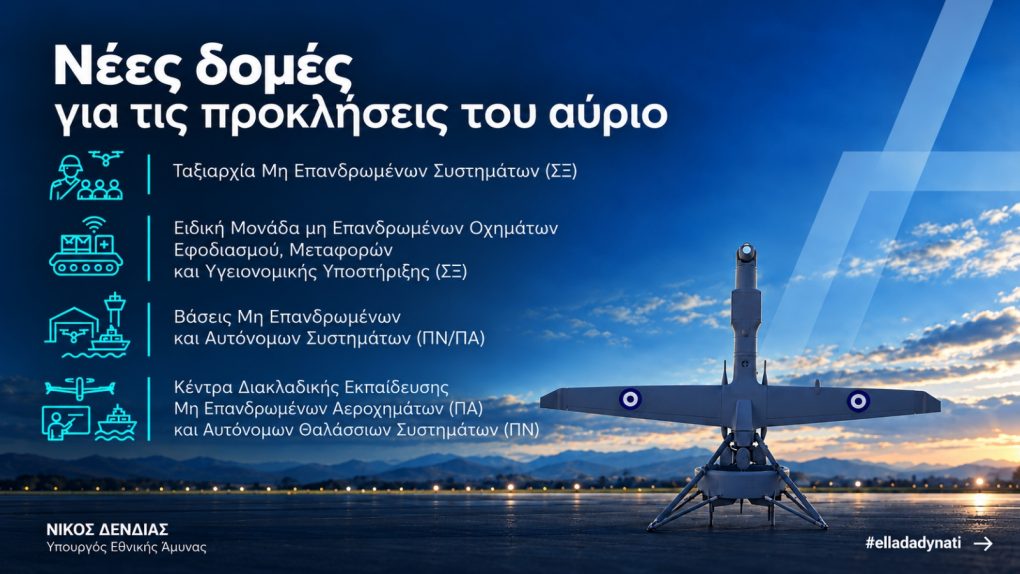
We are creating a series of new Structures. In the Army, the Unmanned Systems Brigade in Litochoro – the Chief of the Army can correct me if I am wrong – where we can experimentally integrate the new systems.
I mentioned previously the Special Unmanned Supply and Transportation Vehicles Unit.
In the Navy, we are creating bases for Unmanned and Autonomous Systems, as we will do in the Air Force. We will create a base for Unmanned and Autonomous Aerial Vehicles. You already attended the inauguration of the Unmanned Systems Joint Training Centre of the Hellenic Air Force and the Hellenic Navy the previous week.
I hope that, within the framework of the establishment of New Structures, in early December we will all get together for the inauguration of the 309th Unmanned Systems Manufacturing Plant, which is Joint and will manufacture Unmanned Systems for all three Services of the Armed Forces here in Attica. And I hope that we will also all get together for the inauguration of the Space Operations Command Centre of the Hellenic Air Force. This is related to the satellite system I mentioned earlier.
The changes to the Structure also affect the Reserve. A model Special Missions Company will be created, consisting of Reservists, largely Reserve Raiders. At some point, you will probably attend an exercise involving it. The Active Reserve is a major asset for the Armed Forces, providing protection for infrastructure and sensitive areas and being capable of rapid mobilisation as a trained force that will allow actual engagement in a future battlefield and not a theoretical, paper reserve.
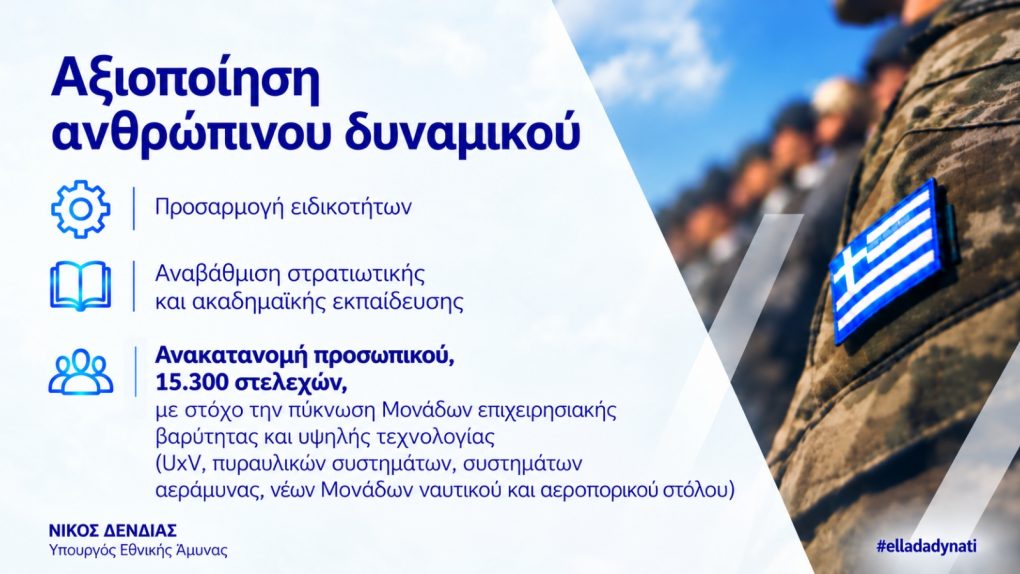
Now moving on to the changes related to the standard of living of the personnel. First, I would like to tell you that, in the following days, I will bring, first to the Cabinet and then to Parliament, the final piece of legislation of my tenure as Minister. It concerns the ecosystem, the emerging defence industry ecosystem. The ability of Greece, as a seller, to conclude “G2G”, government to government contracts. As you know, we have signed many contracts with other countries. We have no legislation that allows the Hellenic Government to sign “G2G” contracts as a seller and the reason for this is that there was nothing to export. We are not there anymore. We are creating the conditions for exports.
We will now make the 25% law, because the initial stage showed that this can work. I.e. the obligation, for any Armaments Programme, to include a minimum 25% Hellenic ecosystem participation.
We will proceed to the reorganisation of the General Directorate for Financial Planning and Support and the Finance Corps of the Armed Forces, based on a study that has already been completed, as well as to the reorganisation of the General Directorate for Armaments.
Now regarding the quality of life of the personnel, there will be changes to the Medical Corps. The 424th Hospital in Thessaloniki and the General Hospital of Chania will become Joint facilities, while we are also proceeding, through a €5 mil. private donation, to the creation of the advanced Trauma Unit. I will have a meeting today in the afternoon in Boston with Professor Velmahos to review its progress. To my knowledge, it proceeds as planned and I hope that this too will be completed, if not by late 2026, by early 2027. It will operate as the Joint Trauma Centre at the 401st Army General Hospital, incidentally with a branch in Balamand, Lebanon. We can have the most advanced Trauma Centre in Europe, associated with Harvard University and with incredible know-how. You do understand the security this provides for our personnel during operations.
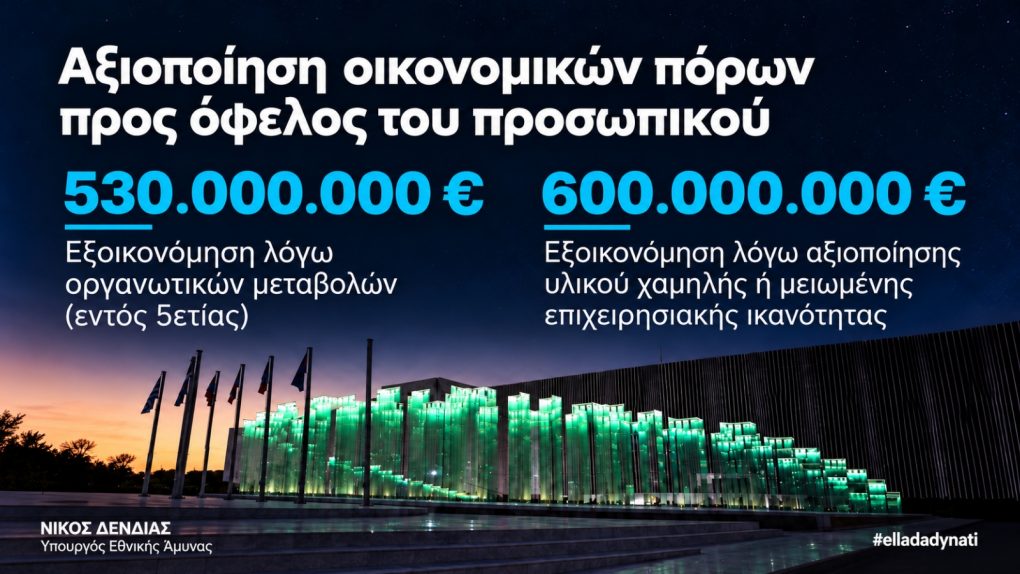
I would also like to tell you that these changes bring savings. These savings are in no way negligible, they amount to half a billion Euro in five years, i.e. approximately 100 mil. per year. Let me give you some examples to understand how these savings are achieved. An FDI frigate – the day after tomorrow we are accepting “NEARCHOS” in Lorient – costs us approximately 2 mil. per year. A Kortenaer S frigate, the old type we are phasing out as we accept FDI frigates, costs us 7.3 mil. per year. A PULS artillery system needs a crew of 2, i.e. two salaries, while an Μ109, the older howitzer, needs a crew of 6, i.e. 6 salaries. The new SPIKE anti-tank weapons need a crew of 2, i.e. two salaries. The older ITVs need a crew of four. Double the salaries.
And that’s not all. Of course savings are also achieved from the operating costs of the merged Units and Structures, etc., these were just a few examples. There is also an ambitious programme of the Hellenic Navy and for that I would like to congratulate the Chief of the Navy: the decommissioning of 21 ships within 5 years. Or, rather, their replacement by newer ships or Unmanned and Autonomous platforms. As you know, we already have an understanding, in addition to the 2+2 Bergamini class frigates, for the acquisition of at least two Gaeta class minehunters from the Italian Navy.
And now, to my conclusion, what will happen with this money. This money, and this is my understanding with the General Accounting Office of the State, will be returned to our personnel. The savings are intended, among others, to create a better standard of living for our personnel, whom we want to be better paid. We believe that their compensation for what they provide to the country must be better. For this, we will take a series of actions. Because the negotiation will have started, now that the Parliamentary proceedings are over and it is certain that we will proceed with the Force Structure reform, I would not like to say more before I have the solid certainty that these have been discussed and agreed upon with the Ministry of Finance. But, as a matter of principle, I want to be clear. This money will be invested in our personnel.
Within this framework of providing better services to our personnel, I would like to tell you, for example, that we must create an Assisted Living Housing facility for retired personnel who do not have a family to support them or are unable to take care of themselves. We will create such a facility. I have already visited the Military Hospital in Penteli. We will start with 25 beds. This number will increase to 50 and then we will proceed depending on the demand. We do not want our retired officers, NCOs, and personnel in general to be at the mercy of God if they have no family to support them.
Another thing we will correct immediately, and we have an understanding for this with the Hellenic Navy and the Hellenic National Defence General Staff and the Chiefs, is the fact that ship crews can not serve at sea above a certain reasonable number of days. We have set this limit to 200 days, at first. It will be unacceptable for our personnel to be at sea for more than 200 days out of 365 in a year. They have to be at home too. They must have a family at some point. Of course, we are the Armed Forces, we can’t deny service, nor can we have predetermined limits to the duty to the nation. If national interest and planning requires sea service for more than 200 days, the compensation will be must higher than the current one. It will be nothing like the compensation they receive today for each day of sea service beyond 200. But all this will be discussed and negotiated with the Ministry of Finance. But these two things I just announced, I take for absolutely granted, even now. There will be more and it will be significant, because the savings we achieve within our existing resources are also significant. And let me say it again, the great and main principle, raising our level, improving our capabilities, modernising our systems and, at the same time, saving personnel and assets, is the most healthy example there can be in a public sector, not only in Greece, but anywhere.
I am available for a few questions. You understand that confidentiality prevents me from saying more than I should and please forgive me for checking my watch, but as I said before, I have a flight to catch. Thank you for your presence here today and I would also like to thank the Chief of Hellenic National Defence General Staff and the Chiefs for their cooperation and contribution to this third phase of the Force Structure reform.
Below are the Minister’s replies to the journalists’ questions:
THANASIS BALODIMAS
Minister, could you please elaborate a little on this Unit in Lebanon? What need does it meet?
N. DENDIAS
It is not a Unit. It is a hospital in Balamand. It is also the See of the Greek Orthodox Patriarchate of Antioch in Lebanon. We want to strengthen Christian presence in Lebanon. On the other hand, our doctors must be the best. To be the best, our doctors must handle cases, many cases. I pray for a stop to violence in the Middle East, but this doesn’t seem possible in the foreseeable future. This serves two distinct goals: supporting the Government of Lebanon and Lebanon as a country in general and the Christian community in Lebanon and the Patriarchate of Antioch in particular, as well as having our personnel train by handling many, many cases”.
GIANNIS LEKKAS
I would like to ask this: We saw the impressive results with the USVs recently and we see that bigger and bigger USVs see service internationally. We saw Saronic’s USV, but there is also a bigger model, the Marauder, which can undertake a much broader range of missions. Are we also examining something similar as a replacement for missions which are currently undertaken by ships with a much larger crew? Thank you.
N. DENDIAS
Thank you. The Hellenic National Defence General Staff and the Hellenic Navy General Staff’s planning is to replace manned platforms, especially for patrol missions, with Unmanned Systems. The Hellenic Navy and the Hellenic National Defence General Staff have seen all three vessels by Saronic, the 7-metre, which has been tested by us, the 15-metre, and the 55-metre, and we have also seen underwater platforms. Underwater platforms for minesweeping, minehunting, as well as larger underwater platforms to protect cables and installations or equipped platforms. You may remember, I went to Australia precisely to see such platforms.
So yes, the answer is that the integration of Unmanned and Autonomous surface, underwater, land, air, and sea platforms is not only absolutely reasonable, but it is included in the planning of the Ministry and the Armed Forces.
KOSTAS SYMEONIDIS
Minister, since you are here, are you concerned in view of the resumption of the cable laying works?
N. DENDIAS
I understand your question, Mr. Symeonidis, but we did not meet today to discuss the cable or Greek-Turkish relations. Besides, in the broad sense, the Structure change addresses precisely these matters.
KOSTAS SARIKAS
Minister, you recently went to Saudi Arabia. Do you have any update on the Patriot battery there, will they stay? I imagine it is obviously a decision of the Governmental National Security Council, but do you perhaps have an update and do you have anything to tell us about the upgrade of the Patriot systems or if something has been agreed with Saudi Arabia on the matter? I believe the Patriot battery has been in Saudi Arabia for almost five years now. Thank you.
N. DENDIAS
You are right, they have been there since 2021. I was received by the Crown Prince of Saudi Arabia (Mohammed bin Salman Al Saud) and had a discussion with the Minister of Defence (Prince Khalid bin Salman Al Saud). I should tell you that Saudi Arabia made a move to honour its financial commitments to this day.
I do not want to say more, but they have already done what they should immediately, within 24 hours after our departure. Our intent – and that will be my recommendation to the Governmental National Security Council – is to extend the deployment of the missiles, given the fact that they are deployed at a critical location and currently the Kingdom is under attack. We are also discussing other forms of cooperation, but I can’t and should not say more. I should say though that the visit was very satisfactory and any misunderstandings were resolved.
STAVROS IOANNIDIS
Good morning Minister. Mr. Rubio, the US Secretary of State, was recently in Athens. We understand that during the discussions that took place on topics related to defence and cooperation with the US, you also brought up various programmes of interest to Athens, such as, for example, the weapons for the Air Force, the F-35, the F-16, the Stryker. Is there an update on these programmes? Are they expected to be included in the updated Long-Term Defence Armaments Programme in the following months? Thank you.
N. DENDIAS
Mr. Ioannidis, regarding the Stryker, our intention is to acquire them as an EDA grant. So, if there is any cost, it will be a small cost for transportation which will come from the operating budget. It wasn’t in our mind, despite the fact that we are very much interested in this type of vehicle, particularly due to their capabilities in the islands as wheeled vehicles.
Other than that, the approved Armaments Programme – and let me stress at this point that it is my intention during the final part of my tenure as Minister to also submit the updated Armaments Programme because, as you know, it is a rolling programme. For the 2027-2037 period, right Chief? 2027-2038. This includes all the programmes you mentioned: the upgrade of 70 F-16 fighters to the Viper configuration and the new weapons for the F-35. We obviously didn’t get the F-35 for show, we also need its weapons. However, and please note this, what we request from the US is the latest weapon at the time of delivery of the F-35. Not existing types of missiles. The point of the F-35 – the most advanced platform globally exported by the US, with the exception of the F-22, which is not exported, as you know – the point is to have the latest weapons. That’s what we requested from the US. That’s what I said to Mr. Rubio. There is no point in giving us advanced weapons. This takes away from the weapon itself. And, of course, our planning, as I said before, is to have collaborative aircraft flying with the F-35. I.e. each F-35 in the air will have up to 6 collaborative drones flying with it. This is a total package and a different concept for the Air Force.
KOSTAS ALATZAS
Good morning Minister. Just to clarify, regarding the savings achieved through all these reforms and changes, as you said, a large part of it will be allocated for additional pay rises to the Armed Forces personnel. Do you have an estimate when the discussions with the Ministry of Finance will be completed in order to be able to announce these new pay rises to the Armed Forces personnel?
N. DENDIAS
Thank you. At the risk of being overconfident, it will not exceed one year. I mean, we will not engage in theoretical discussions. Numbers are numbers. Two things we want to do, I already announced them and we will do them. Other than that, we will give a deadline to the Ministry of Finance. Last time, they accepted our numbers, minus 10 mil. They kept 10 mil. I hope that this time the Ministry of Finance will be generous. No negotiation with the Ministry of Finance is pleasant. It is perhaps the most painful thing to do, but our personnel can’t wait. Thank you.
GEORGIA SADANA
Good morning Minister. Since we are talking about the third phase of the Armed Forces, I would like to ask you whether provisions are made for the development of Artificial Intelligence models and Greek codes, given the fact that weapon systems are very much affected by all these today. Thank you.
N. DENDIAS
Absolutely. It is something I can not talk a lot about, but you are absolutely right that the entire C5ISR-T can not work if it is not supported by Artificial Intelligence. And obviously, at this level, the source code of this Artificial Intelligence can not be co-owned or not owned by the Hellenic State and the Hellenic Armed Forces. Command, Compute, Control, Communicate, Cyber, Intelligence, Surveillance, Reconnaissance and Targeting is the new way of functioning of the Armed Forces. It is a holistic system. Behind this system is computing capacity and Artificial Intelligence. It is the basis of all the changes we are bringing here. A totally different concept, which, to be honest, is necessitated by technology. It can’t be otherwise. It all has to work together and the volume of information means that it can’s be done without Artificial Intelligence. Without a mechanism, if you will, to assist the Staffs and the Hellenic National Defence General Staff and our Units to select the time, manner, and means of response. That’s where we’re heading.
The challenge is obvious and, to be honest, we need to move fact, very fast. There are areas where things move at lightning speed. Cyber is one of them. If we can’t reach a certain level fast, our country will not be protected. Of course this will not be ready tomorrow morning. I don’t cant to create false expectations. That’s why we call it – I’ve said it before – “Agenda 2030”, otherwise it would be 2025-2026. We started on this path in January 2024. I think we moved quite fast around an overall concept, which I described correctly.
CHRISTOS MAZANITIS
Minister, is there a schedule regarding the merger of units and the closure of camps?
N. DENDIAS
Mr. Mazanitis, I don’t have to ask the Chief of the Army who is sitting right next to me. The answer is immediately. Immediately. These are not announcements. And, forgive me, I don’t want to sound arrogant, but these are announcements of things that are happening as we speak. The only thing was that without the typical approval of the competent Committee of the Hellenic Parliament we couldn’t move forward.
THANASIS BALODIMAS
Minister, do we have time for a political question? Since we have entered a pre-electoral period and you are one of the prominent officials of the party. How do you feel about the 25% which the Prime Minister set as his survival percentage as President of Nea Dimokratia?
N. DENDIAS
You are reading too much into this. My personal takeaway from the Prime Minister’s words is the effort to win the majority, which I find absolutely satisfactory and can identify with. We have a proposal for Greek society. We want this proposal to have overwhelming support in order to be able to implement it. One comment on this. Besides, this has been my view right from the start, within the framework of the internal party dialogue in view of the Conference. I said it in Komotini, I said it in Agrinio. I said it at the Plenary Session of the Conference. I think I have a very clear position on what Nea Dimokratia’s goals must be and the ideological framework around these goals. Because one asks for the support of the Greek people not in abstracto, not because one is charming, likeable, or a good person, but within the framework of principles, values, and a specific programme.
Thank you very much”.