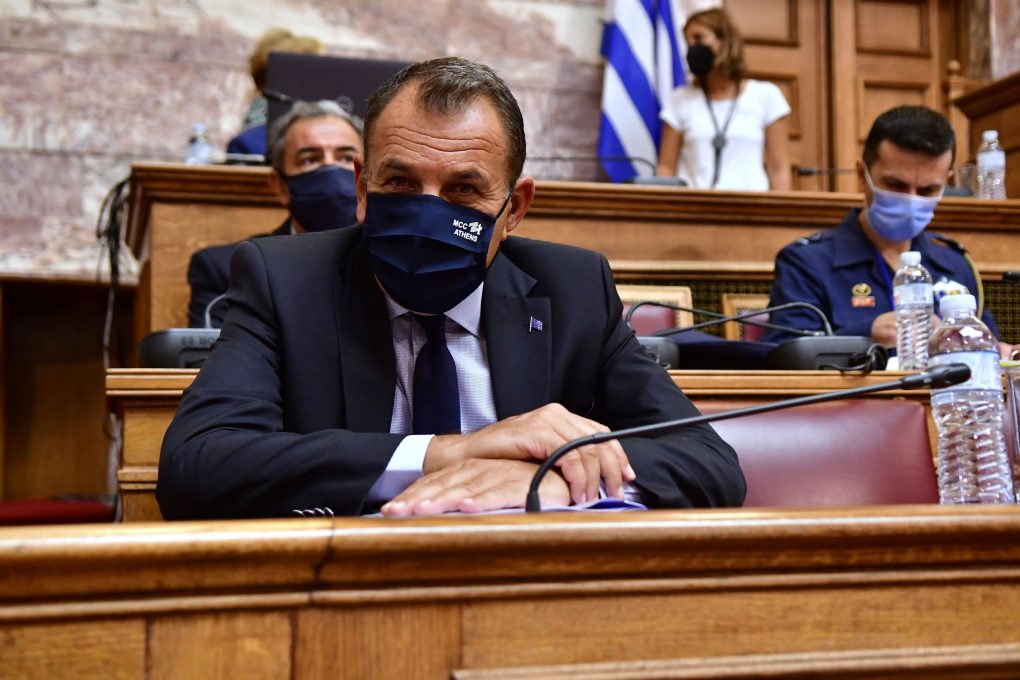
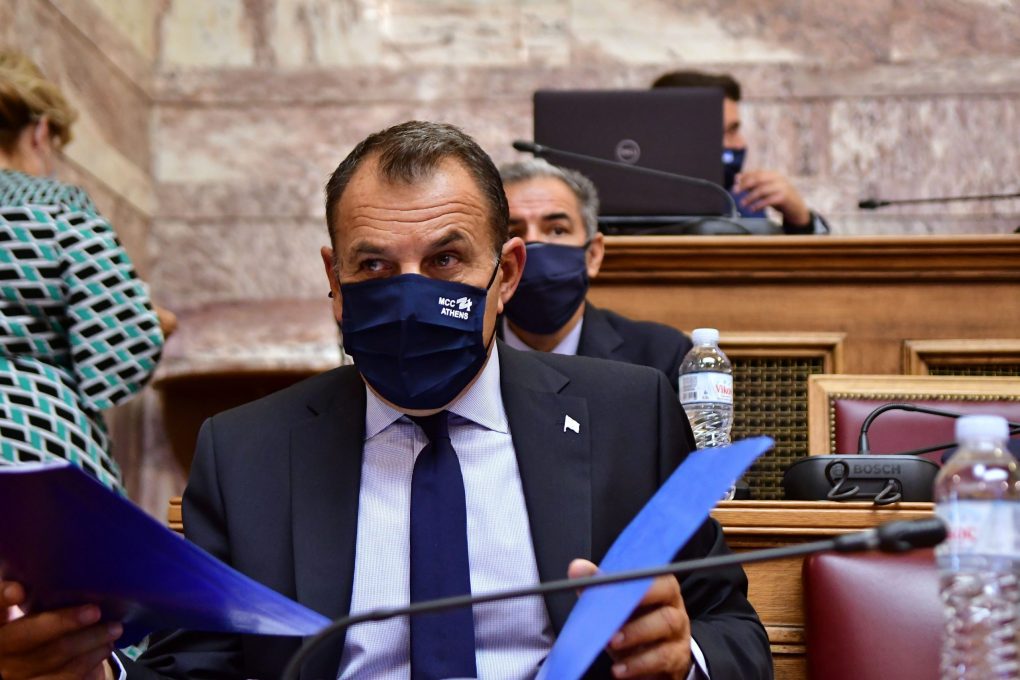
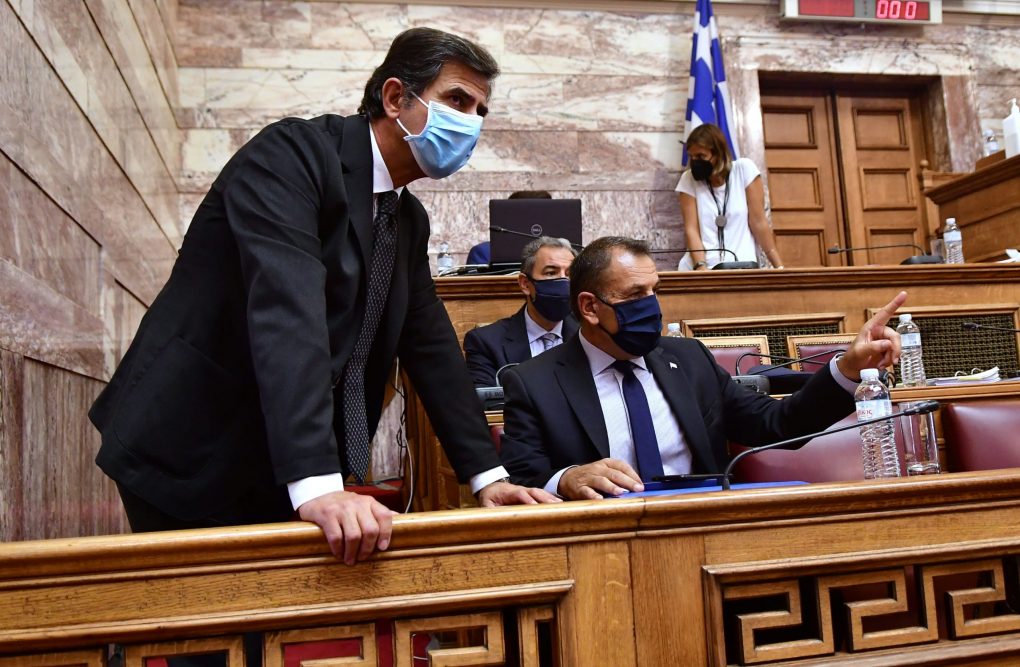
The Minister of National Defence Mr. Nikolaos Panagiotopoulos participated in the National Defence and Foreign Affairs Permanent Committee meeting, held today, Tuesday 21 September 2021, at the Parliament Senate Hall.
The subject of the meeting was the processing and the examination of the Ministry of National Defence Draft Bills, concerning:
a) “the Ratification of the Memorandum of Understanding among the Ministry of National Defence of the Hellenic Republic, the Ministry of Defence of the Republic of Bulgaria, the Ministry of Defence of the Republic of Czechoslovakia, the Ministry of National Defence of Romania and the Ministry of National Defence of the Republic of Turkey (acting on behalf of the Government of the Republic of Turkey), regarding the establishment, command and operation of the Center of Excellence for an Integrated Air and Missile Defence (IAMD COE Operational MOU)” and
b) “the Ratification of the Memorandum of Understanding among the Ministry of National Defence of the Hellenic Republic, the Ministry of Defence of the Republic of Bulgaria, the Ministry of Defence of the Republic of Czechoslovakia, the Ministry of National Defence of Romania and the Ministry of National Defence of the Republic of Turkey (acting on behalf of the Government of the Republic of Turkey), as well as the NATO Supreme Allied Commander Transformation HQs, concerning the functional relationship with regard to the Center of Excellence for an Integrated Air and Missile Defence (IAMD COE Functional MOU)”.
Following the presentation of the Proposers, Parties’ representatives and Members of the Committee, Mr. Panagiotopoulos made the following address:
“Dear colleagues,
I understand that a meeting of the Foreign Affairs and Defence Committee is an excellent opportunity for many colleagues to talk about everything-as Mr. Chatzidakis stated-to search for answers regarding the future and the present of the Greek-Turkish relations, to raise issues on the rapid and wider geopolitical developments, to talk about NATO’s future and its transformation, the European relations, the Strategic Autonomy-which, Mr. Katrougalos, I absolutely agree with, and it is obviously the ultimate goal for the European Union. At last, it is defined by some emergency terms after the disaster in Afghanistan and the inability of the EU to organize an evacuation operation for those who stayed behind. But this is not the reason of the Committee’s meeting and our presence here today. We must take a stance for the Ratification of a Memorandum regarding the establishment of a Center of Excellence and only that. Let us focus on that then, let us look for more opportunities, since the subject of the discussion or the Committee’s convergence is wider and has to do with what I said above, to make these discussions.
Taking the colleagues-proposers’ stance under consideration, I get the impression that they have not understood what a Center of Excellence is exactly. Is it a Military Unit, a School, as I heard? What is a Center of Excellence and why should Greece seek the establishment of a Center of Excellence within the Greek State? The first Center of Excellence that I visited was the Center of Excellence for the confrontation of Hybrid Threats in Helsinki, Finland, in August 2019. You understand that the existence of such an Organization under the auspices of NATO in Finland had to do with the juxtaposition-the historic one if you like-of those countries with the former Soviet Union, now Russia. The Baltic democracies and the Scandinavian countries have some increased sensitivities, the Hybrid Threats developed from there towards these specific countries, so Finland decided to take the initiative to establish a Center of Excellence. What does a Center of Excellence do? First, it attracts members from the Armed Forces of the countries that wish to participate. They come to staff an Organization which studies the events, processes the data, analyzes and comes up with findings, updates and finally finds ways of coping with exactly what constitutes the major threat, that is the Hybrid Threats.
This is also the case here, with the development of Ballistic Missile Shields. The Ballistic Missile and Antiaircraft Defence has always been a major goal in the defence policy of every country, as well as the North Atlantic Alliance. It has always been both a NATO and Defence priority of every country, since the Cold War, when the major threat was the intercontinental ballistic missiles, bearing nuclear warheads. This was the main concern regarding the Ballistic Missile Shield of the U.S.
For Israel, recently, the main concern and the reason of creating “Iron Dome” type Defence Systems, about which we hear many things, was a simple attack with rockets from the Gaza Strip, but the Defence system is a Ballistic Missile Shield, regardless of its range or fire power or accuracy or technological superiority or not.
For Nagorno-Karabakh, the issue of the Antiaircraft Defence was the factor which turned the scales of war in favor of the Azeris, because, if you have been informed, their first concern with the UAVs used, was to defeat the Antiaircraft Defence of the Armenians. When the first wave of UAVs, the Unmanned Aerial Vehicles, revealed the targets, the positions of the Armenian Air Defence, although destroyed, it paved the way for the second wave of the UAVs to come and defeat this Antiaircraft Defence of the Armenians. Without Antiaircraft Defence and several Artillery assets on the ground, the Armenians could not prevail and the scales turned in favor of the Azeris. So, these issues are of importance regarding observation, close keeping up with the developments, analysis of the systems and resulting in findings, with regard to the Doctrine, the Organization, managing the context of shaping a ballistic missile or antiballistic shield.
The concern nowadays with regard to these issues is the creation by many countries of supersonic ballistic systems, which are not easy to detect and therefore to track, to be engaged and be neutralized by the existing systems. There are many countries, China being one of them, that have developed very advanced supersonic Missile Systems nowadays, which are difficult to be confronted by NATO arsenal or the countries that we very well know that have been opposed to the ever increasing military Chinese power. This is an issue to examine and tackle, something which is normal in the context of operation of these Military Organizations. Obviously, a very important element of their existence is examining and finding ways to deal with the Systems used by the rest.
Turkey is a NATO member. Life within NATO includes the relation with Turkey as well, which is known at bilateral level, but from then on, it is also a NATO member state. What are we doing, what are our alternatives? Can we always appeal to the difficult relation with Turkey, the tensions, the challenges, the offensive behavior, the revisionary attitude and to keep our distance from everything, because our only concern is Turkey? And at the same time to observe Turkey being likeable through time in the bosom of the Alliance, while we, since we only have Turkey to deal with and we do not wish to be anywhere, are losing points with regard of being appreciated by the Allies? So, is this what is going to happen? If this is the case, then what you say is what will happen. The time will be passing by and we will see Turkey be reinforced compared to Greece, in the context that the Allies will support it more and Greece will be left behind.
These are of course serious questions and must be answered. What is the meaning of increased participation of the country, not only regarding its obligations but also its rights as an Ally? Because to attract somebody’s attention with a “Center of Excellence”, the establishment and support of such a “Center of Excellence” as well, is incorporated in the framework of the country’s rights. We wish to exercise these rights and we will and we will get the benefits that I will analyze. Our obligations are just to participate in such Organizations, which will be analyzed at a level of Defence Analysis by Military Members, by experts in Security issues. There, we will also participate, not in terms of financial burden, but of participating in this Organization concerning all Allies.
But if we wish Greece to be taken under consideration and have a defence imprint, even outside its boundaries, because it owns capable, operational, fully trained Armed Forces-I think that we should be more extroverts, whether concerning our Allied capacity or the bosom of the EU, now that the idea of a Euro-Army establishment starts to develop.
Regarding the “fine line of balance”, in the context of which a country exceeds some limits or not, it is the Political Leadership that must define it. The Government will define it and we here, at the Parliament, will discuss it.
Some are being critical about the mission of the “Patriot Squadron” in Saudi Arabia. I cannot understand how the mission of a Ballistic Missile Defence System-the “Patriots” promote Defence, they do not launch attacks with missiles-constitutes an offensive stance of the Alliance. I wonder! The “Patriot” systems were dispatched to Saudi Arabia, on the condition that our own ballistic missile capabilities are not weakened, something which is obviously ensured, based on the total planning to set a Ballistic Missile Defence Umbrella in specific sensitive infrastructures in Saudi Arabia which until recently were considered vulnerable, mainly oil production infrastructures, to engagements by unmanned vehicles and other systems, which are characterized as unconventional with regard to their nature, compared to the past and the known arsenal.
It was requested by the Saudi Arabians, with whom our allied relation has been reinforced a great deal recently. I remind you of the participation in trainings and exercises. The Saudi Arabian F-15 were stationed for a long time and they co-trained with Greek crews in Crete, at the 115 Combat Wing, and the very tactical visit exchanges among Senior Members of the Military Leadership. The relationship between the HNDGS/Chief General Floros and his Saudi Arabian counterpart is known.
It is for the benefit of the country to approach countries with which we share common grounds of understanding, regarding Security and Defence issues in the wider region. Through this understanding, we are coming closer to the Defence cooperation. Besides, on April of this year, that is a few months ago, a relative agreement was signed in Rhiad by the Minister of Foreign Affairs Mr. Dendias. I was present in the signing of this Agreement between the Ministers of Foreign Affairs.
I will comment on the “Center of Excellence” again: it must be understood that it is not a Military Unit, nor a new Headquarters. I have the impression, from what I heard, that a new NATO HQs is under establishment in Crete for the Eastern Mediterranean, besides Napoli. But this is not what it is. It is a center of study and development of confrontation tactics, in the context of the Ballistic Missile Defence, with a supportive role. It is a NATO entity, because it is established in the context of the development of these infrastructures of the Alliance, under the capacity of an International Strategic Organization. This is how it is defined, but it has nothing to do with the military aspect.
Its mission is the improvement, the specialization of the Alliance Member States capabilities, in the whole spectrum of activities and operations concerning the complete Antiaircraft and Ballistic Missile Defence. This sector came to the fore, due to the development, as I said, of ballistic and supersonic missile systems, by competitive to NATO countries, based on new technologies, which, in total, paves the way for an environment of increased threats for the Alliance.
The frame-state and host nation is the Hellenic Republic, providing the initial infrastructure, the equipment, the Support Personnel and the Logistics, in accordance with the Provisions of the Memoranda under ratification. Chania is the headquarters. It is important to explain-and I will conclude with this Mr. President- the reason we consider this Agreement, these two Memoranda that the Corps is called to ratify, the first for the Operational, that is the Memorandum of Understanding regarding the establishment of the Center of Excellence, and the second, the Functional Memorandum, comprising the terms that define the functioning conditions, a beneficial case for the country as a whole.
First, our role in the Alliance is upgraded. When a country hosts a Center of Excellence is for its benefit, not against it. As I said, if some people did not possibly wish the country to undertake such obligations, there are many other countries in NATO which would wish to draw the attention in the establishment of such a Center. Of course, one of the countries that systematically pursue to attract the attention with such initiatives is Turkey. So, as Mr. Koumoutsakos put it correctly, that would be an excellent opportunity to exercise criticism. If Greece did not claim the establishment of this Center and Turkey showed up-which will surely enter the game, as it does in such cases as steady tactics, because it protects its interests and in this context it does the right thing, but we, too, protect our interests-to draw the attention to the establishment and hosting of this Center, then I am certain that you who say “Why now?” and question the feasibility, you would say “Why did you lose it and Turkey got it?”. So, we would have sent of course a member of the Armed Forces, as it is customary to be a member of the Delegation and not to spy on our national ballistic missile capabilities, but to participate in data analysis regarding the total problem of the Ballistic Missile Shield. As we said, life in NATO presupposes certainty as well, the truth being that Turkey is a NATO member state and therefore we must proceed with that.
So, it is the first Center of Excellence established in our country. Until now our country did not have a training Center of this nature, which is of course certified by NATO as well. It will render important operational benefits and know how in the critical field of Air Defence. It will become an attraction pole for specialized scientific personnel from other countries, which will staff the Center’s posts and will exchange beneficial views (surely to our benefit too) on the way these systems must function to develop in the field, ways of coping with that, etc. This way, our country’s extroversion will increase at an international level, through the participation and organization in multinational cooperations, seminars, trainings and exercises, with regard to the Center’s establishment.
As you understand, a Center has continuous, tactical, multifarious activities; we see that at the Maritime Interdiction Center whose headquarters is at Chania, Crete, which is really a workshop of continuous activity. The same will apply with this Center when established. As you understand, this will upgrade even more the great strategic important role of Crete, as a Regional Training and Support Center, since it is important to be added in the already existing entities of the wider Chania region.
We also have to deal with Crete Naval Port, which, as we have announced, we intend to reinforce even more, so that it actually becomes the second, fully operational Naval Port of the country, since the new geostrategic reality in the Eastern Mediterranean demands so. We have to deal with the 115 Combat Wing, the Maritime Interdiction Training Center (KENAP), the NATO Forward Logistics Site, which is a forward Supply site in Souda, as well as the NAMFI in Crete.
So, these are considered beneficial for our country, because they increase its defence imprint in relation with its capacity as a Member State of NATO Alliance and the Western Wing, if you wish. And I believe this, due to the extremely rapid developments with regard to the huge geostrategic realignments in the region, cannot cause any damage.
The country must be projected worldwide, among others, in order to be taken under consideration by its Allies as well. Not by its major enemies, but by its major Allies. This is only justified and reasonable, if we estimate the great quality, the excellent functional status and readiness of our country’s Armed Forces. Greece possesses Armed Forces which are of top quality and our struggle to reinforce them is well known, because they are worth it. Since Greece possesses such quality Armed Forces, responding to the challenges in our region and beyond, it is necessary to have Armed Forces of such quality, but also to project their relative numerical imprint worldwide.
Defence Diplomacy is active and multidimensional. In the context of these capacities, I believe Greece must be in a position to attract “Centers of Excellence”, especially with regard to sectors estimated as really important for the organization of the Defence of a country, an Alliance, a region. This is the rationale for the establishment and support of this Center by the country, which will obviously bear some costs in the beginning, which will be high for the establishment of the Center but then the costs will concern only its operation. So, I do not understand the question why we undertake the costs-that is to pay the bills for power, water supply, the phone-of this “Center of Excellence” when it becomes operational. This is how it is done. The country which undertakes the Center pays its support costs as well. I do not think this is an issue for discussion and political juxtaposition.
As you understand, this way the country increases its total Defence imprint. I understand the reservations of the Corps, but I think all questions have been answered.
For the aforementioned reasons Mr. President, I will ask the Corps to ratify, to vote in favor of the establishment of this Center. The goal is to ratify these two Memoranda regarding the establishment of the “Center of Excellence” in Chania and this is what I ask the Corps to do.
Thank you”.