

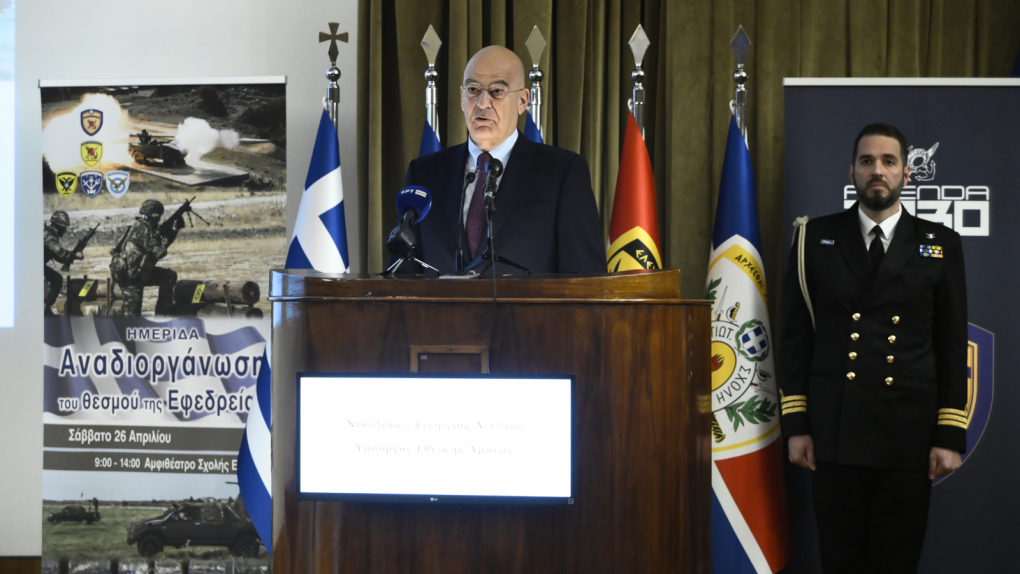
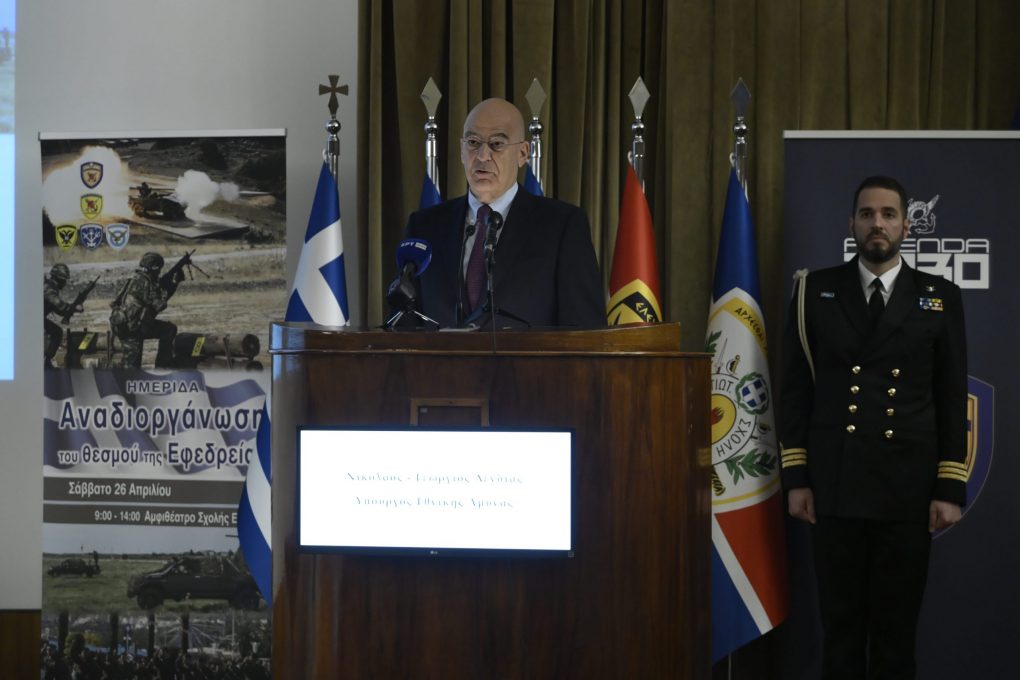
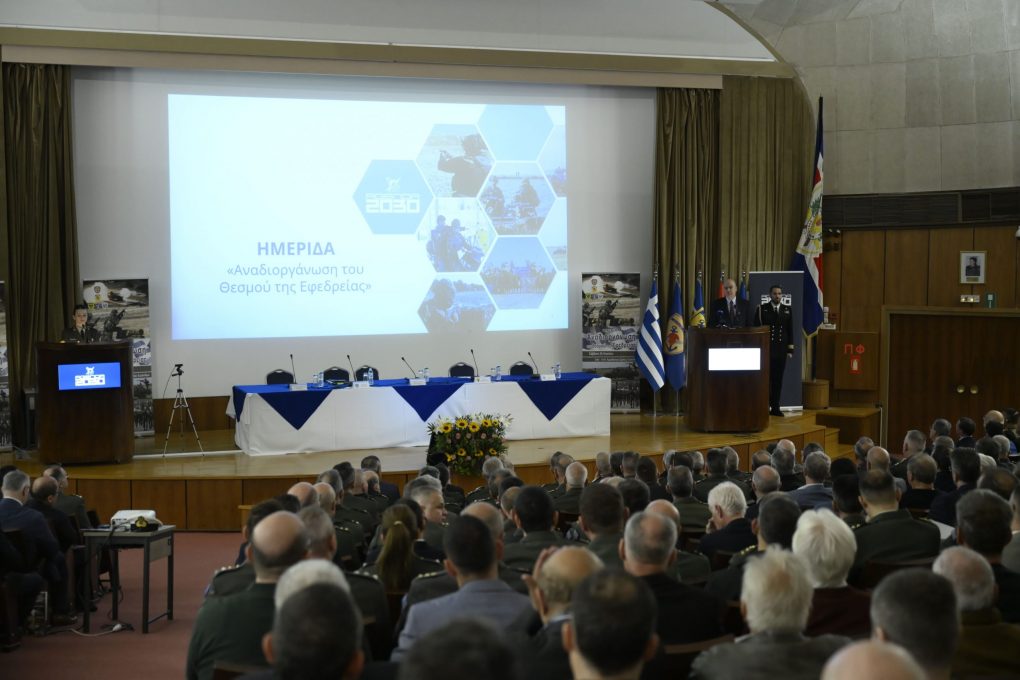
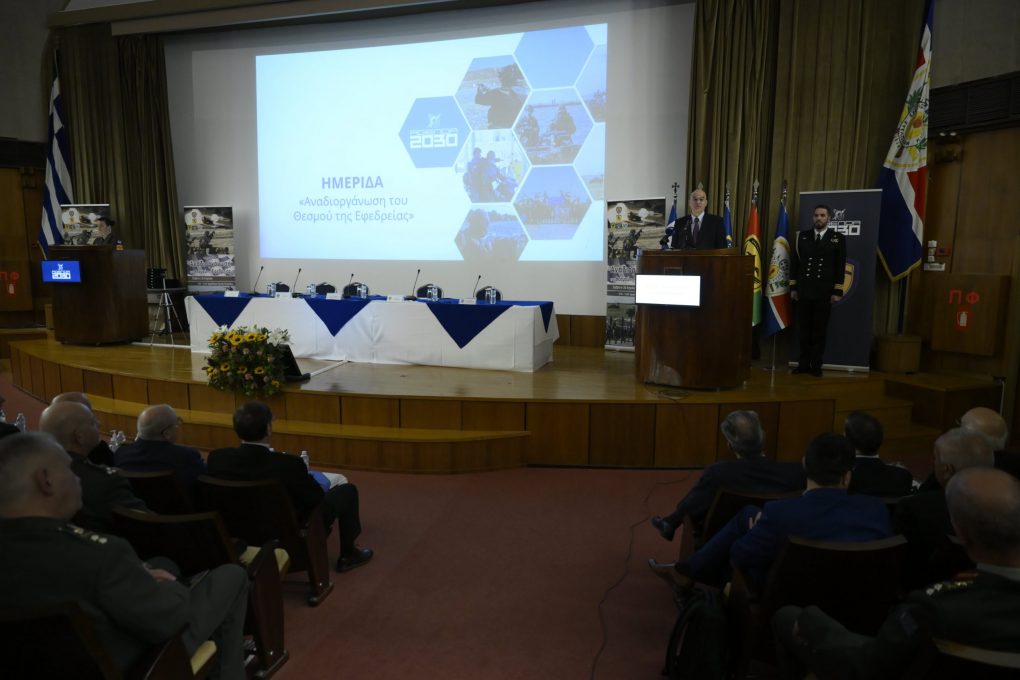
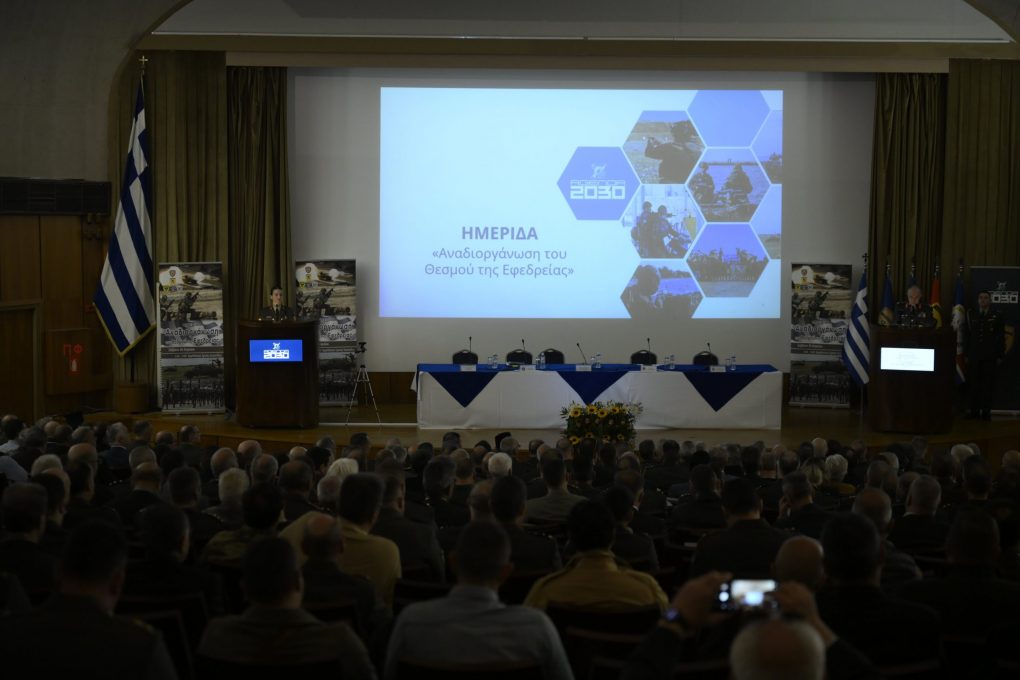
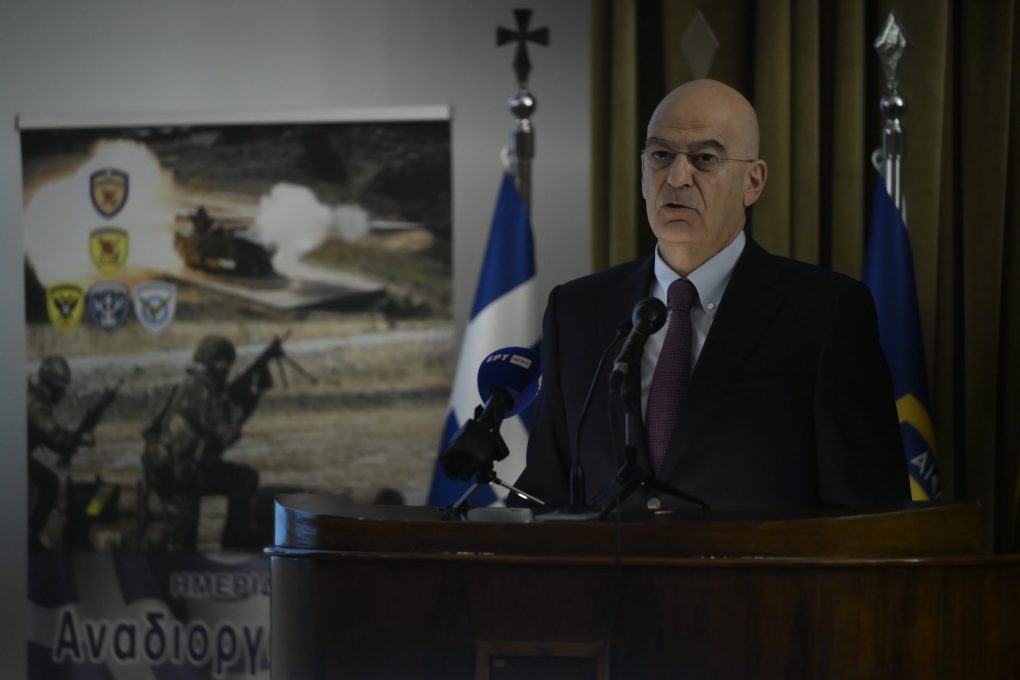
On Saturday 26 April 2025, the Minister of National Defence Nikos Dendias attended a Conference with the subject “The Reform of the Institution of Reserves”, which was organised by the Hellenic Army General Staff, within the framework of the “2030 Agenda”, and was held in the Amphitheatre of the Hellenic Military Academy.
The event was also attended by the MP and President of the Armament Programmes and Contracts Committee of the Hellenic Parliament, Angelos Syrigos, MPs Irini (Nina) Kasimati and Stylianos Fotopoulos, the Chief of Hellenic National Defence General Staff, General Dimitrios Houpis, the Chief of Hellenic Army General Staff, Lieutenant General Georgios Kostidis, the Deputy Chief of Hellenic Navy General Staff, Rear Admiral Spyridon Lagaras HN, as representative of the Chief of Hellenic Navy General Staff, Vice Admiral Dimitrios – Eleftherios Kataras HN, the Director of the Hellenic Air Force General Staff B Staff Directorate, Major General (HAF) Marios Badouvas, as representative of the Chief of Hellenic Air Force General Staff, Lieutenant General (HAF) Dimosthenis Grigoriadis, the Commandant of the Hellenic Military Academy, Major General Anastasios Polychronos, as well as Armed Forces Officers.
The conference was also attended by the Metropolitan of Peristeri and Artillery Reserve Officer Mr. Grigorios, representatives of the Supreme Panhellenic Federation of Reserve Officers, the Pancypriot Federation of Reserve Officers, as well as 39 Reserve Officer Association Liaisons from various Prefectures of Greece.
In his address, the Minister of National Defence stated the following:
“Today’s Conference is one step towards the completion of the “2030 Agenda”. That is because the Reserve Institution is part of that Agenda. The reform and modernisation of the Institution of Reserves.
Firstly, I believe in the meritocratic character of Reserves. It is a connection of values among citizens, the Country, and the state. Ever since the Athenian Democracy and up until 1940, armed citizens have always constituted the foundation of Freedom.
The contribution of Reserves to the History of the Nation is immeasurable. It has been being documented in battlefields for the past 2,500 years and one quick glance at the records, where the names of those who fell for our country are kept, will prove the great number of Reserves who sacrificed themselves for the future of our country.
Thus, we are led to a basic and general truth: the fact that armed citizens are the front-line of the Freedom of the country.
We possess a core of professional personnel, of which we are deeply proud. However, it is the Greek citizens that complete them, by being ready to take up arms when required and defend their country, family, and society.
Apart from a necessity of values, modern reserves are also a strategic necessity. The enemies, threats – or singular threat if you will – that our country is called upon to face, are much higher in numbers. Consequently, the active army must become stronger.
So, we need Reserves that are improved in quality. As well as to incorporate the army of civilians to our national defence planning. Because that is what we need for our safety and national survival.
The “2030 Agenda”, with the way it has been designed, fully incorporates the new institution of Reserves, as well as the institution of the new service for enlisted soldiers, as drastic reforms will take place in that domain too.
We need a dynamic model in both instances, which will have training as its basic foundation. Operational and realistic training, not simply training on paper.
The current weapon systems, as well as those that are going to be procured through the 20-year-long planning happening for the first time ever, also require trained operators.
Similarly, modern combat practices and the doctrines we have acquired from developments in the world today, require new training on the field, as well as with simulators; modern simulators , which adapt to all situations that a modern fighter might be called upon to face.
This is why we are creating the new reserves, a complementary institution. This new complementary institution is found between the army and general mobilisation. We are talking about active, voluntary reserves.
So, we are introducing this new active, volunteer reservist institution. In this institution, Soldiers and Reserve Officer Cadets are called upon after completing their military service.
In addition, we will initially go back and ask all people who have served their military service in the past 10 years, if they desire to be incorporated in the programme.
The aim is that upon the complete implementation of the 2030 Agenda, namely in five years from now, there should be a force of 150,000 active, Reservist volunteers, who will have undergone a different type of training and readiness, in order to be able to immediately assist the active army and cover operational needs.
I think that I am stating the obvious when I say that Greece does not have the luxury of not utilising the citizens who want to contribute to national defence.
Additionally, we are implementing changes in the manner that Reservists are notified regarding their duties. I have to admit that it came as a shock to me, when the call-up system during the first Reservist training that I observed, was the same as it was 50 if not 100 years ago. The Individual Call-up Order, which requires the physical presence of a police officer in order to be delivered. Is it possible that this is the reality in our country in the 21st century?
So, we have already connected the “EFEDROS” application to gov.gr, in order to be able to send call-up documents directly and digitally. Also, we are seeking, benefits and motivating factors for the active reserves, both compensating and economic, within the boundaries of our limited capabilities, and discussing them with you is of great importance.
We are also looking for your thoughts and ideas, dear Reservist colleagues, regarding how the institution can be improved. We need your help in order to cultivate, or recultivate, since I am certain that the foundations are there and stable, a defence culture; a sense in every Greek citizen, that they have a say in the defence of the country and that their contribution is necessary for its defence.
I think that the international environment teaches us that the illusion of constant peace that arose in the beginning of the 20th century, is not what ultimately happened. Sadly, but it did not. On the contrary, we returned to a time of turmoil and war. I would like to clarify that we do not consider the presence of so many Reservists today, as representatives of all Reserve Officers Organisations of the country, symbolic.
I urge for your meaningful participation after the presentations by the Hellenic Army General Staff and our Allies, who will bring us into contact with other models. As you know, I have visited numerous countries in the past months in order to also have a picture as regards the manner that they view the institution of reserves.
Additionally, please give me the opportunity to state something, which I would like to be clear. There is no reform if we remain stuck to past ideologies.
I am referring to the enormous scattering of camps and units in the country. I understand and, occasionally maybe even agree, with local reactions, but I think that national interests are much more significant and we cant afford the luxury of continuing down the same road.
Reactions due to the merging of units and even due to the merging of National Guard units, with the only thought behind them being that we will travel a few kilometres further for our training are not acceptable. And I am ready to undertake all political costs required for the reform of our Country’s Armed Forces. “Opportunities won’t wait” and I think that is understandable by anyone who might take a brief look at our broader geopolitical environment. They do not need to do anything more.
So, of course, I expect support in this effort, as well as constructive criticism where it is needed. It is totally welcome. We do not claim to know everything. Today’s Conference is exactly the proof of our attempt to seek knowledge, opinions, and beliefs within a broader framework. However, what is not going to happen is for us to stop the reform due to reactions.
Ladies and Gentlemen, I would like to conclude that: In our opinion, Reservists are the shield of the State. We are a small country. Nevertheless, our values are not insignificant. We are very significant. And contrary to the tendency of many other countries to maintain a strictly professional army, we have historically chosen as a society, not as a Government, to treat things differently. We believe that it is a more essential way to treat things for Democracy as well. And we deeply believe that Greek Citizens are proud of the choice that their country has made.
Because after all, the uniform which bears the National Insignia, and which all of us, me included, had the honour of wearing for a part of our lives, is our common home.
Thank you very much”.
Addresses were also made by the Chief of Hellenic Army General Staff, Lieutenant General Georgios Kostidis, the President of the Armament Programmes and Contracts Committee of the Hellenic Parliament, Angelos Syrigos, the Metropolitan of Peristeri and Artillery Reserve Officer, Mr. Grigorios, the President of the Supreme Panhellenic Federation of Reserve Officers, Filippos Kostaras, and the President of the Pancypriot Federation of Reserve Officers, Kypros Manoulos.
Presentations on planned changes and optimal practices by other countries followed, as well as a conversation among participants, which was coordinated by the journalist and Armour Reserve Officer, Kostas Sarikas.