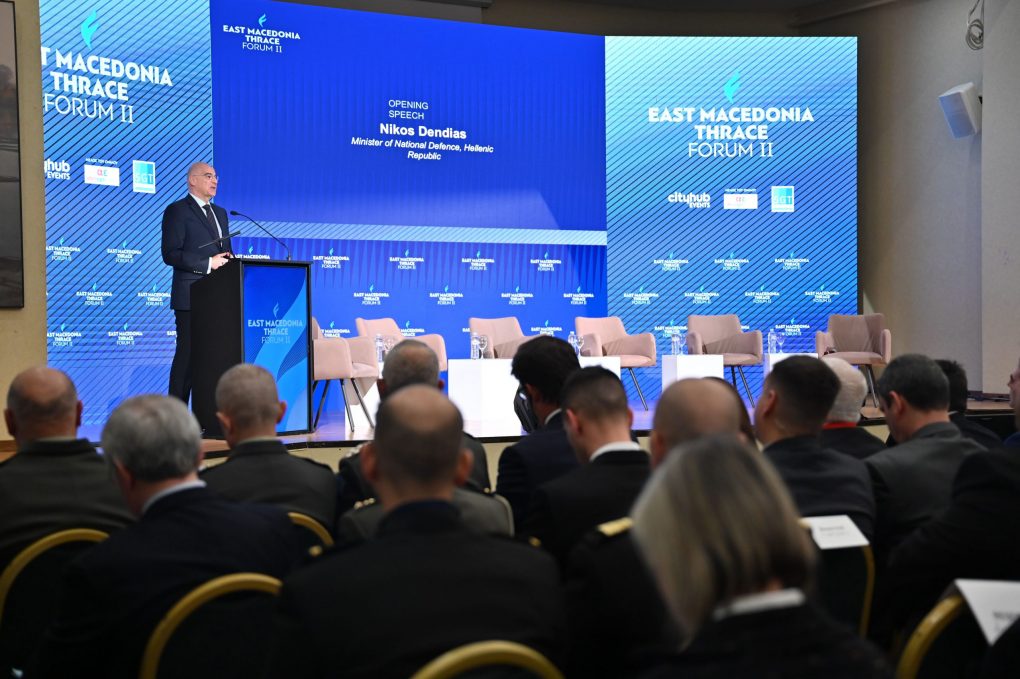
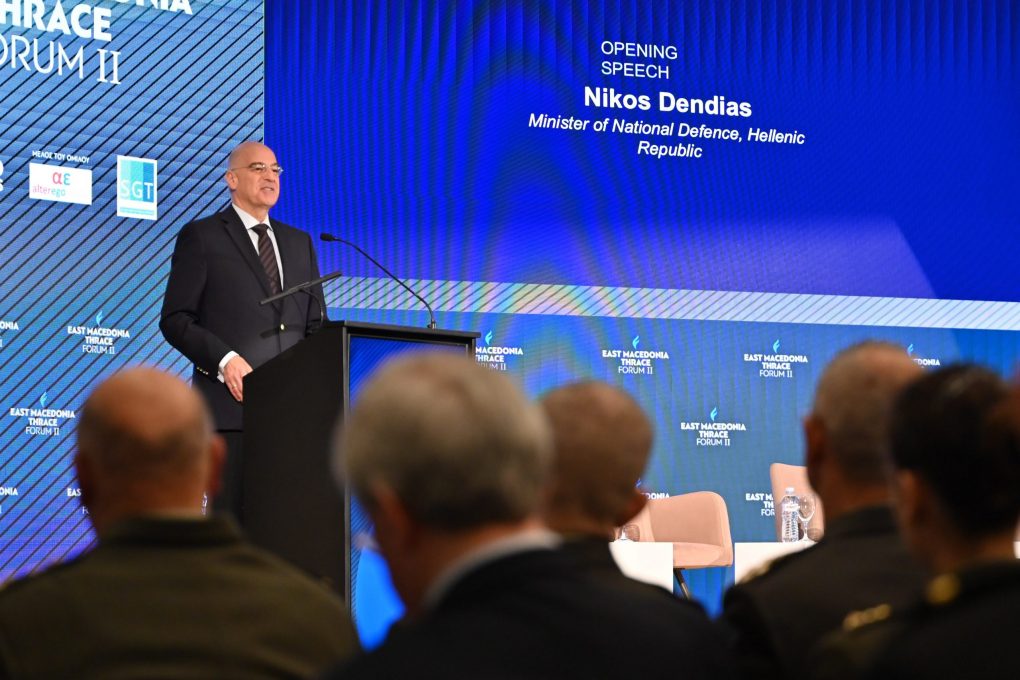
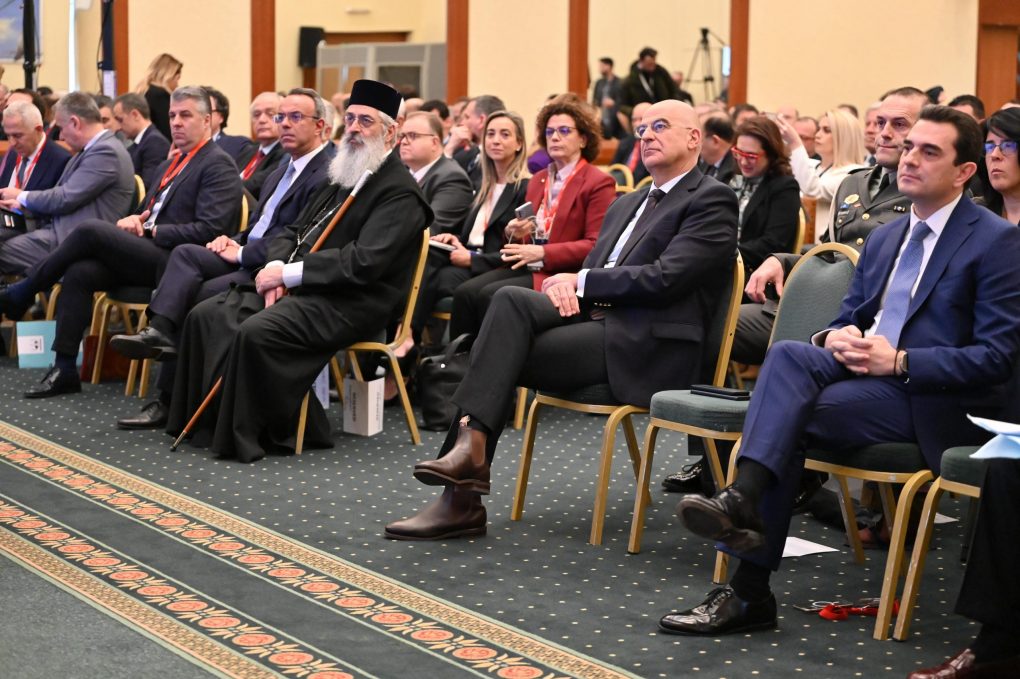
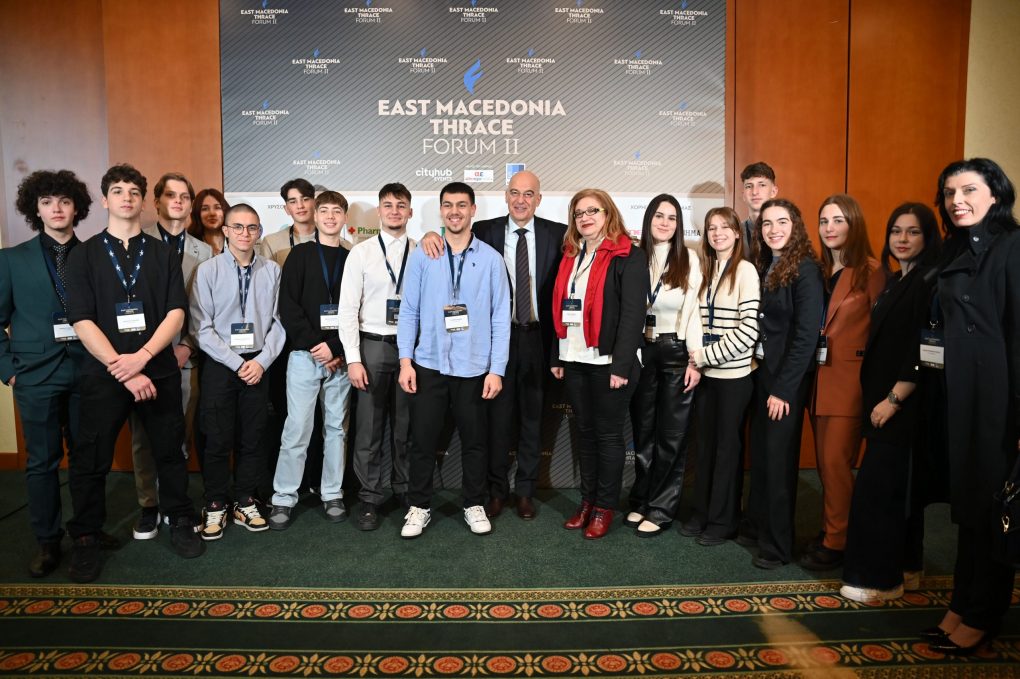
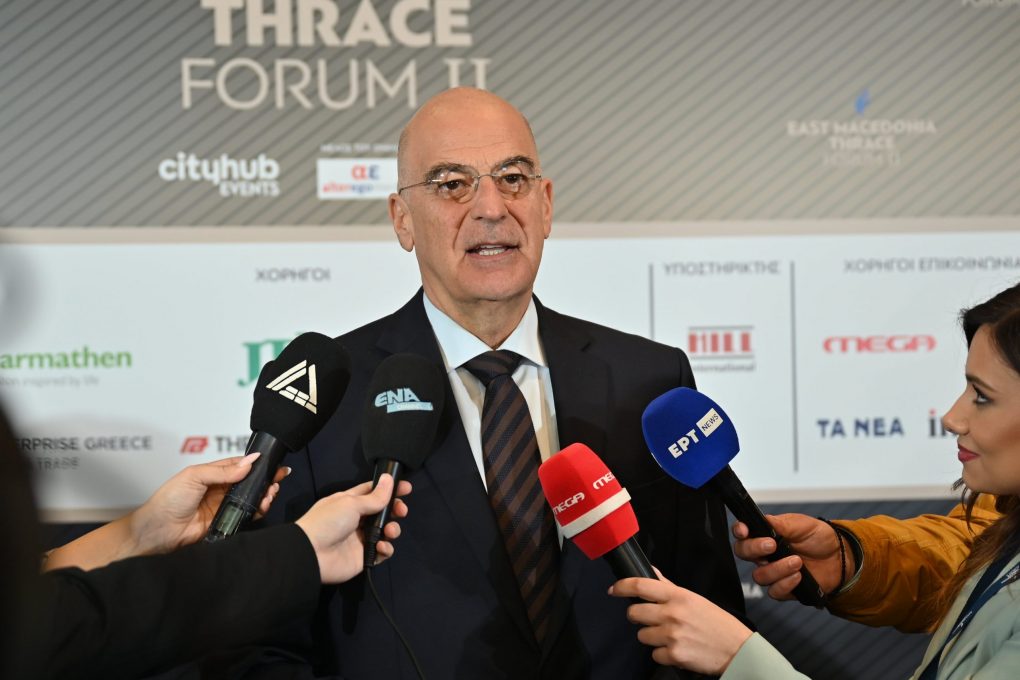
On Wednesday 13 March 2024, the Minister of National Defence Nikos Dendias participated in the East Macedonia & Thrace Forum II in Alexandroupolis.
In his address, Mr. Dendias stated:
“Dear colleagues, your Excellency mister Ambassador, Regional Governors, officials of the local Self-administration, Chief/HNDGS, Army Chief, Admiral, representative of the opposition, mister Apostolakis, colleagues from the other Parties, ladies and gentlemen,
It is a great pleasure and honour to participate as speaker in this important event and I would like Mr. Vrentzos to congratulate you for it.
Thrace, Alexandroupolis, need reinforcement and a real effort is required to be made. For me, it is also a personal joy. The Alexandroupolis Municipality had made me the honour to appoint me as honorary citizen and allow me to say that I absolutely feel like a citizen of this city and a citizen of this region that I love. I have referred to this city and this region many times in the past. A city and a region that literally lie at the borderline of Europe, and of course the borderline of our country.
An area which is a bright example of co-existence as well, among Greek citizens of various religions.
Alexandroupolis, I think, has proven the main role it can play. An important commercial, economic, energy, and defence hub.
I always remember when, on behalf of the Mitsotakis government, I signed the first defence agreement with the United States referring to Alexandroupolis, in 2019. It is worth reading the text.
It explicitly sets forth the strategic role of this city. Allow me to take a few steps back and see, as it is always required, the big picture.
Greece has a policy which, when I was Minister of Foreign Affairs, used to refer to as policy of the six intersecting circles. Europe, that is mainly the European Union is the first circle, the Balkans and the Black Sea are the second, the United States the third, the relations with the Mediterranean, North Africa, the Middle East the fourth circle. From then on the African Continent, the Sahel and the countries beyond the horizon, and the presence of Greece as the 6th circle in International Organisations.
From these six circles, four are intersecting here in Alexandroupolis, because always the Mediterranean, the Balkans, the Black Sea, was a field of communication, of interaction, of approach, as well as a field of conflicts; both a bridge and a field of conflicts.
Of course, the Eastern Balkans communicate with the Aegean and the Mediterranean through Thrace, and Alexandroupolis is closer to Odense than the route through the Bosporus Straits.
We, Greece, have the capability, also through this region, to implement our most successful effort for the creation of a stability and economic growth sector, always taking into account the ethics, in the context of which both our European family and us, Greece, serve: a zone of values regarding democracy, protection of the human rights, freedom, International Law, International Law of the Sea, a perception of values which strongly contradicts any revisionism.
Also, at this point, we must recall the Thessaloniki Agenda. Last year, in 2023, we celebrated the 20th anniversary of the Agenda, the main content of which is the accession of the Balkan Peninsula, not only of Greece, to our great European family. An Agenda with great success, the Eastern Balkans are already in the European Union, I hope in due time we will have the pleasure to welcome Moldavia as well.
In the west Balkans we have much more work to do, always in the context of the Acquis Communautaire, which is the protection of the rule of law. Because the Thessaloniki agenda also serves the Hellenic interest as well.
We have always wanted -and still do- to function as a bridge of communication and cooperation of the north with the south, with countries to the south of the Mediterranean, Egypt, Israel, and even beyond, with the states in the Gulf, the United Arab Emirates, Saudi Arabia, Qatar and other countries.
We Greeks of course also have a complete sense of the instability of the Sub-Saharan Africa as a problem for the European continent as well. We try to awake our European family regarding these risks.
I always say that our relations and alliances are open relations, not closed. We do not create coalitions against someone. We create frameworks in which anyone who countersigns International Law, International Law of the Sea and the framework of values of the Acquis Communautaire is welcomed to participate.
Economic growth, though, is the necessary tool for us to move forward. There must be interconnection, so as to have economic growth; no synergies can be created without it. For this exact reason, we welcome the initiative of the European Union for the map of the new railway commercial route of the Baltic Sea – the Euxine Sea and the Aegean. The initiative between the three seas, the Baltic, the Adriatic, the Black Sea with Greece also adds a fourth sea, the Aegean and so we can, after our accession as a full 13th member in this family, to develop the new communication routes.
Also, I would like to say that we are in an area, the importance of which as an energy hub is obvious. With my new capacity as Defence Minister, a few months ago I signed with the Bulgarian Defence Minister and the Romanian Deputy Defence Minister a “Letter of Intent”, regarding the expansion of NATO fuel supply pipeline towards Bulgaria and Romania.
You can realise the significance in the geopolitical reality we are currently experiencing; and of course everyone understands that we must reinforce the European initiatives for variation of energy sources and energy routes, due to the Russian invasion in Ukraine.
We must decide on the extent of our country’s participation in this, primarily regarding the intermediate fuel, natural gas, but also the electric power as well.
Regarding natural gas, the East Med, the Transatlantic, the Interconnector, the Greece-Bulgaria, is a terminology common to us all, and concerns the area we are in today.
Regarding the electric power as well, our country should have a key role. I believe that the works of underwater Euro-Africa and Euro-Asia electrical interfaces are necessary prerequisites for our country to be able to serve this long term planning.
Ladies and gentlemen, all these infrastructures, all these pipes, all the axes, the whole interconnection, have a basic prerequisite in the 21st century we live in: I refer to the possibility for someone to defend them, to protect them against any form of threat, either conventional, or -as you all understand- hybrid. The result of all this is the absolute necessity to have strong and modern Armed Forces, that can respond to the complexity of the role they are called to play in the 21st century. This is what we have called “Agenda 2030” in the Ministry of Defence.
An Agenda that we think can respond to the existing challenges, and the challenges beyond the horizon as well, with a different structure and perception. With a modern model of service, a modern model of reserve, with growth of the domestic defence industry, I hope here in Thrace as well, in order to withdraw the perception that I, using slang, say “we shop off the self”.
To create a defence ecosystem which our resources, the Hellenic human capital, can effectively serve.
The draft law has already passed from the Cabinet, it will be presented to the Parliament for discussion in the next days. I hope it has total support. It is our window to a new era.
It establishes a Hellenic Development and Innovation Centre, which will be connected with the already recently established Innovation Directorate in the Armed Forces, with our military academies undergoing transformation, which can perform research and award PhDs. It will be interconnected with the joint Information Corps that has just been established. But, due to the disasters that you recall very well last year here in Thrace, we are adjusting to this too.
We are establishing a special Directorate to counter natural disasters, with specially equipped dual-use units, which can help the Greek society to counter the challenges arising from climate change as well.
To be honest, we also wish to help the Greek foreign policy, by displaying soft power; that is by helping with our know-how and the capabilities of deploying a force for this case, for the environmental disasters, to project the specific capability of our country.
From then on, ladies and gentlemen, I want to conclude with an issue that I consider of national importance. I want to say that we are at an era where we must take under consideration -as I said before- not only the current conditions of contesting a fragile geopolitical balance, but a series of changes as well, that will occur in the next years.
Already a few days ago, President Erdogan announced that in 2028 he will withdraw from Turkey’s leadership, he will not pursue his re-election. So, the question we are called to discuss is what will Turkey be after Erdogan? Which are going to be the geopolitical choices of his successors and what will be the direction of this great and important country located at out east?
I do not need to tell you that, when President Erdogan became Prime Minister of Turkey, Turkey had less than 500 religious schools. At this moment, Turkey has more than 5,500 religious schools. Apart from the future of our neighboring country – and, to be honest, I really believe that a democratic and prosperous Turkey is in Greece’s best interest – we cannot ignore the future in the west Balkans as well. This will define the stability in our region.
What will happen to North Macedonia, especially after the elections? How will the situation in Kosovo evolve? What will be the situation in Bosnia-Herzegovina in the decades to come? Of course, we cannot ignore what happens to the south of us, in Gaza. We cannot ignore what happens in the African continent. I remind you that the coasts of the African continent are less than a twenty-minute flight away from Crete. They are much closer to Crete than Alexandroupolis.
So, to face all these potential changes and challenges, basic parameters are required. I call them: national understanding, cooperation of everyone, consents, national planning to face the demographic decline, which is a great national threat, reinforcement of social cohesion through the application of a developmental economic policy that distributes equally the dividend of growth as well.
In addition to the above, as I said before, also the rapid transformation of the Armed Forces, the greater transformation ever made in the Armed Forces since the establishment of the Hellenic State, as Prime Minister Kyriakos Mitsotakis said when I presented the law for innovation to the Cabinet.
Ladies and gentlemen, I belong to the chorea of the optimists. I believe that Greece can move on with self-confidence in the 21st century, devoted to its principles, the International Law, democracy, freedom, the International Law of the Sea; always be active, regarding the initiatives for peace and stability; always be present in these initiatives; absent, of course, from fabricated arguments and threats, fully grasping the end of the old doctrines and beliefs era that lead states and peoples to dead ends.
Yet, Greece should always also defend its sovereignty, its sovereign rights, its independence and dignity with complete, calm and steady readiness.
Thank you”.
The Minister of National Defence, following his participation in today’s works of the Forum, stated to the Press:
“It is a great pleasure to be here today, in Alexandroupolis, the Region of East Macedonia and Thrace, for this very important Forum, which examines the development perspectives of a very important region for Greece.
It is a region which first of all constitutes the frontiers of Greece towards the east, as well as the frontiers of Greece towards the north.
I am very proud because despite the great difficulties that are handled-life is always like that-and despite the natural disasters, the challenges, East Macedonia and Thrace move forward. I am absolutely certain that this Region will have a bright future.
Once again, congratulations for this outstanding Forum. Thank you”.