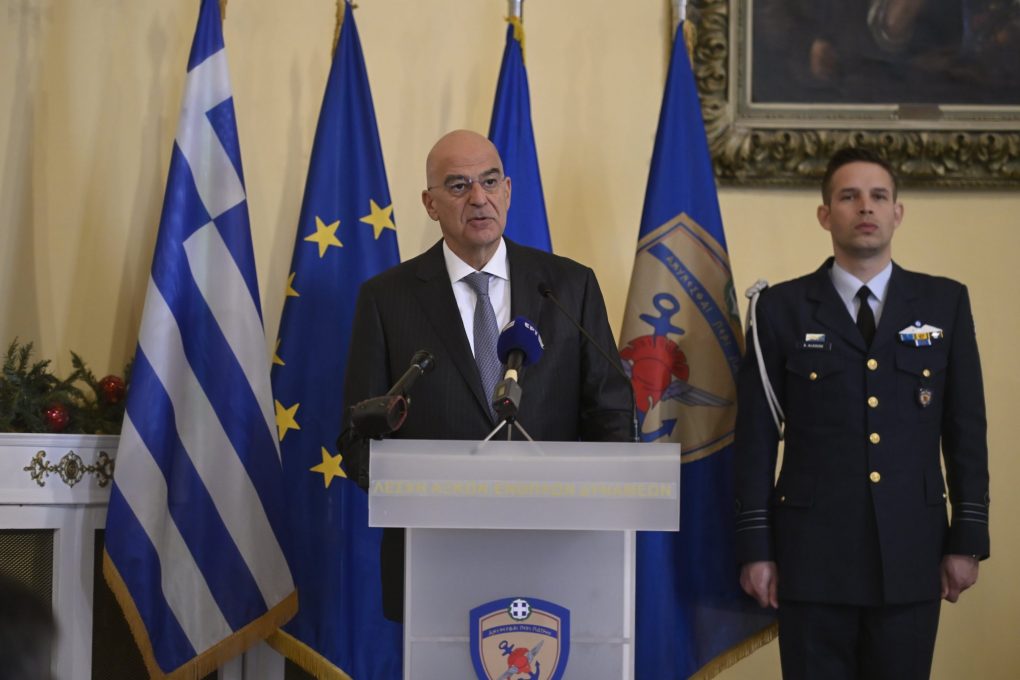
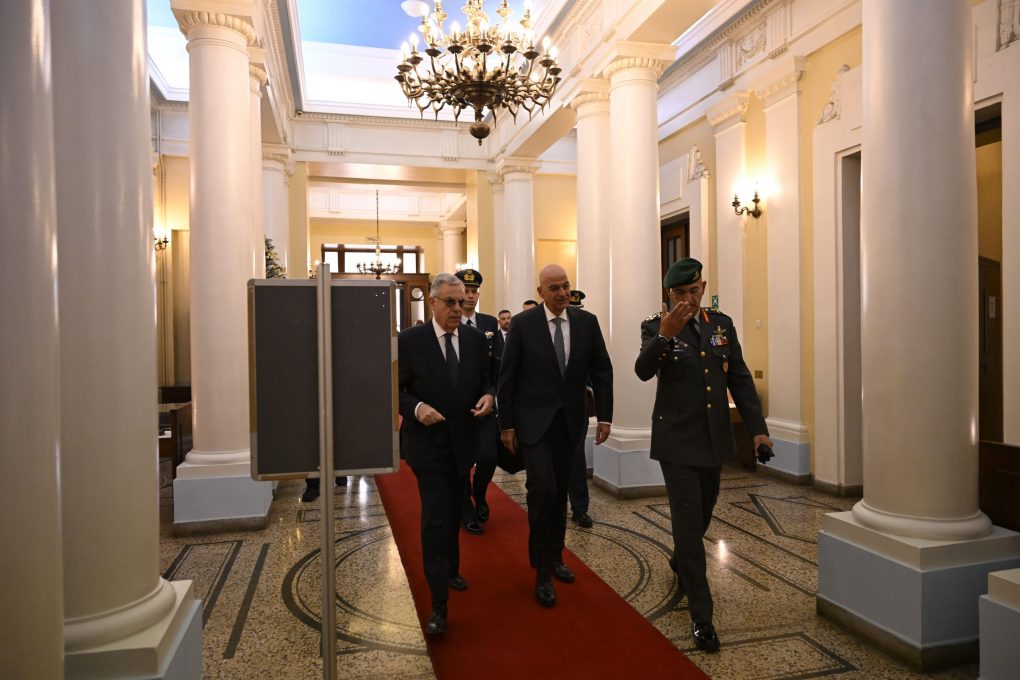
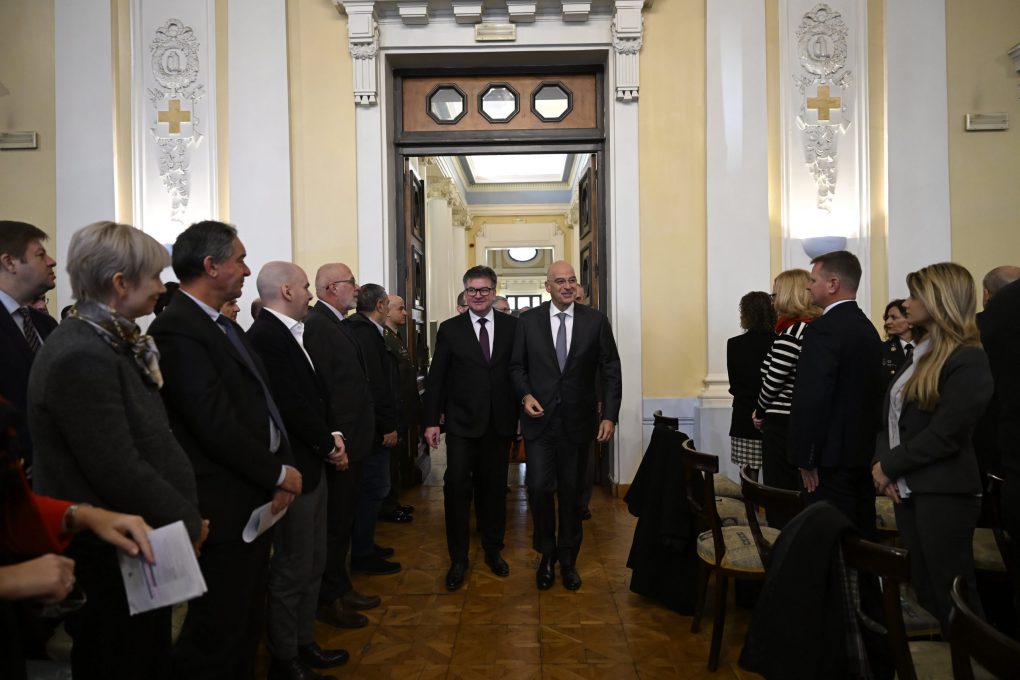
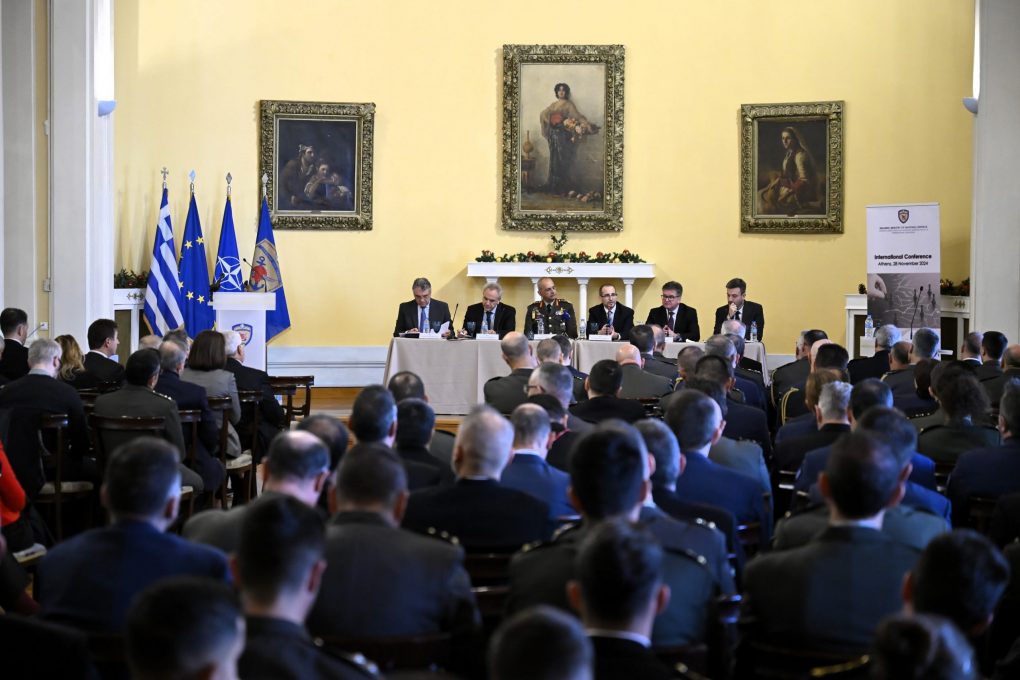
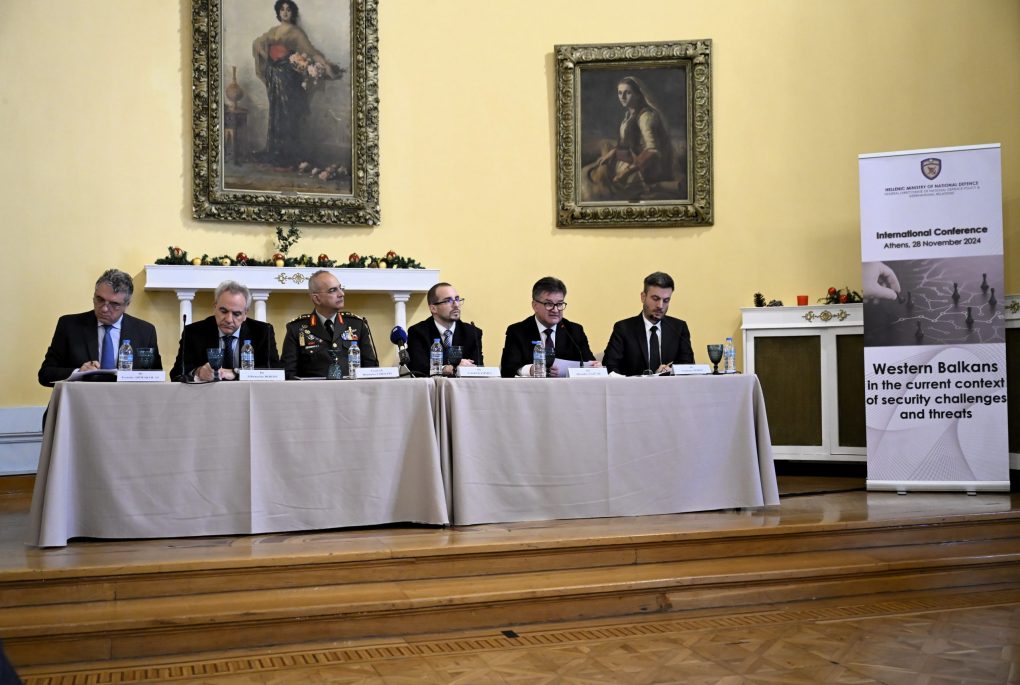
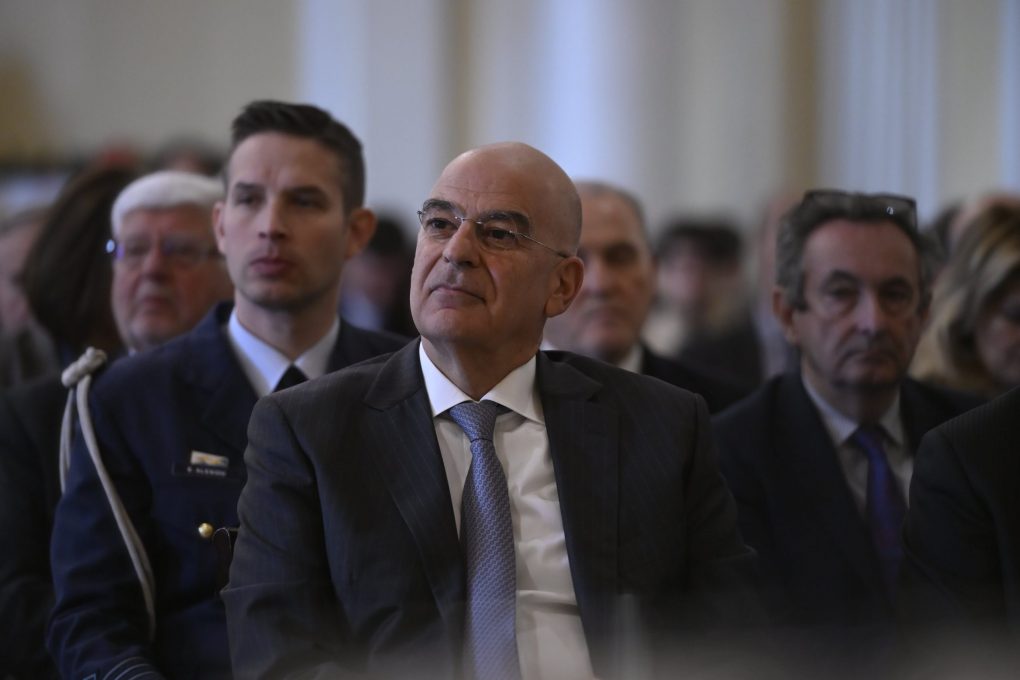
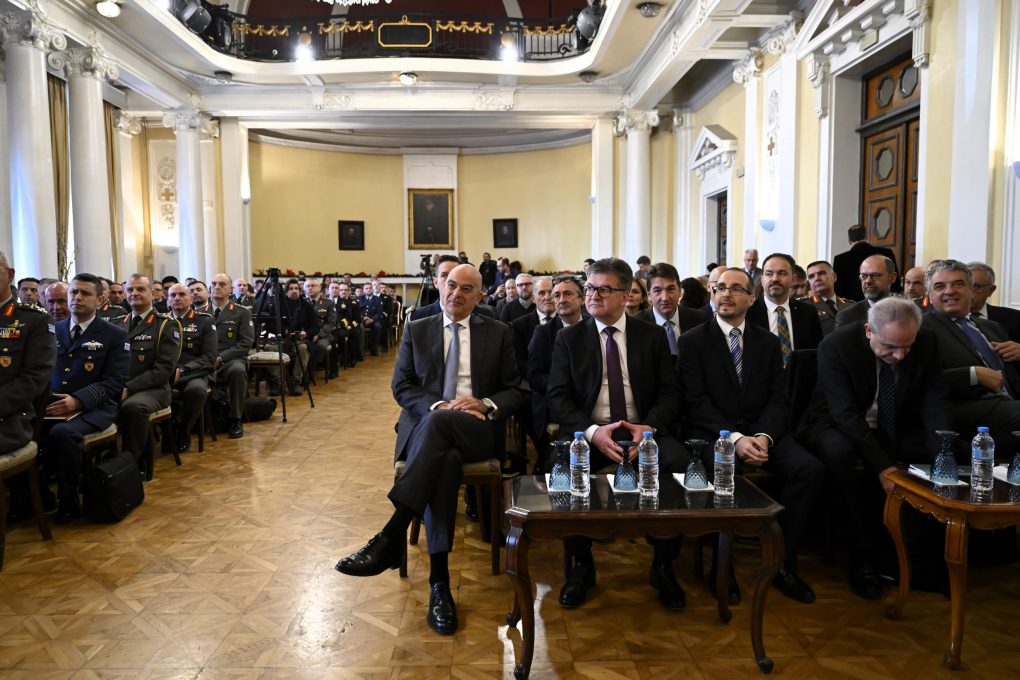
On Thursday, 28 November 2024, the Minister of National Defence Nikos Dendias attended the opening of the High Level International Conference organised by the General Directorate for National Defence Policy and International Relations at the Athens Armed Forces Officers’ Club on the subject “Western Balkans in the Current Context of Security Challenges and Threats”.
The event was attended by the EU Special Representative for the Belgrade-Pristina Dialogue and other Western Balkan regional issues Miroslav Lajčák, the Chief of Hellenic National Defence General Staff, General Dimitrios Choupis, the Secretary General and Defence Policy Director of the Ministry of Defence of Austria, Dr. Arnold Kammel, the Permanent Representative of Greece to the EU, Ambassador Ioannis Vrailas, the National Security Advisor, Dr. Athanasios Ntokos, and the General Director for National Defence Policy and International Relations of the Ministry of National Defence, Ambassador Ad Honorem Michel Spinellis.
The event was also attended by academics, general and senior officers, diplomats, ambassadors ad honorem, strategy analysts, journalists, etc.
In his address during the opening of the High Level International Conference, the Minister of National Defence stressed the following:
“I would like to congratulate the General Directorate for National Defense Policy and International Relations of the Ministry of National Defence for organizing this conference and especially for bringing together so many esteemed participants from Greece, but also from abroad.
We gather here today to engage with a subject that I think holds critical importance not only for the countries of the Balkan peninsula, but also for Europe and if I may say so, the world.
It easy now to underestimate the potential challenges in the Balkans because of the two wars, in the North and in the South.
But yet again, through history Balkans have proven to be a power for the whole world.
So, I have to observe the obvious, that if we want to create a stable system in Europe, in the European continent, we cannot allow black holes in that system.
The Western Balkans historically, for centuries now, have served as a focal point of geopolitical interest and they are shaped by a very complex tapestry of history, culture and socio-political dynamics.
As we navigate our way through the landscape of the 21st century, we are confronted with this plethora of new challenges, and also challenges coming from the past.
Traditional security threats, military confrontations, territorial disputes, emerging risks that are increasingly relevant. We are adding cyber security threats, organized crime networks, Muslim radicalization and, of course, the persisting dangers posed by terrorism.
All these require utmost attention, but also our collective response. And it is most imperative that we unite all our sources. We unite scholars, policymakers, experts, practitioners, all put within local societies, to develop comprehensive answers to these challenges.
We have to foster resilience against political instability, corruption, sometimes endemic corruption, weak institutional framework, ethnic tensions, radicalization, organized crime, narco-trafficking, human trafficking, you name it, it’s around us.
Let us be also very clear to ourselves. Silver bullets do not exist, but the European Union integration could be the pivotal role in addressing as much as possible the overall security challenges in the Western Balkans.
And frankly speaking, I do not see any other way and I don’t listen to anybody proposing any other way, at least any other reasonable way.
Of course, I have to admit to all of you that I’m speaking from the angle of a person committed full heartedly to the European experiment.
And I’m always repeating myself by saying I believe with all its faults, with all these shortcomings, that it’s the most proud achievement of the human being on earth.
The European Union’s commitment in integrating these countries is the most essential fact for a long term peace, stability and prosperity.
And yet, stagnation, obvious stagnation in the enlargement process has reduced the European dream’s credibility, allowing – I am afraid to say- external actors to gain influence in the societies, especially of the Western Balkans.
Furthermore, the EU’s focus on security sector reform is critical for enhancing and addressing issues such as organized crime and radicalization. Ultimately, a renewed and credible EU integration process, which would be offered by the new Commission, is the most vital element for fostering resilience against all the numerus threats I listed before.
We, and now I am speaking for Greece, have always been the strongest supporter for the integration of the Western Balkans in the European Union family. It is mentioned, more than 20 years ago in the Thessaloniki Agenda and it goes without saying, that Greece continues to do so. And Greece’s approach has not changed for the future of the Western Balkans. And we accept, and we realize that we have an important role to play as the oldest country in the region that participates in the European Union and participates in NATO. And we admit that we should focus even more on the Western Balkans. And this role of Greece should be played now. Not tomorrow, not the day after. Now.
But, there is always of course a catch.
We have to speak openly and frankly to the governments and to the societies of the Western Balkan countries. And we can tell them and we should tell them that this road towards a common European dream passes through gates. And these gate are International Law, the Treaties that have been signed and good neighborly relations. Also, the rule of law. They have to pass those gates. But may I say, this is not because Greece, or the European Union, or the United Nations… It is because that is to the benefit of their societies, that it is a benefit for the people. It is exactly what we relate a better future for every person in the Western Balkans.
We, Greece, see ourselves as part of the bridge, a bridge between North-East Africa and Europe. And the Balkans are exactly the continuation of this bridge to the north. This role of ours should never be forgotten.
But please, let me underline. Greece is A bridge but Greece can also play the role of wall. A wall against Muslim radicalization and terrorism.
I would like to underline one very critical part which is usually not observed by other Europe or across the Atlantic. There were many voluntaries from the international communities of the Balkans to ISIS. Not even one was coming from the Muslim community of the Western Thrace, in Greece. And we are very proud of that.
The Muslim minority of the Western Thrace, I repeat myself, did not offer even one voluntary to any radical group.
Also, I come now to my ministry’s job. We are consistently pursuing policies aimed at enhancing military relations with the Western Balkans through bilateral agreements, joint military exercises, and participation in regional security initiatives.
We are participating as you know in KFOR. We are participating in the operation Althea in Bosnia-Herzegovina.
We also can assure you over the years of the air policing of the airspace of countries in the Western Balkans.
We have concluded numerous bilateral agreements in the fields of military cooperation and defense with Albania, Montenegro and Serbia.
We aim to further enhancing our defense relations because we believe again that it is something that helps stability in our region.
And as you know we are in the process of the biggest reform of the Greek Arm Forces ever. What we are calling the Agenda 2030.
We are very happy and very proud to share what we are doing with friends and partners in the Western Balkans.
At this point I want to congratulate someone who is among us here today. And I am speaking about my dear friend Miroslav Lajčák, who is trying to do any possible job as I was telling him right before we were entering in this room. Miroslav is the EU Special Representative for the Belgrade-Pristina Dialogue and other Western Balkan regional issues. And I congratulate him for his efforts in this very demanding and complex task. And needless to say, we all wishing him every possible success.
I believe that today’s event is an opportunity to discuss sustainable answers, I dare to say solutions, and address the huge pressing challenges we face today, but also lay a solid groundwork, which will be allowed to think for a more secure, more prosperous future for the Western Balkans countries and even beyond that.
Thank you so much.”