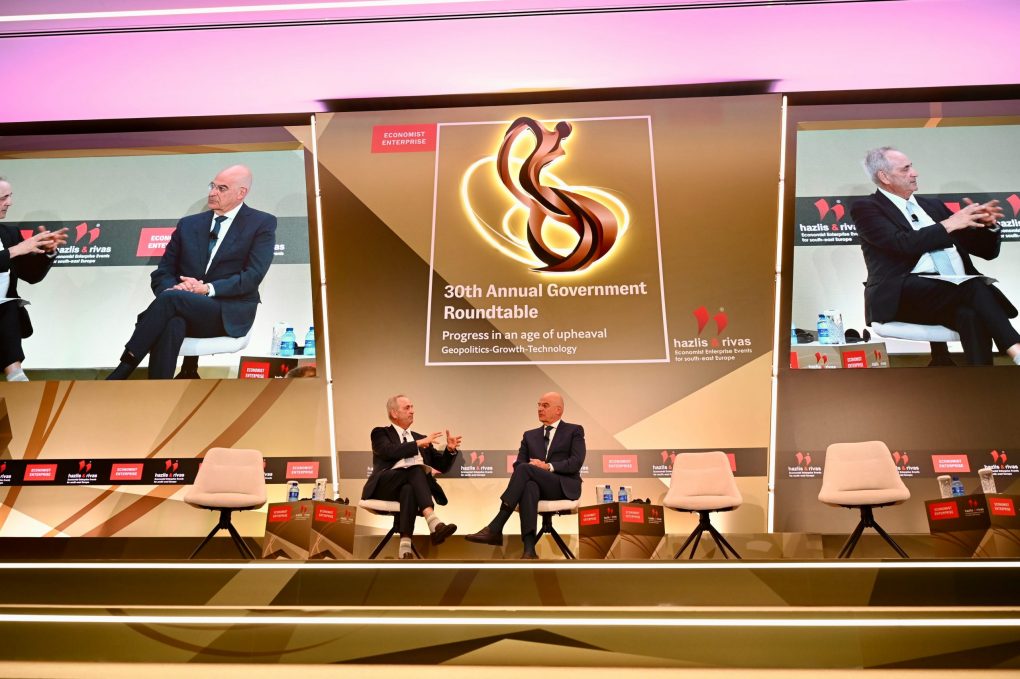
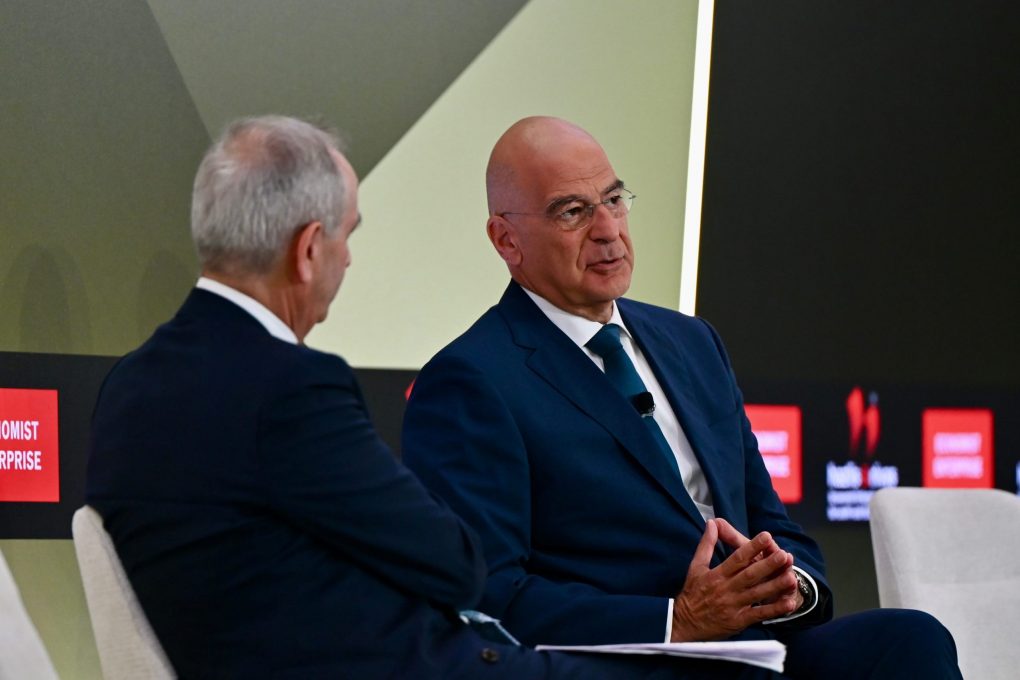
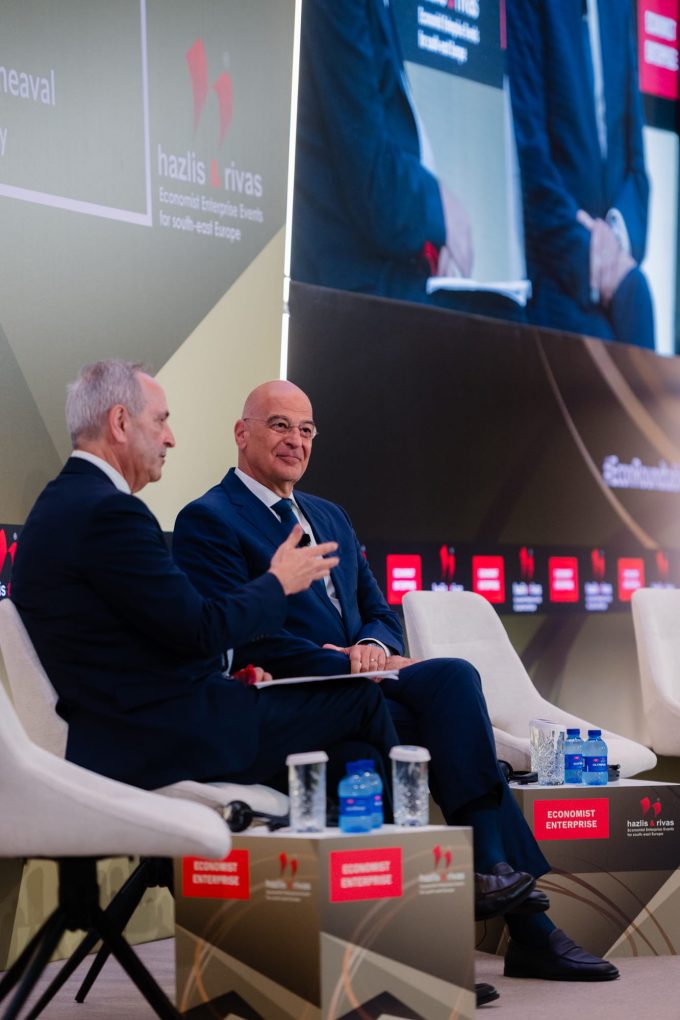
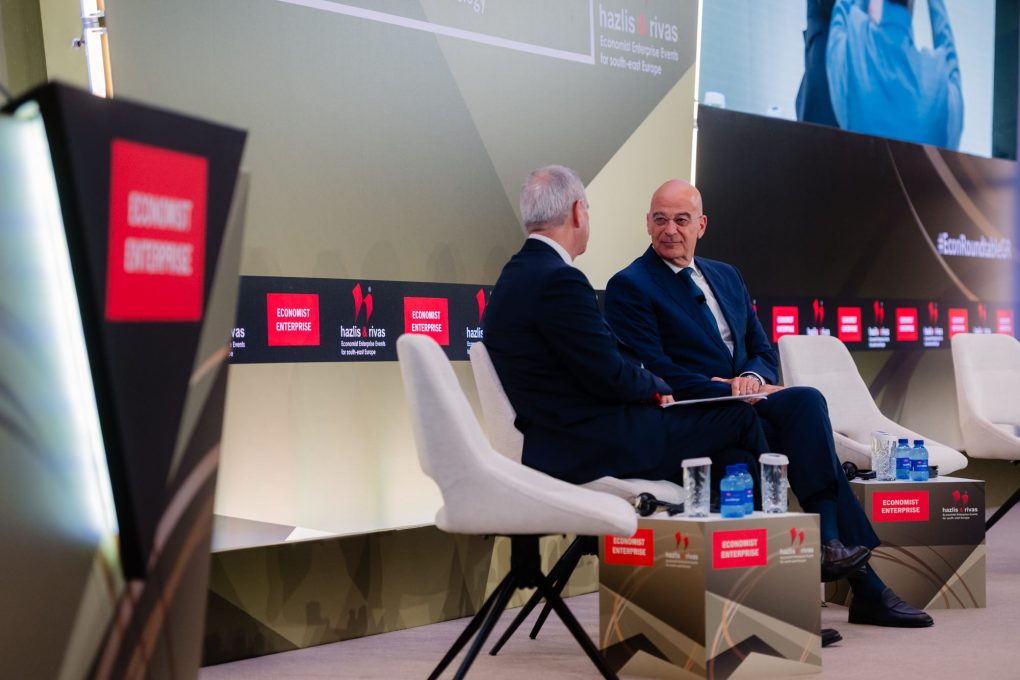
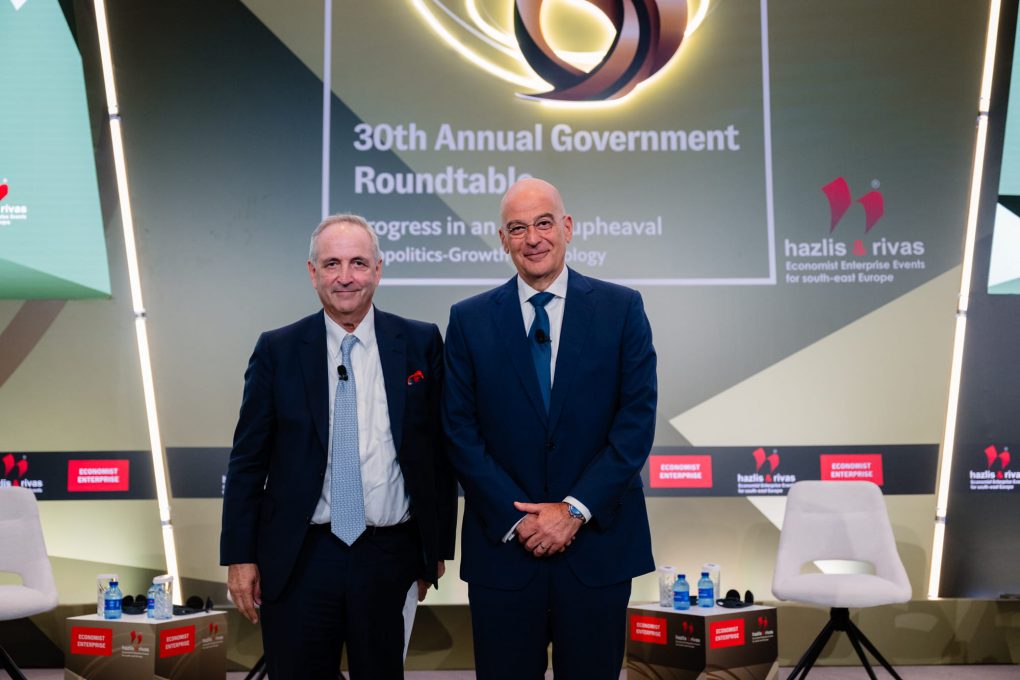
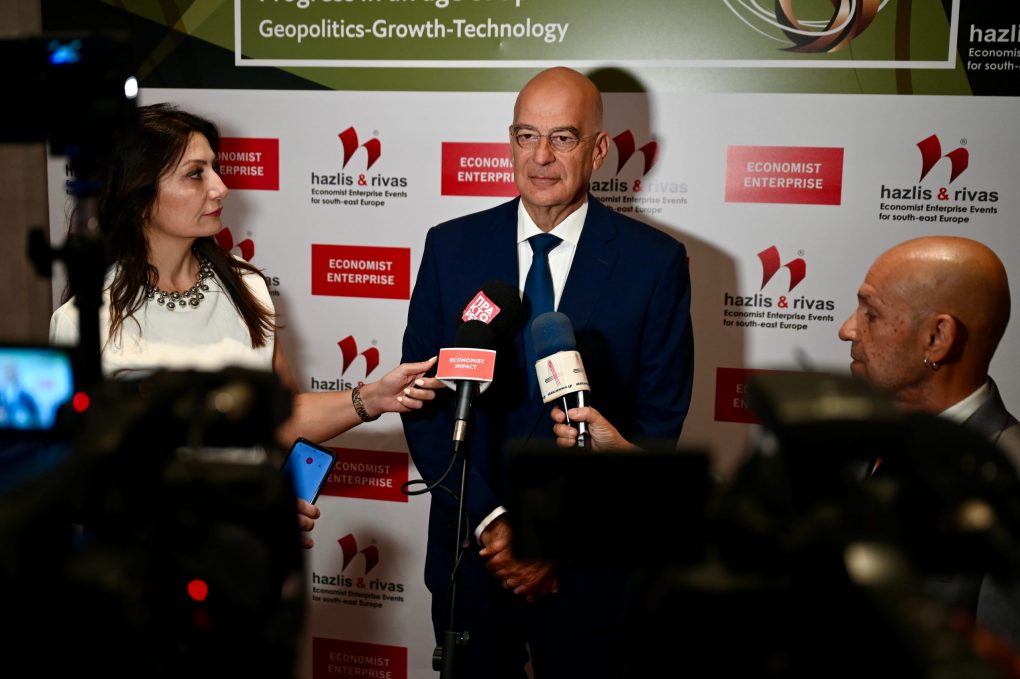
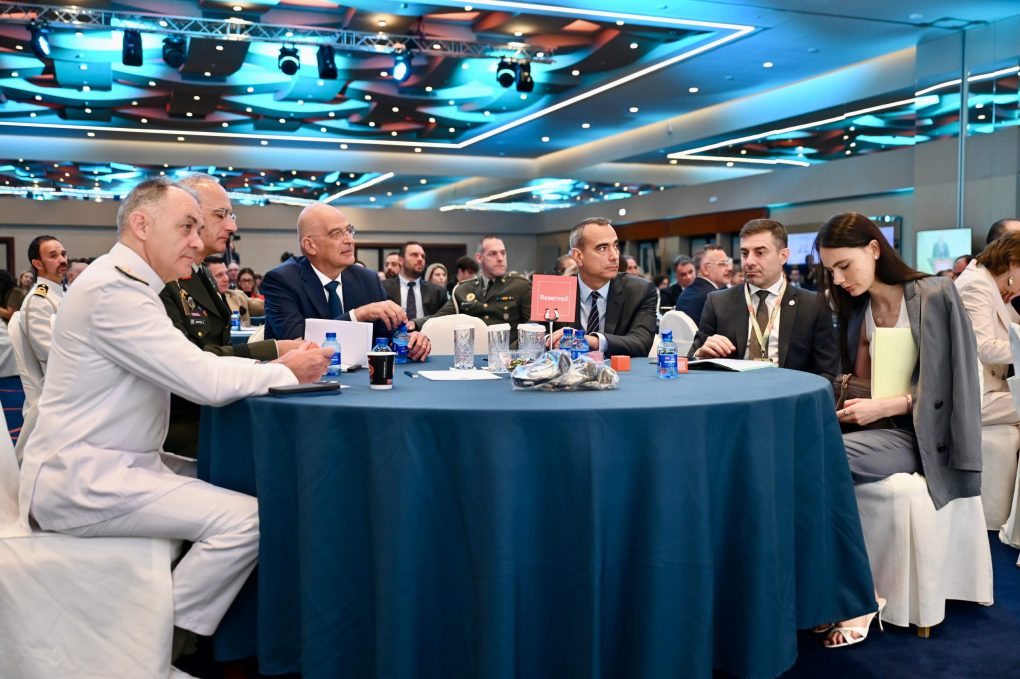
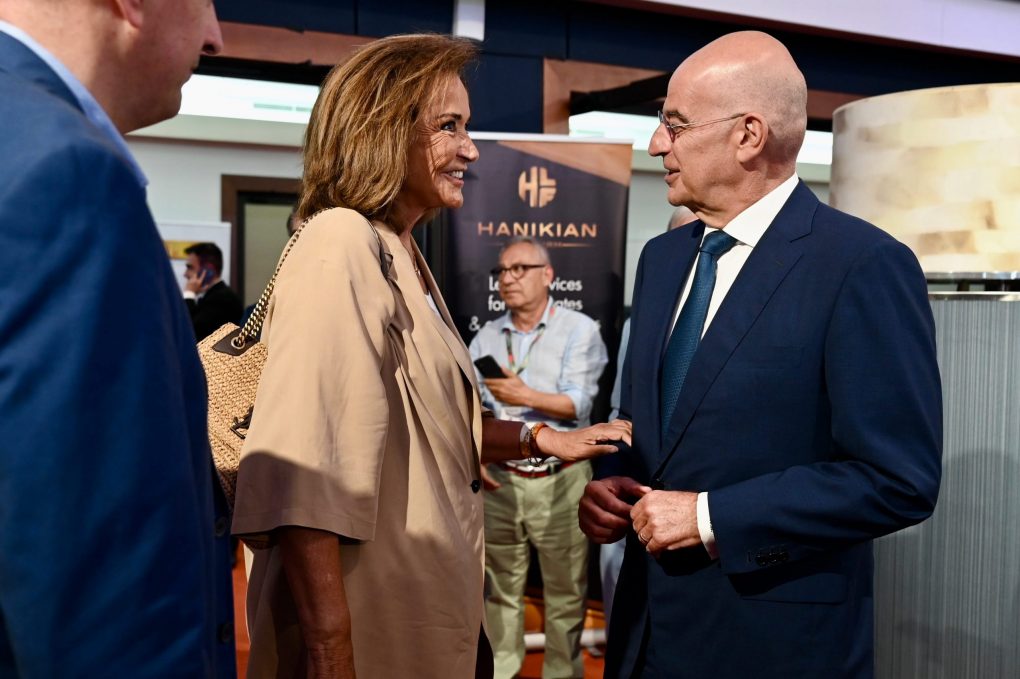
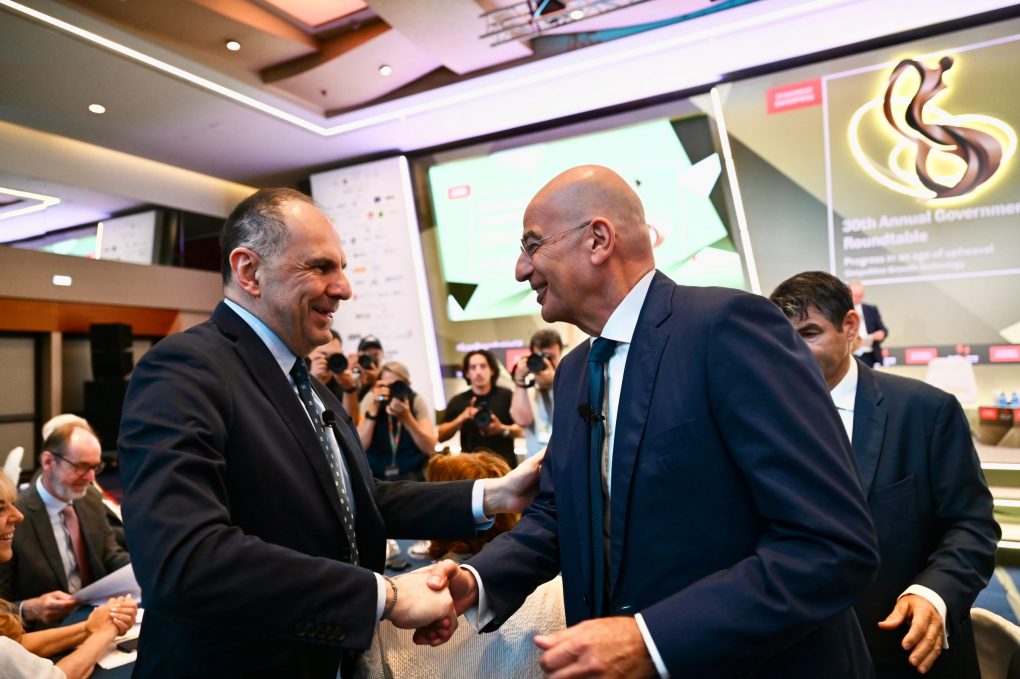
The Minister of National Defence, Nikos Dendias, participated today, Thursday 9 July 2026, in the 30th Roundtable of the Economist, in Lagonisi.
Mr Dendias participated in the session “Guarding the future: defending Europe at strategic frontiers”, in the framework of which he discussed with Daniel Franklin, executive editor & senior editor of “The Economist”.
Attendees at the discussion were the Foreign Minister Giorgos Gerapetritis, the Chief of HNDGS General Dimitrios Choupis, the Chief of HNGS Vice Admiral Dimitrios–Eleftherios Kataras HN, Human Rights Ombudsman of the Parliament of Ukraine Dmytro Lubinets, the Assistant Secretary of State for Energy Resources and former Ambassador of the USA in Greece Geoffrey Pyatt and heads of foreign diplomatic legations in Greece.
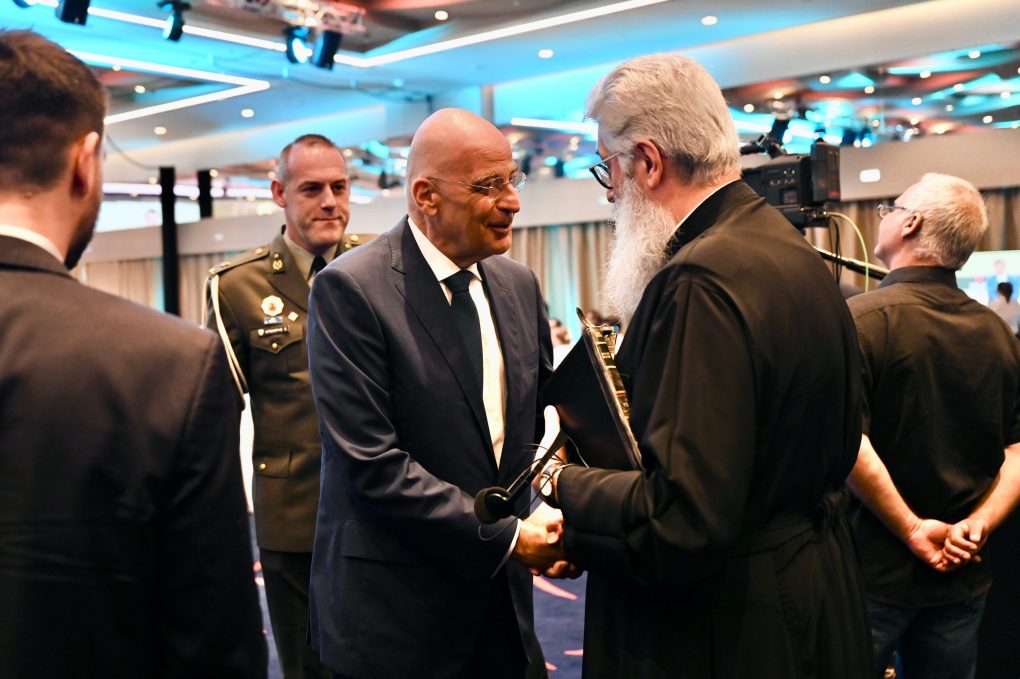
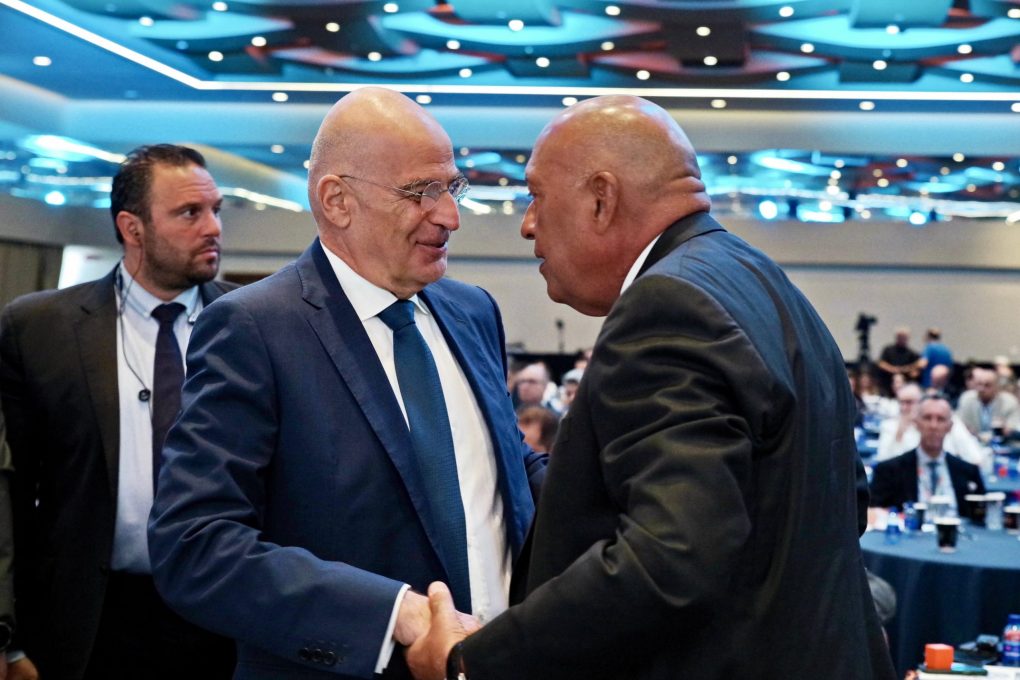
In the framework of the participation in the 30th Roundtable of the Economist, the Minister of National Defence had short meetings, among others, with the Chairperson of the Standing Committee on National Defence and Foreign Affairs of the Hellenic Parliament Dora Bakoyannis, the Minister of Migration and Asylum Thanos Plevris, the Secretary General of the Organisation for Security and Co-operation in Europe (OSCE) Feridun Sinirlioglu, His Eminence the Metropolitan Bishop of Alexandroupolis Mr Anthimos, the former Foreign Minister of Egypt Sameh Shoukry and foreign states’ ambassadors in Greece.
You can read Mr Dendias’ discussion with Daniel Franklin below:
D. FRANKLIN:
Well, first of all, thank you for being back at our event. I don’t know how many times we’ve had you here, but it’s many and much appreciated. And the timing this time is obviously very significant, because we’ve just had the NATO Summit in Ankara. So, I think everybody will be keen to hear your conclusions from what has just taken place in Ankara. And should we feel good or nervous, or what, about the state of NATO?
Ν. DENDIAS:
No, no, I wouldn’t say nervous. First of all, it was a very well-organised event, and that’s something that needs to be said. And also, there were many predictions about President Trump and the European Allies, that there would be huge disagreements, many problems, etc. That did not materialise at all. I would say it was a smooth event.
Of course, President Trump repeated his usual positions about the need of the Europeans to spend more, to participate more, to have a more equal burden-sharing. But apart from that, I would say it was a quite successful event on the NATO level.
D. FRANKLIN:
But there were one or two, and I have to ask you about these, just one or two sensitive moments. There was the issue of Greenland that came up again, perhaps not quite as intensely as before. And not within, not within the summit. So how to interpret that specifically, first of all?
Ν. DENDIAS:
Well, that’s a question that needs to be answered by the Government of the United States of America, not me. What I have to say is, in the formal meeting, in the formal discussion in which I was present, that was not put on the table as an issue. So, what President Trump said, outside the meeting, that’s a totally different issue. It concerns the United States Government.
D. FRANKLIN:
If I was speaking to the Spanish Defence Minister this morning and not the Greek Defence Minister, then maybe the tone might be slightly different, because there was a distinct attack, if you like, on Spain for being a terrible member of NATO and talk of trade sanctions. I don’t know what the status of these trade sanctions are on Spain, but how do you interpret that?
Ν. DENDIAS:
First of all, I would not say attack. You know that President Trump has a rather unusual way of expressing himself. But having said that, we in Spain are in different areas of Europe, and the main issue that was discussed during the NATO summit was spending more than 3.5% on core Defence and another 1.5% on additional expenditure that will be added to the 3.5%. And that was a decision taken unanimously by NATO Allies in The Hague Summit one year ago. Greece constantly spends above the NATO threshold. So there was no blaming, nothing to be said against Greece. Now what Spain has to say and what Spain’s position would be, that will be for Prime Minister Sánchez to answer, not me.
D. FRANKLIN:
We heard yesterday, by the way, from the U.S. Ambassador to Greece that Greece is in very good standing on that front. The defence relationship is very good. But more broadly, on the NATO level, in the Alliance, there has been progress on spending, but in many countries, including my own, Britain, it’s tough to get to that level of spending.
Ν. DENDIAS:
Well, I heard Prime Minister Starmer, who is on his way out, of course, to say that Britain, the United Kingdom, will keep the commitment and will spend more. And also, we’re talking more about spending. I would put another angle on it. We have to spend efficiently. It’s not just the amount, it’s how we spend them. Because, let us be
frank, there are other needs. Societies need support. We’re at a critical junction. Everything is changing in the world economy. And we have to keep society together. So, just throwing money on Defence is not the answer. It is one of the indicators, but not the sole indicator. It’s the efficiency of how we spend the money that is also very critical. And I think that’s the next level of discussion within NATO. Maybe it’s more technical, but it’s equally, if not more important.
D. FRANKLIN:
I want to come on to more of that, but just to say that if you take my country as an example, we’ve just had, as I’m sure you’re very well aware, a big tension between the Ministry of Defence and the Treasury. I’m sure you know Mr Healy very well.
Ν. DENDIAS:
Yes, and I’m sorry that I lost him.
D. FRANKLIN:
Yes, he resigned because he was engaged in an enormous battle with the Treasury and the Finance Ministry, over the spending of not only the amount of money, but I think there is also a deep suspicion by those who have to give the money and find it from other budgets, from other accounts, about precisely the question that you mentioned, the efficiency of the spending. There is mistrust. They say “we can write a big check, but is it going to be well used?” So, is any of that debate, discussion, dynamic, does that occur in Greece as well?
Ν. DENDIAS:
First of all, who am I to judge what’s happening in the United Kingdom? But having said that, there was one indication that created awareness in our system that there’s something problematic there and I will specifically mention the occasion on which the sovereign bases in Cyprus were attacked from Hezbollah. There were Greek frigates sailing the sea. I gave the order at 12 o’clock at noon. The two Greek frigates sailed at 10 o’clock that evening to protect Cyprus against Hezbollah. It took 21 days for the British frigate to sail from Portsmouth. So, that tells us something.
D. FRANKLIN:
I totally accept that there is a problem with readiness and the level of investment in defence, but the principle issue was on the treasury’s side. They were concerned that they would give money to big investment programmes, big military spending programmes, and that the money would be somehow not used efficiently.
Ν. DENDIAS:
That is a completely different issue concerning the United Kingdom.
D. FRANKLIN:
But my question is, does this dynamic exist at all in Greece? So, you say that defence spending has to be done smartly, it is not just about the amount, but do you also face scrutiny?
Ν. DENDIAS:
Well, I should. I should because I’m the spender. But on the other hand, we are quite open on those issues in Greece. We’re implementing an agenda, which we started in January 2024. We call it “Agenda 2030”, which is a total reform of the Hellenic Armed Forces, the Hellenic Armed Forces of the 21st Century. And the basic idea behind it is modernisation, not just spending money on big, fancy platforms. For example, we don’t aspire to have a helicopter carrier. We don’t aspire to have an aircraft carrier in Greece. Well, we are small. We don’t punch above our weight. We’re trying to produce innovative solutions that will serve two purposes. The first one, which is our constitutional duty, is to defend the country against any threat.
But the second is also to create growth in the economy, which is also an element that we have to take into account. If we spend 5% of our GDP, we have to give to society something back. So, for us, the idea is to spend cleverly, efficiently, and use this expenditure to create a Greek ecosystem on defence that will be able to produce dual-use solutions that will serve the rest of the economy as well.
By the way, I’m always saying that Greece went into the 2010 crisis for two reasons, the public debt and the fact that we’re exporting much less from what we were importing. In the Ministry of Defence now, we offer an example, a paradigm, of how we can address both of those issues. First of all, we stay within our fiscal space. We don’t overspend. We spend exactly what we have, not a penny more.
And second, we’re trying to create home-produced solutions that are exportable and can help us address the balance of payments. So, we believe that apart from doing our constitutional duty, which is defending the country against threats, we are also serving our economy and we are serving the Greek people.
D. FRANKLIN:
Well, let’s dig into that a little bit, because I know you’ve been… in fact, most Defence Ministers or Defence Departments are doing this now. You’re very interested in drones. We’ve seen from Ukraine the revolution sparked by drones and more autonomous systems.
Ν. DENDIAS:
We had seen it before that. We just hadn’t noticed. We saw it in Nagorno-Karabakh in 2020.
D. FRANKLIN:
So, can you tell us a little bit about the state of play with drone development, manufacture? What is Greece’s niche in this area?
Ν. DENDIAS:
Well, let me be honest. We entered this rather late. But having said that, we have one huge advantage. We can do a jump start. So, we can learn from mistakes of others, and we can go very, very quickly in even more innovative solutions. For example, right now, artificial intelligence is everything. It’s not just the drone. It’s the swarm of drones, either on the air, on the sea, under the sea, on the ground. So, that’s exactly where we’re going.
And also, in a very limited time, we have created lines of production, because, I’m opening a parenthesis here, drones are not like other things. You don’t have to have a huge stockpile. That would be stupid, because they’re developing so fast. By the time you need to use them, they’re outdated. So, you have to throw them away.
So, what we’re doing is creating lines of production that can be used efficiently if and when the needs arise. Of course, you have to have a minimum production in place so that these lines are open. But produced in a limited amount, just for ordinary use, and be ready to really overproduce when it’s needed. We have created two factories, two military factories. Two are already operating. One is under construction, but it will be fully operational by the end of this year.
D. FRANKLIN:
Are these state owned factories?
Ν. DENDIAS:
Yes, state-owned. Ministry of Defence-owned factories. And also, thirdly, we’re doing something that I don’t know any other military in the world having done that. We’re creating movable, movable-in-container factories of drones. So that each major unit of the Hellenic Armed Forces can produce, with 3D printers, its own drones.
D. FRANKLIN:
So, this is the security of production in any conflict, so that it’s less vulnerable to attack.
Ν. DENDIAS:
Exactly. We can spread them and diversify very quickly.
D. FRANKLIN:
And how does this fit in, or does this fit in? You said, you know, you want to create investment in military capabilities that are exportable, that can be a net gain for the Greek economy, or at least bring in advantages for the broader Greek economy. Is the drone technology part of that, or are there other areas?
Ν. DENDIAS:
There is also the anti-drone technology. We have produced, I think, one of the cheapest and best anti-drone systems in the world nowadays. We call it “Kentavros”. It’s one of the few in this world that has seen action. And on a Greek frigate, it brought down Houthi drones in the Red Sea. And it costs, I think, 50 or 55% of the price of what you would have to spend if you bought from another European country or the United States of America. And, of course, it’s exportable. There are other countries around the world that have shown interest in coming to Athens to see what this could do. But this is only an example.
D. FRANKLIN:
Yes, so give us some other examples of some of the main technologies where you think you have export potential.
Ν. DENDIAS:
What we can also do, and the product will be extremely good, is sea drones. Especially because of the environment that we have to address the challenge from, the Aegean and archipelagic environment. We could, and we are creating a system on multiple bases, which would automatically relate to each other and be able to produce answers to challenges that I don’t think any other country right now has the efficiency to produce.
D. FRANKLIN:
Are you learning from the battlefield in Ukraine?
Ν. DENDIAS:
I’ve been to Ukraine myself twice, but I’m not the one that will really learn. What can I say, I’m just a lawyer. But what we’re doing is understanding what’s happening, not just in Ukraine, because Ukraine has its own conditions. Iran, the Red Sea, the Persian Gulf, is another front. But the speed of innovation in Ukraine is what’s striking, isn’t it? Six months. You have to be able to understand that after six months, many things have changed. So, unless you have a mechanism to understand changes very quickly and implement changes very quickly and reproduce what you already have done and also test yourself constantly, you cannot survive in this modern world. And I assume by the time that artificial intelligence gets much more embedded into the world economy and the world production lines, we could even have faster developments than six months, which now approximately is the timeframe.
D. FRANKLIN:
So, you’ve talked about some of the advantages that Greece has. Maritime is obviously one. Maybe you can sort of leapfrog some stages of development. What are the gaps? There are always gaps. There are always things where you think we need to be much more efficient or much more active in certain areas. So, what are some of the areas that you’re focused on?
Ν. DENDIAS:
Well, one thing was clear at the minute that we began a quite technical discussion. We were late into that game. Our military, because of historical reasons, was focused on big platforms, frigates, airplanes, tanks, that was the name of the game. So, from 24 to 26, that is less than two and a half years, we had to totally change the mentality because that’s the most difficult thing. The most difficult thing is not to change from a tank to the drone. That is doable. The most important thing is to change the mentality of the officers that use them. To understand that the drone or the artificial intelligence is the name of the game today. And unless they go to that era and implement it and change also the structures, because let me say something else. If you have a rigid structure in which the lieutenant has to report to the major, the major has to report to the colonel, the colonel has to report to the brigadier general, the brigadier general has to talk to the general, the general has to talk to the vice secretary, the vice secretary has to talk to the minister, etc. There cannot be efficiency. You have to allow, even at the level of the company, at the level of the battalion, at the level of the brigade, decision-making. And also, as I said before about the container solution, not just decision-making, but production decisions. So, it will not need the decision of the Minister or the Chief of Staff who developed the process. We have to create a new understanding of what’s happening. By the way, the Ukrainians were quite successful on that.
D. FRANKLIN:
Let’s be honest. The reason why Greece has met these targets, why it has had a relatively high share of GDP going on Defence is because of the security concerns you feel with Turkey. Fellow NATO member, of course, but nevertheless a security concern for Greece. How do things stand now with Turkey today? Turkey’s going to get new aircraft now, it seems, from America.
Ν. DENDIAS:
Hopefully not.
D. FRANKLIN:
Well, perhaps you could comment on that and the implications for Greece. So, how is this changing Defence environment affecting that rather core Defence concern?
Ν. DENDIAS:
Again, let me be honest. Nobody would believe me if I answered otherwise. Greece is not happy for Turkey to get the F-35. Greece is not happy with Turkey getting engines for a new generation aircraft. And our general approach to that is we’re not to judge what the United States of America is doing and to whom the United States of America is selling. That’s the business of the United States Government. We’re just asking one question. Is it to the real interest of the United States of America? Yes or no? And of course, it’s for the American people and the American Government to answer that. Let
me give you again just a small comment. It is certain that for the United States Government, NATO and especially stability in the Eastern Mediterranean is essential. So, giving a platform to one country in the Eastern Mediterranean without the caveat that this cannot be used against another Allied member, is it to the interest or not to the interest of the United States? And the same could apply for Greece as well. Let’s say I’m going to the United States on a trip and I’m meeting with War Secretary Hegseth. And he tells me, “I’ll give you F-35s, but you will not attack Turkey with those F-35s”. What would I say? That this is unacceptable? I wouldn’t mind because I’m never even dreaming of attacking Turkey. Or by the way, Italy or any other NATO member.
D. FRANKLIN:
So, if that was the condition for the sale of F-35, would you be happy with the sale?
Ν. DENDIAS:
Well, this is for the Government and the Prime Minister to answer, but I would say, my advice would be of course a big “yes”. If whoever sells whatever to a NATO Ally with a caveat, let us not isolate this. Let’s assume it has to do with Italy or with Spain or with the United Kingdom. I think it’s really elementary that these platforms sold from one country to another within NATO are not used against another NATO member.
D. FRANKLIN:
And how is diplomacy on that front going? Presumably, you’ve put this position to the American Government?
Ν. DENDIAS:
Well, exactly because it’s diplomacy, I would not like to comment openly. But we’re going to try hard.
D. FRANKLIN:
Okay. Because we have very little time, let’s step back a little bit to the situation right now in the war with Iran. It seems to be flaring up again. What do you think will happen and what do you fear might happen and how do we interpret what is going on right now?
Ν. DENDIAS:
First of all, I was not happy this morning, let me be honest. When I read the report, I don’t know what will happen. I’m not good in predicting things. I’m not even necessarily good in analysing. What I can say is what is good for Greece, what is good for the European Union, what is good for NATO, and what is good for the world economy. And that is preserving freedom of navigation and Iran becoming a normal country. Not exporting terrorism, not exporting instability, not threatening, not sending ballistic missiles all around the region. I mean, why did they attack Saudi Arabia in the past? Why did they attack Bahrain? Why did they attack UAE? I mean, why did they even, through Hezbollah, attack the British sovereign bases on Cyprus? It was clear that those bases were not used against Iran in any way. So, what I expect from Iran is to act in a responsible way. And, of course, the Strait of Hormuz is not owned by Iran. It’s international waters. Imagine what will happen if every country in the world thinks that they could block a sea lane and impose fees. What if we closed the Aegean and imposed fees? What if Spain and Morocco closed Gibraltar and imposed fees? What if Argentina and Chile closed the Strait of Magellan and imposed fees? What if Singapore and Indonesia closed the Strait of Malacca and imposed fees?
D. FRANKLIN:
You’re outlining a scenario that is not impossible.
Ν. DENDIAS:
This is a nightmare for the world economy. Then we will have zero growth in the world economy. We’ll go back to negative numbers. It will be a world recession. It will be a total catastrophe. A social model will collapse. That cannot be allowed. It has to be made clear to Iran, very, very clear that that is not acceptable. Because if we allow that to happen, that will create an example which others will follow.
D. FRANKLIN:
So, obviously, that’s clear that you don’t want it to happen, but how do you prevent it?
Ν. DENDIAS:
Well, first of all, let me not punch above our weight. We are Greece. We have a big merchant maritime fleet, the biggest in the world, but we’re not the ones… I mean, we have done it in the past, Alexander the Great did it, but we’re not at that point. So, we’re not going to plan to campaign against Iran or such, but we’re a member of NATO, we’re a member of the European Union, and we’re Allies of the United States of America. And we’re clearly saying, this cannot be allowed to happen. And you can address it. There are many ways to address it. Hard power is one. The Americans are using that, but there are also other solutions. There are economic sanctions and there are things that the world economy can do to protect itself. And I’m not excluding China on that, and I’m not excluding other countries that are friendly to Iran either, because at the end of the day, China, for example, has a very big stake in the Strait of Hormuz, much bigger than Greece.
D. FRANKLIN:
Yes. Final question, because we’re short of time now, so your biggest priority for the coming year as Minister of Defence in Greece, what would it be?
Ν. DENDIAS:
Well, I have stated it clearly from day one. When I’m saying “Agenda 2030”, it means that I would like to see the Hellenic Armed Forces, probably I will not be there at 2030, but I would like to see the Hellenic Armed Forces at 2030, to be one of the most modern, if not the most modern armed forces within the European Union and also to be able to see that growth in the Greek economy has been created exactly from the
expenditure of the Hellenic Armed Forces.
D. FRANKLIN:
Well, we look forward to having you back here to describe the progress over the next year. Thank you very much! Thank you!
Ν. DENDIAS:
Thank you so much! Thank you!
After his speech, Mr Dendias stated:
“With great pleasure I participated, once more, to the Economist Conference, here in Lagonisi. Congratulations for the 30th birthday!
However, I would like to say, from a more general perspective, that this event and other similar ones are important for the country, because it is a forum for exchange of views and expression of thoughts and ideas beyond the narrow confines of a diplomatic negotiation or the exchange of ministerial visits or visits of state leaders.
Here we can create a cell of thought, which can help the international presence of Greece, but also the perception of our own positions abroad and the thoughts of other states here in Greece. Sincere congratulations once more.
Many happy returns! I hope that I will be here for the 31st and 32nd birthdays. Let us not look too far ahead, beyond that point. Thank you very much”.