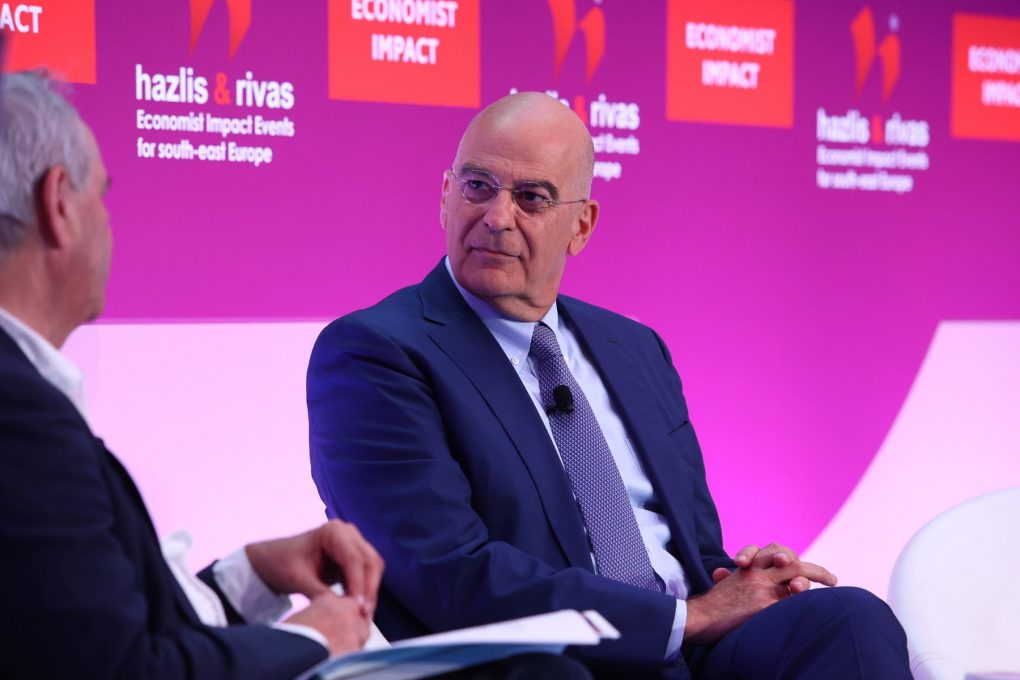
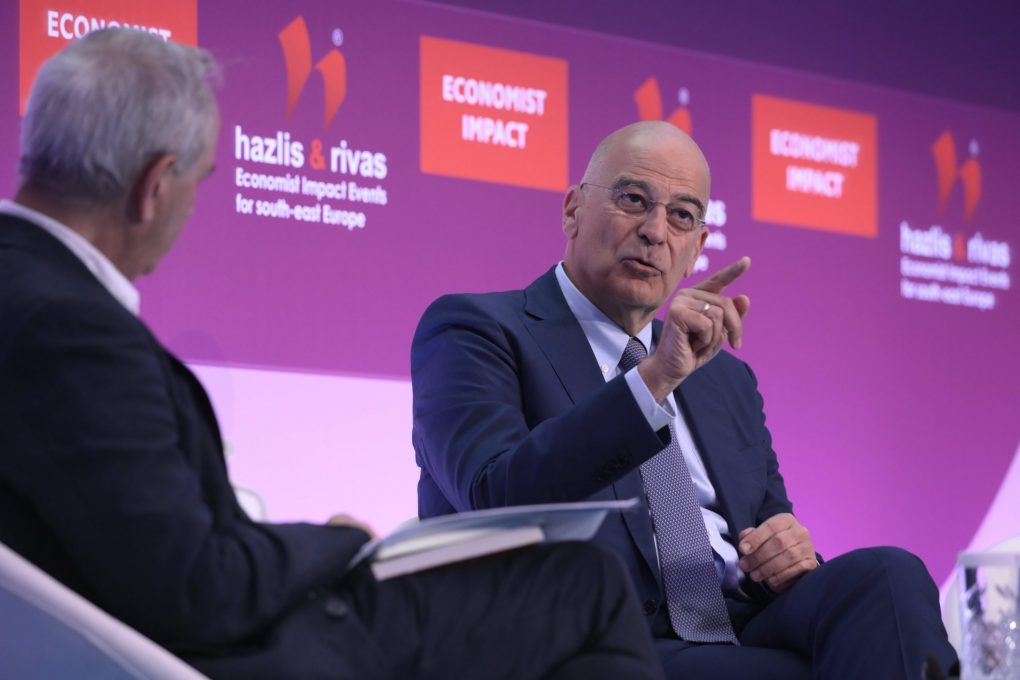
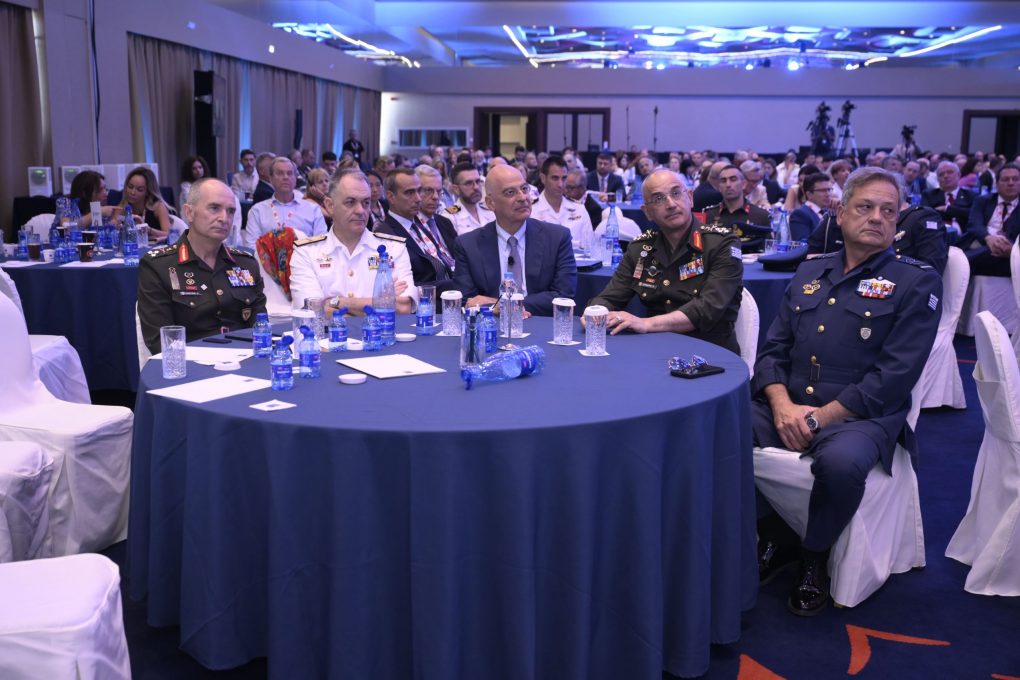
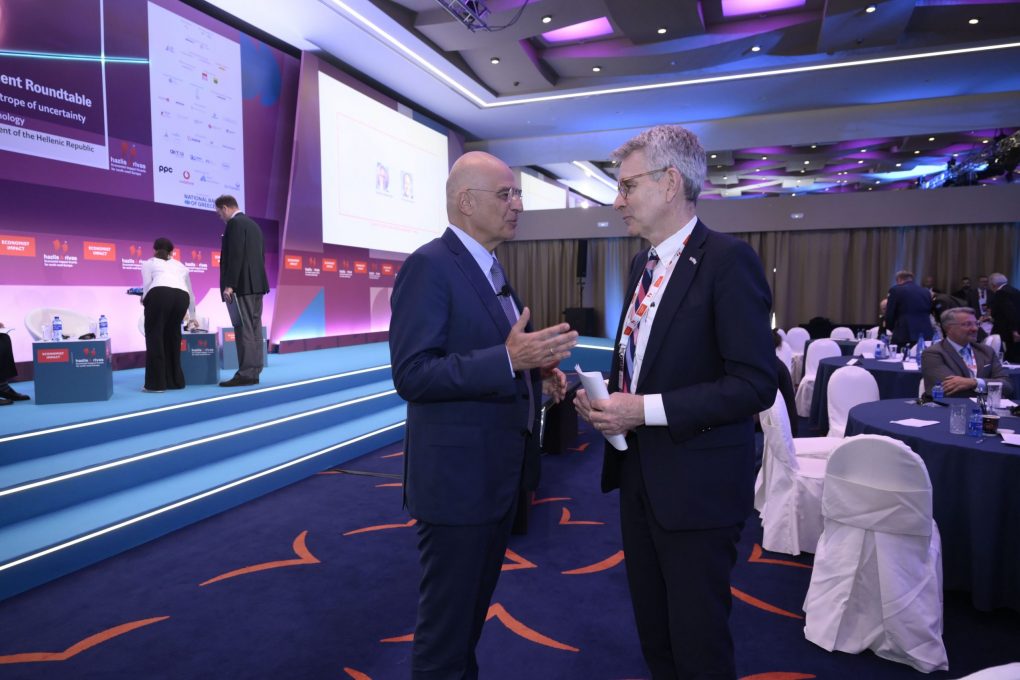
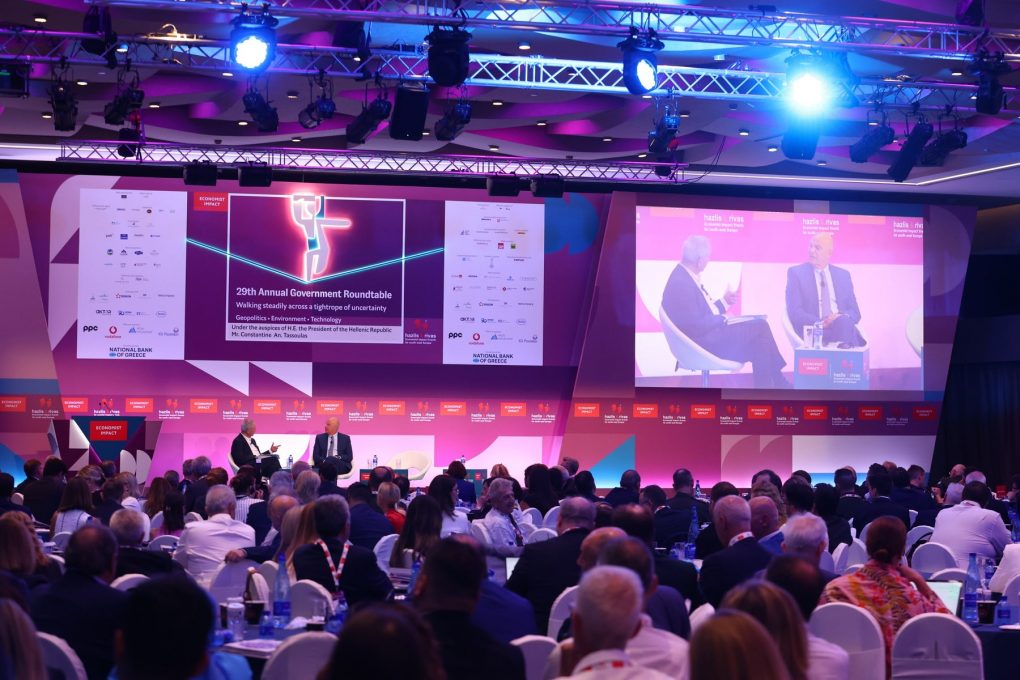
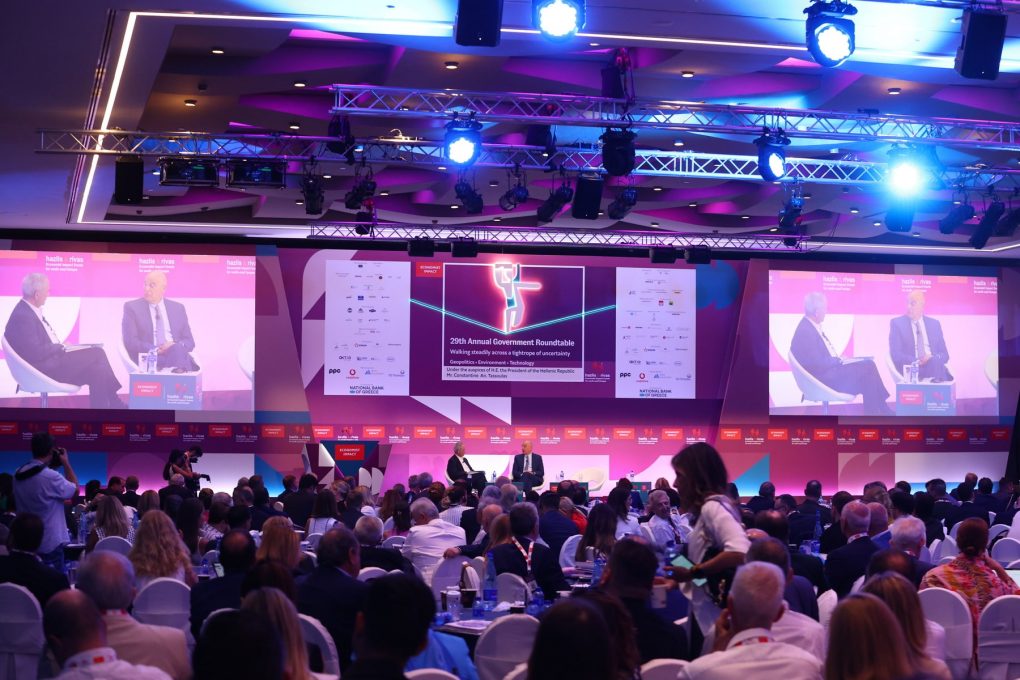
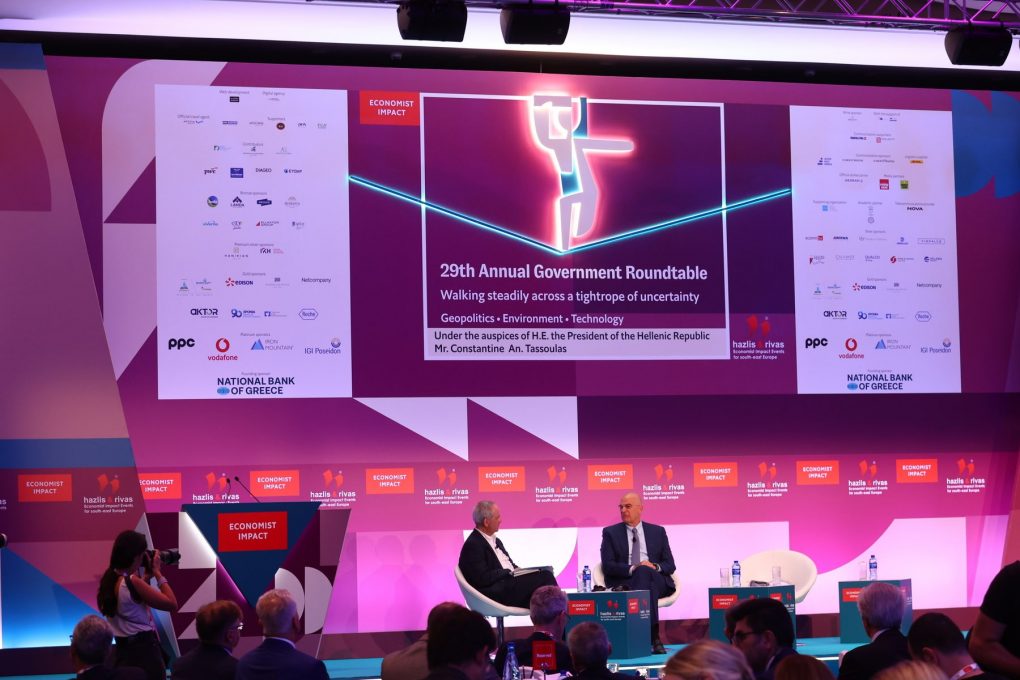
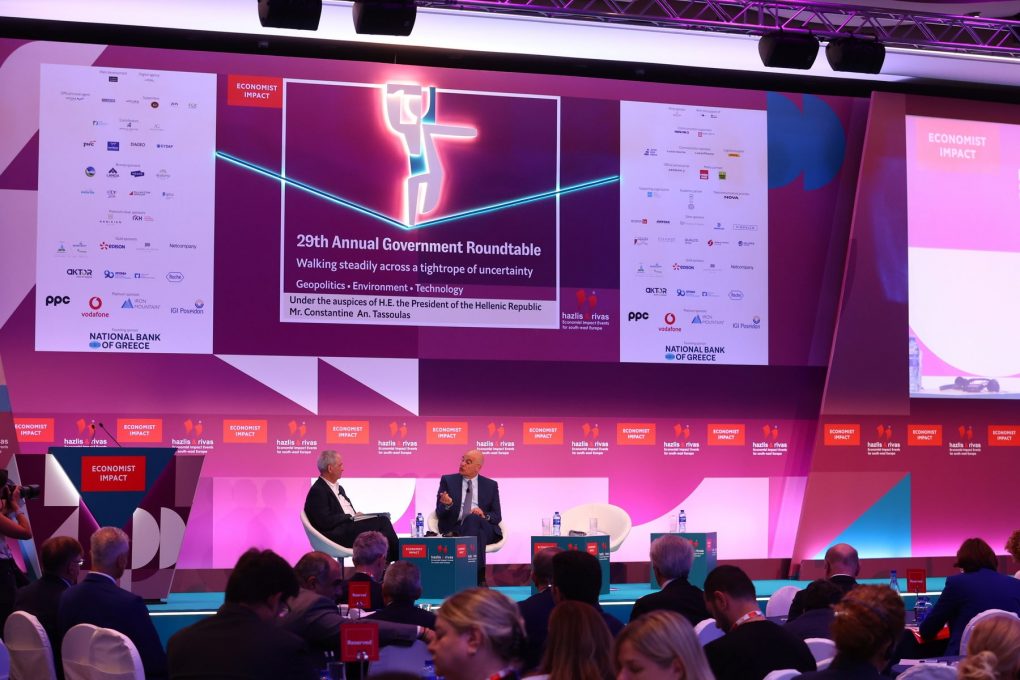
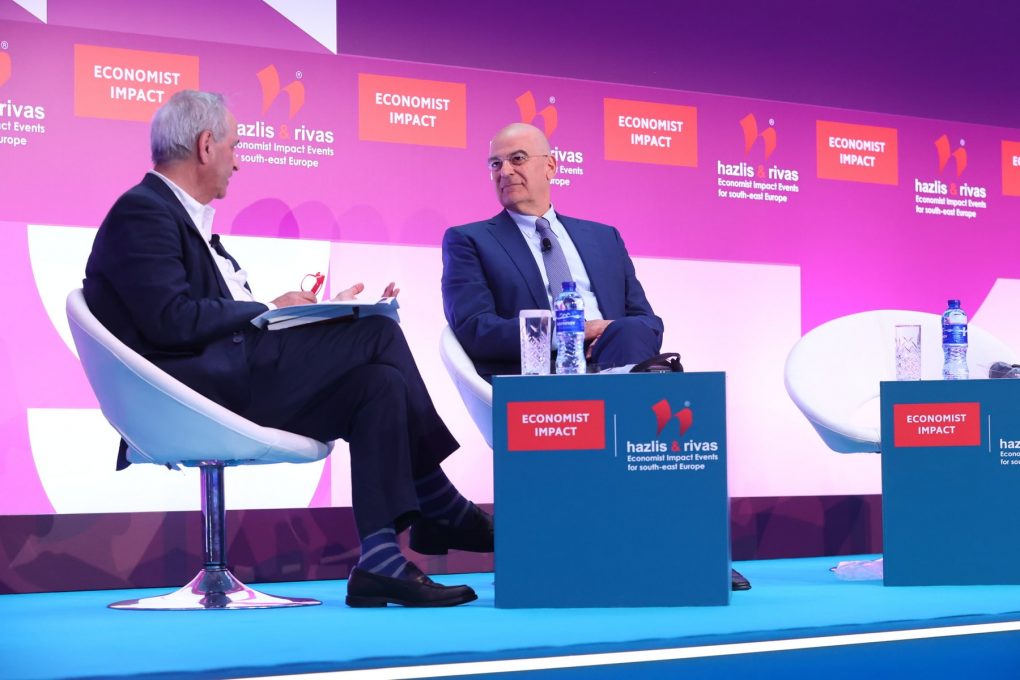
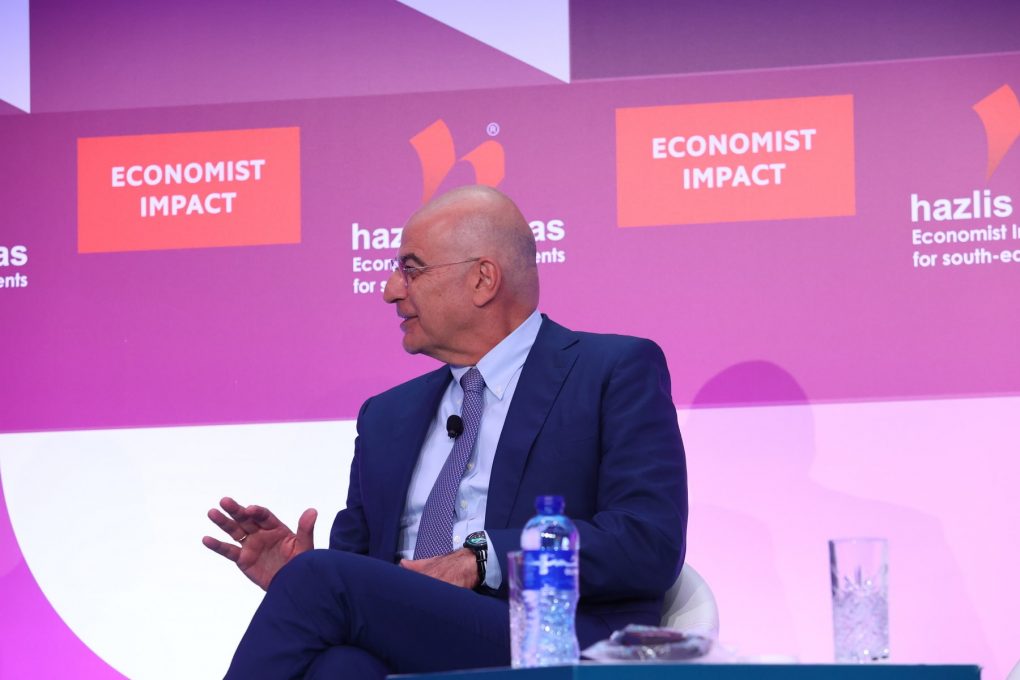
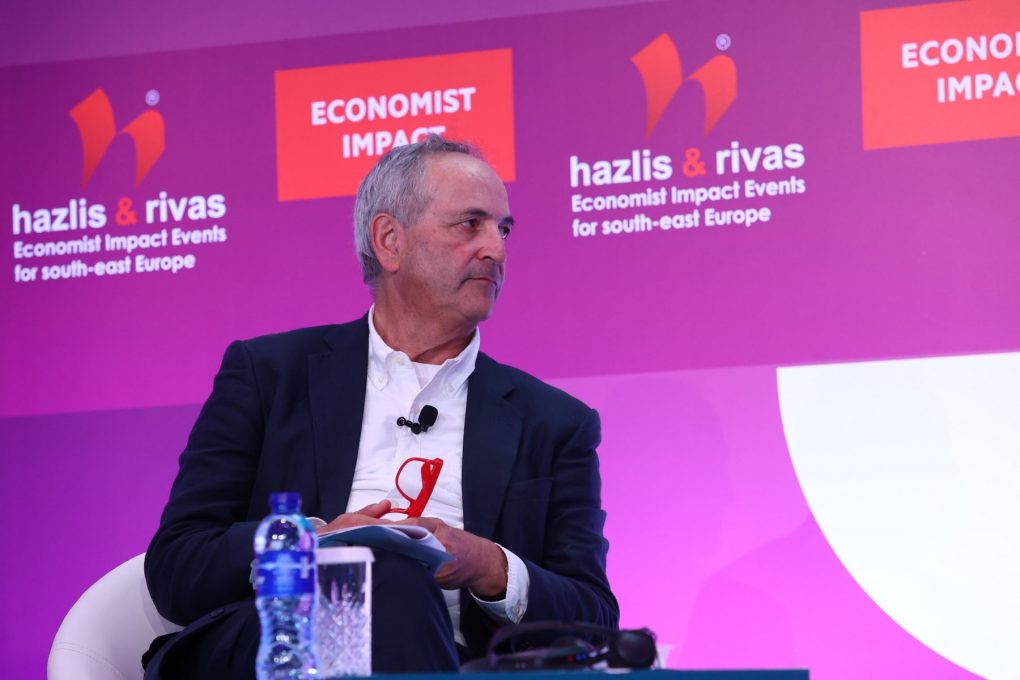
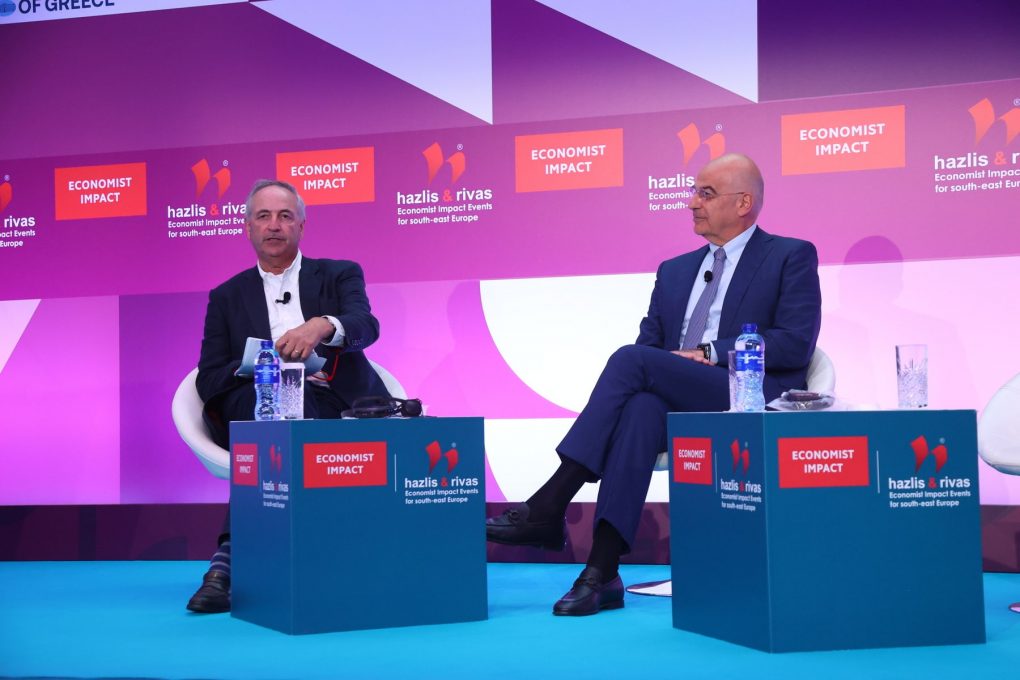
The Minister of National Defence, Nikos Dendias, participated today, Tuesday July 1 2025, in the 29th Annual Economist Government Roundtable, in Lagonisi.
Mr Dendias participated in the session “Europe’s Strategy on Defence and Security”, in the context of which he had a talk with Daniel Franklin, executive & diplomatic editor of “The Economist”.
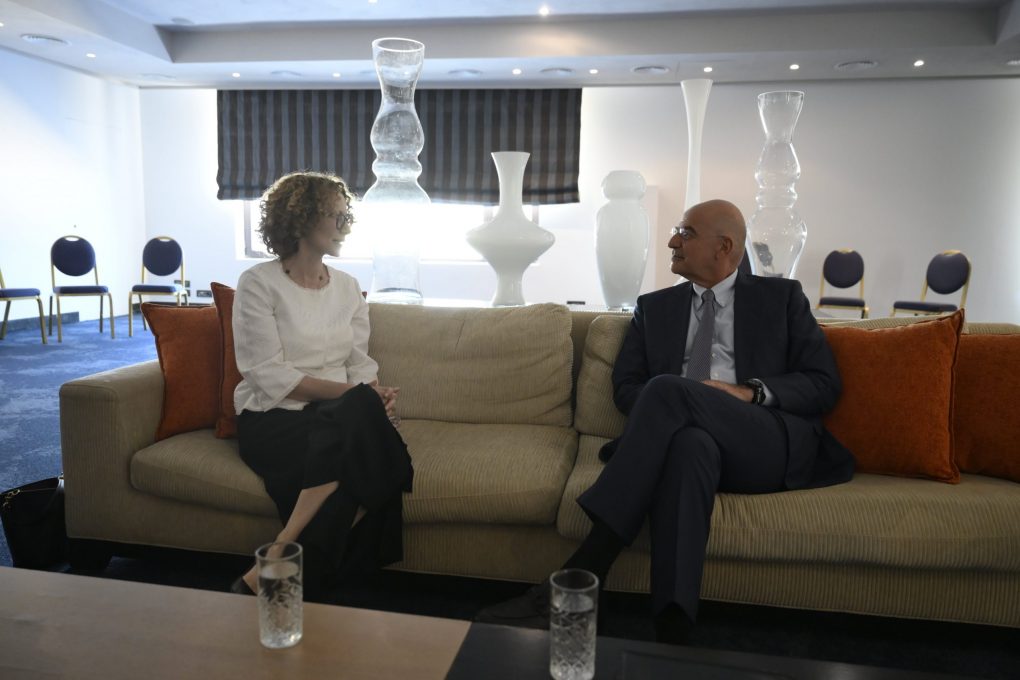
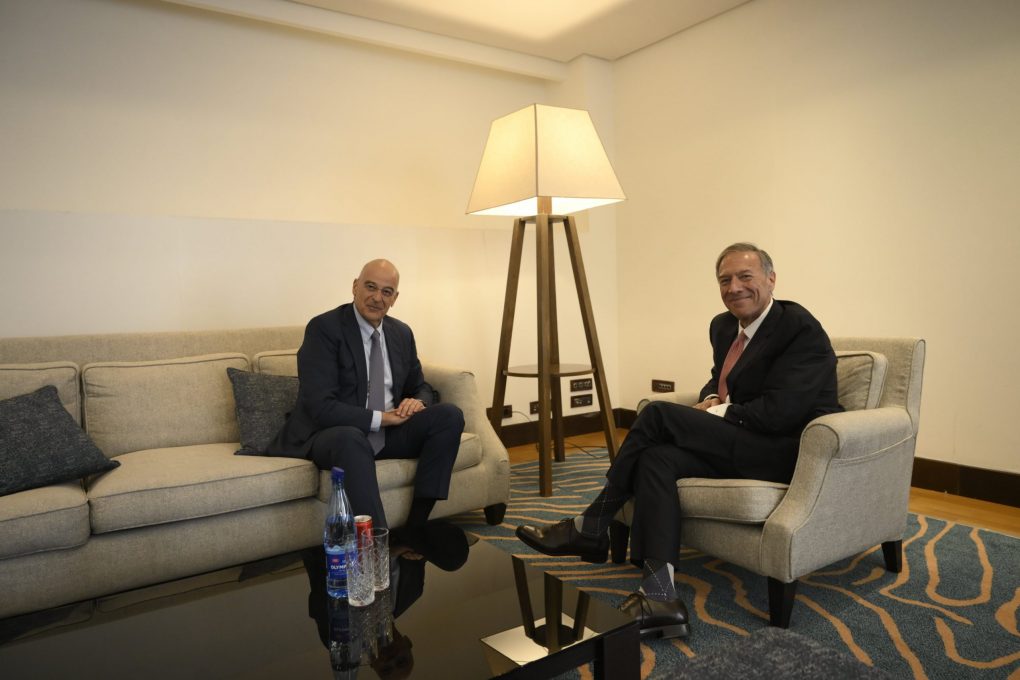
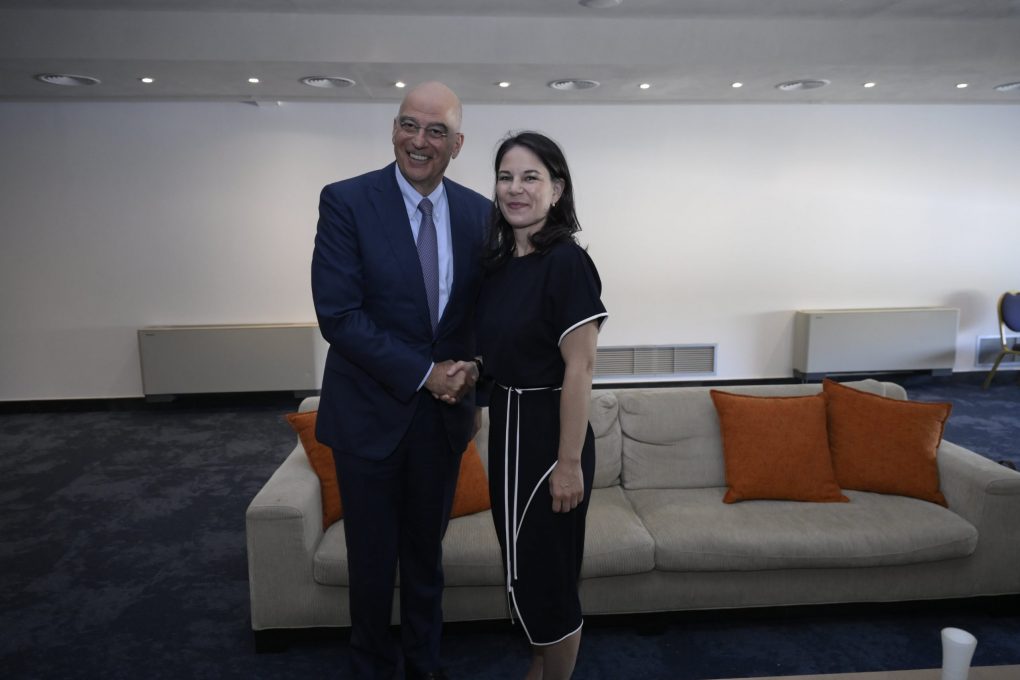
In the framework of his participation in the 29th Annual Economist Government Roundtable, the Minister of National Defence met with former and current officials of foreign states and Organisations. In particular, he met with the Deputy Secretary General of NATO, Radmila Shekerinska, the former US Secretary of State Michael Pompeo and the former Foreign Minister of Germany and President of the 80th session of the UN General Assembly, Annalena Baerbock.
The talks were also attended by the Chief of HNDGS General Dimitris Choupis, the Chief of HAGS Lieutenant General Georgios Kostidis, the Chief of HNGS Vice Admiral Dimitrios – Eleftherios Kataras HN and the Chief of HAFGS Lieutenant General (Pilot) Dimosthenis Grigoriadis.
Below you can read the discussion between Mr Dendias and Mr Franklin:
D. FRANKLIN: I would like to invite the Minister Mr Dendias to join us. A regular of our conferences. We would like to thank the Minister of National Defence Mr Nikos Dendias very much. Therefore, we are now in the first part of our session on the issue of European Defence and Security.
Of course, this discussion coincides with a very nice and good occasion, right after the end of the NATO Summit. We will begin with you. What is your sense of what the NATO Summit managed?
N. DENDIAS: I think we can all agree that the Summit went very well. Perhaps unexpectedly well. A month ago, perhaps I would have told you that it would not be an easy Summit.
However, at the end of the day it was very easy, with a specific communique, one of the shortest I have ever seen. This is good, because if someone examines the communique, looks closely at the meaning of the words, the language used, then they can perceive the meaning.
Everyone agreed to increase their expenditure to 3,5% plus 1,5%, there was an overall understanding of the challenges the Alliance faces.
I must say, as a final observation, that yes, it went well.
D. FRANKLIN: The critical decision taken was the increase of defence expenditures. The defence expenditures by the member-states and there was some scepticism expressed by Mr Pompeo earlier, about whether this number, this level of expenditures will actually be achieved.
How can Europe secure the world and itself, that this goal will have meaning and substance, especially in view of the past experience regarding the goal of 2%, which the members ignored for a long time, not Greece, Greece has always been a substantial factor in defence expenditures.
N. DENDIAS: We must agree on the following, if we were in the same position a year ago and we were talking about the fact that all NATO states would unanimously agree to increase the percentage to 3,5% plus 1,5%, they would think we were crazy, we would be examined by doctors.
This was a huge step for NATO and it is significant that everyone understood that Europe has to pay for its own defence.
That being said, of course, there are remaining challenges, we know that all countries may not reach 3,5%, let alone plus 1,5%. We do not know what kind of equipment will be acquired.
Because there is also another issue, not just how much you spend, but also how, which systems will you procure, how does innovation work, how is Artificial Intelligence integrated, how do you upgrade infrastructures?
D. FRANKLIN: In this framework however, in any case, the step is huge. What will your priorities be in this framework? How will you evaluate expenditures? Tell us three things which you consider Europe needs, NATO or Europe needs, so that these amounts of money will be utilised, since we live in a time of great opportunity.
N. DENDIAS: Right, let me be frank, I cannot choose three things, because there are many things which need to change in European Defence. We must modernise.
I must say that most of our armies live in another time, they are ready for other kinds of battles, they are not ready for what is happening right now in Ukraine or in other fronts throughout the world.
Therefore we must be aware of innovation, Artificial Intelligence, train our soldiers in war conflicts of a different nature, different character, different technologies and methods.
And something very different, we must train them to be able to change course.
D. FRANKLIN: Must the “metabolism” change?
N. DENDIAS: Exactly, the whole culture of a strict mechanism, following orders from above, is something that needs to change. This means that the structure must also change. More power must be given, not necessarily to the high-ranking officers, but to the low-ranking officers.
D. FRANKLIN: Do you do that in Greece?
N. DENDIAS: Yes, of course.
D. FRANKLIN: How does this whole think work?
N. DENDIAS: We had announced, eight to nine months ago, the new approach for the restructuring of the Armed Forces, the so-called Agenda 2030. And I must honestly say that what was just said in Europe is something that we have announced for approximately 18 months.
D. FRANKLIN: All this innovation present in Ukraine, has it mobilised you?
N. DENDIAS: What we see in Ukraine confirms that if we don’t change we will not be able to be competitive, it is very simple, it is clear.
Necessity leads us. The approach of the Armed Forces has usually been the following: Acquire equipment and put it in stock. That practice does not work anymore.
If you purchase a million drones, you put them in storage and you try to use them 2 years later, they will be obsolete, it would be better to just throw them away. They will have no value.
What you have to do is establish an approach during which, through, let us say, 3D printers near the front, you will be able to produce challenges, respond to the challenges you will be facing at that moment.
So, change of software, of comprehension, of systems. We are talking about a completely different approach.
D. FRANKLIN: We hear many things about the need to rationalise the defence industry. Many national, small units must merge. In what degree does that concern Greece, with regards to the things it must do differently from now on, in a unified European Defence system? I am referring to the industrial level.
N. DENDIAS: For us it is important to participate in this new reality. We are not a big country, we cannot produce big platforms on our own.
Greece does not believe that it will produce the 6th generation aircraft on its own. We act within our reach.
What we can offer, however, in this new day of European Defence is this: Innovation. We have exquisite scientists in small defence companies but with huge capabilities, in our ecosystem, who, if integrated in the wider European ecosystem, can offer much.
D. FRANKLIN: Let us talk about some more sensitive issues.
We heard this morning Ms Ntora Bakogiannis speaking about Turkey and Europe’s defence expenditures, which may potentially be channelled towards Turkey. It is an issue about which you have also spoken.
How do you see this issue in this time of increased defence expenditures and enhanced cooperation?
N. DENDIAS: First of all, let us state the obvious. Turkiye is a NATO ally. On the other hand, Turkiye still has a casus belli against Greece. So, for us it is a dual issue. We want Turkiye to be treated as an ally, but on the other hand, we see Turkiye as a country which has declared casus belli against us.
So, the enhancement of their defence industry without a commitment from Turkiye’s side that they will change their approach towards Greece, is a problem.
D. FRANKLIN: What can you do about it within NATO? Can you speak up about it, do you have the right to veto?
NATO is an Alliance against third parties. It is not an Alliance protecting the members from the other member-states. Therefore, if you do not approve the money expenditures for Turkey, what can you do?
N. DENDIAS: There is not something we can do if Turkiye invests on its own defence industry or has bilateral projects. We cannot do anything and we must not do anything. Our main issue is if European money, meaning money of the European Union, are spent in a way which directly or indirectly threatens Greece’s defence.
We are willing and, technically speaking, I think we can. The issue is not whether we have the capability to veto. The European Union does not operate on the basis of veto. It mainly operates on the basis of consent and I think that our friends and partners within the European Union will understand this oxymoron. To fund a weapon which can be turned against one of the partners of the European family.
D. FRANKLIN: Another difficult issue, at the moment, are relations with the United States. Historically, Greece has had exceptionally close cooperation relations with the USA.
You have the infrastructures in Alexandroupoli, you have the Souda Bay. The Naval Base in Souda. How do you see the situation at the moment, when at times, the commitments of the USA to the Alliance are called into question.
N. DENDIAS: An initial observation. It comes out naturally. You mentioned Alexandroupoli before Souda. This demonstrates what my Government achieved when it signed the MDCA with the United States, since it showcased Alexandroupoli, it put it on the map and now it is even mentioned before Souda.
We have a very good relationship with the United States, regardless of the administration and the Government of the USA. Now we have Mr Trump’s Administration.
Mr Pompeo was the one with whom we signed the first MDCA, we have a very good relationship. We had a very good relationship with the Biden Administration and I think that we will have an exceptional relationship with the Trump Administration.
It is an ally. We have common concerns and I think that this will still hold true in the future.
And of course, we use similar equipment, we have the F-35 which are currently the best aircraft in its class, we are talking about a fifth generation aircraft. We stand very close to the USA and we will continue to do so.
D. FRANKLIN: When issues are raised regarding the commitment of the USA to Article 5, do you think that this is just noise and that you do not have to worry so much?
N. DENDIAS: I do not think that we are threatened by one source, against which Article 5 can be implemented.
D. FRANKLIN: Let us talk about Iran, the Middle East borders, the lessons learned from the defence point of view, I mean. We talked earlier about Ukraine, however, we also witnessed developing military conflicts, from which many people extract conclusions, from a strategic point of view.
N. DENDIAS: A school.
D. FRANKLIN: It is like a school, precisely. Or rather, a university. What are your conclusions regarding missile defence, the need for adequacy in some systems?
N. DENDIAS: It may sound a bit arrogant, but we had predicted the way this conflict would develop. Therefore, we have a holistic approach, we call it the “Shield of Achilles”, since it is multilevel, it protects the country from missiles holistically, from aircraft and drones. That is what we are currently doing and that is what is going to happen within the next years.
D.FRANKLIN: Do you have some equivalent to the anti-ballistic protection system in Israel?
N. DENDIAS: Not at the moment, but I would say we will in a few months, not in decades.
D. FRANKLIN: Does this affect your investments plan?
N. DENDIAS: The “Shield of Achilles” is a big part of our approach with regards to the equipment utilised by the Armed Forces.
For the first time in Greek history, this government issued a 20-year plan of public procurements for the Armed Forces and the anti-missile defence is a part of this approach.
D. FRANKLIN: So, at the moment, in a period when Europe is investing significant sums and you say that these conflicts are schools for strategic lessons, I am talking about Ukraine and the Middle East, what is currently your highest priority, your first priority with regards to the next phase of Greece’s preparation at the strategic and defence level?
N. DENDIAS: I repeat, the Shield of Achilles is something holistic, it integrates everything, whether it be Army, Air Force, Navy, or our air-defence.
Therefore, we practically modernise everything. Even the structure of the Armed Forces. We are changing the Navy, we acquire new frigates from France, 4 new ones which are top for their class. We aim to acquire frigates from Italy, to upgrade the rest of our fleet, so we change everything.
D. FRANKLIN: Of course, you are saying, at the same time, that the factor which made defence expenditures in Greece remain over the limit…
N. DENDIAS: Everyone knows that, it goes without saying, there is no reason for me to say it.
D. FRANKLIN: Does this new goal also affect Greece, in terms of expenditures’ increase, or are you already at a level which will allow you to say there is no need for…
N. DENDIAS: I will tell you, we are not going to increase our expenditures significantly.
D. FRANKLIN: Where are you at the moment, percentage wise?
N. DENDIAS: At 3,1 to 3,2%, which is enough. Well, Turkey is spending, in terms of numbers, much more than we are, but we are a smaller country.
In any case, our priority is defence. We are not attacking. As you understand, this creates economies of scale. We are not planning to attack anyone.
Therefore, we must modernise and our priority at the moment is the holistic approach of the “Shield of Achilles”.
D. FRANKLIN: Since we are running out of time, one last question. If you wanted to send a message to your counterparts in NATO, regarding the following period during which the decision made by the Summit will have to be implemented, what would the message be?
N. DENDIAS: Spend cleverly. Because we run the danger of creating inflation and buying worse systems with more money.
We must act prudently, with wisdom and restructure the units. Buying new systems, new weapons without changing the structure, without changing the system, the approach or the culture, makes no sense.
NATO has to reform and the European armies especially have to reform. For years nobody in Europe, I am not including Greece, nobody in Europe believed that war would come back in the continent.
D. FRANKLIN: I think this will feed the next part of our conversation. Thank you very much mister Minister.