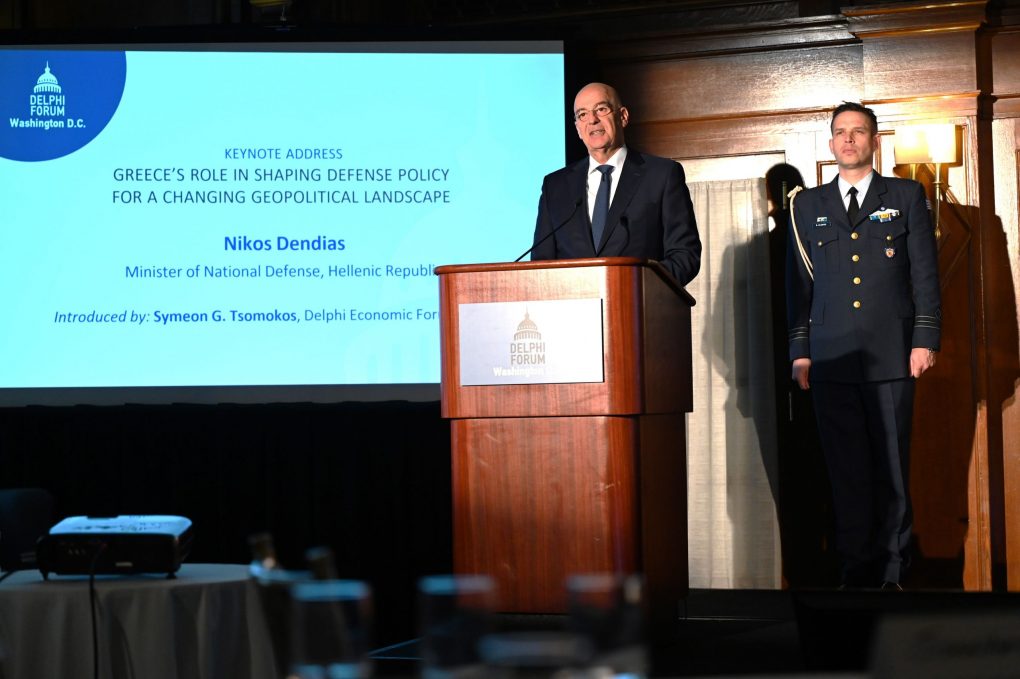
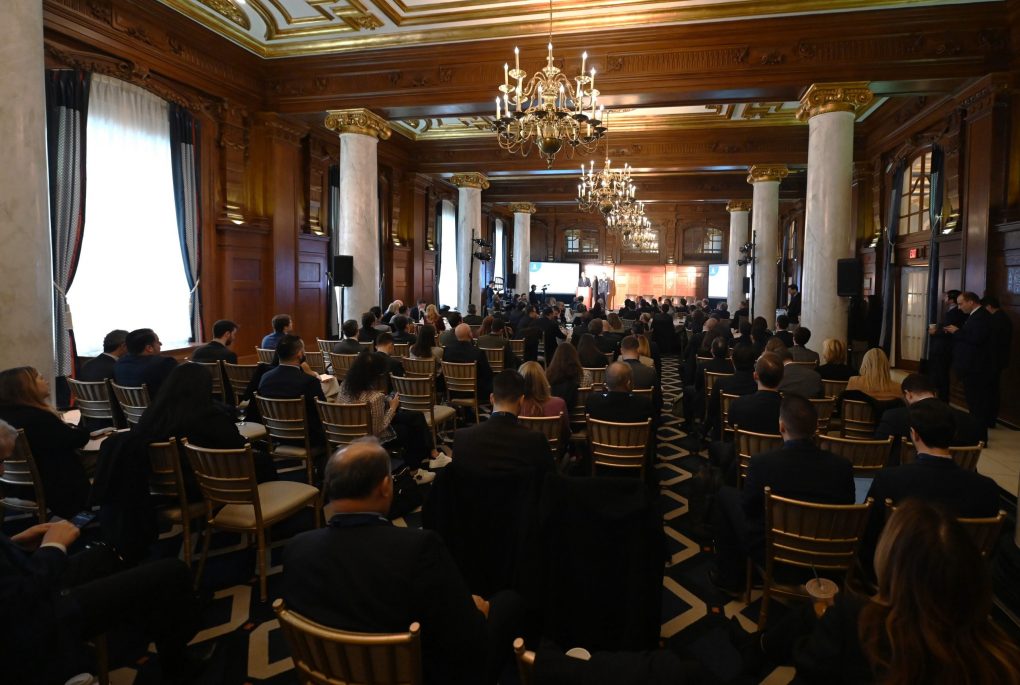
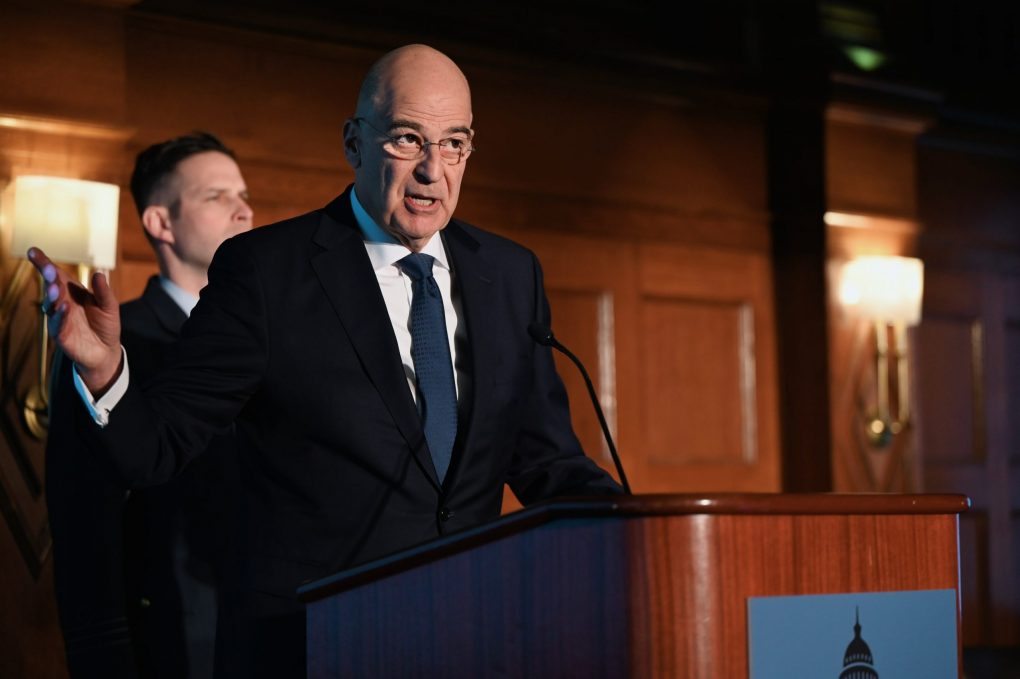
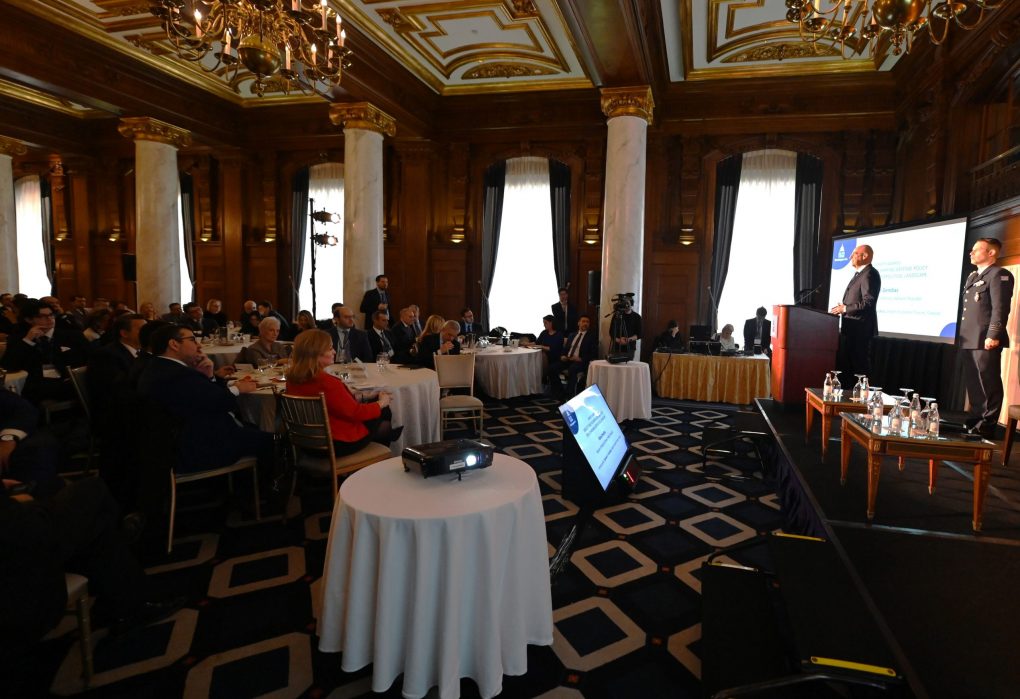
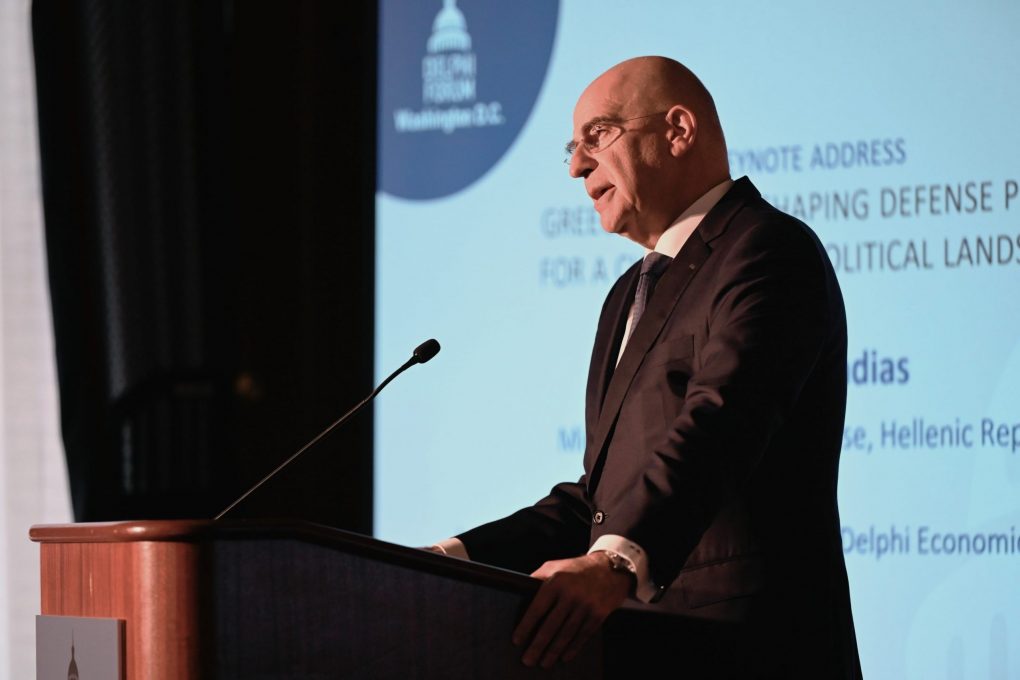
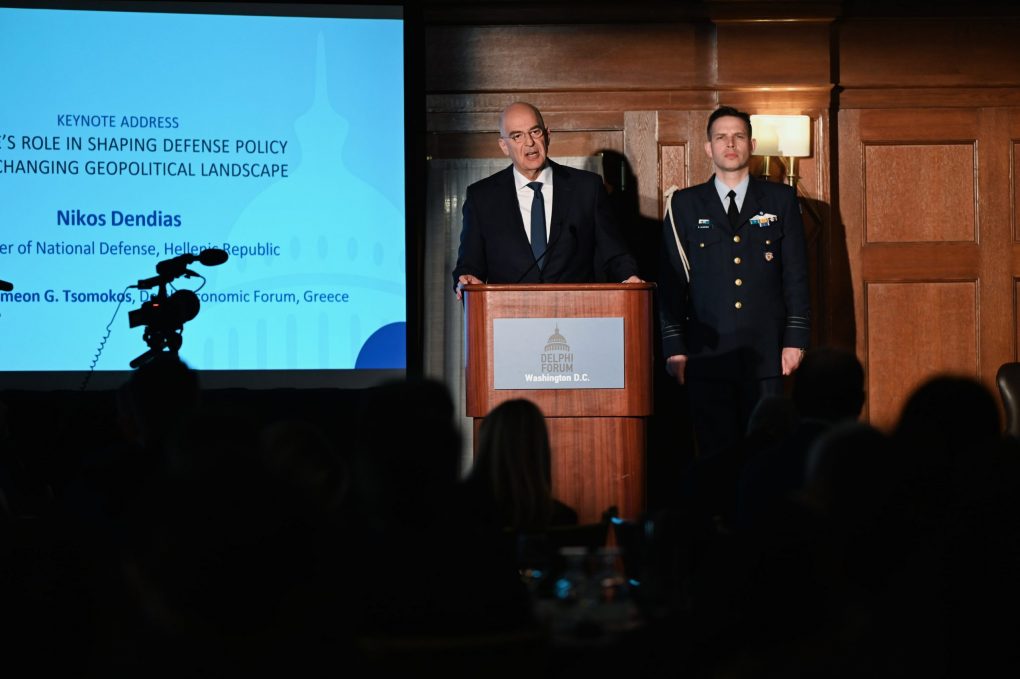
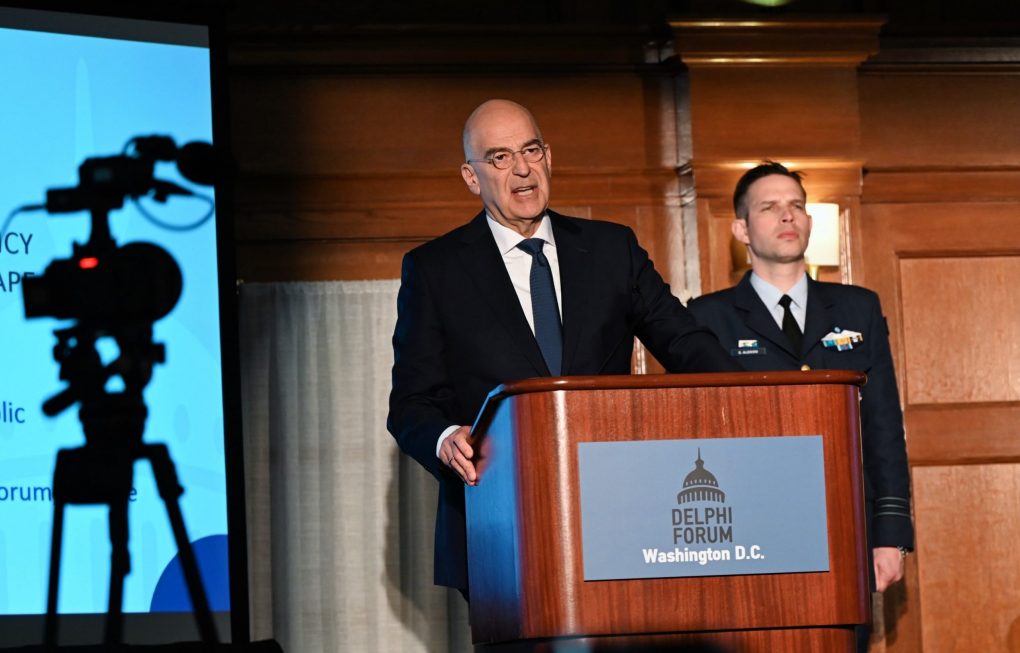
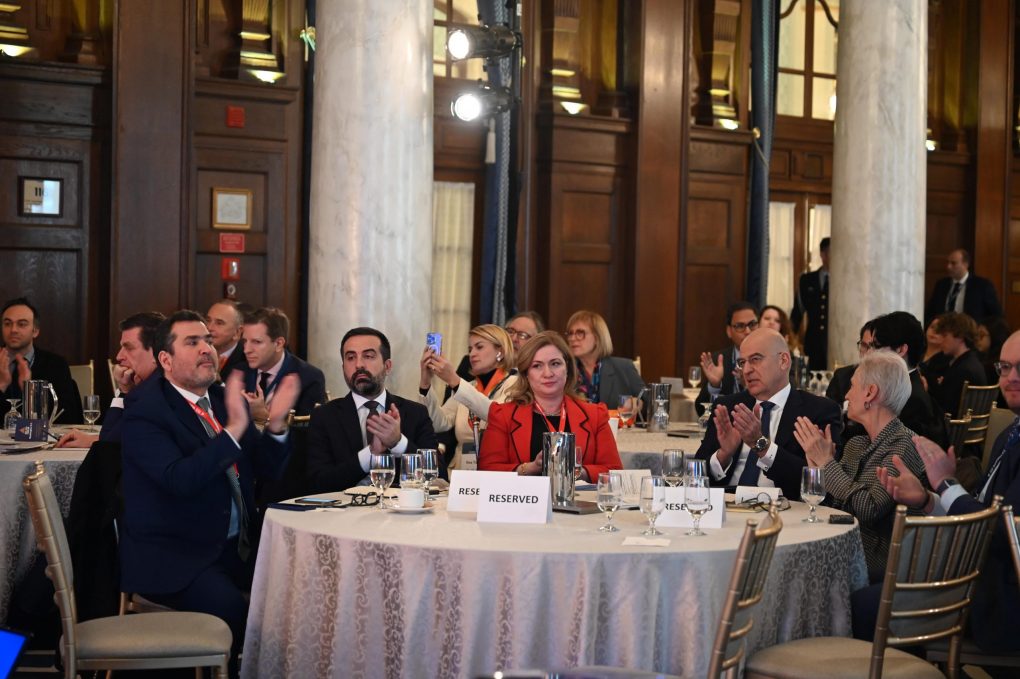
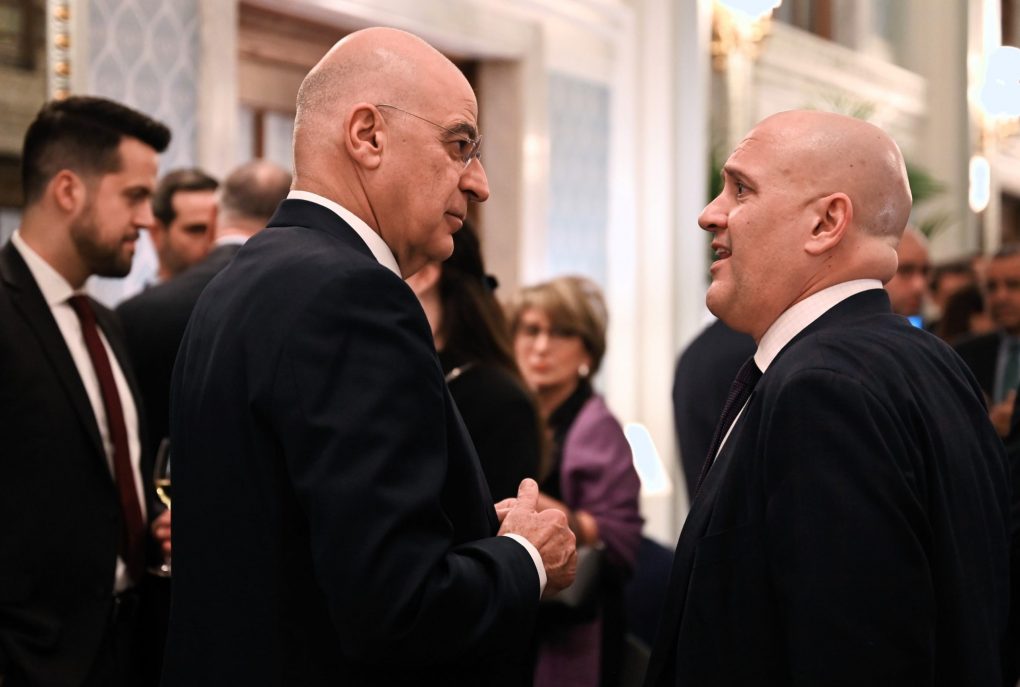
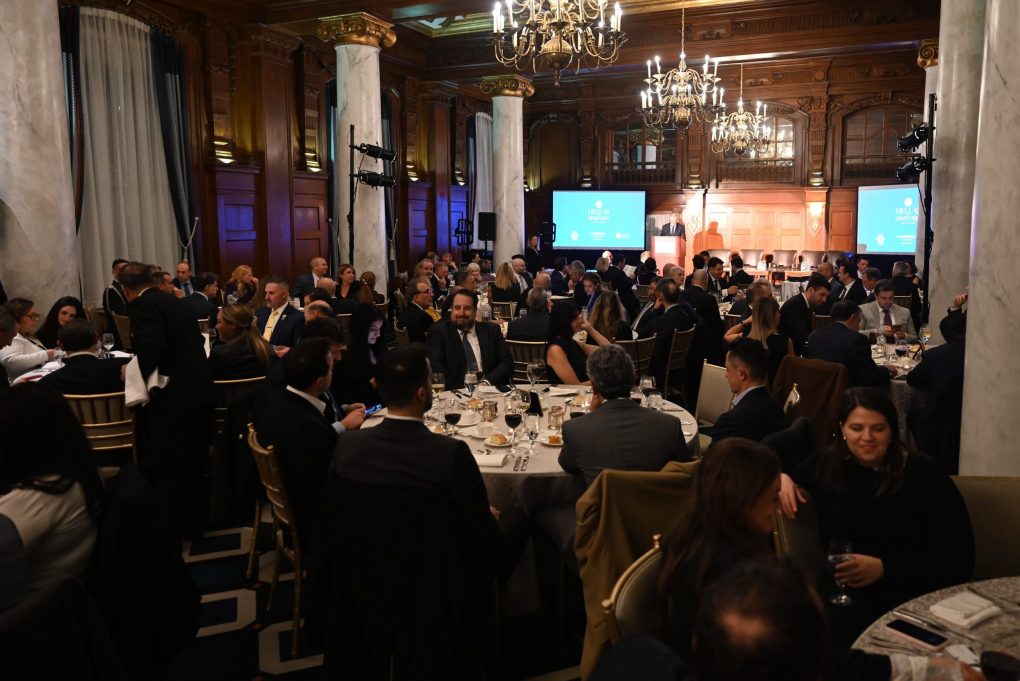
The Minister of National Defence, Nikos Dendias, addressed a speech yesterday, Tuesday 11 February 2025, at the “6th Delphi Forum Washington DC”, in Washington, which is organized by the Delphi Economic Forum, in collaboration with the English version of the newspaper “Kathimerini” and the Hellenic American Leadership Council (HALC).
In his speech regarding “Greece’s role in shaping Defense Policy for a changing Geopolitical Landscape”, Mr. Minister stated:
“I have to say it is my great privilege to be invited to address the esteemed guests of the Delphi Forum here in Washington D.C.
Well, I’ll try to make a meaningful contribution here, so let us agree on the overall picture we are facing.
Following the end of the Cold War the dissolution of the Warsaw Pact and the fragmentation of the mild Soviet Union, the rise of China and other mid-sized powers we are see a new world order evolving. The world as we know it has been transformed from a bi-polar to a multi-polar with the USA, of course being at a class of its own.
The optimistic approach we were holding onto in the end of the 20th century didn’t materialize. Certain assumptions we have made were proven wrong.
The first was that democracy has prevailed following of the fall of the Berlin Wall, the Good Friday agreement (in North Ireland), the fall of the Apartheid in South Africa.
Another wrong assumption was that Russia would become a part of the security architecture of Europe.
Another also wrong assumption was that the Palestinian issue would be sidelined following the Oslo Agreements.
And the fifth wrong assumption was that the model of the economic development that we have been following in the 20th century we could continue in the 21st century without addressing climate change, and believing that we will continue to raise the level of the living standards of our people.
Now, we realize that the world that we thought would exist has almost disappeared. New challenges emerge, old ones increase. And these challenges cannot be easily addressed by individual nations, not even a nation as mighty as of the USA. We, therefore, need to accept a modus operandi in our common defense strategy, at least between us the western world. But let me ask one basic question. What do we mean by ‘we’? Who are ‘we’? Who would be the allies of the USA in the effort to stabilize this world?
Well, what I am going to do is I am going to suggest two different examples, as they exist in our neighborhood, in eastern Mediterranean. And then I think it is for the USA to decide which of the two examples best serve its interest.
On one hand, we have an authoritarian country that does not feel that it has abide by international law and international law of the sea. A country member of NATO, yet again not imposing sanctions on Russia, maintaining the closest of relations with Russia.
And this is not a one off policy. It is a consistent policy. Let me remind that this country was an ally of the Central Powers in the World War I, was neutral when the democracies were fighting in the World War II, it didn’t participate in any way, it didn’t even allow use of its territory in the Iraq wars.
Of course, as we know, it challenges internationally recognized borders, it challenges international treaties, it is actively involved in almost any regional conflict, it is a source of instability itself, it is becoming more Islamist by the day, it is opening thousands of Islamic schools, it hosts Hamas brotherhood, it is friendly towards Hamas, it is a declared adversary of Israel, it develops attacking drones, it develops long range missiles, it builds aircraft carriers in a geography that have no use, it threatens an ally with war casus belli, shoot the latter exercise lawful rights.
It projects military power based on the notion that might is right. It considers resurrection of an empire a legitimate goal in the 21st century. It is a potential member of the BRICS. It is a very, very long list, I could go on for hours, but let me stop here.
So allow me to present another example.
A country supporter international law and international law of the see and rules based international order. A modern democracy with all its faults but a democracy with fundamental rights, freedom of speech, rights of women, freedom of political expression, committed to democratic values. Member state of the European Union.
A country that fought in the two World Wars in the side of the powers of democracy, it lost almost 10% of its population in the World War II. A country that stands by Ukraine and its right to defend its territory, a country that proposed the Thessaloniki Agenda, it helped the Eastern Balkans become members of the European Union, it is helping in the western borders to become members of the European Union.
A country that has resolved disputes with all regional players by adhering to international law, a country that is modernizing its arm forces, but on a dispensing, not an offensive, doctrine. A country with a rich ancient democratic heritage that has significantly influenced the Founding Fathers and the Constitution of the USA.
So these two models present themselves to the USA to choose.
I would take this opportunity to expand a little on the road that my nation Greece can take by briefly describing our defense policy.
As you are aware, we are in a region that there are numerous ongoing conflicts and problems. Ukraine, South Caucasus, Syria, Yemen, the Sahel, political instability in Iraq, the fragile ceasefire agreement in Gaza, Sudan, radical Islamism advancing in sub-Sahara Africa. Problems in Ethiopia, in the Horn of Africa, the Congo.
Important checkpoints just mentioned before on the map in our region, I will mention the Bad al Mandab, the Strait of Hormuz, the Suez Channel. Only the Suez Channel is used by 12% of the world trade. You understand what that means.
We have the Cyprus Question; I was in Nicosia just three days ago, the last, the last divided capital in the world today.
But also let me mention the Western Balkans, there the problems are just behind the curtain. Kosovo, Bosnia-Herzegovina and a government in North Macedonia out of touch with modern reality.
In all those challenges Greece responds with a very clear position, respecting international law and the treaties, and at the same time safeguarding its own sovereignty, sovereign rights and territorial integrity.
Beyond also our immediate neighborhood, there is a very unstable environment. And in order to address it, we have formed multilevel collaborations with countries in our region and if I may say beyond our region.
To mention a few, Israel, Egypt, Cyprus, United Arab Emirates, Saudi Arabia, Jordan, Armenia, India, Bahrain, all the European Union countries of course, but also African countries; Senegal, Angola, Gabon, Wanda, and our close neighborhood, the Balkans.
These collaborations all have the same exact characteristics. They actively pursue and promote stability, security, cooperation and development.
I will mention a few treaties that stand. We have signed more than 350 in the last five years, but I would like to mention the two mutual defense cooperation agreements with the United States of America, the defense agreements with France and the UAE, the strategic agreement with the Kingdom of Saudi Arabia, the exclusive economic zone delimitation agreements with Italy and Egypt and multiple trilateral and multilateral framework of understanding and cooperation with all the countries I mentioned before.
We have deepened also our relations with India. Just recently, the Indian Air Force were participating in common exercises with our own Air Force.
We became members of the Three Seas Initiative by the inclusion of Greece to become the Four Seas Initiative.
We have an active contribution to NATO and all the European Union defense initiatives.
We contribute to the security of our close neighborhoods, by air-patrolling the Albanian, the North Macedonian, the Bulgarian and the Montenegrin airspace.
We support and we participate in the KFOR in Kosovo, we are present with troops in Bosnia-Herzegovina.
Our navy delivers humanitarian aid to Gaza. Our Air Force delivers aid to Lebanon.
We provide energy corridors to central and eastern Europe; our FSRU units are the ones that facilitate the export of American gas and as we speak -it was mentioned also before – the European Union conducts two naval operations. One in north of Libya. Another one in the Red Sea. Both have Greek names. IRINI and ASPIDES, because we were the ones who took the initiative for it.
We were elected as non-permanent member of the United Nations Security Council with 182 votes. And we spend more than 3.5% of our GDP on our defense, of which 45% is spent on armaments.
By the way, when I mention what we spend, I always make an observation on the schizophrenic approach of the European Union, which on the one hand asks to enhance our defense and on the other hand, limits the financial space that we can use to defend ourselves.
What we are doing now, stricto senso, in our Armed Forces, we call it the “Agenda 2030.”
We are trying through deep reforms to establish a modern and efficient defensive ecosystem that can produce innovative solutions to the challenges of the 21st century.
We are also changing the structure of our Armed Forces. We are changing the role of our fleet and we are modernizing our fleet.
We are creating what we are calling an Achilles’ Shield, which is a dome, a seven-layer dome that covers our country, anti-drone, anti-missile, anti-aircraft, anti-ship, anti-submarine.
And we are changing also our training methods. We will stay with the conscript army, because we believe that a conscript army is absolutely necessary for a democracy, but we will very much change the way our young men are being trained.
The important part of our strategy is our connection with the United States of America. And we are continuously looking to deepen the relation with the United States, under both administrations: Trump 1.0 and Biden.
Also, our defense systems that you already know are closely connected with the systems and the platforms of the United States of America.
We are part of the F-35 Program, we are part of the program for the new frigate, the Constellation frigate that we are going to build together with the United States, and also, we are acquiring as we are speaking more than 40 Black Hawk helicopters. So, we share a lot with the United States defense forces.
But allow me, as my finishing remark, to present you another argument, which I think is maybe more important than armaments. And now I am speaking about the soft power realm.
Greece, through its historic presence, for millennia, in an area that connects East and West, can offer what I believe is invaluable. Keys and methods of understanding countries, peoples and societies.
Let me give you a few examples. Who can advise better than Greece on the Orthodox societies of the Balkans, with which we coexist more than 1,500 years, under the spiritual leadership of the Ecumenical Patriarch?
And who can better explain and address the game Russia is playing within those societies?
Who can understand the Egyptian society better than the Greeks, who have been there for thousands of years? Kavafi, the known Greek poet, expressed it very eloquently.
But I will go much closer to the present. Without understanding Muhammad Abduh, Saad Zaghloul, or Hassan al-Banna of the Muslim Brotherhood, Naguib, Nasser, the Egypt of Al Sisi and the Arab Spring remain an enigma.
And speaking to an American audience, let me please, with all due respect, remind you the mistaken perception of President Obama of what was happening in Egypt during the Arab Spring.
But also, going even more to the South, who can better advise on Abiy’s Ethiopia and the relation in Ethiopia between the Orthodox Monophysites, Amharas, the Omores, the Tigrays, and the Eritrea of Isaias Afwerki, better than us?
Most people over the ocean do not even know what the word “Monophysite” means.
Which institutions are more important in the Middle East than the Greek Orthodox Patriarchate, in Jerusalem, in the exact spot where the three great monotheistic religions meet?
And who can understand the Semitic people better than the Greeks, who have been interacting with them for millennia. I know that many in the western world have read the book E. Lawrence, the “Seven Pillars of Wisdom,” and his famous Chapter 3 on the Semitic people, but reading is one thing; understanding is another.
And I could go on and on and on and on. But I think I have made my point.
I would like to conclude by saying that I believe that we, Greece, have the right policies, we are creating the right Armed Forces, we possess through history the soft power and the knowledge to play the necessary role of a bridge of stability, security and understanding that would help the United States of America to create a better future.
But, of course, this is for the United States to judge. Myself, being a lawyer in my profession, the only thing I can do now is rest my case.
Thank you so much.”