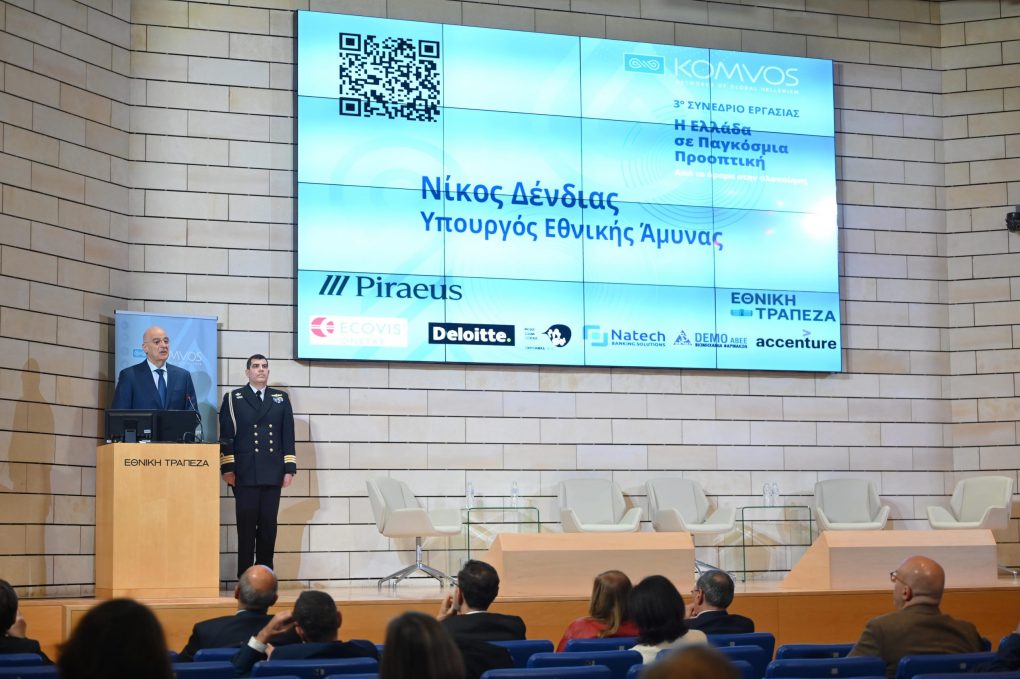
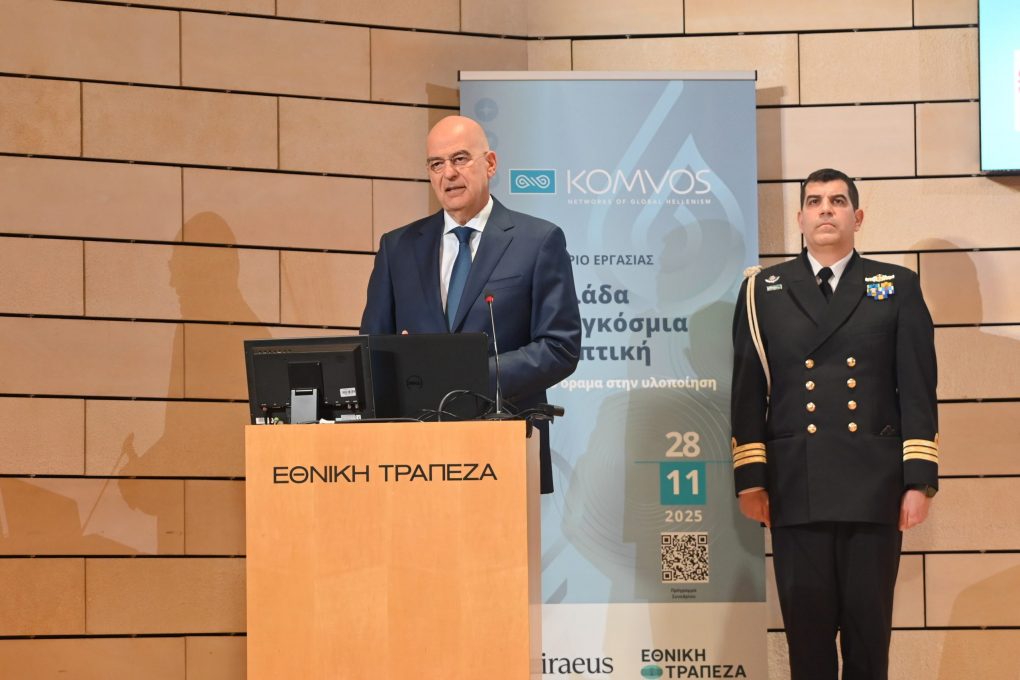
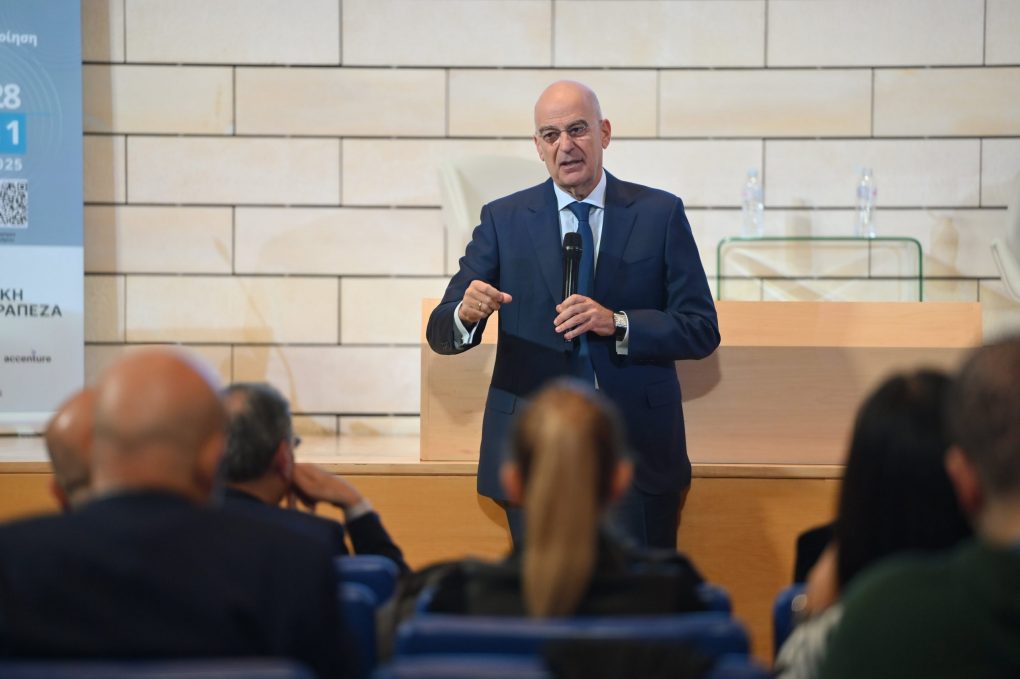
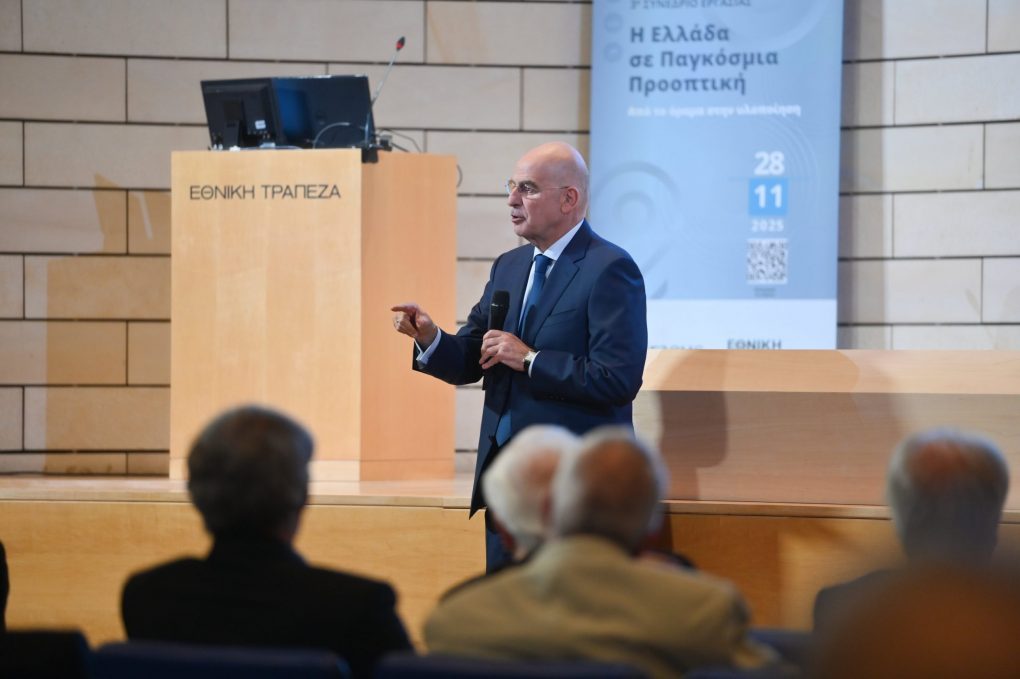
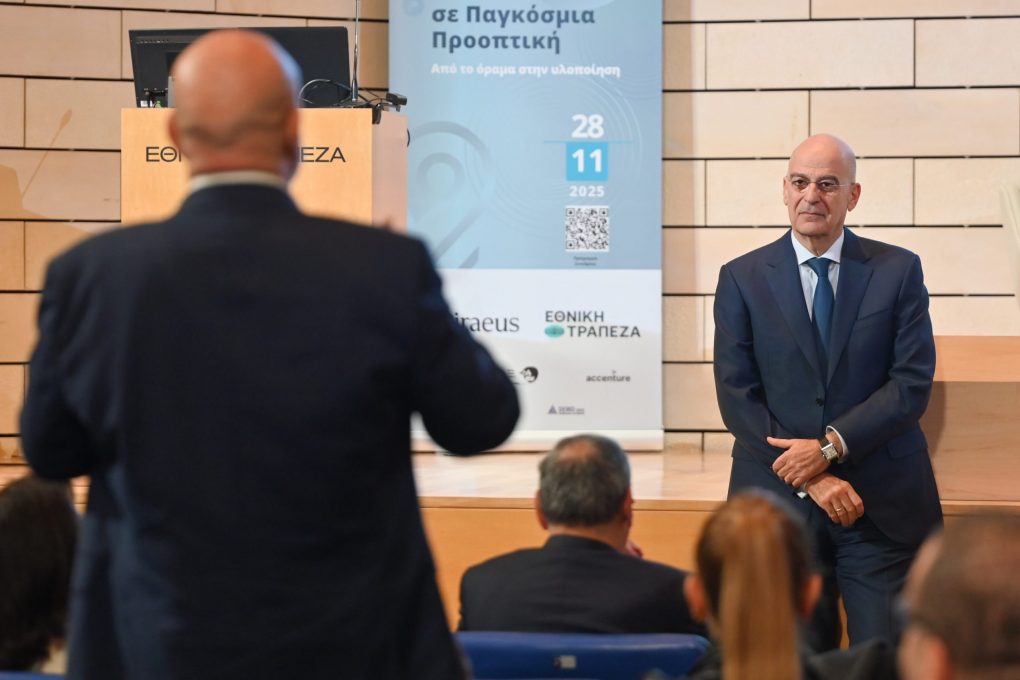
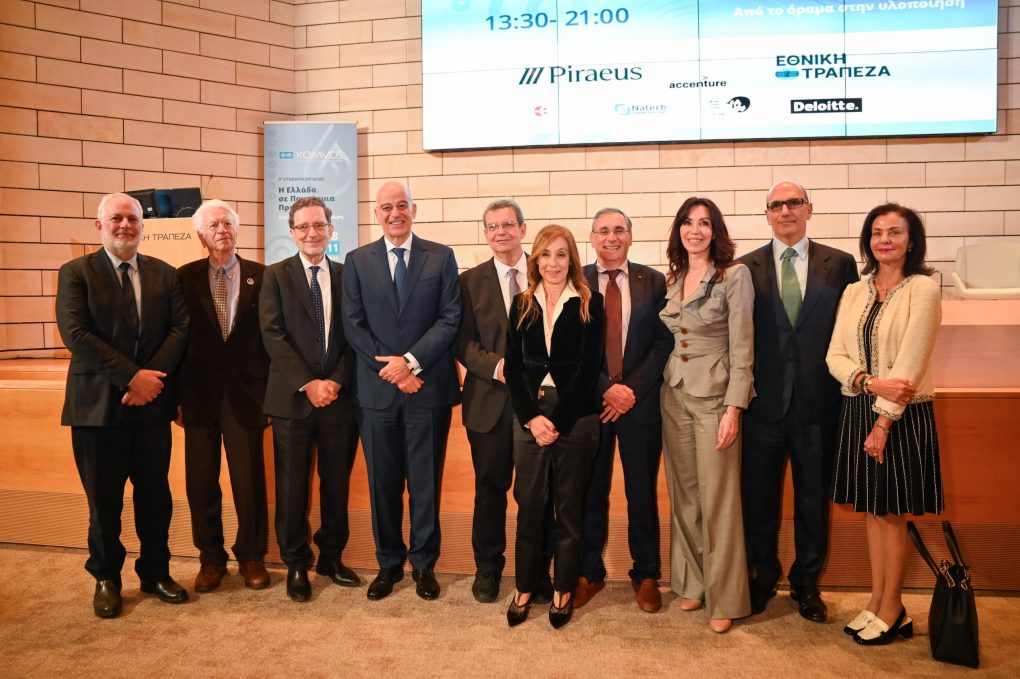
The Minister of National Defence Nikos Dendias, attended on the evening of Friday 28 November 2025 the 3rd Working Conference of Komvos “Greece in Global Perspective” held at Karatzas Megaron.
In his speech, Mr. Dendias stated:
“I would like to thank Professor Chaniotis, Angelos for me since we were classmates, together with Michalis Chaliasos as well, and for this reason, please allow me to feel a great sense of familiarity.
I could perhaps deliver a speech, but I would prefer, if you would be so kind and if you agree, to outline two or three directions of what is being attempted in the field of Defence, and perhaps, if you see fit, you can critique this model, suggesting what more could be done or perhaps what is wrong with this attempt, because no one is infallible in this life.
I would simply like to describe the problem that the Ministry of National Defence of the Hellenic Republic is called upon to solve at this juncture and the solution that is being proposed to Greek society through a series of legislative measures, some of which have already been passed by the Greek Parliament – with the last major law being voted on January 8th as I understand from the Parliament’s schedule. And this will complete the legislative part of the reform.
Firstly, the environment. I think we can all agree that the geopolitical environment has changed completely, but for Greece it remained problematic. In other words, Greece has been living in a state of contradiction since 1952. It is a member of a large and successful alliance, the North Atlantic Treaty Organisation – NATO, however the main threat to its security comes from a member of that same alliance. Therefore, based on this fact alone, Greece is necessarily a sui generis – as is Turkey – member of this alliance. Greece defends itself and Turkey threatens a member of the same alliance.
The second is that after 2000, or around that time, a sense of euphoria took hold across the planet. It was a justified euphoria following the fall of the Berlin Wall in the previous decade. That Democracy has won; that the free economy and the values that Democracy represents now prevail in the world, and we are entering a great era of peace, prosperity, etc. None of that happened. The misconception is justified, because it was not just the fall of the Wall, I remind you, it was the Good Friday Agreement, it was the fall of Apartheid, it was the Oslo Agreements for the Middle East… in other words, a series of events that gave humanity this perception. But that did not happen. We did not go that way. The result is the Russia invasion of Ukraine, but this is not the only war going on. I recall the war between Azerbaijan and Armenia, which is significant for Greece, in the South Caucasus. I recall the situation in sub-Saharan Africa, the civil was in Sudan, and a series of other events, the attack on Iran, and Iran’s positions in the wider region. In other words, a general environment of instability. We have two failed states on the shores of the Mediterranean, both very close to us: Syria and Libya. This is a situation that requires the country to acquire serious Armed Forces capable of dealing with threats. And this in a constantly changing environment, not only geopolitical. But also an environment that requires new solutions. New technological responses, given that the threat is manifold. It is economically manifold, numerically manifold, and I must say that in the age of UAVs, it is technologically much more powerful.
The response that is currently being attempted is a completely different approach to the threat. Let me explain.
The first concerns how you protect the country. Until now, the country has followed the basic doctrine that “the Army protects the land, the Navy protects the sea, and the Air Force protects the air”. Obvious, you might say? No, it is not that obvious. Let me explain: In order for Greece to face what lies ahead, it probably needs a “heretical” approach.
The Navy: The Aegean Sea has no reason to be protected by the Fleet, as has been the case until now. The new frigates and ships are far too expensive to be confined to a narrow sea such as the Aegean, exposed to modern threats. You can destroy a billion-dollar frigate with a drone costing a few tens of thousands of euros. And also, in this environment, they cannot develop their true potential, which is the strategic weapons payload they carry after the changes to the frigates. And without going into too much detail, we have completely changed our doctrine. The Aegean Sea will no longer be protected solely by the Fleet. It will be protected mainly by missile artillery that will be scattered and moved around the hundreds, if not thousands, of islands in Archipelago. We will close off the Aegean from the mainland. The Fleet will be free to operate, but not confined to the narrow sea. And also by changing the specifications of the ships we had already ordered. Both the four French frigates – on December 18th I will receive the first one in France and we will raise the Greek flag – and the four Italian ones that we will acquire (2 plus 2), will all carry strategic missiles. That is, missiles that can be launched from anywhere in the eastern Mediterranean and strike targets over 1500 kilometers away. This provides a strong deterrent power to potential adversaries.
Which leads me to air; I will come to land later. What has been the main anti-aircraft force in our country to date? The answer is its Air Force. However, this is not a correct answer. It is a very accurate answer though. Is it possible? Yes, it is. But is it correct? No, it is not correct. I will tell you something that of you may know, but have not notice. Since 1973, a fundamental question has been answered. What was the question? In a battle between an airplane and anti-aircraft artillery, which is stronger? And why do I say 1973? 1973 was the last war between Israel and Egypt. We all know that Israel won that war. But what many of us may not have noticed? There was a great battle between the Israeli Air Force – always one of the best in the world – and Egypt’s anti-aircraft forces at the time, which, if you remember, had SAM missiles. The Israeli Air Force did not win. The Israelis lost many aircrafts and many pilots. The way Israel managed to win the war was when General Sharon crossed the Canal and destroyed the Egyptian anti-aircraft defences on the ground. Or to use a more contemporary example. At present, Russia theoretically has complete air superiority over Ukraine. It has over 650 aircrafts. Ukraine has far fewer, and I do not know how many of those are airworthy. The Russian air force is not flying. It is not flying over Ukraine. Nowadays, anti-aircraft weapons can prevent aircrafts from flying. So why should Greece confront the air threat with its own aircrafts? Greece has therefore made the choice, with the New Doctrine we are implementing, under what I have called “Achilles’ Shield”, to protect its territory holistically with missile systems. Just as it will protect the sea.
And, of course, the third part is the anti-drone systems, because the country that poses the most real threat to us manufactures drones, and from the information we have it has over a million drones ready at the moment. That is why the country made a huge effort with the HCDI – I understand that many of you know what the HCDI is, and I will explain it later – and right now, the first Greek anti-drone system is in production, the “CENTAURUS”, which has been tested in real combat conditions in the Red Sea and which we will continue to improve and multiply. There will be a “Centaurus” on all Greek frigates, but we will also convert it for land use and with various smaller derivatives for similar use, the “Orion” and the “Telemachus”, as they are called, we will be able to cover our space against drones.
We are conducting research into anti-missile systems, i.e. systems that will deal with potential incoming missiles. There is also research into how we will counter threats under the sea. Because the “Achilles’ Shield” is a holistic approach. It aims to close off the entire space, in the air, at sea, and under the sea.
Now, as regards the Army. In the past, you know, Western armies, before Ukraine, still used Napoleonic tactics, literally Napoleonic tactics.
Divisions, large units, soldiers lined up, perhaps not in red or blue uniforms, marching with their weapons, as in the Napoleonic wars, but nevertheless with the soldiers gathered together to concentrate their firepower, etc. All of this is no longer true. The fighter’s weapon is no longer the rifle. What we call a weapon is the drone. The drone, the First Person View. That is what he fights with. It is both the weapon and the bullet. And it is expendable. You can see if you search the internet, Ukrainians and Russians with FPVs on their backs. Usually six or eight. Which, I repeat, are expendable. The Greek Army must therefore, and we must do so very quickly, exit the era of weapons and enter the era of drones. This means that every soldier must be trained in the use of drones. This is why we are undertaking a major reform of the way soldiers are trained. We are also creating an active reserve force of 150.000 volunteers, who will be properly trained and will continue to be trained so that the country can field an active force of approximately 250.000 trained reservists. I repeat trained, because theoretically today the country can field 800.000, but it is not appropriate for me to comment on the level of training of the reservists that the country is fielding at the moment.
Now, in order to create a defensive capability, the country must have a defense ecosystem. The country currently has a very small defense ecosystem, which, to give you a quantitative sense, contributes between 0,4% and 0,7% to the country’s GDP. For a country like Greece, which had spent €270 billion on defence by 2004, you can see that this is rather ridiculous.
So what can we do to motivate it? First of all, we have no ambitions beyond the limits of our size. We do not aspire to build large platforms. We do not aspire to build an airplane like our neighbor Turkey. We do not aspire to build an aircraft carrier like our neighbor Turkey. We aspire to build a modular ship, which may be complex, a missile boat or a corvette, but we mainly aspire to be able to – and here your role is extremely important and perhaps one of the reasons I am here today – to motivate our human scientific capital and be able to produce advanced technology products that will give us a technological advantage over what exists on the other side.
We have taken certain steps. I believe they are important steps. The first was the creation of HCDI. The second was the creation of the Innovation Directorate in the Armed Forces. These two operate in the form of dialogue. Until now, what did the Greek Armed Forces do? They requested something, and the Minister of Government at the time, if they had the money, gave them the money to go and buy it. “Nice”, one might say. Not nice at all. We are trying to teach the Armed Forces a completely different concept. Not to ask for products. To ask questions. The Armed Forces’ Innovation Directorate asks the Armed Forces to formulate problems.
Example: “I would like you to give me an answer on how to deal with a Bayraktar 2 swarm». Not “I want you to buy me an anti-drone system.”
This question is taken up by HCDI – I will put it in simple terms, but I think you understand much more than I am saying – it transfers it to the innovation ecosystems, formulates the question, and asks for an answer. The answers provided by the ecosystem – based on my limited experience, because HCDI, which is like my child, has only been around for 1.5 years – are evaluated by the Armed Forces, who request prototypes, the prototype is funded, the prototype is tested in exercises by the Armed Forces, another link that did not exist until now. If someone had a small company in Greece and made something that had dual use, but one of those uses was military, they had nowhere to test it. How do you imagine that? They launch a drone, and the drone takes off and goes and drops a grenade somewhere? There was no such possibility. So, the prototype is tested, and if it works for the Armed Forces, they place an order, which means a huge leap forward for the company receiving it, because it has proof of sales. With proof of sales, it can go to the banking system to borrow money; it can go abroad to try to sell the product.
We are therefore called upon to ask the ecosystem to provide answers to a series of questions posed by the Armed Forces. At the same time, we are training the Armed Forces to ask questions. No to go out and buy products off the shelf. And we finance and have set aside – the English expression is “firewall” – a portion of defence spending, a total of 2.5% to be used only for these purposes. Not for purchases. And indeed protected. If they are not absorbed in this way, they will not be allocated. They cannot say “Sorry, this did not happen, so I will take the money to do something else”.
Concluding, the question is whether this effort will succeed. There is an additional basic prerequisite that you can help with. This prerequisite is to create a broad framework for communication with the global Hellenic community, and especially with professors and researchers, at international research institutes. I have already been to several of these – and continue to do so – which provide mentoring in this endeavor. Together with our own research Institutes, of course, together with our own laboratories, together with the exceptional scientists, Professors, and researchers who are already in the country.
Because the difference between us, the numerical difference between us and our neighbouring country, requires us to take a big leap in order to avert the threat.
That is all I have to say; I do not want to delay you any longer. Thank you again for the opportunity to express my thoughts on this reform, which we have named “Agenda 2030”. Thank you”.