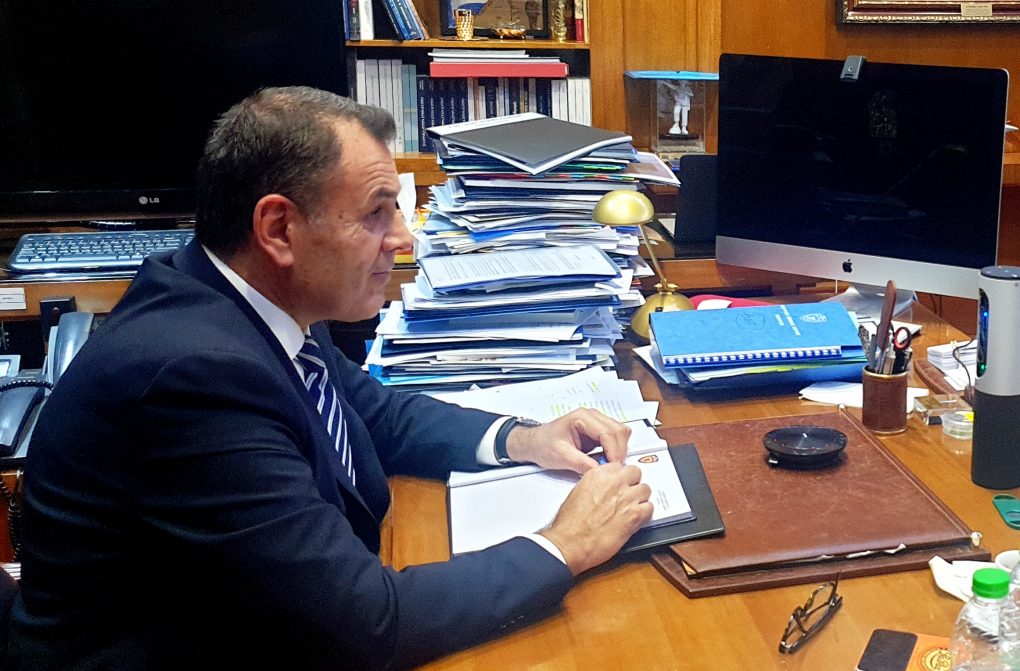
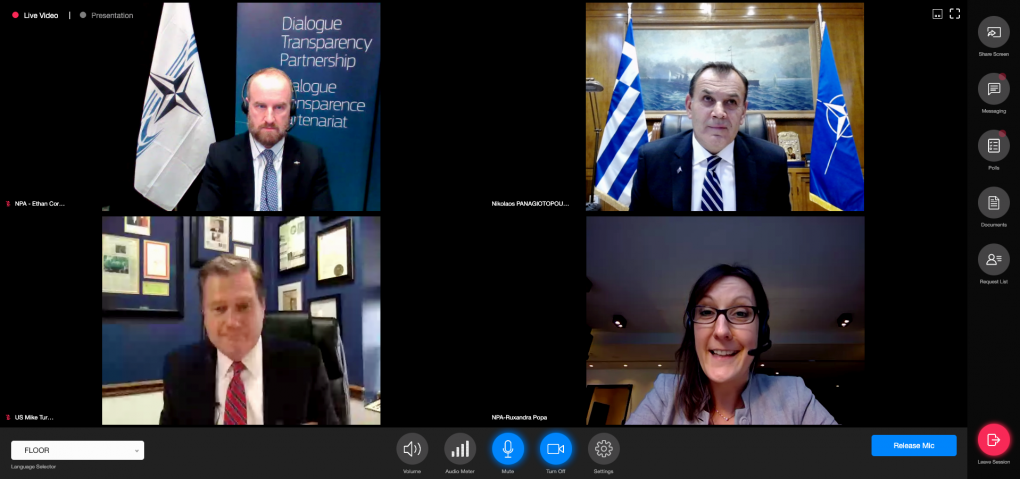
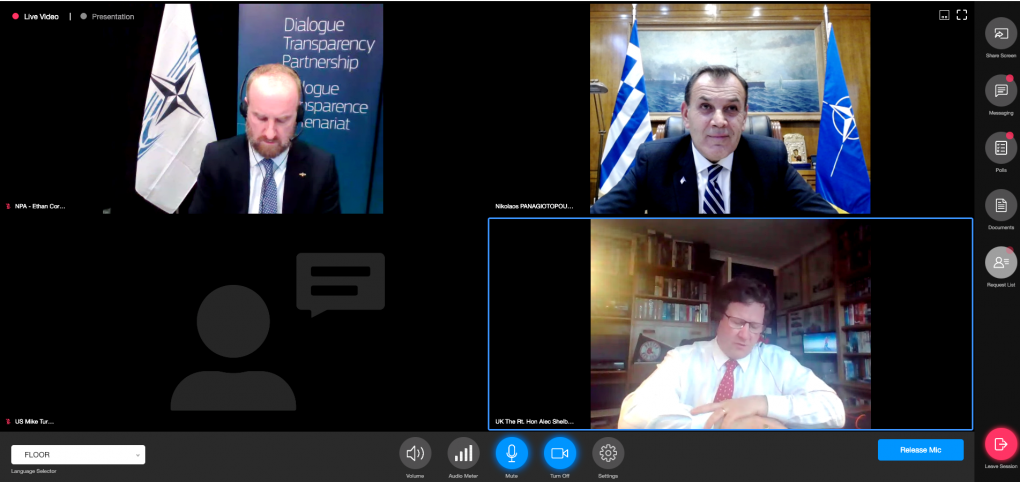
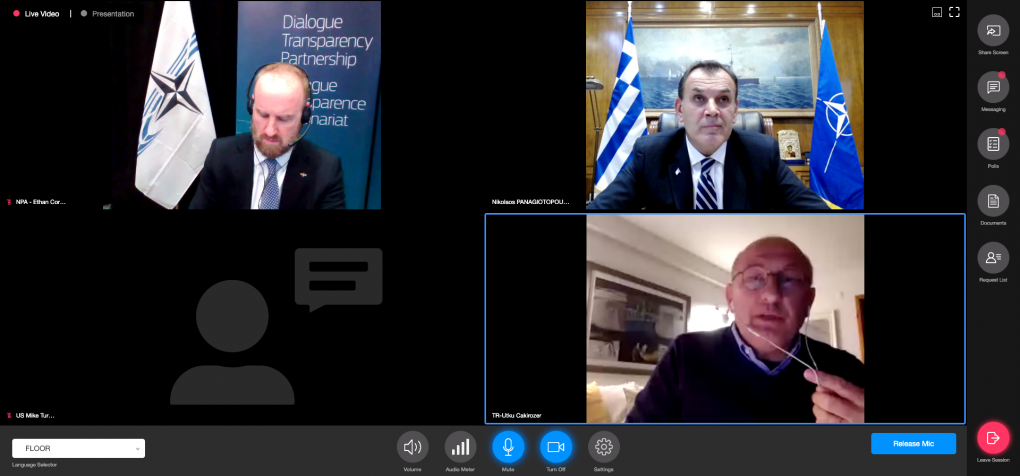
The Minister of National Defence, Mr. Nikolaos Panagiotopoulos, participated today, Saturday 21 November 2020, by videoconference, in the 66th Annual Session of the NATO Parliamentary Assembly.
During his speech, the Minister of National Defence expressed his pleasure and honour of having the opportunity to participate in the meeting of the Committee and noted that in the absence of the health crisis due to “Covid-19” pandemics, he would like to welcome in Athens the members of the Defence and Security Committee of the NATO Parliamentary Assembly today, of all days, on the Armed Forces’ Day.
Mr. Panagiotopoulos stressed that the existing geopolitical circumstances, the challenges and threats both to Greece and to the wider area impose the need for powerful and highly trained Armed Forces with a deterrent effect. To this end, the Leadership of the Ministry of National Defence keeps working to safeguard the national integrity, our country’s sovereign rights and our obligations towards the Alliance.
He pointed out that Greece is engaged with NATO as of 1952 and with the European Union as of 1981, confirming its special status amongst the democratic countries of the West and added that Greece fully respects the principles of the North-Atlantic Treaty and especially, the commitment under Article 1 on the settlement of any international dispute by peaceful means and refraining from the use of force in any manner inconsistent with the purposes of the United Nations. Mr. Panagiotopoulos highlighted though that as of August, the Greek Armed Forces are standing by, in order to deal with an unprecedented provocative behavior that threatens out country’s sovereign rights in the Eastern Mediterranean, not by any third country but by a NATO member-country, Turkey.
The Minister of National Defence emphasized to the members of the Defence and Security Committee of the NATO Parliamentary Assembly that the Greek Government has made it quite clear – since the onset of the crisis – that a meaningful and constructive dialogue would be possible, provided the research / survey vessel -along with the naval patrol units that accompany it- withdraw. He reminded that on September 12th, the reopening of technical discussions was achieved under the supervision of NATO leadership for the establishment of a possible involvement avoidance mechanism in agreement with the Greek side. However, our neighbouring country proceeded with a new challenge, in violation of what was agreed on the crisis resolution mechanism, by sending the research / survey vessel even closer to the islands. According to Mr. Panagiotopoulos, this behavior confirms the inconsistency between the statements and the actions of our neighbouring country, undermining its credibility towards the Alliance, while indicates its real intentions. Turkey cannot possibly request a dialogue about the delimitation of the continental shelf, when it attempts to create a fait accompli in the same region.
Regarding Greece’s reaction, the Minister of National Defence noted that as of August, our country experiences the developments with composure, responsibility and restraint, maintaining full operational readiness and determination. He even explained that these actions affect the stability in the Eastern Mediterranean, as well as the Alliance’s unity and cohesion, since they are in contradiction with Article 1 of the NATO Treaty, given that they do not constitute peaceful means for the settlement of a dispute between two Allies and neighbours. He commented that the gunboat diplomacy cannot be considered a willingness for a peaceful settlement.
The Minister of National Defence reiterated that Greece seeks dialogue, to be held in compliance with International Law and not with the threat of use of military violence, challenges and designed disinformation. He also stressed that while the Secretary General of NATO, Mr. Jens Stoltenberg asked that seismic research activities be avoided, he has been ignored.
In relation to all other matters of the Committee’s concern, Mr. Panagiotopoulos referred to Greece’s consistency with the guidelines of Defense Investment Pledge (DIP), based on which 2% of the GDP should be spent on Defence. The Government has already developed and implements an integrated plan for the modernization and the reinforcement of the resources and the materials that have to be acquired by the Greek Armed Forces. Our country will continue to have a presence in the Alliance’s peacekeeping mission, to the extent that readiness circumstances allow so, as the Minister pointed out at the beginning of his speech.
With regard to migratory flows, reference was made to the incidents that occurred in May, when groups of thousands of illegal immigrants tried to breach the Greek and European borders in Evros. Mr. Nikolaos Panagiotopoulos noted that the Greek Armed Forces and the Security Forces dealt with and suppressed this unprecedented hybrid attack, which motivated many EU partners to assist both at operational level together with the Greek Authorities on-site and at political and institutional level.
As regards the NATO 2030 process, Mr. Panagiotopoulos suggested that the Alliance would maintain its importance on the international scene, strengthening its political dimension by cooperating at first with the European Union. He explained that the NATO and EU Member-States should play a full equitable part, without discriminations and exclusions, while in the same way, the decision-making autonomy of both organizations should be respected. In that direction, Greece strengthens diplomacy and the development of initiatives that reinforce stability in NATO’s southern hub, by means for instance of joint trainings and joint exercises held on a regular basis with countries, such as Egypt and Israel.
Responding to questions, he underlined that our country supports the Euro-Atlantic perspective of the Western Balkan countries, based on EU and NATO principles and requirements and in full compliance with good neighbourly relations. Moreover, he stressed that the Turkish claims for the demilitarization of the Aegean islands are lacking legal foundation, whereas Greece, just as any other sovereign state, has an inherent and legal right of defence, under the UN charter, against any serious threat by Turkish military forces in territories opposite the Islands.