

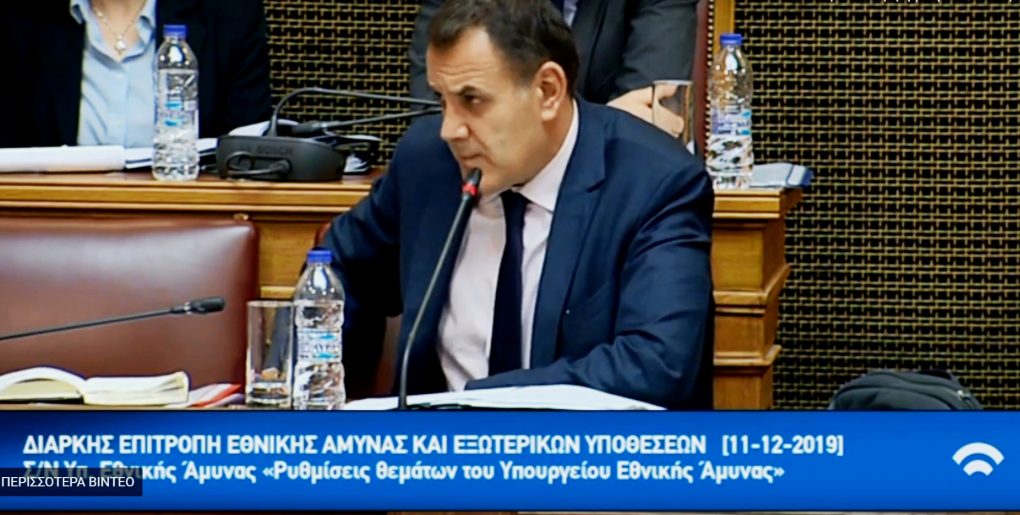
“The debate on this Draft Law is being concluded in the Committees for National Defence and Foreign Affairs, as well as Armaments, which were convoked for the purpose mainly of hearing the Military Leadership and secondly, but no less importantly, the representative of Lockheed Martin, who in my opinion was most informative by means of his answers and helped the House understand how much transparent is this regulation we are introducing with regard to the F-16 upgrading programme.
It is not my wish that the debate on this first article of the Draft Law is trivialized to an unusual competition of “as a result of my actions” on behalf of one or other of the parties. I dare say that following the unsuccessful attempt by Mr. Panos Kammenos in January – due to the incorrect way in which the draft law has been introduced for legislation – a semester of total inertia followed.
Why a semester of no action at all on the part of the next Political Leadership of the Ministry of National Defence for introducing – in the appropriate way though – the upgrading of F-16 in the Parliament had to follow? There was no urgent reason then?
What happened is that we slowed things down in the summer and now, we are racing against the weather conditions for waterproofing the roof of the Hellenic Aerospace Industry, so that this programme would start, while we could have perfectly well solved this issue – it is of a technical nature – during the summer that it is not raining.
In any case, I should commend the atmosphere of consensus in general, as regards the positive tendency of most political parties towards voting the provisions of this Draft Law. I appreciate it and I am glad that it is understood that it is urgent to upgrade our Armed Forces in terms of armaments.
Of course we are not satisfied with the “ceiling” of 530 million euro in the Armed Forces’ budget for covering armament needs, because not all armament needs may be covered. And the armament needs are not only limited to the maintenance of existing systems, but possibly to the acquisition of new ones for all Branches, so that – at the very least – we would follow our persistent, annoying and very contending neighbour, who in recent years has admittedly made great strides in the armament of its Armed Forces.
Therefore, if you remain at a standstill, even if you do not retreat, while your potential opponent – who no longer hides his expansionist intentions to the detriment of your own sovereign rights – is being armed at a very fast pace, then you remain behind in the overall balance.
And that is a condition and a situation that is now recognized by anyone in the society. Of course, our Armed Forces are powerful; there is no doubt about it, and remain armed with very good and advanced weapon systems at all Branches.
We, as a society but also as a Mass Media system, should not succumb to such a propaganda – that we are always at a disadvantage. This is a huge mistake and it is something that is certainly not the case for our neighbours. There is a propaganda for the creation of a climate of superiority, not a propaganda for promoting a climate of defeatism. Some should not serve, by means of their attitude, centers that provoke defeatism by adversely affecting the morale.
Apart from that, I will make a statement that aims at answering questions on articles, on each article of this Draft Law, given that we will have the chance also to talk about it at the Plenary Session. It has been made clear in the first article that the first provision involves Security, Supply and Information programmes that result from the programme for the upgrading of F-16 of the Hellenic Air Force.
The agreement was concluded in 2018 on the modernization of the Hellenic Air Force’s F-16 aircrafts, amending the preexisting Intergovernmental Agreement of 2006. The total budgetary cost amounted to 1.5 million, with the respective agreement of the manufacturing company Lockheed Martin amounting to approximately one billion dollars.
This was launched in 2018; however, it is now ending and of course, it ends as regards its regulation, because we all understand that the major issue of the following day concerns the “running” and implementation of this programme by the Hellenic Aerospace Industry. We all understood that as to the substance of the matter. The Hellenic Aerospace Industry will be supported.
The provision on the original recruitment of specialized personnel that should join the Hellenic Aerospace Industry and get trained – because they will not start their work at once in order to disassemble the first aircraft that is already situated at the premises of the Hellenic Aerospace Industry – has been adopted and then, it will be quickly form part of the technical personnel that will implement this programme.
Therefore, we do realize that the next high stake is to support, as a Ministry, if required, the Hellenic Aerospace Industry, so that it would implement this programme of key importance for the upgrading our Air Force’s fleet.
During the negotiation phase in 2017 – 2018, the Ministry of National Defence was right to demand the participation of the Hellenic Aerospace Industry in the works of the programme, as well as some additional improvements in the operational capabilities and infrastructure that would allow the best possible operational utilization of upgraded aircrafts. Due to the offsets agreement in 2000, Lockheed Martin was obliged to offer returns equal in amount to the cost of upgrading. Given though that the legislative framework for offsets has been repealed as of 2011, it was agreed that – in order to solve this problem – on one hand an Agreement on the Security of Supply should be concluded and on the other hand, it should be separated from the prior agreement, the “parent” offsets agreement of 2000 to the original agreement and moreover, the matter should be regulated in such a way that would ensure both the country’s interests and the compliance with European regulations, article 346 of the Lisbon Treaty on the possibility for any Member Stake to take such measures as it considers necessary for the protection of the essential interest of its security, which are connected with the production of or trade in arms.
Therefore, a slackening of the Directive’s prohibition rule that allows to benefit programms to be implemented as we have already mentioned in many other European countries, despite the fact that these are also subject to the directive’s community law, allows to other countries as well to have similar benefit programmes, as the one that we are legislating today for the Hellenic Aerospace Industry through Lockheed Martin.
More than 70% of the programmes with an overall value of 279 million dollars is channeled towards the Hellenic defence industry and the Hellenic Aerospace Industry in particular, as a subcontracting project. Moreover, it is intended for the development of the capabilities of our defence industry, at a time when its support is of crucial importance for its revival, its upgrade, but specifically for the Hellenic Aerospace Industry for the continuation of its operation.
It is a fact, objectively speaking, that the Hellenic Aerospace Industry exists and is dependent in recent years on the work assigned to it by Lockheed Martin. Now, it has the chance to be able to claim and assume more and technologically upgraded work, as a result of domestic investment made to the infrastructure of the Hellenic Aerospace Industry through Lockheed Martin’s benefits programmes with the consequences that this entails and for the purpose of continuing its work, its human resources and workforce.
The question was raised why does the F-16 upgrading needs to be regulated and whether the amount of 279 million dollars offered by Lockheed Martin, mainly in subcontracting work, is countervailable. We said that the agreement’s programmes constitute in essence returns from the modernization programme and in order to form the agreement we are introducing, we had to reconcile the national requirements – imposed in other words by the Ministry and quite rightly – that work should result for the Hellenic Aerospace Industry, with the company’s obligations and the European Union’s restrictive framework.
Directive 2009/1981 of the European Parliament and of the Council provides for the possibility of the Ministry of National Defence to take all necessary measures for the establishment and maintenance of a domestic technological – industrial base in specific strategic fields of Defence and Security for the protection of the country’s substantial Security interests and in particular, for the security of Supply. We had to come up with this formula, in order to be compliant with the law with regard to the way in which this specific provision is being brought to a vote.
Apart from that, the offsets agreement of 2000 could not be used automatically as a contractual means for returns from the upgrading programme. We had to find the solution and given the Ministry’s requirement for return programmes, it was agreed exactly that; on one hand, to enter into an agreement and on the other hand, its separation from the original agreement and in addition, the regulation of the matter in a way that would first ensure the country’s interests, but also the compliance with the European regulations. Therefore, it has already been said a number of times and I believe that we have all understood it.
We had to answer to the following questions as well:
-
What vital security interest did we want to protect? The establishment and maintenance of a domestic technological – industrial base in strategic fields of Defence and Security.
-
What was the relation between this security interest and the decision? The fact that the majority of the agreement programmes serve as subcontracting; in other words, as a domestic investment in the Hellenic Aerospace Industry and thus in the Defence Industry.
-
Why is the implementation of the directive on public contracts necessary in this specific case for the protection of the said vital security interest? We have said that since Directive 89 does not regulate strictly the matter, there was a need for original and independent provision, since based on the Directive, the programme is not completely excluded; a benefits programme as this emerges. Therefore, the Directive is prohibitive, but not completely prohibitive; we have explained that during the previous session as well.
-
Who undertakes the programmes of the agreement on the security of supply? In which way was their cost calculated and what is their implementation plan? It is important that this question is answered and it was indeed answered so that the spirit of transparency would prevail in this regulation. Therefore, the detailed description includes the agreement – and we do answer; the programmes assigned either to the Hellenic Aerospace Industry or the Hellenic defence industry in general are mentioned or the programmes will simply constitute a provision to the Armed Forces, one by one descriptively.
As regards two programmes with a value of 48 million dollars, there is an intention of re-evaluation, so that recent operational requirements of the Hellenic Air Force would be taken into consideration, as explained by the Military Leadership the day before yesterday. Apart from those two programmes, the vast majority of the remaining ones are intended for the Hellenic Aerospace Industry, as well as other two benefits programmes for the Armed Forces with the consequences that this entails for their benefit.
The manufacturing company has assessed the amount of the programmes very accurately and through the use of its own resources. However, it is its own investment; its own money that will be used for the implementation of these programmes and therefore, it had every interest in making an accurate and correct assessment, while the provision of the said programmes will not affect, as it has been explained, the cost of the main agreement, since on one hand this has already been set by the US Government and on the other hand, the prices included in the main agreement are the same with the ones that would be offered for the same armaments and services for the US Armed Forces.
Implementation Schedule: As we know, the first aircraft is already located at the 114 Combat Wing, ready to be disassembled. This will happen whenever the industry will be ready with regard to its technical capabilities to proceed with the project. The completion of upgrades for all aircrafts – we have said that 84 aircrafts will go through this upgrading programme – is scheduled for 2027. Obviously, the subcontracting work included in the programmes will be completed within the same period. Besides, this subcontracting work will be partly used for the implementation of this programme itself, of course.
The programme may run at a faster pace, depending on how many aircrafts the Hellenic Air Force wishes to commit to this upgrading programme and therefore, to deprive of its daily operational availability required and also required by the entire country. It is clear that apart from the same fuselage, the same landing gear and the same engine, everything else changes in the F-16 fleet, so that upon completion of this programme and delivery of all 84 aircrafts we would possess in effect a different F-16 fleet and consequently, a different Air Force, with upgraded capabilities with regard to the electronic systems of these aircrafts in particular.
The Viper version is currently the most advanced F-16 version worldwide and I would say that it constitutes the “verge” – the intermediate stage of the transition from 4th generation combat aircrafts to 5th generation ones, F-35 and others. Therefore, by means of this programme our domestic aerospace industry is given the opportunity to be able to perform support works as well possibly tomorrow for 5th generation combat aircrafts. As you may understand, this is another multiplying benefit offered by this upgrading programme.
Why does New Democracy party bring the same provisions? What has changed? What has changed with Lockheed Martin letters? Just a brief reminder: The provision for the approval of the programme on the security of supply etc. has been at first introduced in January. We are choosing this process for transparency reasons, but also for reasons of exhaustion of the width of discussion, without surprises, no pun intended, without context, without suspicion. In fact, this is the fourth meeting of the Committee and we will also have another chance to discuss things at the Plenary Session openly and in transparency – I am afraid it’s something that has not taken place during January’s surprise and that was the reason why the attempt failed; because it provoked in the first place a climate of suspicion.
And of course it was wrong that this has not been attempted to be rectified by means of its introduction by a Draft Law, as you have pointed out yourself Mr. Dritsas that afternoon or evening in January. It has been brought as a Draft Law also during the semester that followed and Kammenos’ attempt.
The important thing is that the agreement that we are bringing today for approval is improved, in a way that is beneficial for the State, given that Lockheed Martin, based on its updated offer, undertakes the obligation to provide additional subcontracting work to the Hellenic Aerospace Industry amounting to 16 million dollars. Whereas it is bound to replace the well-known two programmes of 48 million with nine different ones, based on what the Hellenic Air Force will request given its updated operational requirements.
Article 55 of the omnibus bill was voted today and therefore, the way is paved for the settlement of the issue regarding the Hellenic Aerospace Industry’s personnel.
Regarding the second provision, the approval of three framework – agreements on the operational support of Mirage aircrafts.
Hence, by virtue of the second provision, three draft framework agreements on follow-on support for Mirage 2005 aircrafts between the GDDIA and three French manufacturing companies – namely, Dassault, Thales and Safran – are being approved. A problem is being solved, which unfortunately exists as of 2012, but even before that, because the difficulty in the supply of spare parts existed even before 2012. The support of Mirage 2000-5 aircrafts, whose specific operational benefit has been established – of course whenever there is the availability required at the theatre of operations in the Aegean Sea, due to the strategic weapons that these aircrafts bear – expired in 2012 following several extensions, but has not been further extended.
I consider it regrettable that as of 2012, we are aiming at regulating today this outstanding issue. A new follow-on support agreement was required based on the new legislative framework. The tenders launched, but also the efforts that were undoubtedly made for the conclusion of a government-to-government agreement, proved to be unsuccessful. As soon as these tenders were found to be unsuccessful, a solution should be found. Efforts indeed continued and in 2018 a question was raised by the companies regarding the non-acceptance of specific terms of the legislative framework in force. Consequently, the legislative framework should be adjusted. GDDIA was authorized to make negotiations for the purpose of reaching a mutual understanding about the framework agreements and to initiate the procedures for the regulation of the ratification of these drafts.
Negotiations kept going throughout 2018, until finally and particularly following my visit to Paris and the direct dialogue with the leadership of the French Ministry of Defence, it was agreed that we had to have this long-winded affair settled. It was agreed that Mirage aircrafts constitute our top priority as regards the structure of the Armed Forces. Possibly the French side felt in the back of its mind that if this affair is settled, then a future window for Rafale remains open or perhaps we could have a chance with the frigates.
It has been agreed that Mirage project should begin, because we required so, so that they would fly again in accordance with the proper availabilities. In order to avoid misunderstandings, a good proportion of the Mirage fleet is in immediate operational readiness.
Besides, yesterday, many of them took off in a surprise move of the Hellenic Air Force in the Aegean and with an advantage in numbers, I dare say that they gave another lesson to the Turkish Air Force that things are not so easy, as Mr. Çavuşoğlu thinks making his own warlike calculations or won’t be easy in any case. However, more aircrafts need to take off. This can be achieved, where there is an unrestrained flow of spare parts even of a small value that could be easily fitted on the aircrafts, so that they would become operational. This can begin to take place as of next month, so that we would know that within four, five or six months, a significant proportion of the fleet comprising totally 44 Mirage 2000 and 2000-5 would be available for the needs of the Hellenic Air Force, with the consequences that this entails.
In this way, we came up with the framework agreements. The funding of this programme, whose ceiling was set at 260 million euro for seven years, has already been approved. There was a case and we informed the French side accordingly, that Greece – and this was not a normal condition I dare say – had the money in hand, the spare parts were found and all that was left to do was to agree. As you understand, we agreed and the funding for the period from 2019 to 2021 – 30 million per year – has already been announced by the Ministry of Finance.
Let me answer to a question: Why are the first two provisions confidential as regards the agreements, while the agreement on the following article 3 on the additional equipment, is not? The text on one hand of the agreement on the Security, Supply and Information for F-16 and on the other hand, of the framework agreements on Mirage aircrafts and their support are not included in the Draft Law in question. Not because we needed to hide something, but because these texts include a large number of confidential military information. Involving the organization, structure, supply and obviously equipment of the Armed Forces, whose publicity would cause damage as a result of the leak of secrets about the country’s Defence and Security.
Even the disclosure of the titles of programmes would possibly lead to the uncovering of deficiencies in the Armed Forces and in my opinion, there is no purpose, no reason at all for this to happen now. As regards specifically the framework agreements on the support of Mirage aircrafts, there is some information included in the form of technical details, specifications, etc. pertaining to the industrial and trade secret of the contracting French companies, who requested that this information is not disclosed, in order to safeguard their lawful interests. For this reason, we will review the list of spare parts – if you allow me to say it simplistically – only as regards the agreement on the excess materials, and not those involving the aircrafts.
Finally, as regards Mirage aircrafts, the power conferred to the General Director of GDDIA pertains only to the approval and amendment of implementing agreements to be concluded, so that we would determine the orders for the purchase of spare parts to be fitted to the aircrafts. Therefore, any approval of and amendment to the implementing agreements, framework agreements under the specific terms of the implementing agreements should in any case finally comply with the contractual framework defined for what we are brining now; in other words, the framework agreement without any margin of deviation.
I have two comments to make regarding the third provision, regarding the excess material. We are in the fortunate position of finally terminating, settling a difficult and long-winded case; a case that has to do with the implementing agreement on the manufacturing of submarines.
Mr. Dritsas, you are very well aware of how difficult and tortuous it was at all stages. In any case, we are expressing our confidence that this agreement gives an end to everything, and not only to the case of excess material, guaranteeing it at least for our Navy, with additional benefit of five million from the already existing material and another 15 million from the claim that will not be pursued by the Hellenic Shipyards Co. against the Hellenic Navy. Therefore five plus fifteen makes a benefit of 20 million, but ends up a series of fierce and bitter dispute between the parties involved. This litigation could go on forever. It would be good for the attorneys, but bad for the parties involved, particularly for the Armed Forces and the Navy.
Through this regulation, the outstanding matter is brought to an end. The Greek State benefits, the Navy accepts the excess material and all other material within a short period of time after the regulation. This will be used for the performance of current and future maintenance works on the submarines. Costly and time-consuming disputes regarding this matter finally close. Clearly, I would say that the Navy will breathe a sigh of relief, when these things will no longer bother it.
Article 4 deals with the problem of backlog of outstanding and overdue debts of Army hospitals and the 417 Army Equity Fund Hospital (NIMTS). We all understand that Army hospitals and the 417 Army Equity Fund Hospital face static important problems of liquidity, mainly due – and that is not something new – to their unpaid receivables against Social Insurance entities resulting from the provision of hospital services. The Army hospitals system is not crumbling, but apart from that, it is in a difficult situation without these unpaid receivables. If there was any way – and this relates to the letter that we have sent to the Minister of Health together with the Deputy Minister – to collect these unpaid receivables even in part, then Army hospitals would become even better and provide even better Health services that, as you are very well aware of, are not being provided exclusively to the personnel and the members of the Armed Forces.
The carrying out and completion of tendering procedures requires time, mainly due to the procedure for objections. A solution should be found and the provision of the possibility of paying the debts of Army hospitals and the 417 Army Equity Fund Hospital, as well as regarding the provision of services, is absolutely necessary for their smooth operation. This is what we do, by means of this regulation. I have informed you about the amounts owed by the insurance entities. It is a large amount. I have informed you about the relevant letters sent to the Ministry of Health and the Chairman of the National Health Services Organization.
Article 5 regulates career issues, by means of two regulations that aim at rectifying the disharmony and inflexibility of the existing legal framework relating to matters of career and development of Long Service Volunteers and Professional Conscripts; I should make it brief. I believe that in this way the legal framework somewhat rationalized, so that these two categories would not be disadvantaged in issues relating to their career. The provisions involve matters of an urgent nature, since some are about to retire while others have some issues with the duty with troops. There is no room left for postponement and we considered that from a medley of provisions that we could bring and it is our intention to bring regulating or being able to regulate personnel issues, those of an urgent nature should be included in this draft law.
As regards article 6, involving regulations on the Civilian Personnel, certain imbalances in the current legal framework are being rationalized, while through article 7, regulation becomes necessary for the sustainability of the Hellenic Defence Systems, whose Management recently changed and we must give it a chance to operate as of the commencement of its term of office and not to face as of its first – second week a problem with obtaining a tax clearance and an insurance clearance certificate, fact that actually paralyses any possibility to actually manage the Hellenic Defence Systems.
Article 8, as he had anticipated in the beginning, cannot be submitted and we withdrew it, given that when we addressed the Ministry of Citizen Protection, we encountered its objections, the need for a discussion between representatives from both Ministries, for the avoidance of any surprises or even misunderstandings, with regard to the synergies we are developing for addressing the problem, with the Deputy Minister being the main coordinating body. The synergy with the Ministry of Citizen Protection is necessary and we decided to exhaust the discussion, so that a new proposal regarding the Army Equity Fund would be brought jointly.
At this point, I would like to conclude my position on the articles in essence and in the second reading of the Draft Law. I am looking forward to a discussion on the same wavelength at the Plenary Session.
Thank you, not for intending to vote in favor or against this Draft Law, but because during the debate that has developed so far, I believe that everyone, all political parties are arguing for the national need to examine in which way could the capabilities of our Armed Forces be upgraded.
And for this purpose, I would like to note that, since the debate is opened up, we ought to behave and act intelligently, in a targeted and prioritized way. There were – and still are – many needs in the past that needed to be covered. But I think that now is the time to set our priorities.
For instance, a priority for the needs in armaments of the Hellenic Navy should be the acquisition of heavy-weight and technologically sophisticated torpedoes, in order to be used by the advanced and exceptional weapons of the Navy, the type 214 submarines. The fact that these submarines do not possess the latest state-of-the-art torpedoes just impairs their operational capability.
It is a pity, therefore, that we are facing today a problem with submarines and torpedoes, like we did in the past with Leopards and missiles, especially at a time when Turkey’s naval presence in the Eastern Mediterranean Sea – and not only – is dramatically upgraded. The main weapon for halting this upgraded activity is the advanced type 214 submarines. Let us provide them the capabilities that they are able to and should have and that would be the main – along with the average upgrading programme for our frigates – prioritized programme as regards the Hellenic Navy. There are more to come.
In any case, what we need to bear in mind is clever solutions, as cost effective as possible, but that does not mean that we may not require additional funds for the needs of the Armed Forces and the targeted, prioritized needs that the Staffs are currently processing and will be soon at the disposal of the ones who decide.
Thank you once again for your contribution to the debate and we will be back on Friday at the Plenary Session”.