

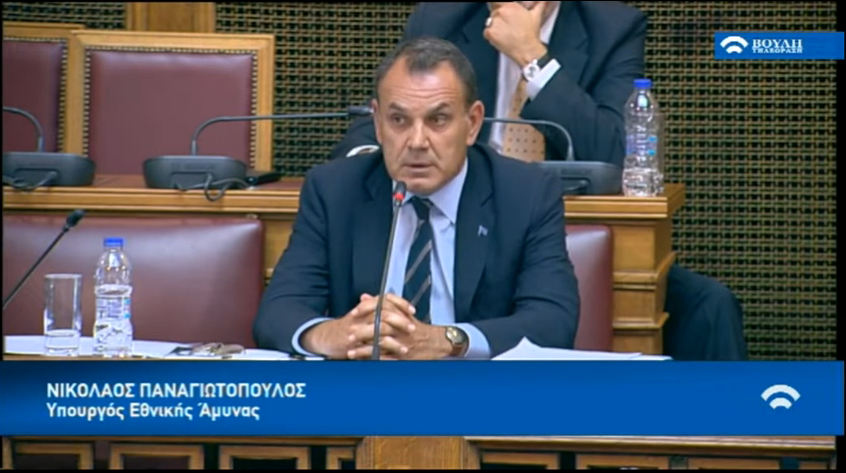
FIRST SPEECH:
“Dear Colleagues, thank you for the views you have expressed. If anything, this is a very interesting debate.
We came here today to contribute to the debate on the approval of a Defence Agreement with Israel and nothing more. We do this, because we believe that this agreement establishes the framework for many other defence cooperation agreements to follow, more specialized ones and absolutely beneficial for the country. And I am indeed surprised, because I feel that not everyone in this room understands that these agreements cannot wait any longer.
We agreed on general provisions with general statements. However, the time is now – and this is the result of months of hard work – for such a general agreement in the field of defence cooperation to become a reality. The only thing that I was not asked to do, was to return to Israel the two UAVs we leased a few months ago, for the surveillance of the sea and land borders for reasons of national interest and there will be more to follow.
What if, let’s say, tomorrow or the day after tomorrow or next month, as soon as health circumstances permit, representatives from Israeli companies start coming one by one to conclude agreements on cooperation, joint manufacturing, synergy in the defence industry with Greek companies? Are we going to send them back, because possibly in the meantime, the statement expressed by the PM of Israel on the annexation of West Bank Palestinian territories would occur? And are we going to decide that this serves the national interest? Let’s not get involved in the serious problem, not doubting, the Palestinian problem. That is not the point today. Nor did I come here to take a stand on behalf of the Ministry of National Defence of course, on a matter that relates to the country’s foreign policy with respect to the Palestinian problem.
We came here to strengthen the strategic partnership with Israel, a large part of which is the defence cooperation, with tangible upcoming results and not table-top exercises or theoretical announcements that constituted the agreement as of 2016 or earlier to this day. We came here to implement, to lay the foundation for the implementation of things next month absolutely in the national interest.
Ι understand the objection of legal nature that was raised. I have to say that the choice of the date on which the discussion in the Committee will take place is at the discretion of the Bureau, following consultation of course with us, the leadership of the Ministry of National Defence, because the schedule is very busy. We selected a day that was more favorable and we did what we did without intent as regards the announcement of the PM of Israel about the annexation of territories as of July 1st; which after all was called into question – from what I understand – because as I was informed this morning and within the Israeli government this is not confirmed. Several Ministers have come out saying that this does not mean that it will take place on July 1st and we are not certain that this will indeed take place and in any case, it may have been announced, but it will not occur.
Of course, there is no conspiratorial type of deceit that “we are trying to send a message” or show “our siding with this announcement”! Not at all! On the contrary! It is wrong to make such assessments. By all means, I believe that the question of a legal nature, rather than the political question that you are raising, is strong reason to consider whether we should discuss this today. But what I need to say Mr. Loverdos is the following. As I have been informed by the services, an explanatory memorandum has been submitted. However, possibly due to the fact that the General Accounting Office’s Report that eventually provided for some expenses was somewhat delayed, the service deemed appropriate to submit a second explanatory memorandum with an addition, a paragraph. That is what I see. The whole question is about a paragraph, Mr. Katrougkalos.
I refer to the text. Three lines have been added as follows “Financial burden arises from the Provisions of the Agreement on the State Budget and therefore, in accordance with the provisions of article such and such, paragraph of the Constitution, the legislative ratification thereof is required”. Our Legal Service addressed the appropriate Service of the Ministry of Foreign Affairs and obtained an opinion endorsing the legislative ratification of the agreement at the Parliament. I would like to remind you that we are having a discussion about this in the Committee. The formal and technically accomplished ratification of the agreement will take place in the Plenary next Tuesday; Don’t forget that. Consequently, this agreement shall be regarded as ratified as of next Tuesday. You just know better than me that the parliamentary procedure proposes the discussion on this agreement on the substance at the meeting of our Committee today, at this time.
I kind of understand the argument that is put forward, but I do not think that an issue arises – unless we look at this with strict technical legislative formality – given that the difference between the one text and the other is only one paragraph that refers to the burden on the State Budget based on the General Accounting Office’s report that was produced later. This is my interpretation. Signatures remain the same.
At some point, a question about the order of signatures by Ministers unto the text was raised with the Parliament’s appropriate service. Some changes have occurred, because the Parliament’s Scientific Committee requires a specific order of signatures and this is not always the case. In any case, however, these are technical legislative matters, which could impede the continuation of the procedure, but it should not have for the House.
I agree with Mr. Syrigos; this is not a simplified agreement that just specifies in its provisions certain aspects of defence cooperation. It establishes the framework for the defence cooperation that will emerge from agreements that will follow from now on, when the expected mobility of agreements of defensive nature, specifically between Greece and Israel, starts for a series of actions.
If we have to look at a reason of vital urgency, due to the situation, in order to proceed with an agreement obviously beneficial for the country, an agreement that will put the strategic relationship between Greece and Israel on an ad-hoc basis and not on the basis of vague, delicate and grandiose announcements without specific content, I think that we should all recognize the need for the ratification of this agreement.
Leaving the entire framework of the discussion outside, completely outside the Palestinian matter, based on the announcements of the PM of Israel for the annexation of Palestinian territories in West Bank and Israeli settlements in Occupied Territories that was announced for today, but it has not yet occurred. As I told you, this can or cannot be done anytime. This is an international political development that has nothing to do with the defence cooperation between Greece and Israel.
Let us not make the defence cooperation between Greece and Israel hostage of such development in the Palestinian issue or absolutely dependent on this development in the Palestinian issue. I think that this approach is not beneficial for the national interest. Therefore, President, given that this date was selected for discussion, more due to our limited possibility to come here, but also your possibility to organize such discussions bearing in mind the problems of spatial planning nature, here at the Chamber and due to the very busy schedule of the House, but also the Ministry. This date has been selected; nothing more nothing less. No association, no connection by any side to regard this discussion as a message of international political nature. I repeat that this case will end on Tuesday, when it will be ratified by the House and therefore, this agreement will have an institutional status.
I would like to suggest that we get on with this procedure. I guess that the discussion on the substance will last less than the discussion on the incidental issue, because things are crystal clear, to move on and mainly to upgrade a strategic relationship by which benefits in the defence sector could be delivered to our country.
I would like to give a swift answer to Mr. Katrougkalos: Ι certainly did not come here to draw a new line in the country’s or the EU’s Foreign Policy. Positions have been expressed and there is no need for me to make any intervention today, outside my competence, because I am not materially competent for the country’s Foreign Policy. Of course, I am materially competent for the country’s Defence Policy. Certainly, there is a connection between those two, but it is not my wish at the moment to bring forth even the slightest hint that Greece is changing its positions with regard to the ones that has adopted and are known to everybody and consist, after all, the European Union’s positions as well.
I came here – as I already said and I repeat it in order to get our head around it – to contribute to the debate on the ratification of a Defence Agreement in the framework of the strategic cooperation between Greece and Israel; nothing more, nothing less. The positions of the country’s and the EU’s Foreign Policy are known and remain unchanged. And certainly, they are not changing here, today”.
SECOND SPEECH:
“Thank you President,
Ι will confute all suspicions that today’s debate is an indirect intervention in the University issue, insisting to stick strictly and rigorously to the content of this Defence Agreement. I believe that beyond anything else, it opens up the scope for multiple interpretations. I insist on focusing on what we – as the Ministry’s political leadership – came here to support; that it is, in other words, in the country’s national interest to ratify this defence agreement with Israel by way of the House’s vote.
Let me tell you briefly because I understand that soon we are completing three hours of discussion about the ratification of this Defence Agreement, which has been signed while the Main Opposition Party was in government – and I cannot help wondering what will happen when soon the agreements on the acquisition of French frigates or on the implementation of this Defence Cooperation, which are at multi-dimensional level with Israel, or other major agreements on Armaments reach us, when we spend so much time on this.
In any case, we neither can nor wish to bypass the parliamentary procedure and for that reason, I shall try to be brief, given that many useful things have been heard on this matter. Although many times I was given the impression that I hear even follow-up remarks from colleagues on the first part of the debate that consisted in the analysis of the incidental matter and not on the discussion on the substance about the Defence Cooperation between Greece and Israel.
The strategic relationship between Greece and Israel obviously constitutes a major priority for our country, mainly due to common challenges, but also common interests that characterize both countries. Our country’s such strategic choice is expressed either at a bilateral level or within multilateral cooperation schemes. A simple example of this is the participation of Greece and Israel in multilateral cooperation schemes at military exercises level, which (these schemes) are strengthened and intensify their activity in a variety of ways.
We consider that the cooperation with Israel strengthens a pillar of stability in the Eastern Mediterranean Sea. It does not have a destabilizing impact. There are other things that have a destabilizing impact on the Eastern Mediterranean Sea, and not the strengthening of our country’s strategic cooperation with Israel. It is growing, thus playing a role as a counter-weight to Turkey’s unstable and destabilizing behavior, which (Turkey) as you know continues to provoke and show that it does not care about the International Law requirements, but only about the “Law of the Jungle” against which there is only one way to respond: the development of a powerful deterrence nexus, the strengthening of the country’s deterrent power. For me, for the Ministry’s political leadership – together with the Deputy Minister – there is only one way to achieve this, based on two axes:
-
On one hand, strengthening the country’s Strategic alliances at all levels; in other words, intensification of Defence Diplomacy;
-
On the other hand, upgrading the country’s weapon capabilities through this effort we are making that is constant and very intensive, because there is no time. Too much time has been lost and it is nationally imperative that no other time is lost; that the country is better equipped or its already existing defence systems are upgraded.
This agreement submitted for ratification represents exactly our strategy for our country’s position in the international environment and the strengthening of bilateral relations with a strategic interest and mainly, in a beneficial way for national interests.
This agreement is beneficial as well:
First, because it introduces a procedure and gives the possibility of uninterrupted continuation of defence support whenever the need may arise. In this way, as you can understand, it contributes to the increase of our Armed Forces’ capabilities, since it establishes an alternative way of implementation of necessary equipment and services for covering the needs of the Armed Forces. It creates a procurement framework under general terms, by way of procedures laid down, which is based on the drawing up of agreements between states – in other words, “G to G” agreements – providing the opportunity for both countries to conclude individual contracts.
That is the framework established through this agreement. I believe that this is good, in view of the mobility to be developed in the immediate period ahead, through the interest expressed by many Israeli defence material manufacturing companies in coming to our country, not only for them to sell or for us to buy, but to develop joint manufacturing and synergy schemes for the manufacturing of defence material in Greece in a beneficial way for both parties, for their own reasons. Therefore, given this forthcoming mobility, it would be best if this agreement is ratified and therefore institutionalized in a solemn way by the Hellenic Parliament, which is indeed valid as of 2016, but it has not been yet equipped with this institutionally enhanced manner.
The procedure provides for support elements on the part of Israel, both during the stages of the systems’ qualitative acceptance and during their follow-on support and this is also important. The aim is to avoid mistakes of the past; that the Armed Forces’ capabilities are upgraded methodically, but also with high-function solutions as regards new technologies. Everybody knows that Israel mainly produces Defence and Security. Their Ministry of Defence has a budget of approximately 36 billion, compared to our 530 million euro per year and for that reason, Israel is in a position to manufacture advanced systems in the field of Defence and Security.
As we see it, one of the issues here is how we can benefit from these manufacturing capabilities, mainly in the field of systems with state-of-the-art technologies and if possible, proceed with the joint manufacturing of part of these systems in our country. The leasing agreement on unmanned aerial vehicles, the so-called “Heron”, with the Israeli Aerospace Industry is already in progress. This agreement is the first of its kind in the Armed Forces. The commencement of the operational use of the above elements will take place within several months from now. The systems have already arrived; the personnel is already getting trained and in a few months, they will conduct operations at our sea and land borders.
Until then, we may possibly receive further proposals as well, either for the acquisition or for the joint manufacturing of UAV systems of various capabilities, fact that reduces the cost of the operation but also the risk involved for the personnel of the Armed Forces when it carries out a series of missions that the UAV we have acquired may carry out (and we are planning to acquire more).
During the recent visit of the Prime Minister and the government mission to Israel, all these topics were discussed and we reached the conclusion that the strategic cooperation between both countries is primarily based on the defence sector. I explained to you why. However, the difference with the past is that while in the past there were various announcements and statements of “good intentions” – if I may say – between both countries, at this point in time we are ready to take practical steps; in other words, to do tangible things with measurable results evidencing in practice our strategic relationship, beyond the level of announcements or an intensice activity in military exercises.
Second, the agreement contributes to the further strengthening of bilateral relations. It does not serve as a framework for the conclusion of agreements, the supply of materials and assets, but it is proof of the full support between both countries.
The security of supply pursued is not something that can be achieved through a contract with a foreign company, since the consequences from the violation of the terms transcend the economic dimension of the matter in respect of this agreement. Because in this case, Israel – as a strategic partner – undertakes through the agreement to ensure the uninterrupted execution of individual contracts, allowing the Armed Forces to plan and carry out procurements that are necessary for the operational needs. Let me remind you that the parties, as you have seen, are on one hand the Greek Ministry of National Defence and on the other hand, the Ministry of Defence of Israel. Consequently, there is an institutional oversight, surveillance, consolidation of the agreements that will follow, in implementation of this main agreement.
The stable strategic cooperation through joint exercises, but also at a higher level of planned projects, such as “East Med”, is exactly the proof of the long-term planning of this strategic relationship.
Third, by way of this agreement, the strategic cooperation between the two countries is also extended to the field of Defence Industry, with the added value that we so much need and is expected to result for the national economy. This may be achieved through the effective participation of the national defence industry, both public and private, but also of other entities that may assist.
After many years of inaction and absolute stagnation that no doubt costed the capabilities of the country’s Armed Forces, I believe that we are now standing in front of an “hyperactivity” landscape. And we have to translate this into tangible results.
Today, at “Elefsis Shipyards” the coming of US capitals was announced, in synergy with a domestic investor, who has proven that he can perform work in the field of ship repair industry, in anticipation of a change in their ownership. Soon – near the end of the month – the Navy will receive the sixth out of seven vessels that is striving to receive for several years. If I am not mistaken, the first agreement dates back to 2009, while the amended agreement to 2016, by virtue of which the Navy undertook to pay the “Elefsis Shipyards” employees, so that they would continue the shipbuilding of missile boats no. “6” and “7”.
By the end of the month, the Navy is going to receive vessel no. “6” almost completed. Some adjustments to the weapon systems will be pending, which would be complete soon. Our aim is to achieve the launch of vessel no. “7”. We agreed to give another small, very small extension, so that “Elefsis Shipyards” employees would be convinced that we are not abandoning them to their fate, until in the meantime the transfer of ownership to the new investor, who shall act with US capitals, would be complete. I believe that the pressure each one put on his side, with shorter deadlines and clear explanations that the Navy needs its ships – because if not now, then when – had this effect.
In the course of time, a proposal is expected that has already seen the light of publication and concerns the cooperation between the upcoming investor and Israeli shipyards; a proposal (which has not been accepted yet, but is being of course considered by the Hellenic Navy General Staff) on the future shipbuilding, according to its capacities and its various elements, of Greek ships through synergy between Israelis and a Greek company, here, in Greece. This is the famous “Themistocles” corvette. At this point, the Hellenic Navy is working on the proposal; I cannot tell you anymore. The fact is though that there is much of a future and a lot of activity there where a couple of years ago there was absolutely nothing, but demands of workers (fair, I could say) and absolute uncertainty regarding the future of “Elefsis” Shipyards and the Defence Industry. There will be more news within the following weeks. In any case, the Hellenic Navy has every reason to be pleased, because an old-back problem is being solved and it receives a ship (the missile boat no. “6”) just when it is most needed and now sees a specific timeline for receiving the last one too.
So, the possibility of partnership between companies of both countries and of joint manufacturing of equipment may constitute a driver of growth for the Hellenic Defence Industry. I always like to say “not only for the Hellenic defence industry, but for the overall Greek economy”, because Greece possesses Armed Forces with such a presence, such capabilities and quality that should be supported. And it’s a real pity if they are not supported by the domestic defence industry, which is of equal value and equally functional.
I believe that this Agreement of Defence Cooperation with Israel will open the way for synergies with advanced state-of-the-art defence material manufacturing companies of this country, which is of course have been developed to the greatest extent possible in order to deal with its own security challenges and survival. However, in this case, since it appears that it seeks to cooperate strategically with an EU member-state and consequently to enter this market, it has an extraordinary amount of interest in cooperating with Greece.
I do not want to say anymore, President, because we have already dwelt on that. I repeat that we should conduct a debate about the Defence Industry in its entirety. We will try to determine a date, which – if anything – will not give rise to suspicion that some deception is concealed; to pass an international political message and escape from a debate that is of great significance on its own. Let’s do that in consultation with political parties.
Thank you for your participation in such an interesting debate and I call upon you as a Committee on Foreign Affairs and Defence today and as a House tomorrow, to ratify this agreement because in my opinion, it is extremely beneficial for the national interest and it can deliver only good results for our Defence Industry and therefore, for the country’s overall defence capability.
Thank you”.