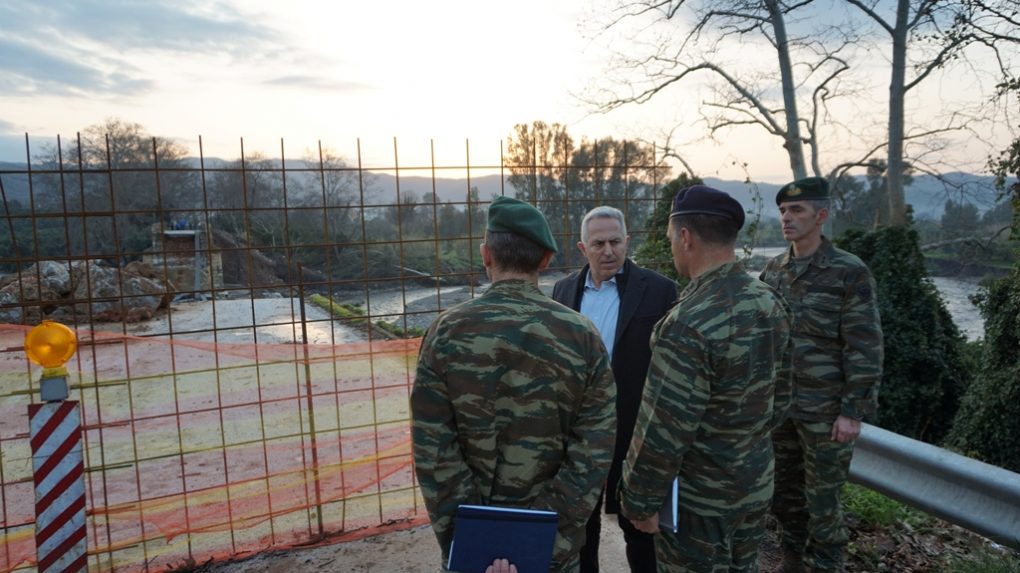
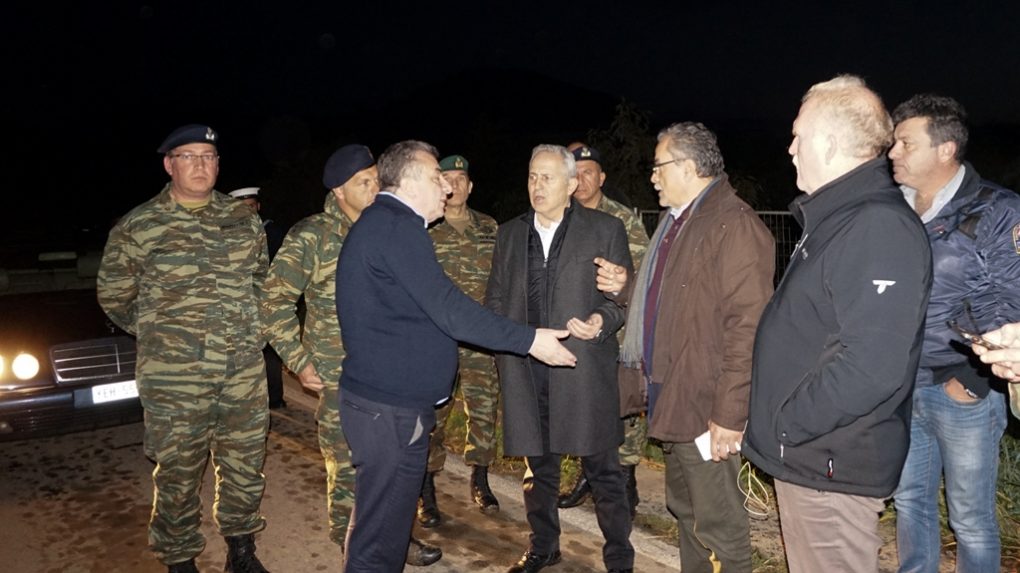
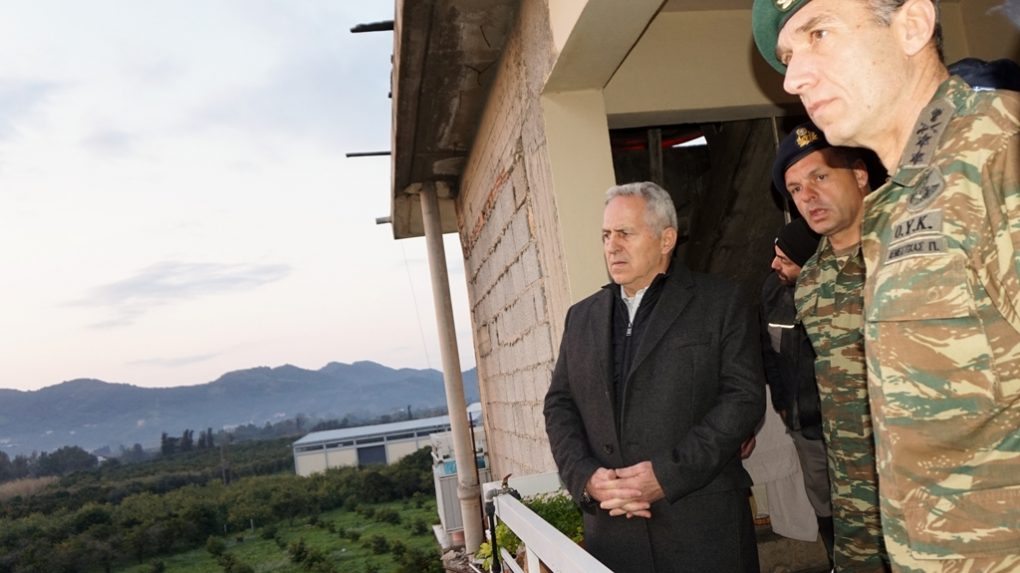
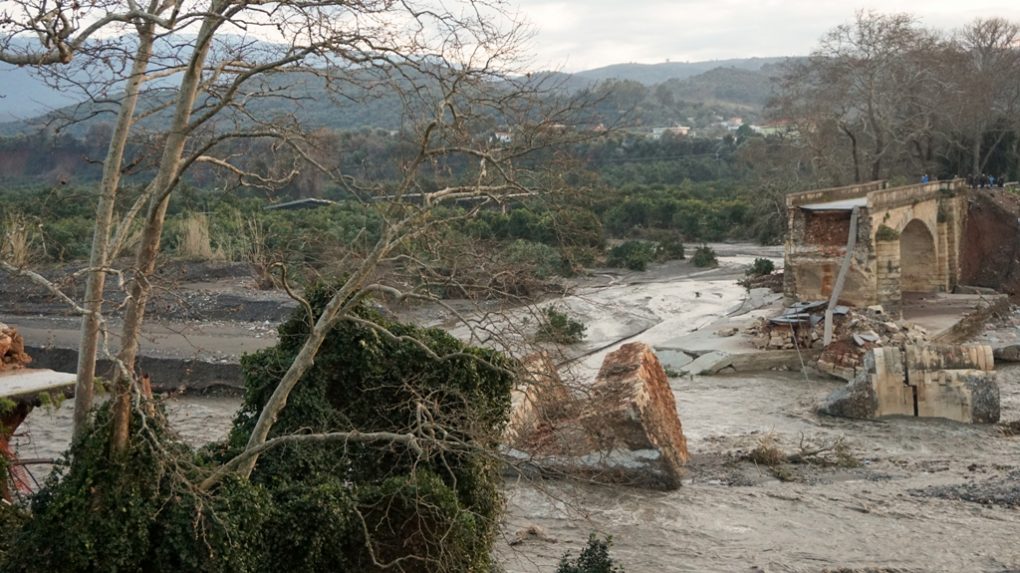
“I came here today, as directed by the Prime Minister, so as to help the Region, in an effort to restore what we can of the caused damages. I am briefed on my own mechanisms and those of the Region and I have talked with the Head of the Region Mr Arnaoutakis and with Mr Spirtzis. What remains is to decide on how we are going to set up the staff. We have already loaded two Bailey bridges which are already in Platanias and we are optimistic that by tomorrow we will have begun the restoration procedure, placing the first bridge and then looking for ways to cooperate with the Region, so that we can contribute to the restoration of communication of the Western Crete villages, since we have concluded that it has suffered a great deal of damage.
We hope that we will be successful very soon”.
Journalist’s Question: Mr Apostolakis, where will the first two bridges, which have already reached Chania, be placed?
E. Apostolakis: From what I understand the first bridge, according to the estimates of the engineers, will be placed in Platanias and then we will consider our options. There are two more bridges in Athens ready to be loaded. Starting with the first, we will then decide what other interventions we can make, so that the restitution will be as quick as possible.
Journalist’s Question: Minister, apart from the bridges, do you know that a great deal of damage has occurred at the infrastructure of the Prefecture’s mainland? Will the Army be able to assist in the restoration of those damages?
E. Apostolakis: We can do nothing on our own. First we need to know what the Region requires. What kind of support it needs in terms of the existing infrastructure. There is no doubt that if we can we will assist wherever support is required, that being the purpose of my coming here. To be fully briefed on how we can help, in cooperation with the Ministry of Infrastructure and Mr Spirtzis.
As you can see, the response of the mechanism was swift. We worked throughout the night to manage to prepare the bridges and load them on the ship which departed at six o’clock in the morning.
Journalist’s Question: Minister, based on the experience of the technicians, how much time is required for the placement of the bridge?
E. Apostolakis: I have been informed by the engineers that two and a half to three days are at least required. If there is existing infrastructure to use as the groundwork, if the foundations are still in place, then it is possible to finish in two and a half to three days.
Journalist’s Question: One last thing, what are the dimensions of this bridge, so that the people can have a better idea.
E. Apostolakis: The bridge which we can place can be up to 35 metres long.
Journalist’s Question: I imagine that it is just a temporary solution…
E. Apostolakis: Yes, it is a temporary but secure solution, so there are no concerns. It connects two points, allowing cars, buses and fairly heavy vehicles to pass through.
Journalist’s Question: Will the bridges be one-way or two-way?
E. Apostolakis: Initially they will be one-way for big vehicles and two-way for small vehicles.