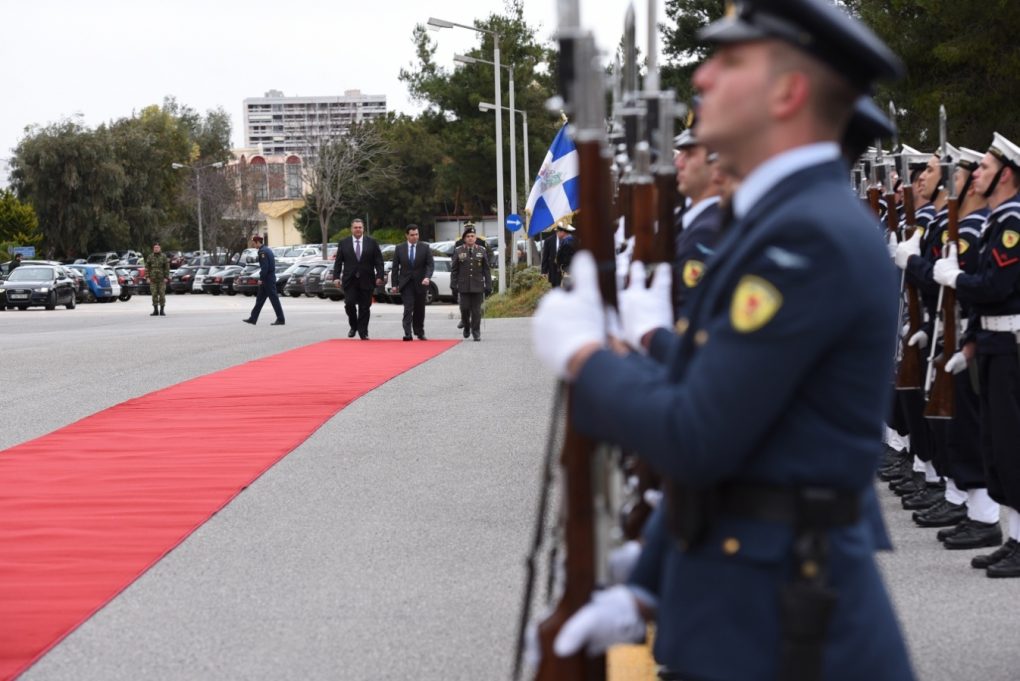
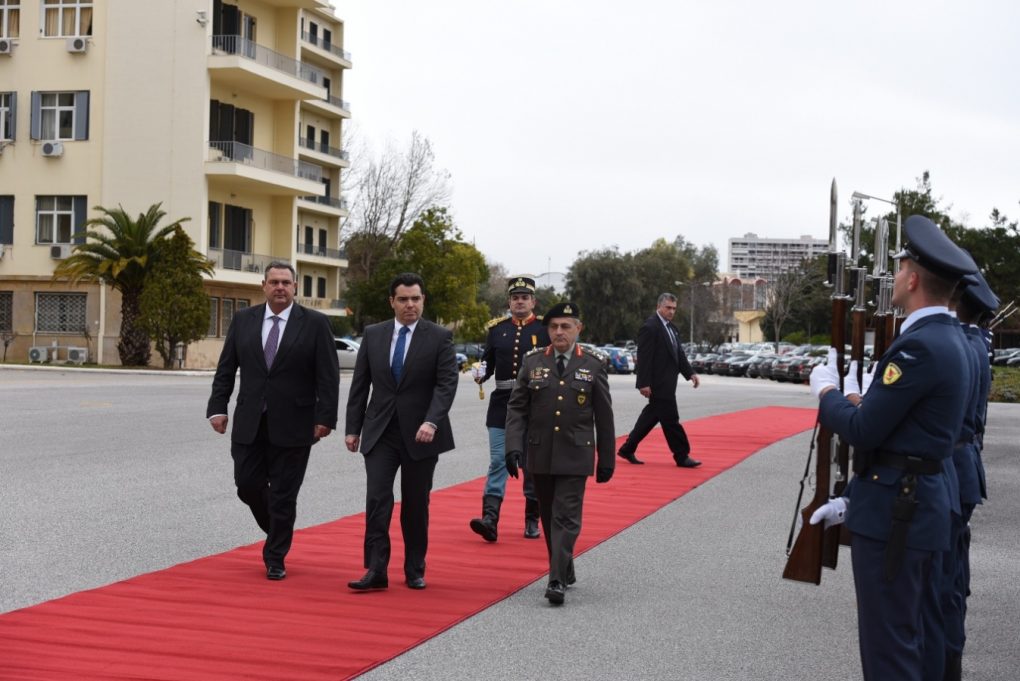
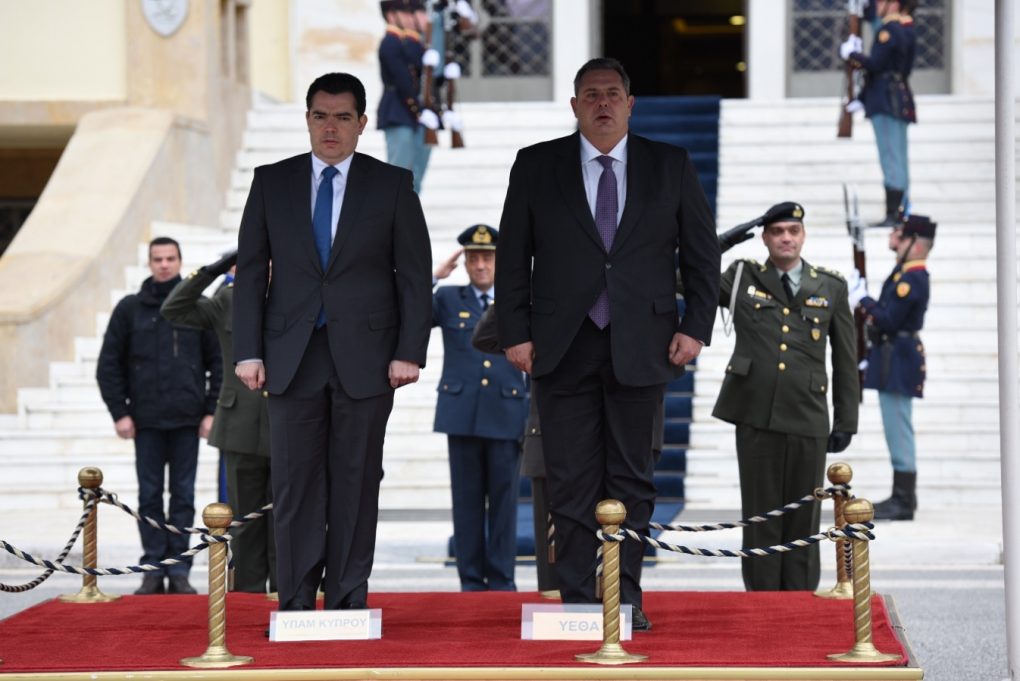
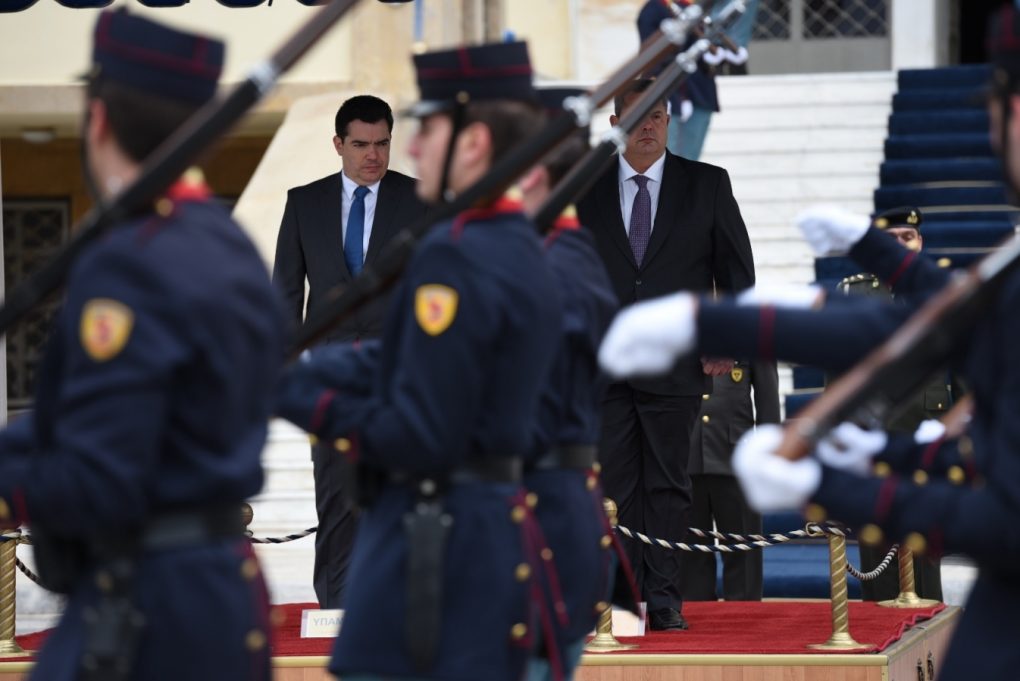
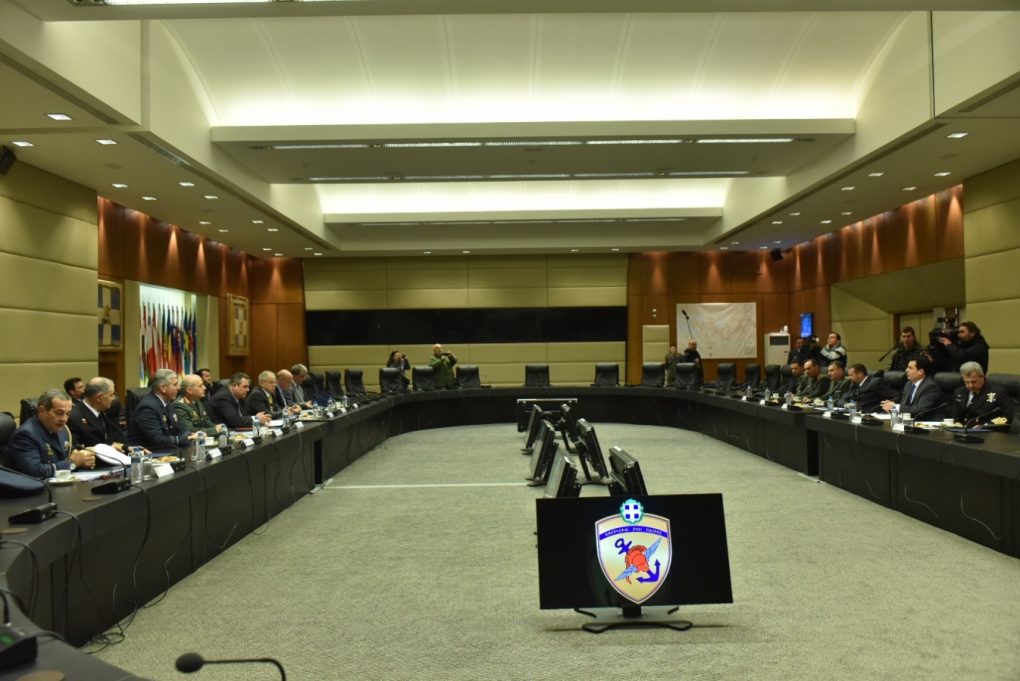
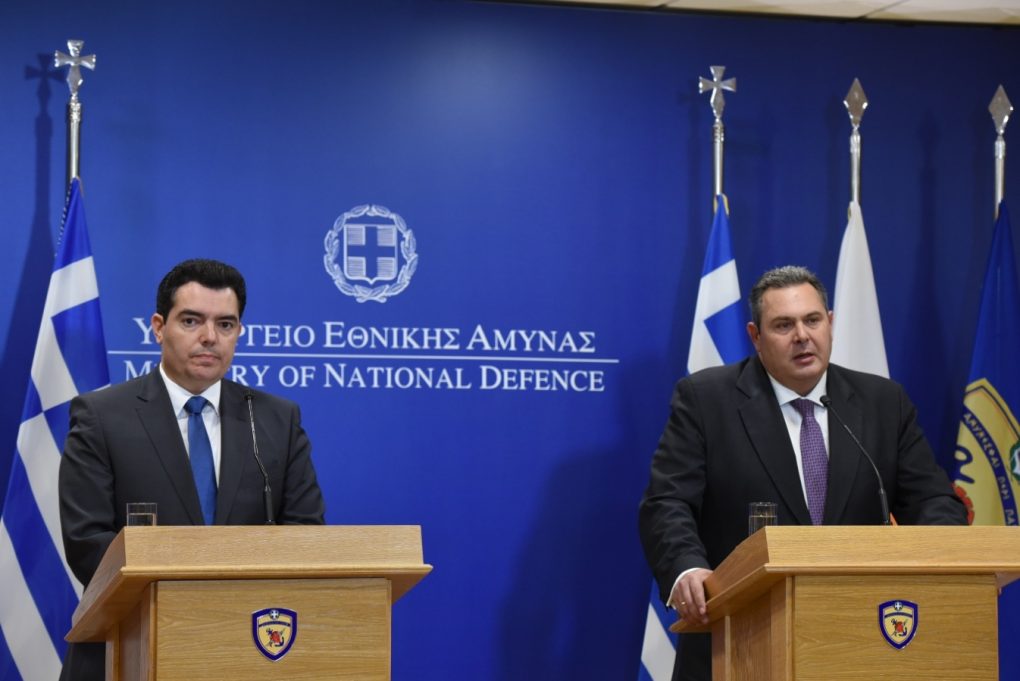
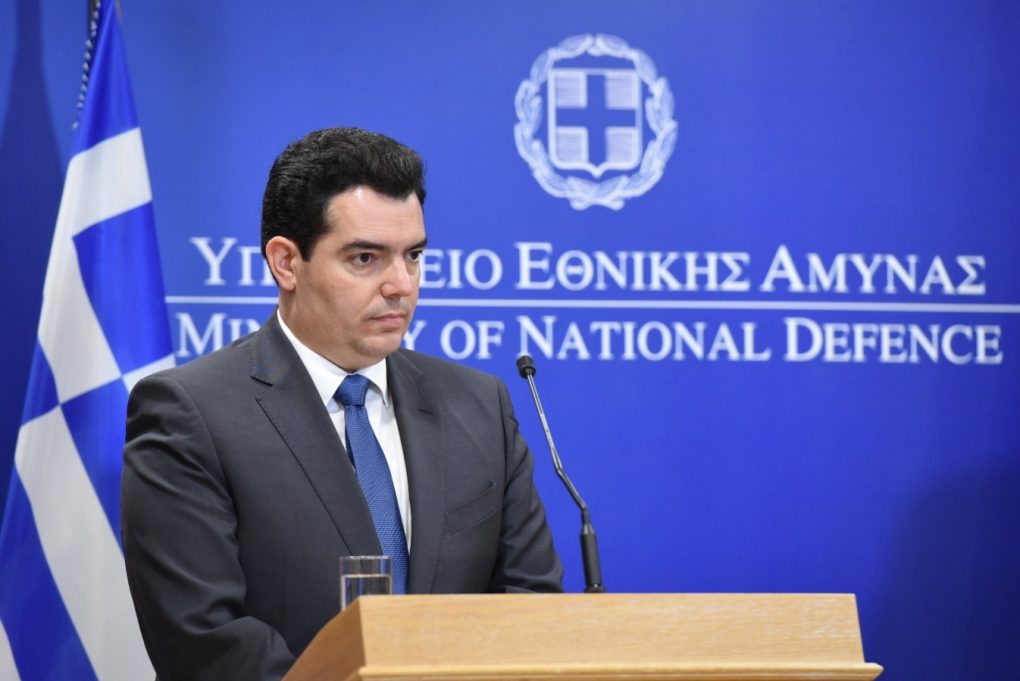
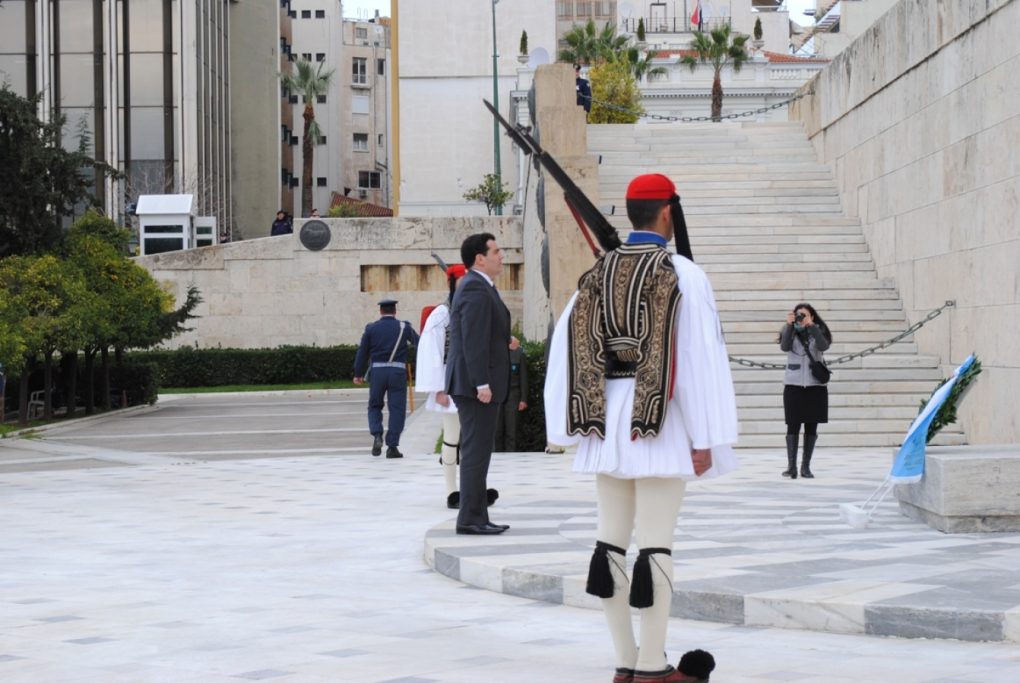
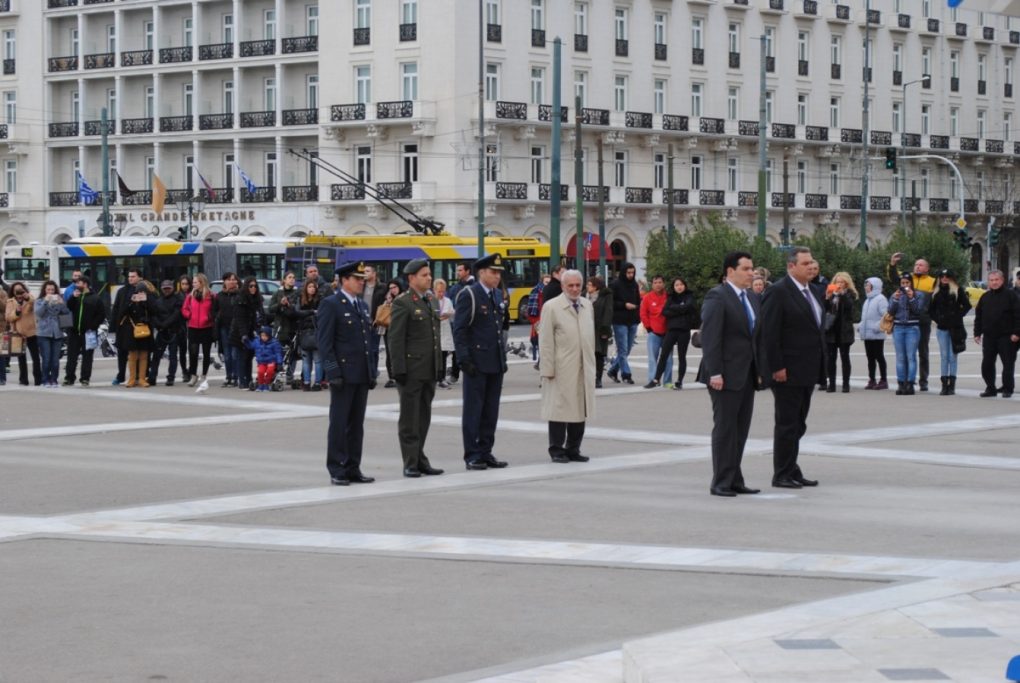
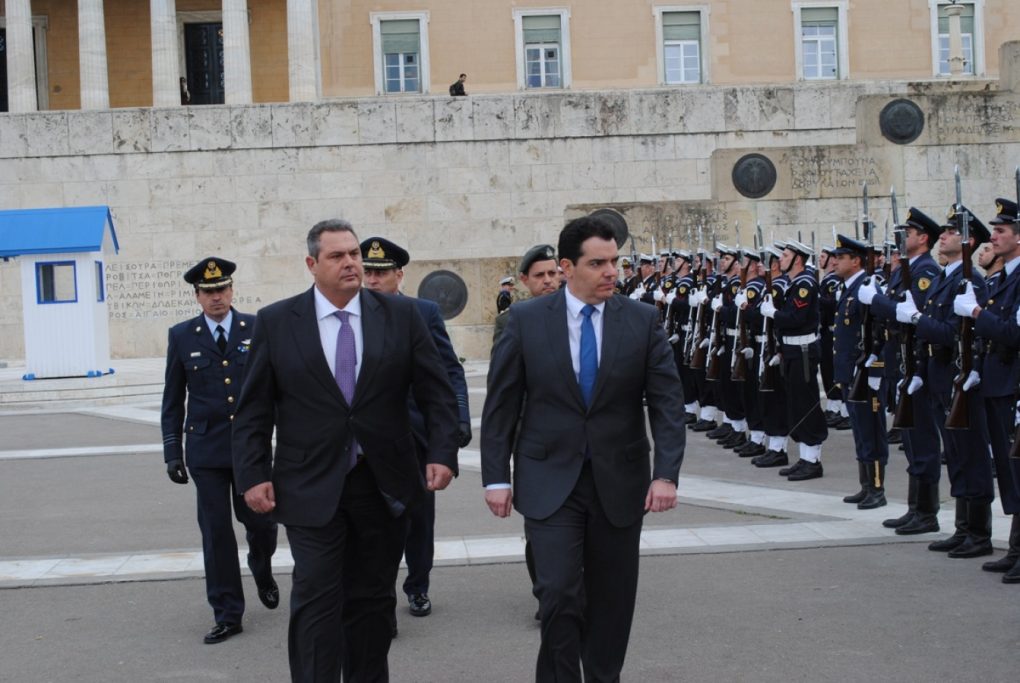
P. KAMMENOS: “The official visit by the Minister of Defence of Cyprus Mr. Christoforos Fokaides is a great pleasure and honour today for me as well as for the Ministry of National Defence. It is his first official visit, though we had the opportunity to meet several times in Athens and in Cyprus throughout the year.
I would like to welcome the Minister of Defence of Cyprus and tell you that the past year has been a year during which we had the opportunity to close several chapters and abeyances. Particularly in the field of Defence, we had the opportunity to build close relations, with the establishment of a direct phone line between us, which was instituted for the first time with the assignment of a National Guard contact to the Hellenic National Defence General Staff. At the same time, we had the chance to raise sensitive issues which, since 1974 – since the invasion and occupation – had never been raised.
The common presence of the National Guard and the fighters of the Hellenic Force in Cyprus in the parades in Cyprus, Athens and Thessaloniki was an important message that we do not forget: that Cyprus is not far away. The mutual initiatives in regard of the friend countries in our region, Israel and Egypt, the establishment of the expansion of the integrated defence doctrine, the common policy of Greece – Cyprus in Greece – Cyprus – Israel and Greece – Cyprus – Egypt demonstrated our determination to work hardly so as to establish stability mechanisms in the broader region.
The close cooperation between the National Guard, the Hellenic National Defence General Staff and the Hellenic Force in Cyprus in matters of mutual exercises and organisation of our Armed Forces, as well as the recognition of those who fought in 1974, during the invasion and occupation operations, leads to initiatives which will help close the old wounds and restore justice. As you know, already the Captain of LST LESVOS Eleftherios Chandrinos has been decorated after death, as the least recognition to an officer who decided to fight his battle, with the raiders who refused to leave Cyprus, when some believed and acted like Cyprus is far away.
The joint event tomorrow for the Captain of patrol boat FAETHON, as well as the initiation of all procedures to render the honours due to Greek and Cypriot fighters of ’74 will lead, within the year, to the reparation of those injustices I made apologies for when I assumed office at the Ministry of National Defence last January. As you know, a vast event was organised for the Hellenic Air Force, so as to honour the participants of operation “Nike” and the procedures for the bestowal of the medal due are ongoing.
At the same time, the Hellenic Navy General Staff and the Hellenic Army General Staff proceed to the investigation of all those cases of Greeks who participated in war operations during the invasion and occupation, who resisted and either fell heroically in battle or survived, so as to render the honours due.
The situation in the broader region of the Middle East and North Africa, as well as the need to define a financial zone in Greece, in relation to the policy implemented, generates the requirement for defence and strategic cooperation between Greece and Cyprus. We closely cooperate with the Minister, Mr. Fokaides, my friend Christoforos, towards this direction and I hope that, within the following months, what has been done in the context of the National Guard’s reorganisation and of the Hellenic National Defence General Staff’s redesign will bear the expected fruit. I welcome him once more and I especially thank him for the excellent cooperation we had so far and assure him that this cooperation will continue in the months to come”.
C. FOKAIDES: “I have the pleasure to be here today, at the Pentagon, where I met with my friend Minister of National Defence, Mr. Panos Kammenos, the Staff Officers and associates. First of all, I would like to say that we had the opportunity to inform and discuss on the Cyprus issue, in the light of the latest developments. I had the opportunity to repeat once more that our side, in the spirit of good will and honesty, remains firmly committed to its goal which is of course the termination of the biggest political and historical anachronism still existing in modern Europe, with the division and occupation of a member-state. We have also repeated, always as far as the Cyprus issue is concerned, our common position for the issue of guarantees; videlicet, we have repeated the obvious, that it would be an absurdity to try adopting in a modern state, an EU member-state, the trusteeship system through the reproduction of guarantee mechanisms reminding other eras, Cold War eras.
Moreover, we had the chance to discuss in depth the geopolitical developments taking place in our broader region and concerning international, as well as our national, security. At a time of new asymmetrical threats, but also at a region where armed violence, terrorism and fundamentalism worsen, Greece and Cyprus play a critical stabilising role as basic pillars of security and democracy in the area. Facing new threats and challenges in the field of security presupposes the maximum possible cooperation of all those who stay committed to the perspective of peace and the establishment of regional stability circumstances.
New energy perspectives in the Eastern Mediterranean can contribute to the future of this cooperation and act catalytically so as to face chronic problems and traditional divisions. Cyprus and Greece, through the cooperation relations they promote with countries in that region, with friend neighbouring countries, encourage this perspective; not only to the benefit of our own national interests, but also towards the general perspective and interest of a broader vision. We work having a plan and vision, but also through several tangible steps which produce results. My belief is that, step by step, we can create the conditions so that gradually on the long term, the Eastern Mediterranean will transform from an area of conflicts and tension to a region of peace, stability, growth and well-being.
Concluding, I would like to say that today we had the chance, as my friend the Minister said, to review the whole spectrum of our bilateral relations which, with an admirable and harmonious cooperation, are constantly enhanced, also within the new context designed by the common memorandum of crisis management we signed almost a year ago.
Minister, my dear friend, I would like to thank you once more on behalf of the Cypriot Government and express our gratitude to the Greek Government and the Greek people for their traditional and abundant support to Cyprus and our struggle. Greece, under all circumstances, notwithstanding the political conditions or difficulties, remains a stable and selfless partner to our fight for deliverance from the occupation and reunification of our country.
I would like to express my thanks once more to you personally for the warm welcome, as well as for today’s very fruitful and essential discussions.
Thank you very much”.
P. KAMMENOS: “Thank you too. Allow me to say, before accepting your questions, that the day the Minister of Defence of Cyprus visits is symbolic. Tomorrow, our flags flying at half mast at the Pentagon, we will render the honours due to the relics of the heroes which, accompanied by the Alternate Minister Mr. Vitsas and the Chief of the Hellenic National Defence General Staff, we will receive here and finally render, after many years, the long due military and religious honours.
JOURNALIST’S Q.: The question is for you both Ministers. Cyprus is a member of the European Union, not a member of NATO. Greece is a member of both. Through this warm cooperation, do you see us taking a step towards military cooperation in the EU? How would you comment the statement concerning Turkey by the President of the Hellenic Republic at a German newspaper? Among others, he referred to the fact that there is proof that all the problems with the refugees’ issue emanate from Turkey, etc.
C. FOKAIDES: I need to say that, as you might already know, the Cypriot Government has expressed, ever since it assumed office, its intention for the accession of Cyprus to the partnership for peace. Of course it is known that Turkey, which definitely has a right to veto, does not concur to this direction, while our position is known and indicative of our intentions to facilitate further cooperation between EU and NATO.
P. KAMMENOS: At the next EU Summit – as you already know – an informal meeting in Amsterdam, initiated by Ms Mogherini, will mark the design of a new EU strategic plan for defence issues. At this point, decisions will have to be made. Does the European Union, when referring to European borders, mean common European defence, ensuring the broader European region, or not? Because, when we speak of European defence, we should realise that the first thing to be recognised by the EU is the European borderline.
Therefore, the European airspace cannot be violated by Turkish aircraft and, at the same time we cannot have European boats just observing the violations of Greek airspace or the violations of national or European borders. Consequently, that alone demonstrates that in future European planning we will have to make suggestions, referring first of all to the self-evident. If the European Union wants to realise the concept of European Defence, it will have to recognise the European borderline before anything else.
For example, this means that Turkey cannot deny accepting the existence of a European member-state of the EU, such as Cyprus. The EU cannot carry on allowing the violations by Turkey of national airspace, which is also European airspace, and of national waters. That Turkey cannot refer to a casus belli against Greece, without having it also considered as a casus belli against the European Union.
Therefore, Europe will decide for its future in the field of defence and it should take all that under consideration. Of course, we are both member-states of the European Union. However, I would like to say that the issue of terrorism by the ISIS Islamofascists does not only concern NATO and EU members. Terrorism proliferates to non-NATO or EU countries and we need to cooperate with them too. President Al Sissi and the Egyptian Government give their struggle so as to stabilise North Africa. Egypt is not a NATO or an EU member-state. However, we cooperate closely, and will also do so in the future, aiming at restoring peace and stability in the region. Israel is not a NATO or an EU member-state. Yet, we have close relations with Israel, so as to ensure peace in the region. The same goes for Jordan, Lebanon and other countries, the Emirates, moderate countries of the Middle East we should cooperate with.
At the level of intelligence on terrorism, we refer to military intelligence and for this reason we proceed to the formation of a Military Intelligence Service at the Hellenic Ministry of National Defence. At this point, I would like to say that we should cooperate with other countries as well, non NATO or EU members. We should realise this. We are NATO members, yet Chechen terrorists attacked the Marathon in Boston. We cannot afford not establishing cooperation at the level of intelligence exchange with countries such as Russia or India, and I particularly refer to the populations coming from Pakistan and possibly participate in such organisations.
Therefore Greece and Cyprus, along with countries such as Israel and Egypt, are stability factors in the broader region and we will do everything possible so as to ensure stability and peace in our area. As far as the declarations made by the President of the Hellenic Republic are concerned, I would like to say that I fell proud that the first citizen of our country does not speak with riddles but clarifies the Greek position. I believe that His Excellency the President of the Hellenic Republic’s comments on Germany reflect our national positions, the positions of all Greeks that of course we support.
JOURNALIST’S Q.: The question is for you both Ministers and relates to the impendent – if there will be one – solution of the Cyprus issue and especially the guarantee, the matter of guarantees also relating to military presence -particularly of Turkey- to Cyprus. I returned from a journalist mission to the island and what I got from the people I talked with at the free areas was their concern, the fear that the Turkish Army might stay there. What they told me is that they will not accept a solution to the Cyprus issue if this means that Turkish forces will stay there; they could consider the rest. The question is, first of all, if you believe that Turkey will accept to stop being the guarantee force and withdraw its army from Cyprus and, second, if that actually happens and we have a solution to the Cyprus issue, what will the role of Greece be, as far as the military field is concerned? Will we be outside of Cyprus, will we be away, will we observe, will we monitor, will we provide some other kind of security?
C. FOKAIDES: Allow me to add something more to the previous question. I haven’t heard the statements by the President of the Hellenic Republic, in any case Turkey should realise that it should start acting as a modern state, as a state wishing its accession to the European Union. Therefore, it should act with predictable terms and with terms governing good neighbouring relations and compliance to international law and the agreements it has signed. Consequently, any solution to the Cyprus agreement, which is of course the goal, and the direction towards which we are working, should include the complete withdrawal of all Turkish troops from Cyprus, and it should also raise the guarantee system, left to us by a Constitution of the ’60’s, an anachronistic system allowing possibilities or rights for intervention. As I have said before, it is a anachronism. There can be no guardians or guarantors to a modern state and especially to an EU member-state.
P. KAMMENOS: “I would like to tell you, Mr. Fokaides, that it is the first time I actually believe there could be a solution to the Cyprus issue. And I say this because I was among those who fought against the Annan plan here in Greece, even when my party agreed to it; I fought against it as I thought that it is a plan that was not implementable, and I am very pleased that the Cypriot Hellenism voted it down. Yet, I believe that at the present circumstance, the international community realises what is happening in the broader region and can help towards finding an actual solution. It is the first time that the Turk-Cypriots themselves realise that the greatest threat for them is the theocratic state Erdogan is trying to build.
The international community now discerns – and they say it in all friend and allied countries – that currently Turkey or certain people in Turkey are behind the illegal smuggling, by ISIS terrorists, of oil, drugs and humans. Now is the time for the international community to understand that the UN’s decisions must also be applied where there are citadels, not only where there is oil and oil fields.
I believe that Cyprus deserves the possibility to unite its people, who have proved throughout the centuries that they can coexist; however, under conditions of implementation of the international rules of law. It is certain that the Turkish army and the occupation forces cannot be a part of such a solution. Claiming that you can agree that the occupation forces can stay at a country they invaded, performed assassinations and child gatherings and where, even as we speak, there are missing persons, and believing that this can be a part of the solution, would be like assigning a paedophile to a nursery school. The first thing to be done is the immediate withdrawal of the occupation forces. After that, I believe that we would be on the right track and this year, if the international actor wishes it, we might have a fair solution to the Cyprus issue and a reunification of the island.
JOURNALIST’S Q.: I would like to ask both Ministers what will be the thing they believe that the international community will do this time so as to pres Turkey? And one political question, if you want to answer mister Minister, as far as the electoral law is concerned. Do you think that something should change to the electoral law?
C. FOKAIDES: I believe that there are several factors or motives shaped as a result of the new geopolitical data that, if analysed rationally, will lead the international actor towards putting pressure or encouraging Ankara, so that it will advocate or let things develop towards a functional and viable solution of the Cyprus issue. Moreover, there is the new environment at the broader Middle Eastern area, with several uncertainties and instabilities, which definitely advocate stability and problem resolving, which could enhance as stability and security pillars the general effort made to fight terrorism and new asymmetrical threats. At the same time, the perspective that will definitely be favoured is Turkey’s European course, also still needed by Ankara I believe.
P. KAMMENOS: “First of all, I think that what the Cypriot people want is quite clear. I do not only speak for the Greek-Cypriot, but for the Turk-Cypriots as well. Turning Turkey into a theocratic state is not becoming of the Turk-Cypriots’ civilisation. It is clear that they cannot follow the policy currently pursued in Turkey. Also, they finally see that Cyprus has developed its energy policy and can be autonomous, without needing guarantors, protectors or creditors. I also believe that, with the changes to come and especially the formation of the Kurdish state, Turkey should realise that it cannot survive by slaughtering populations. One hundred fifty years after the Massacre of the Armenians and of the Pontian Greeks, which we will celebrate together at the Ministry of Defence of Armenia, the policy drawn by scimitar can’t be implemented any more. Turkey should realise that respect of human rights, respect to the rules of international law is the only way it will be allowed to have a course that keeps pace with Europe and the rest of the world. I hope it will realise that.
As far as the electoral systems are concerned, I think that all this is in the context of petty politics. We are now discussing on national matters, allow me to answer that at some other interview. For us and for myself, national matters are far more important than any political matters and, what I wish to say from the Ministry of National Defence is that what Cyprus needs now is the unity of Greeks, at least in national matters. We have so many things separating us that, at least the Cyprus issue, the Thrace issue, the Macedonian name issue should unite us all under one voice.
Thank you.