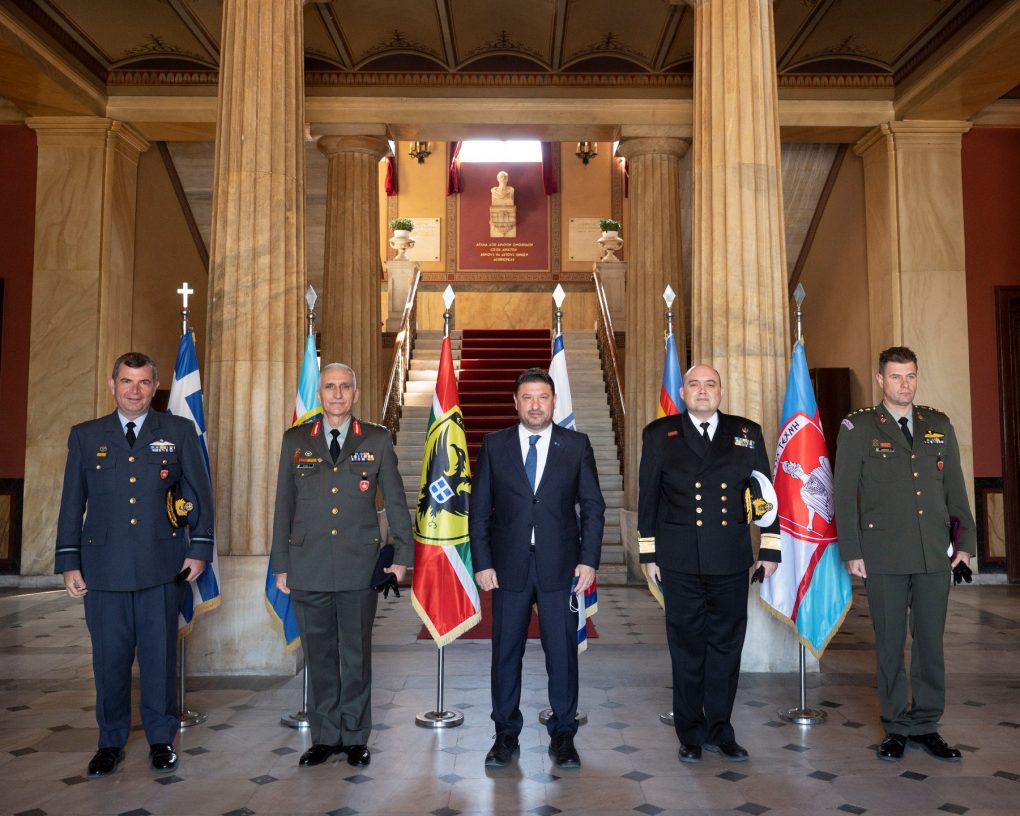
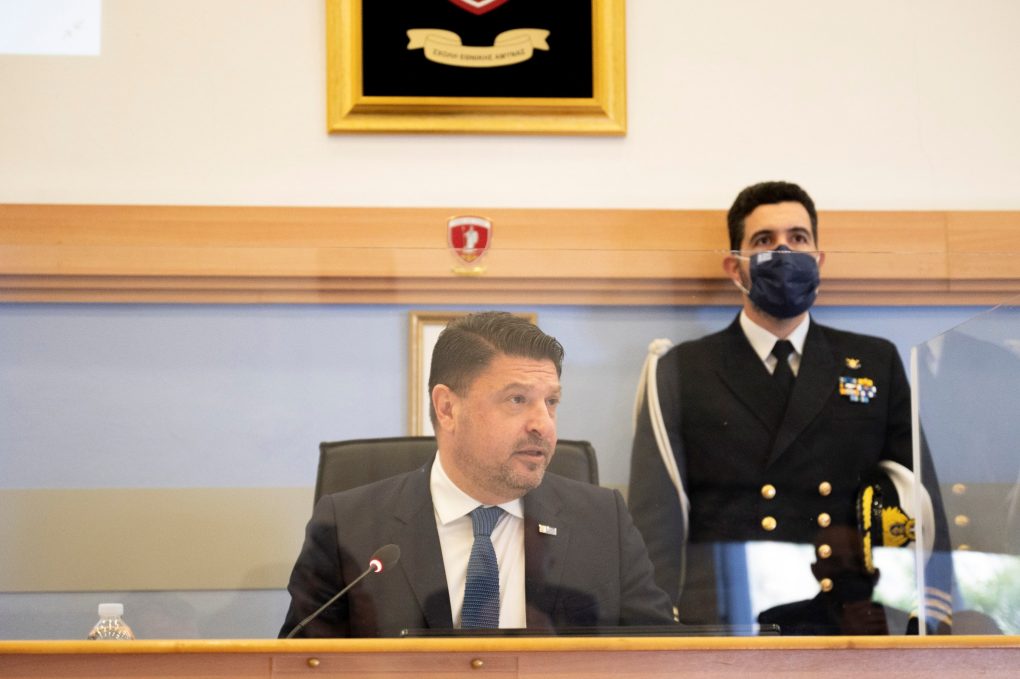
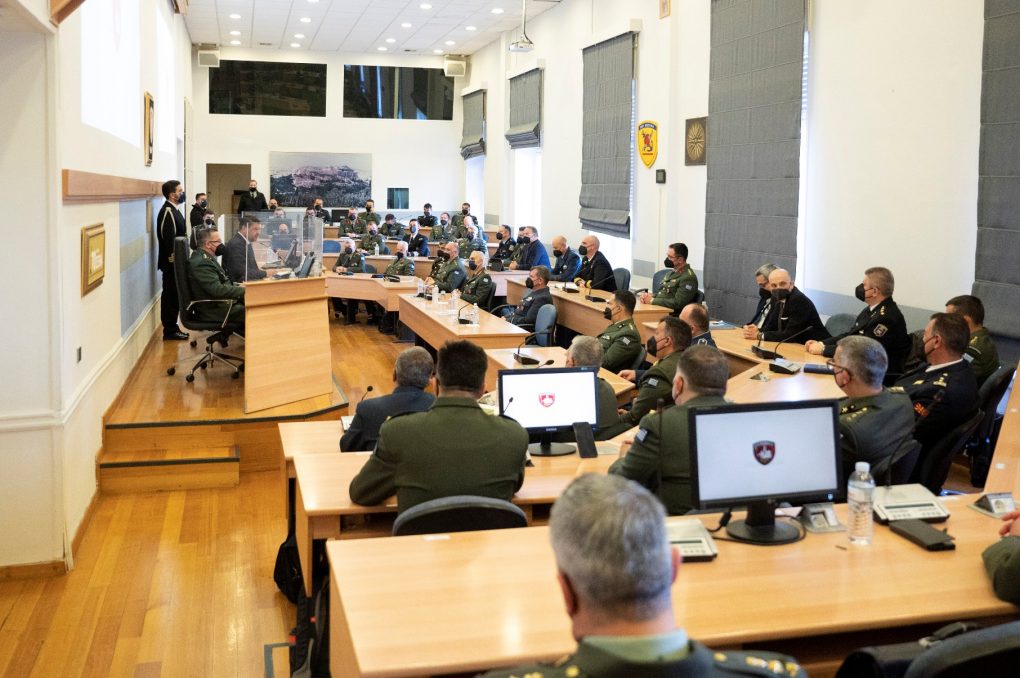
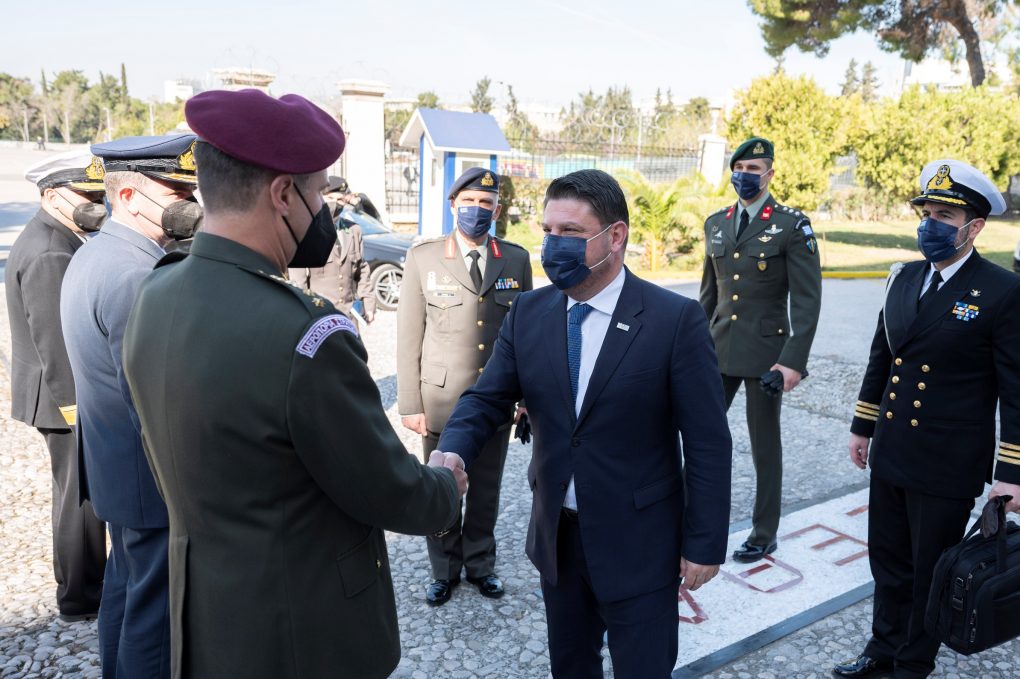
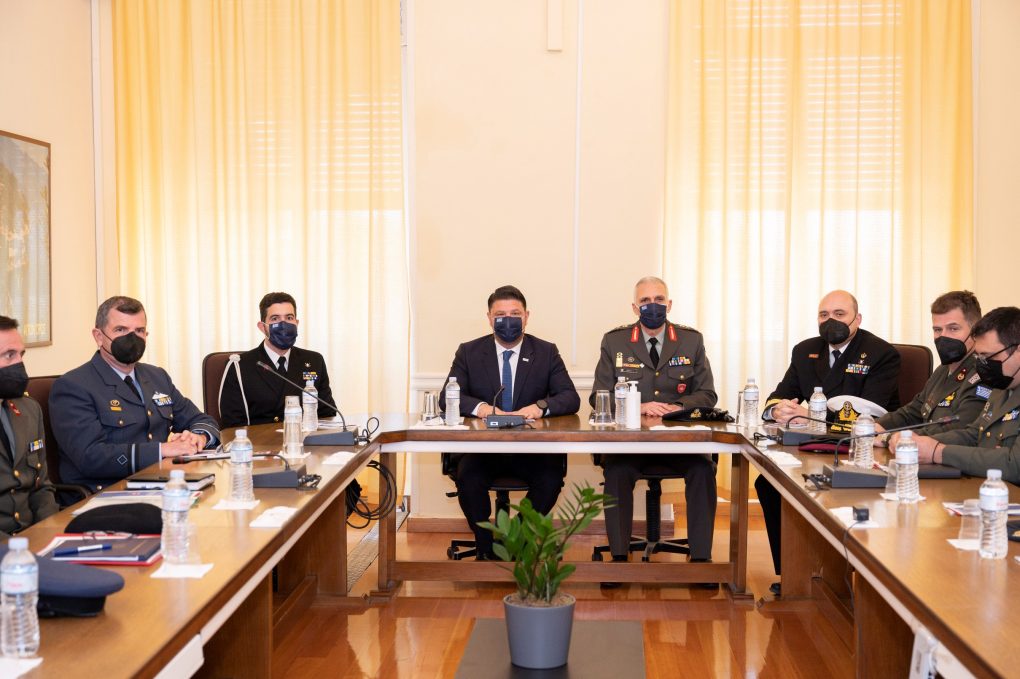
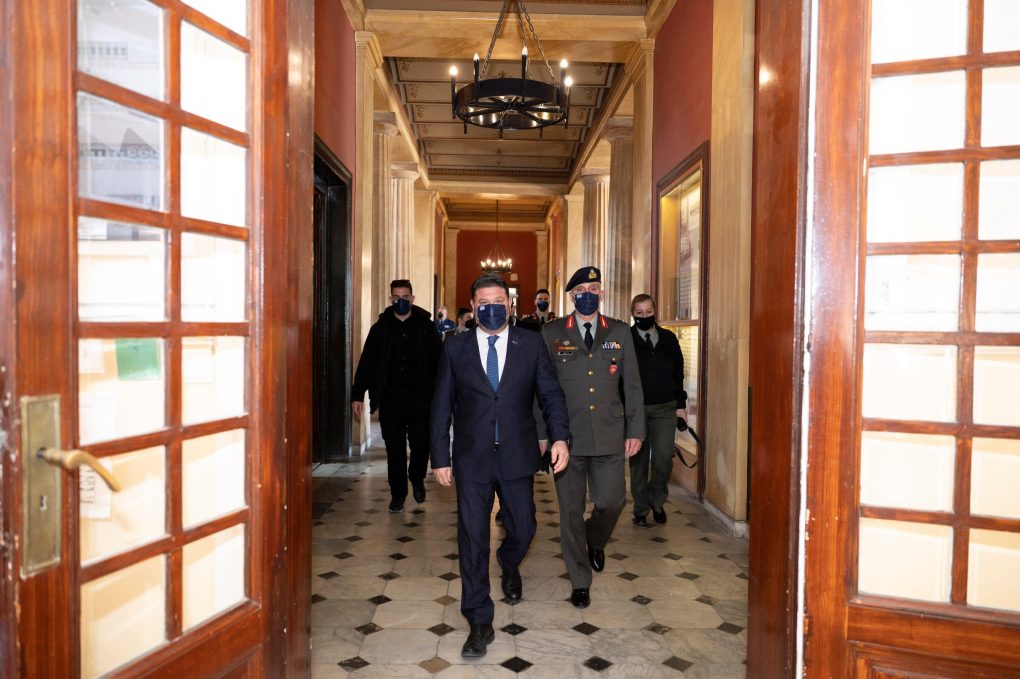
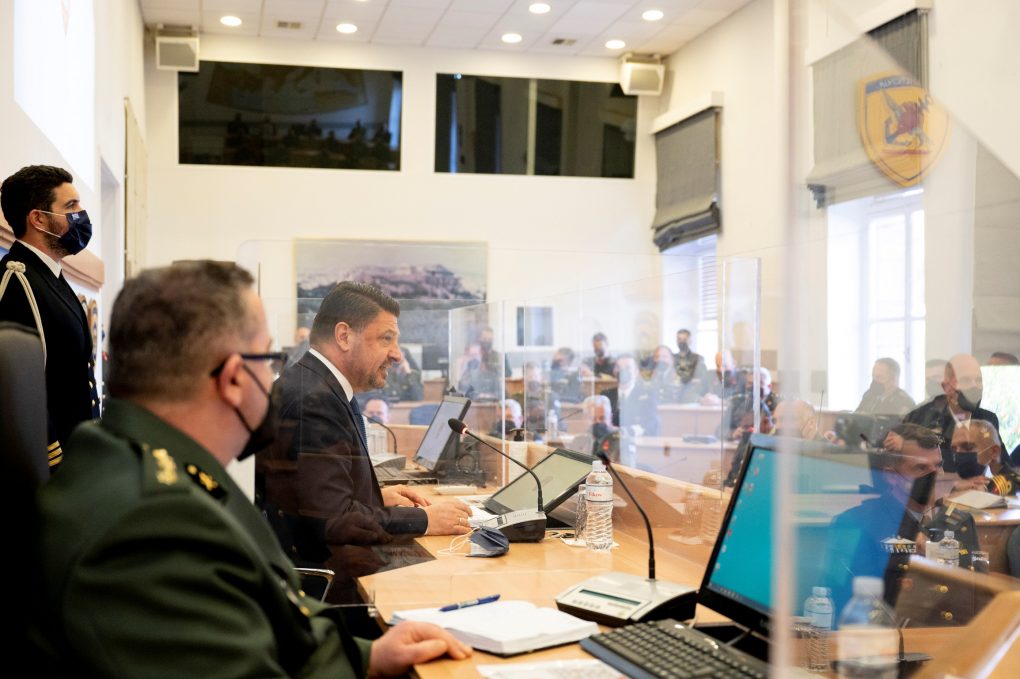
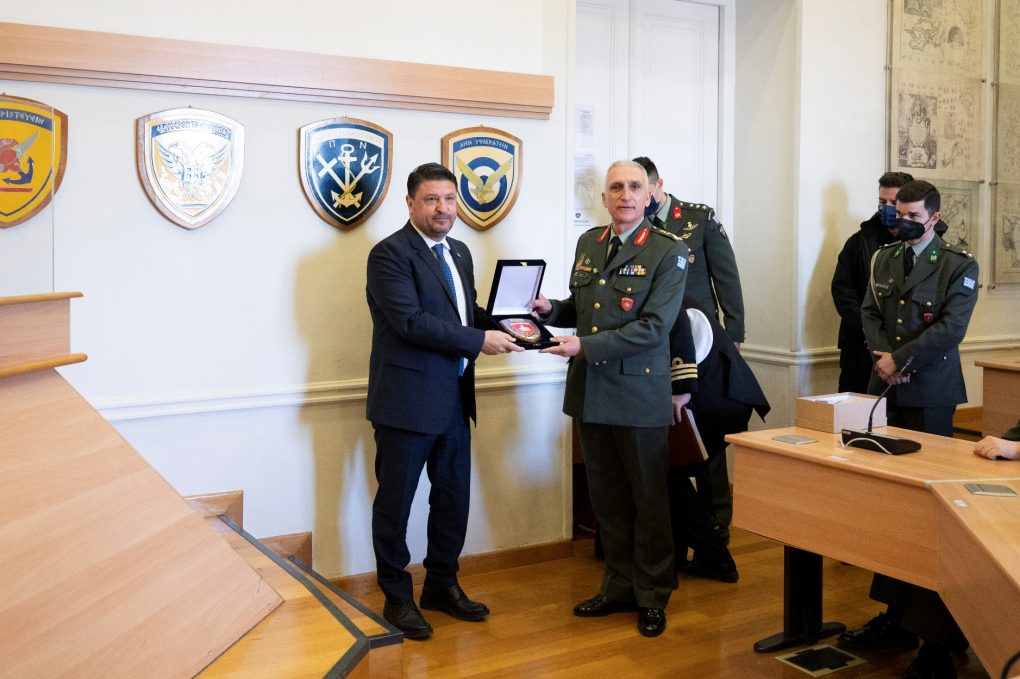
The Deputy Minister of National Defence Mr Nikolaos Chardalias, conducted today, Wednesday 13 April 2022, a visit to the premises of the National Defence College, in Athens, where he was received by the College’s Commander Lieutenant General Anastasios Spanos.
The Minister of National Defence was briefed on the organisation, the mission, the training work, the study and education programmes of the Officers of the Armed Forces, the Security Forces and the civilian personnel of the Hellenic Public Sector, as well as the training goals of the College.
In the context of the visit, Mr Chardalias delivered the following speech to the students of the 74th Training Series, who are about to complete their academic education:
“It is a particular honour, to address today, from the podium of the National Defence College, you, its esteemed students, who are about to complete your academic education and will be called to respond, as National Defence Staff Officers, to the high expectations of your Services.
You had the privilege to attend the highest military training institution of the country, a high–level scientific body and at the same time a post–graduate inter–service college for the Armed Forces, which provided you with the proper academic knowledge in the wider sector of Defence Policy and National Strategy, aiming to build the required sufficiency so that you can effectively manage National Defence issues in the context of your staff and operational competences in the Armed Forces, the Security Forces and the wider Public Sector.
Furthermore, the College, through its rich training programme, provided you with specialised knowledge in the wider sector of Strategic Studies too, so as to render you capable of developing the strategic analysis capability of the international and regional geopolitical environment, as well as enhance your capability to shape and present proposals, on the considerations arising in issues of National Security.
There is no doubt that we live in an age, where the modern security environment is characterised by intense phenomena of instability, volatility, high inter–dependence and fragile balances, resulting in great world actors such as the European Union, NATO, but also other International Organisations, to constantly face a plethora of asymmetric challenges and threats, such as climate change, medical crises, war conflicts, migration, religious fundamentalism, international terrorism, cyber-attacks and the dissemination of weapons of mass destruction.
The above challenges in combination with the positive geopolitical and technological tug–of–war between the states, compile a particular global mosaic, which is further perplexed by the recent unprovoked invasion of Russia in Ukraine, a military undertaking which produced an unprecedented offensive, regarding the post-war reality of the European Continent.
The Russian revisionism is now introducing new variables to the international relations, going over the accepted limits of interstate competition and comes to overturn the “constants” of the international system and the global state of affairs that we knew up until now. That way, the international legality and justice is called in question, while at the same time, the European and international security and stability are undermined.
At the same time, the war in Ukraine demonstrates, in the most tragic and vivid way that, in the global geopolitical scene, that which remains eternally dominant, is the classical reminder by Thucydides, according to which: “the strong do what they can and the weak suffer what they must”.
With these facts, world peace, security and stability, have entered a new uncharted and dangerous path, since all of the international organisations constituting the international status quo are not in a position to secure stability and the principles of International Law.
The search for a new model of security architecture, without the recognition of forceful accomplished facts, must remain as the central goal of the global political scene and in this context the European Union must redefine its position, deciding whether it will remain just a big financial market or if it will undertake its corresponding role as a geopolitical superpower security provider in the global state of affairs.
That can be achieved with a more integrated and cohesive approach in the individual national policies of the EU member–states, an approach which will contribute to the spherical and holistic determination of the strategic European interests, through the prism of the further development of the capabilities of the Common Security and Defence Policy, in order to promote the dominant strategic role of the Union, but also its capacity for autonomous action, when and where it is deemed necessary.
Naturally, the building of increased military capabilities in the European Union, will not solely contribute to the achievement of its defensive and operational goals, but it will further contribute to the enhancement of its industrial and technological basis, which will gradually translate to technological dominance, a fundamental perspective of its strategic autonomy.
Greece, unreservedly constitutes a proponent of the multilateral approach, with regards to the complex global challenges of our times and at the same time a steadfast supporter of the absolute necessity for Europe’s strategic autonomy, without that resulting to a damage of our transatlantic bonds.
As a country, we support, in no uncertain terms, a strong, closer, collaborative and mutually beneficial relationship between NATO and the European Union, always according to the Joint Declaration of EU-NATO Cooperation cosigned by them, which constitutes the framework of cooperation and the principles of participation, mutuality and respect of the autonomy in decision-making.
Within that fragile global environment of defence and security, the Homeland, apart from other things, is called to confront the familiar everlasting challenges and threats of the Turkish revisionism, with the irrational neo-ottoman narratives of the “Blue Homeland” or of the “…borders of the ottoman heart…”. Against these provocations, the Greek diplomacy moves rationally and resolutely, showcasing in the diplomatic field all the illegal Turkish actions, such as the revisionism pertaining to international treaties, the unacceptable casus belli, the denial to accede to the UN Convention on the Law of the Sea, the insubstantial Turkish-Libyan memorandum, the provocative dispute of the Greek island sovereignty with the pretense of demilitarisation, the flights over the Greek islands, the violations of the national airspace and territorial waters, the instrumentation of the migration issue and the divergence from the rule of law.
At the same time, the country premises in every opportunity it gets, its devotion to legality, International Law, the United Nations Charter, the Security Council’s resolutions and the Convention on the Law of the Sea.
It also systematically cultivates to its European and international partners, its powerful geostrategic position in the wider region of the Balkans and the Eastern Mediterranean, a position which renders it an indubitable factor of peace, security, stability and prosperity.
The above intense, multidimensional and multilevel, defensive diplomatic effort, constitutes a fact which is widely comprehended at an international, inter-allied and bilateral level, through a widely expanded grid of activities, collaborations and agreements, which aim to upgrade the country’s geopolitical imprint and to secure its vital, national, European and transatlantic interests, in strategic cooperation with the United States, France, the Republic of Cyprus, Egypt, Israel, the United Arab Emirates, Saudi Arabia and the other regional and international partners and allies.
Concluding this brief apposition of mine, I would like to stress, that the Armed Forces with constant operational readiness, but also their high combative might, constitute the unquestionable nodal Pillar of National Power, playing a particular crucial, dual and demanding role, on one hand to safeguard the national independence and the territorial integrity of the Homeland and on the other hand to contribute, through their strong deterrent imprint, as a tool of exercising active and multidimensional defensive diplomacy.
Dear Students,
Ladies and Gentlemen,
With these thoughts and convinced that you will respond to the high expectations arising from your imminent graduation from the College, I would like to wish you success in your duties and to the remaining of your careers.
I urge you to take advantage of every given opportunity to implement the knowledge you acquired, capitalising the time you invested as students of the National Defence College.
Thank you”.