
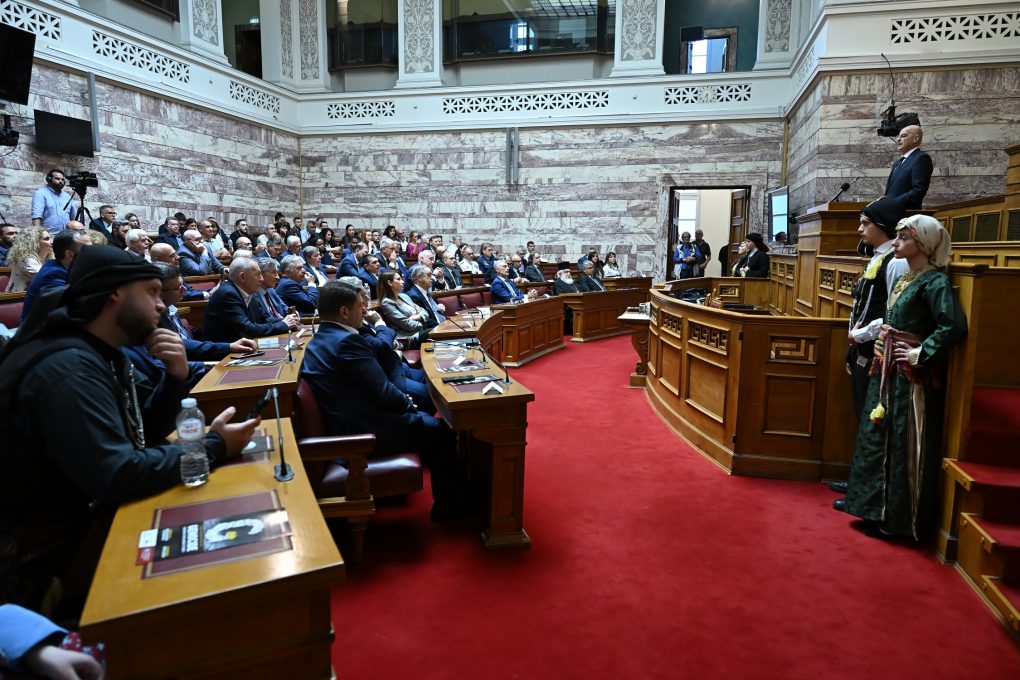
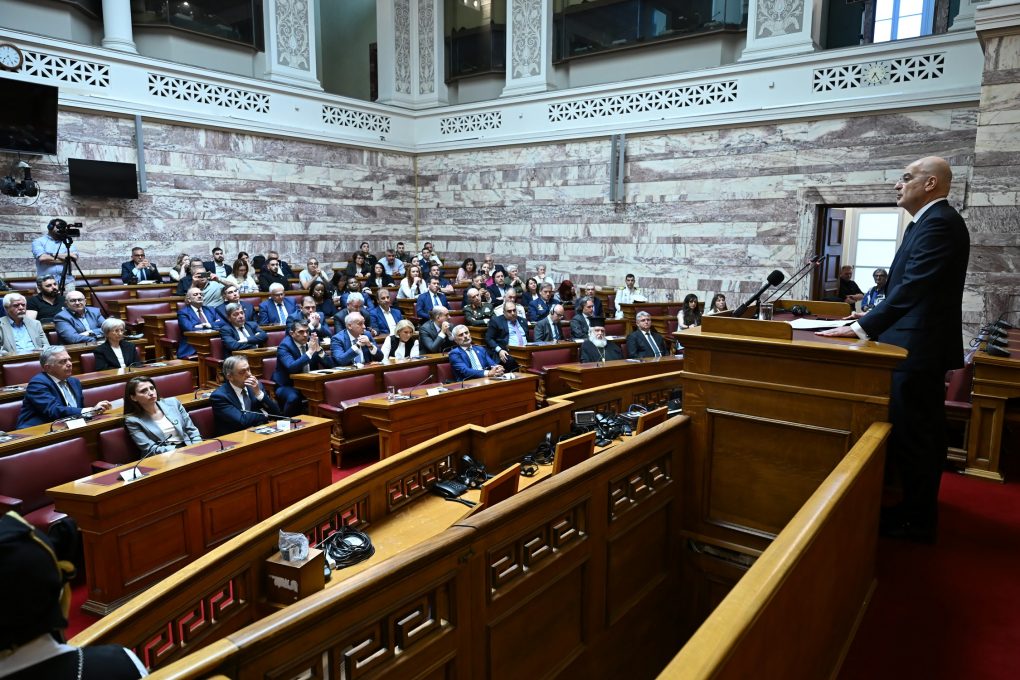
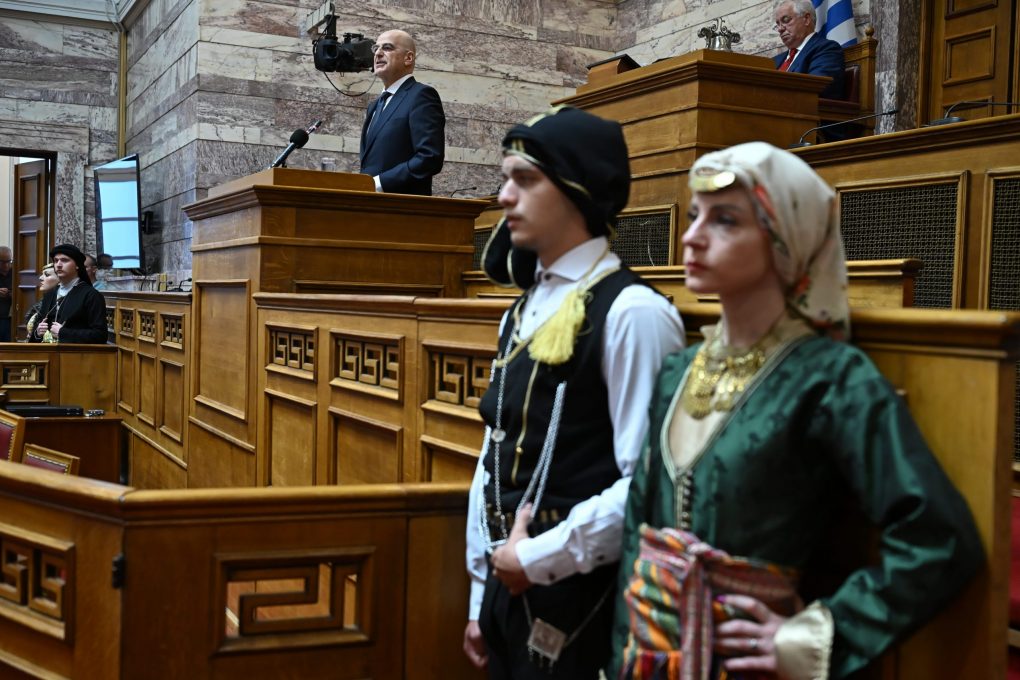
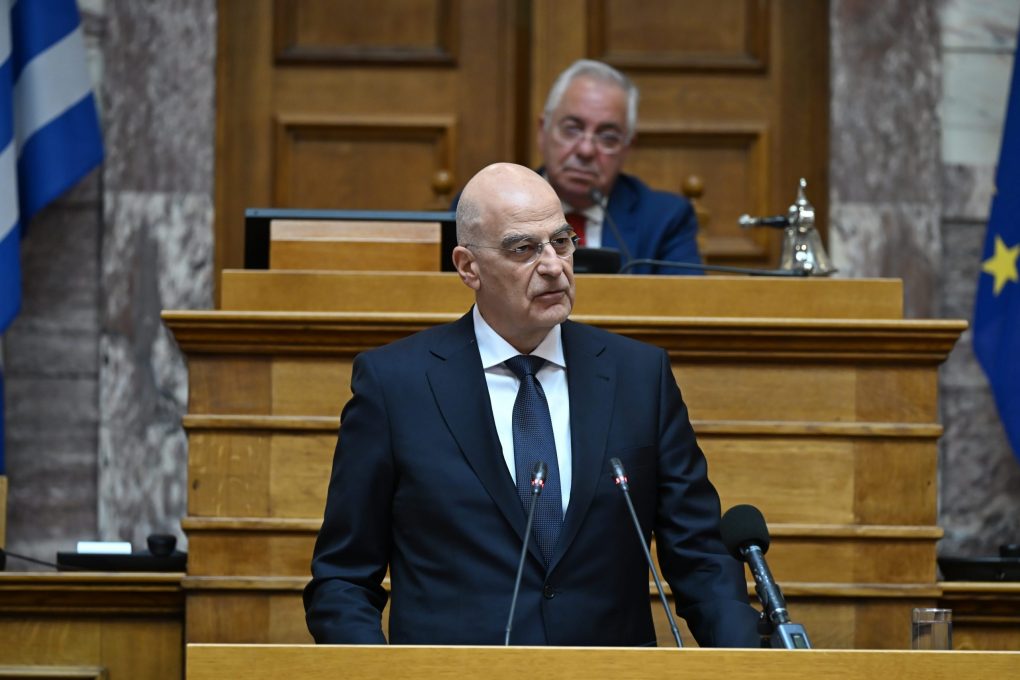
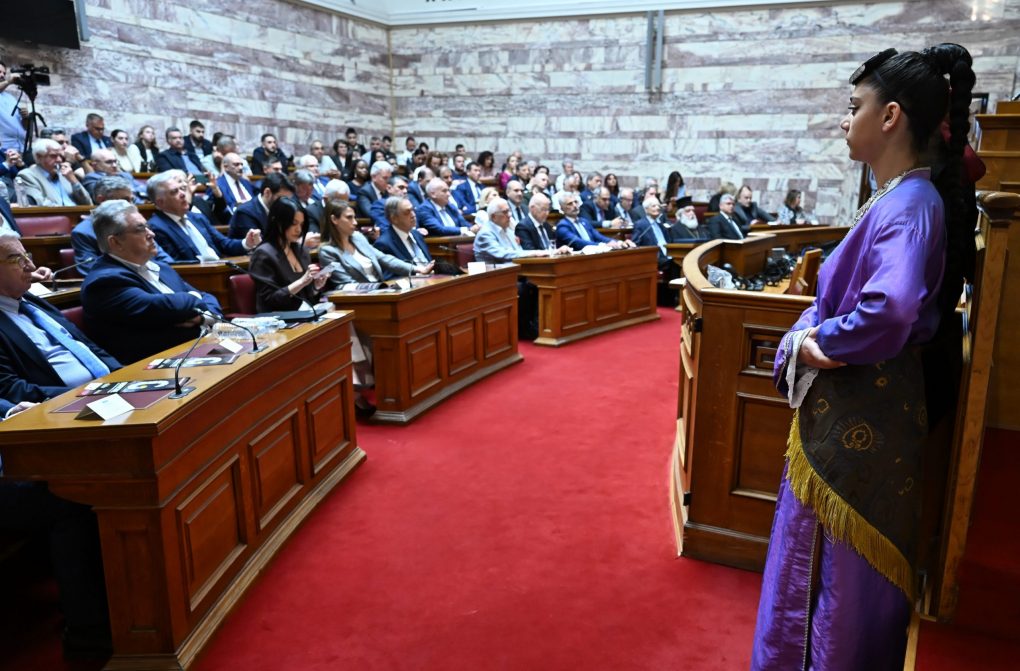
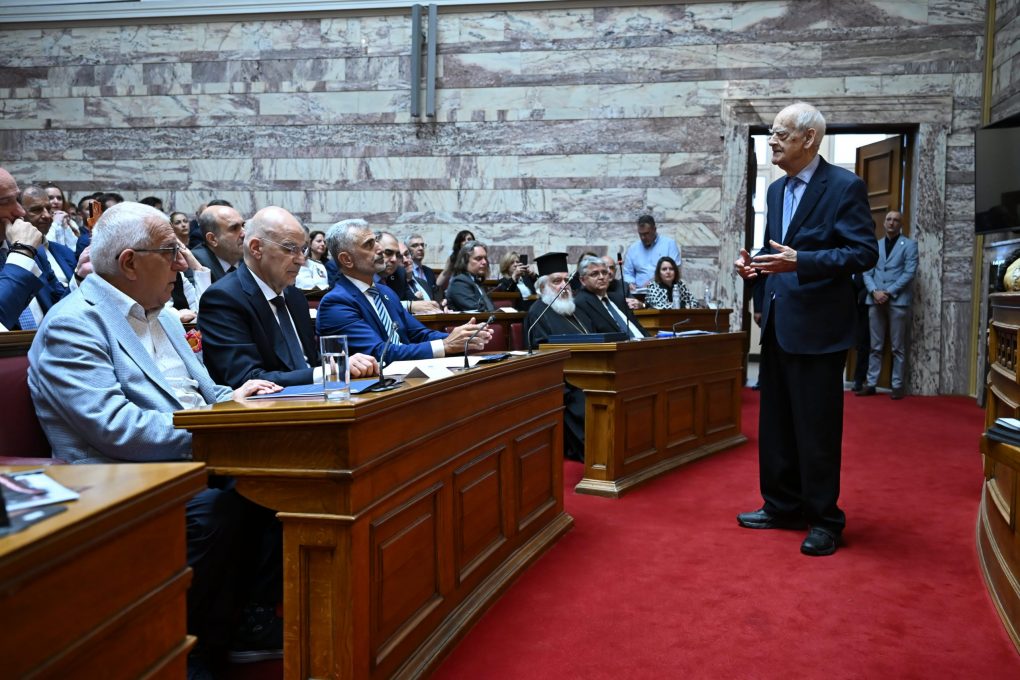
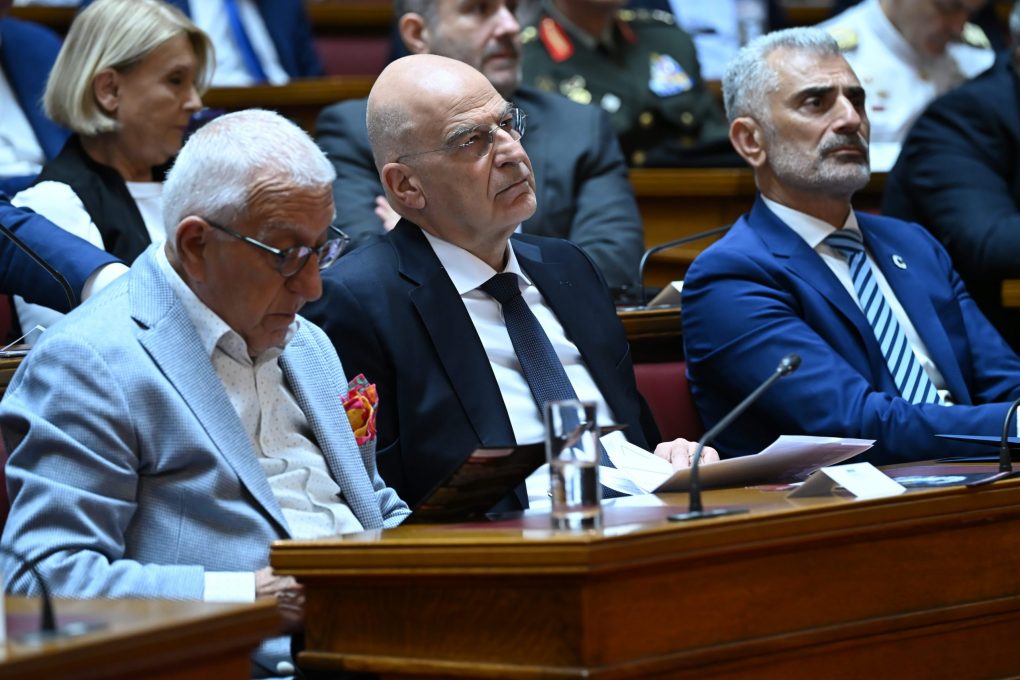
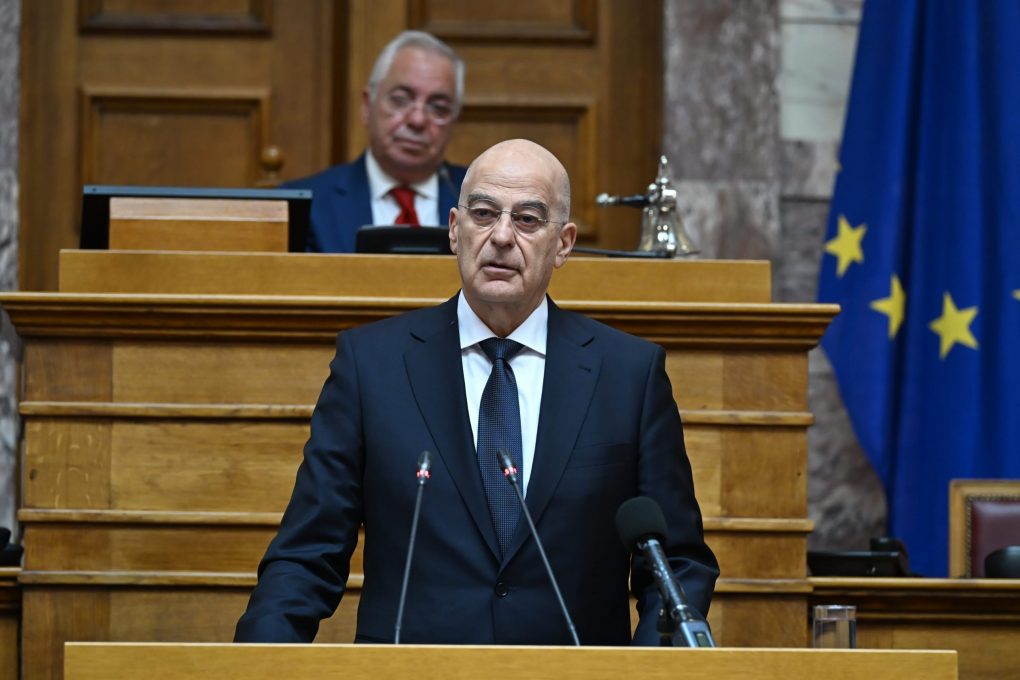
The Minister of National Defence Nikos Dendias participated today, Monday 18 May 2026, in the event titled “The Genocide of the Pontian Greeks: Memory, Strategy and Internationalisation of Historical Responsibility”, organised by the Panpontian Federation of Greece in the Senate Chamber of the Hellenic Parliament, honouring the memory of the Genocide of the Pontian Hellenism.
The Minister of National Defence was the event’s keynote speaker, while its commencement was declared via address by the Speaker of the Hellenic Parliament Nikitas Kaklamanis. Subsequently, the president of the Panpontian Federation of Greece Giorgos Varythymiadis gave the keynote opening speech and the Secretary General of the Communist Party of Greece Dimitris Koutsoumbas and the President of the NIKI Party Dimitris Natsios made addresses.
Furthermore, representatives from the Armenian National Committee of Greece, the Panhellenic Association of Assyrians, as well as the Federation of Refugee Associations of Greece made statements regarding the “Historical Triad of Genocides”.
Moreover, an address was made by the District Governor of AHEPA HELLAS Dr Nikos Dimitropoulos.
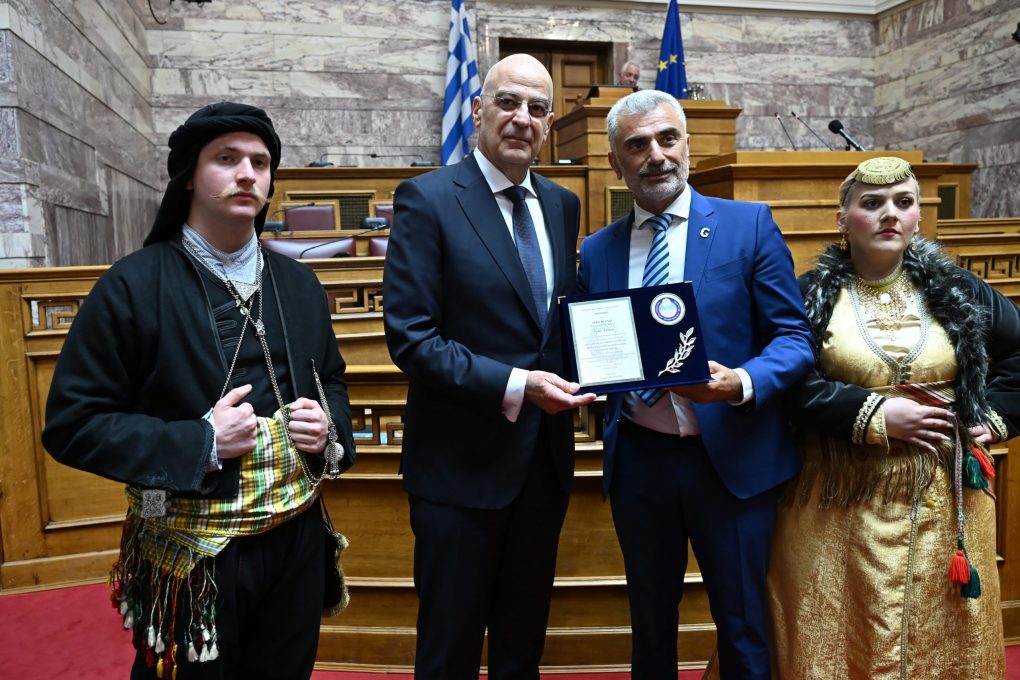
During the event, the Panpontian Federation and the Hellenic Parliament honoured the former Speaker of the Parliament Apostolos Kaklamanis, awarding him for his everlasting contribution to the Pontian Hellenism.
Mr Dendias stated during his speech:
“Dear ladies and gentlemen,
The 19th May is the day on which Hellenism stands with reflection and the deepest kind of grief, opposite one of the darkest chapters of its history, the Genocide of the Pontian Greeks. The massive, organised murder and the violent uprooting of the Pontian people from their homesteads.
I am saying what is already known, that Pontus -it was said before- means “sea”. It was one of the everlasting historic cradles of the ecumenical Hellenism. The 19th May 1919, the day Mustafa Kemal landed at Samsun, marks the beginning of the second and bloodier phase of this genocide.
However, I would like to remind you that the genocide began before the outbreak of WWI and continued without ever actually stopping for 9 continuous years and it was an organised plan aiming to obliterate the Armenians, Greeks, Assyrians, meaning all the Christian peoples of the wider region.
Unfortunately, these genocides are not the first of the 20th century. The abhorrent tradition of genocides had begun earlier. However, it is not known, because it happened in Africa. It happened in Africa by a German general, von Trotha, resulting in approximately 100.000 victims, inhabitants of Namibia.
However, in the sad case of the genocide of the Armenians, Greeks and Assyrians, there were also officers of imperial Germany, of Kaiser’s Germany present. It has been historically verified that von Schellendorf, the main German councillor at the Ottoman Forces General Staff in WWI, knew, if not accepted, the genocides of the Greeks, Armenians and Assyrians. Besides, this was not the only presence of a senior German officer in the Ottoman Forces. Von der Goltz who later trained the Ottoman Army, Liman von Sanders the head of the Turkish Armies in Gallipoli, von Falkenhayn the head of the imperial German staff before his transfer to the Ottoman Empire, are officers who prove the intense engagement of Kaiser’s Germany with the Ottoman Empire during WWI. However, modern Germany, and that is the reason I am saying all this, while it has recognised the Armenian genocide, thus expressing, even belatedly, its apology, has not yet recognised the Pontian genocide.
However, that which remains an absolute certainty, as a proven historical fact, regardless of any claims, is the Pontian genocide itself. The death marches, the slaughters, the uprooting from the homesteads.
All of the above, I repeat it because it must be said, not as a senseless outburst of violence. That would also be absolutely condemnable. However, in reality, this plan was organised, studied and executed via the guidance of a central authority. That is precisely what modern science terms as “genocide”.
Therefore, we saw a patriotic movement which followed the general principles of the 19th century romanticism for the establishment of a national state, turning, at the latter stages of the Ottoman Empire, at the hands of the Young Turks, not into a positive national narrative, but into a violent, dark, abhorrent narrative of ethnic cleansing.
Furthermore, there are many who believe that the number of 353.000 Pontian souls, victims of the genocide, is lower than the actual number and falls short of the truth, because it does not include numerous victims from the first phase of the genocide. We now have data regarding the victims. There are names. They have acquired their identity once more. There are undisputed testimonies by Greeks and foreigners, even Turks, about the organised crime committed in the Greek East and it is a crime which the Greek State has institutionally recognised with a unanimous decision of the Hellenic Parliament as genocide.
I am repeating myself by saying that it is a deed of respect towards the dead, but also a deed of truth. And I always explain the difference of the word “truth” in Greek (αλήθεια), in relation to other languages.
In Greek “αλήθεια”, ladies and gentlemen, is the rejection of Lethe, oblivion. Greek are a very important, a great language, not because we speak it, but because they submit an autonomous philosophical approach to life. And the world “αλήθεια” includes that approach. Let me explain: Let us take for example Latin. In Latin the “truth’ is translated as “veritas”. The root of the word is the Indo-European “ver”, meaning “real”. In French today is translated as “verité”. Or, since we spoke about Germany earlier, the real one in German is translated as “wahrheit”. The great difference of the Latin languages when compared to ours and the way we see things, is that for them the real thing is the actual thing, that which today is before us. For us what is real is that which is everlasting, that which we have not forgotten, which exists now and forever.
Thus, we say that the recognition of the genocide constitutes an act of truth and I take this opportunity to address these countries which are covered by the convenient view that these issues pertain to history and they must be judged by historians.
As if, ladies and gentlemen, history is a laboratory phenomenon which lives, grows and is examined in laboratory formalin, without pertaining to human blood and bones, names, women, children, fellow humans.
Ladies and gentlemen, it would be unjust for this day to say that we only honour the victims of a historic tragedy. At the same time, today, we honour a precious, living part of Hellenism, with deep historical, spiritual and cultural course, meaning, through the memory and tragedy of the dead, we also honour the living. The Pontian Greeks, who did not lose their identity, despite being uprooted. They brought it with them as their own and offered it as another foundation for Modern Greece.
So, today, we are not just talking about dead memory. We are talking about the living and screaming truth. And the Pontian Greeks came here and flourished. They distinguished themselves in economy, commerce, arts, literature. And I wish to say that even in the Armed Forces, where I have the honour of being the political head, two of the three Chiefs of General Staffs are Pontian Greeks.
Ladies and gentlemen, I am nearing the end so as not to tire you. The recognition of the organised annihilation of ethnic, religious and cultural groups as a genocide, does not constitute particular individuals’ claims, a domestic case of any state, regardless of power or position in the world order. It is not an issue of domestic law. This issue was sufficiently analysed and resolved, once and for all, for humankind, during the Nuremberg Trials.
Therefore, it is an issue of international responsibility. It is an issue of accountability against humankind.
Thank you very much”.
Other attendees were the MPs of New Democracy Sofia Voultepsi, Dimitris Ypsilantis, Dimitris Markopoulos, the MPs of PASOK – Movement for Change Pavlos Christidis, Nantia Giannakopoulou, the MPs of the Communist Party of Greece Dimitris Pafilis, Leonidas Stoltidis, Christos Tsokanis, the MP of the Greek Solution Stylianos Fotopoulos, the MP of NIKI Andreas Voryllas and the Independent MPs Nina Kasimati and Evangelos Apostolakis.
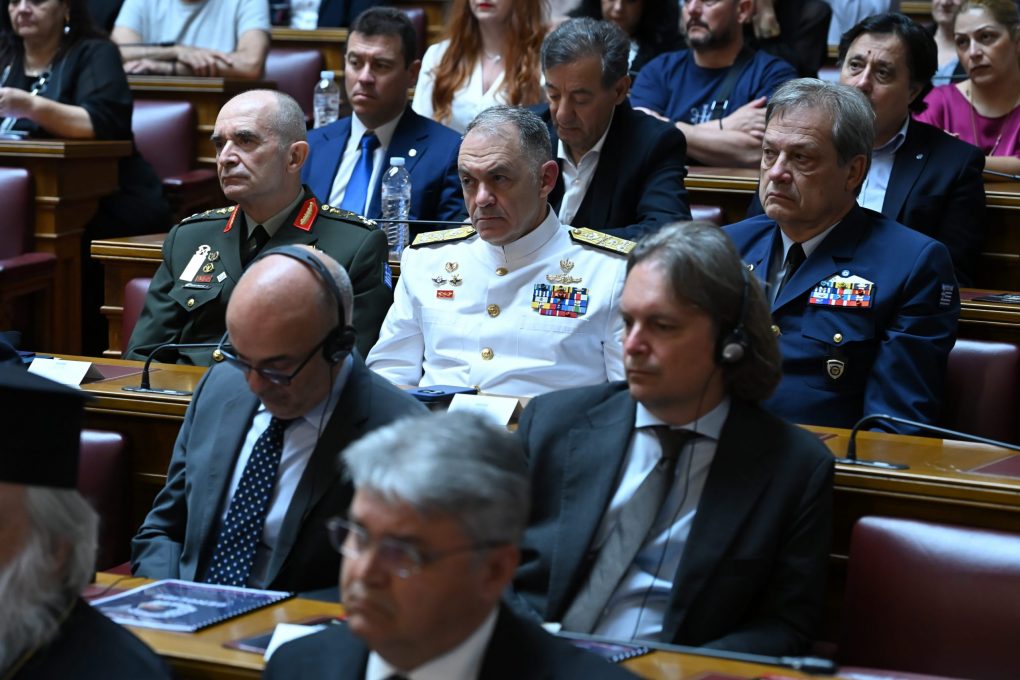
The event was also attended by the Head of the Attica Region Nikos Chardalias, the Chief of HAGS Lieutenant General Georgios Kostidis, the Chief of HNGS Vice Admiral Dimitrios – Eleftherios Kataras, the Chief of HAFGS Lieutenant General Dimosthenis Grigoriadis, the representative of His Beatitude the Archbishop of Athens and All of Greece, Reverend Protopresbyter father Ilias Drosinos, the Mayor of Aspropyrgos Ioannis Ilias, the Mayor of Lavreotiki Dimitris Loukas, the Mayor of Nikaia-Agios Ioannis Renti Konstantinos Maragakis, heads of foreign diplomatic missions in Greece, a representative of the European Parliament in Greece, the President of the Athens Panpontian Union Christos Mouratidis, the Secretary General of the Panpontian Federation Athina Sotiriadou, the President of the Armenian National Committee of Greece Spartalian Harutyun, Presidents and members of Pontian Unions and refugee associations, academics, etc.