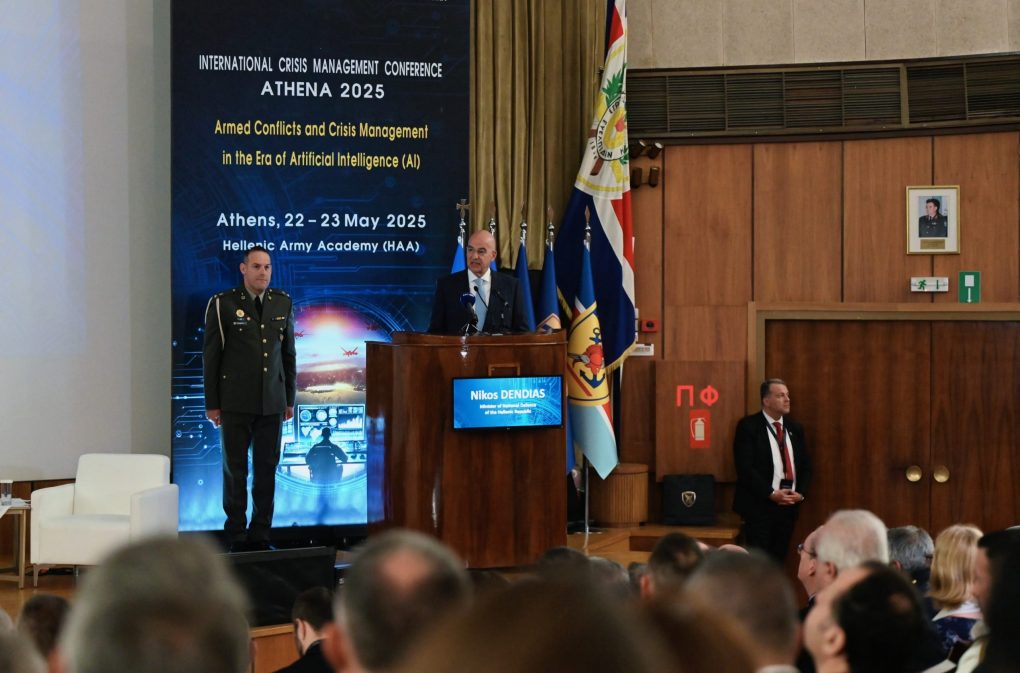
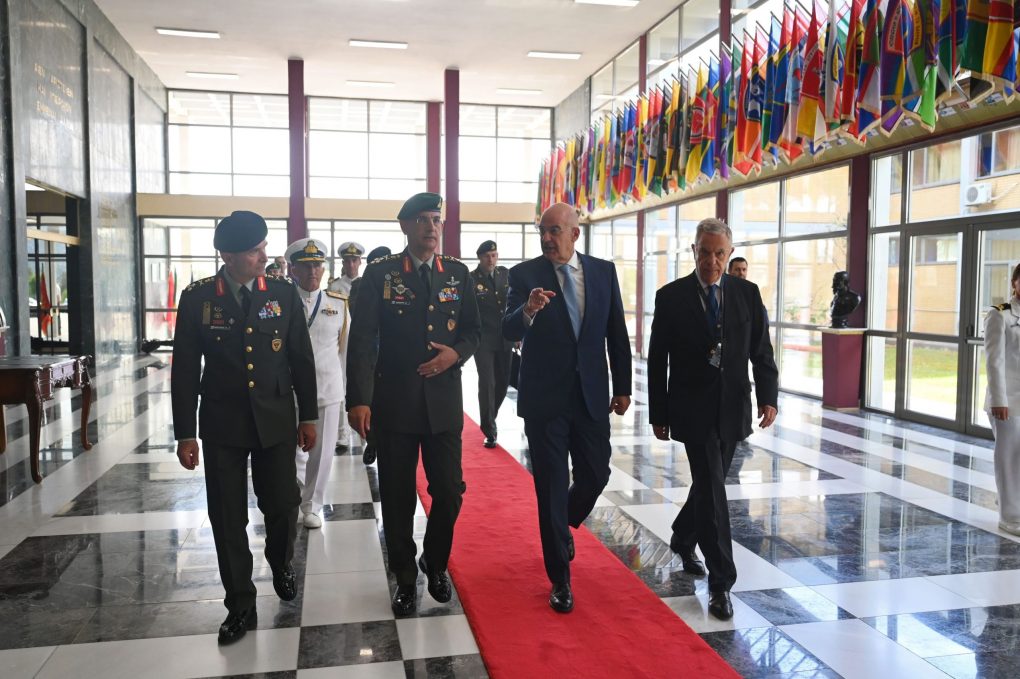
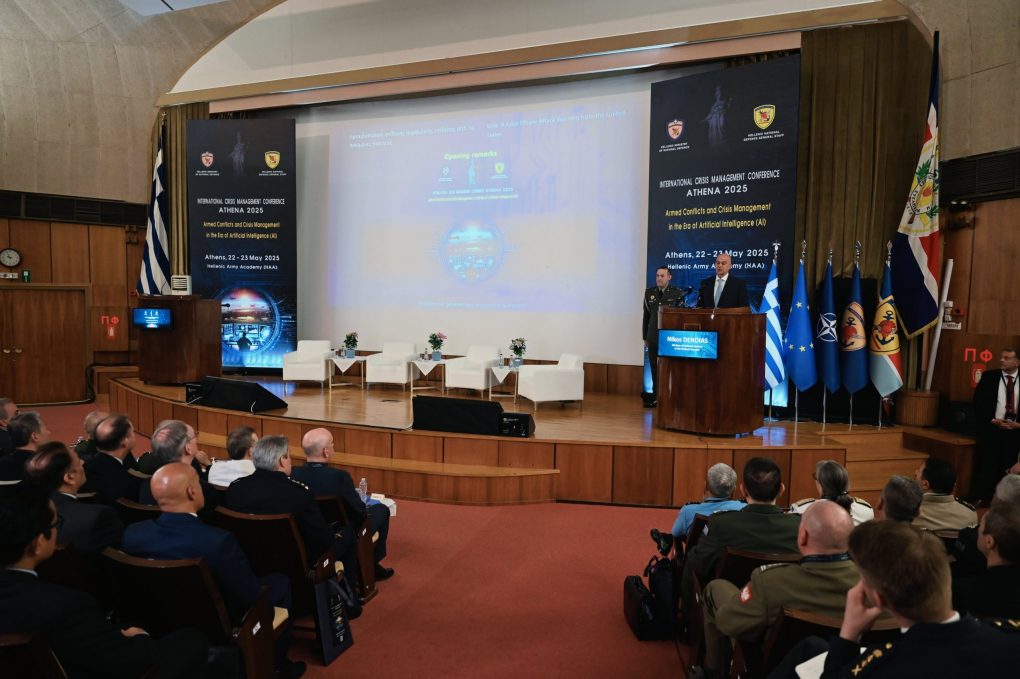
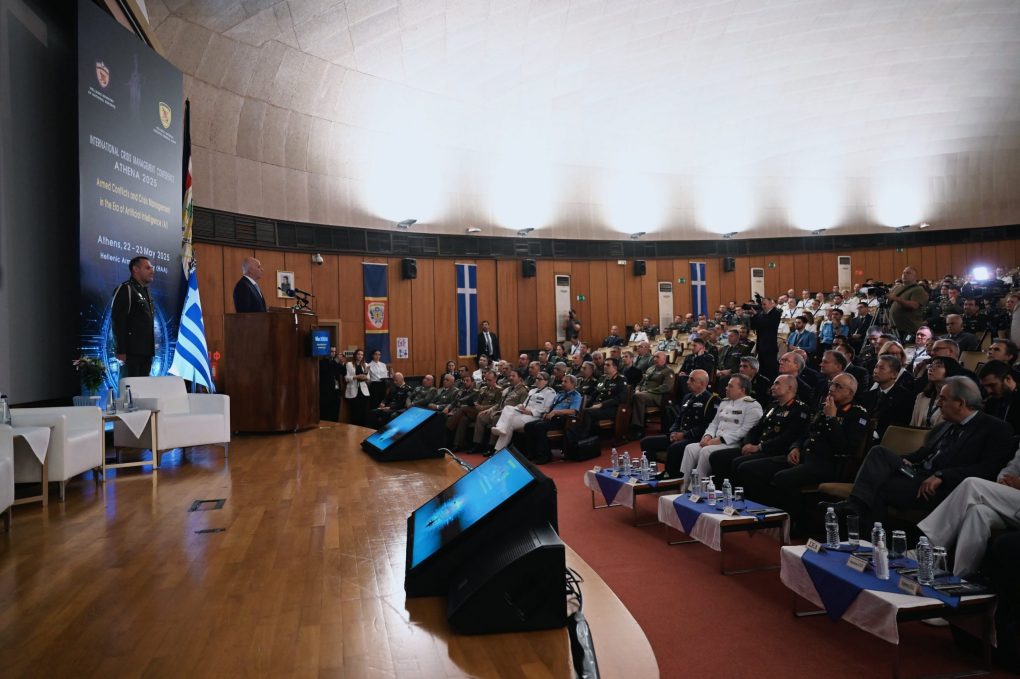
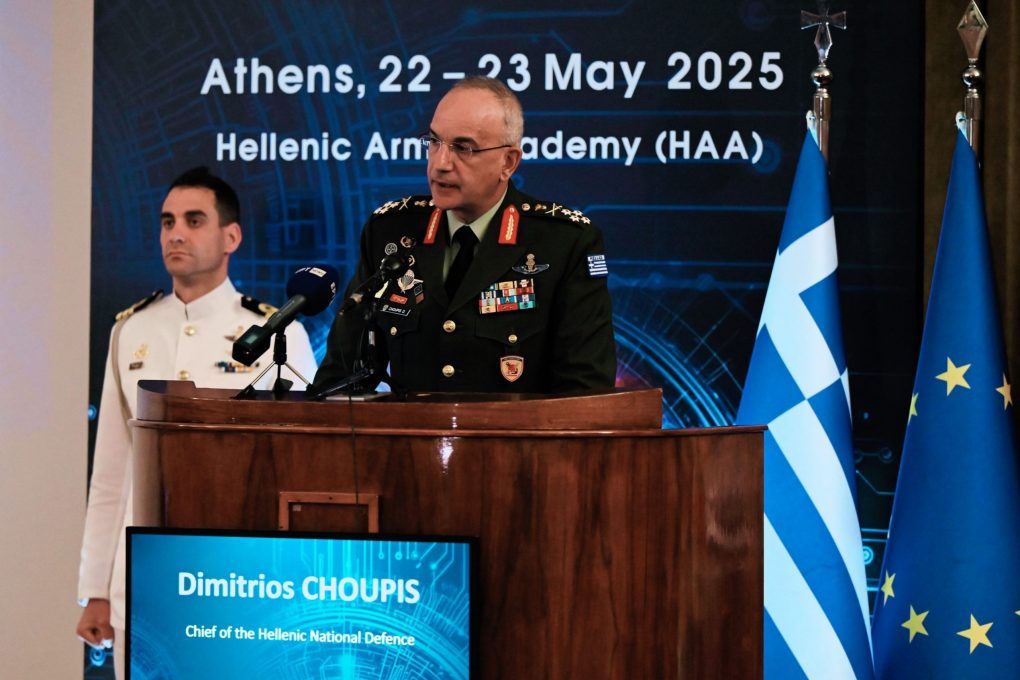
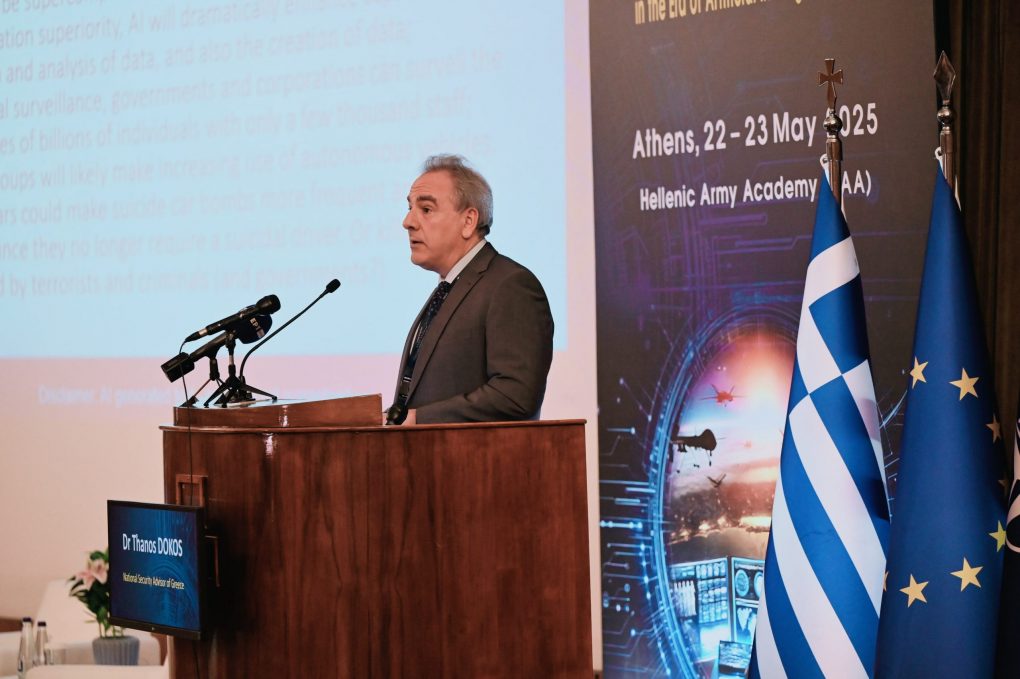
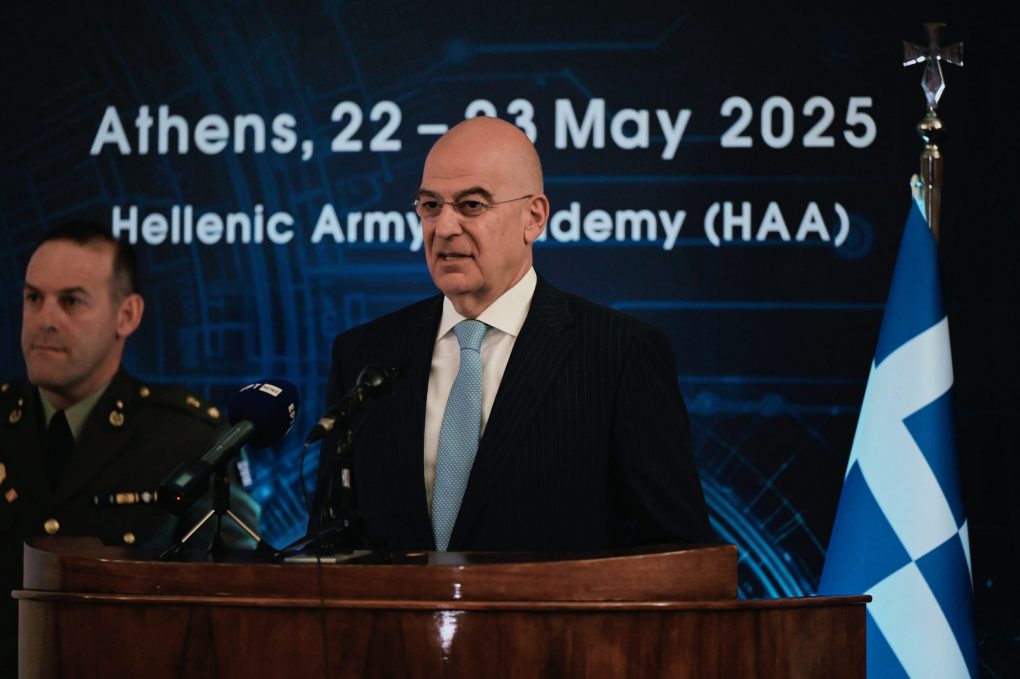
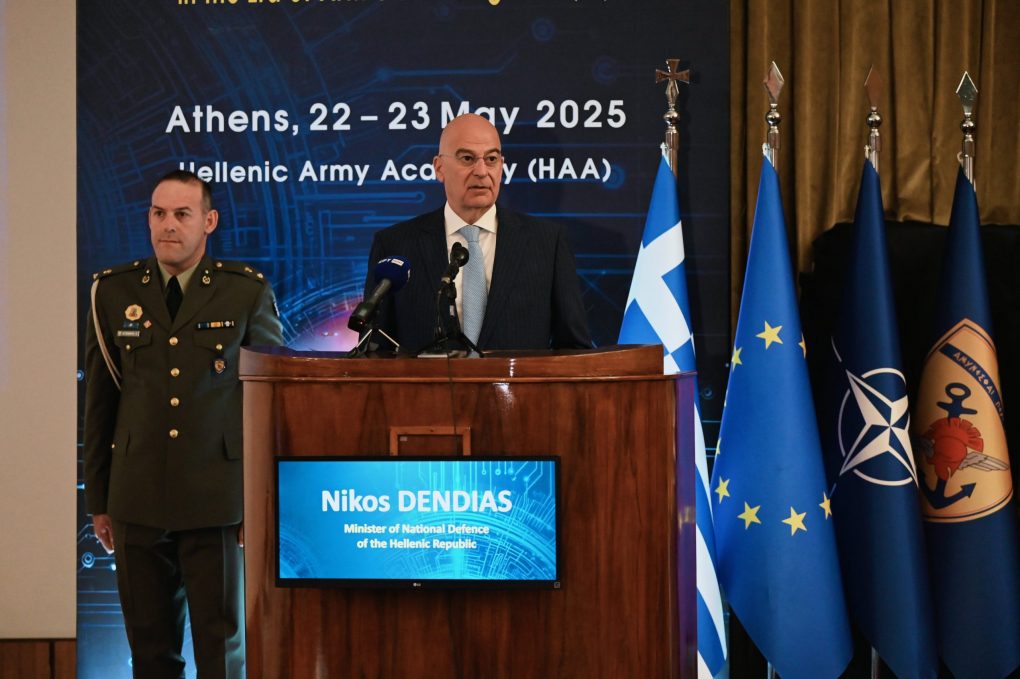
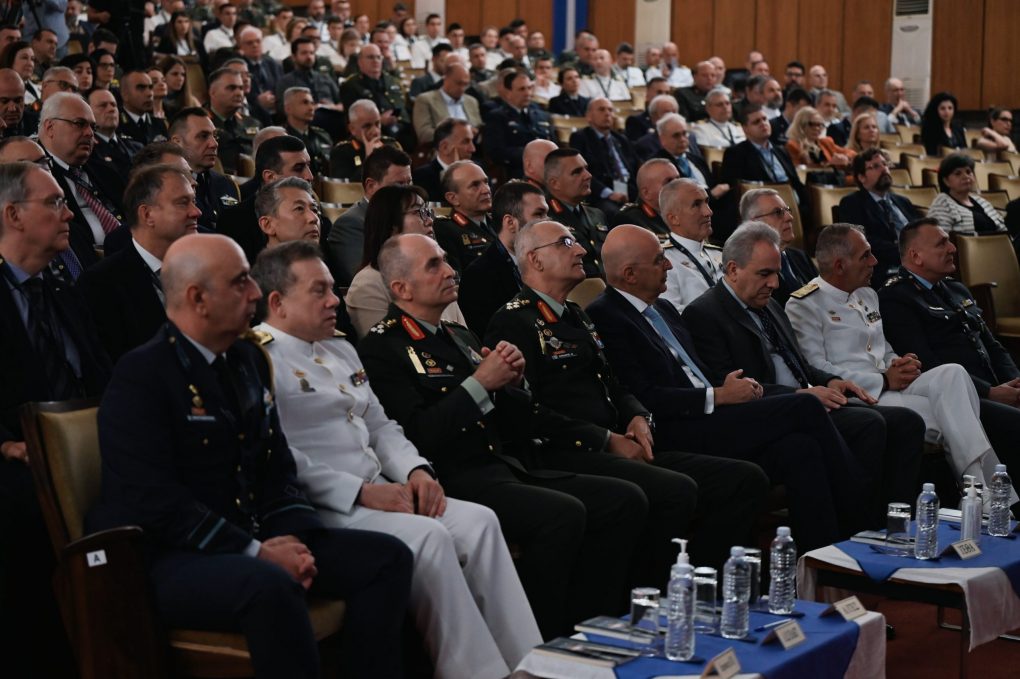
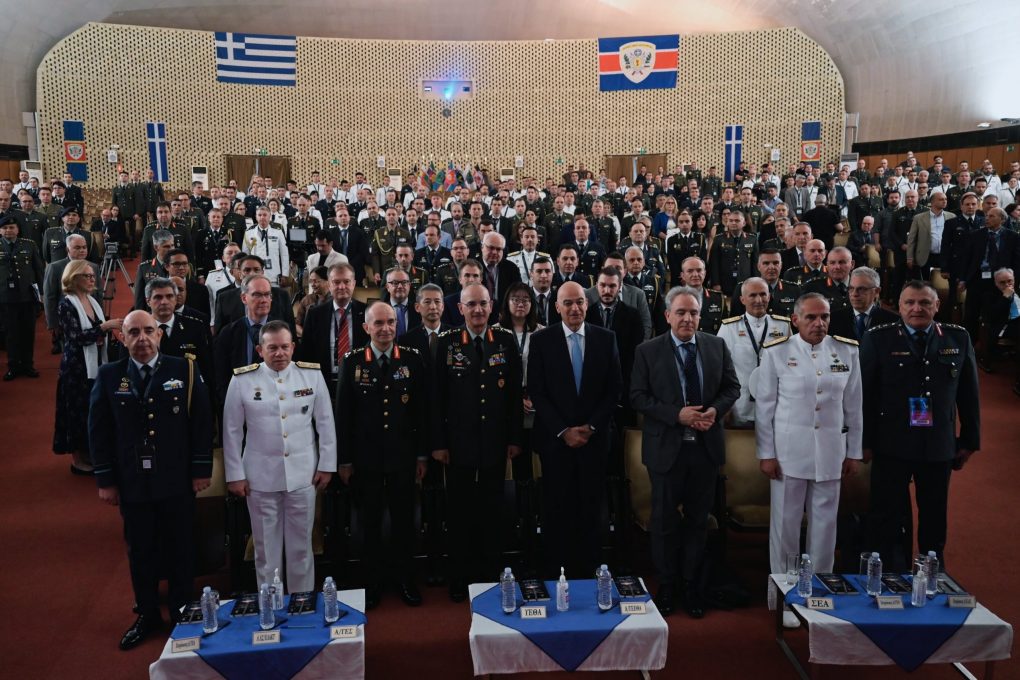
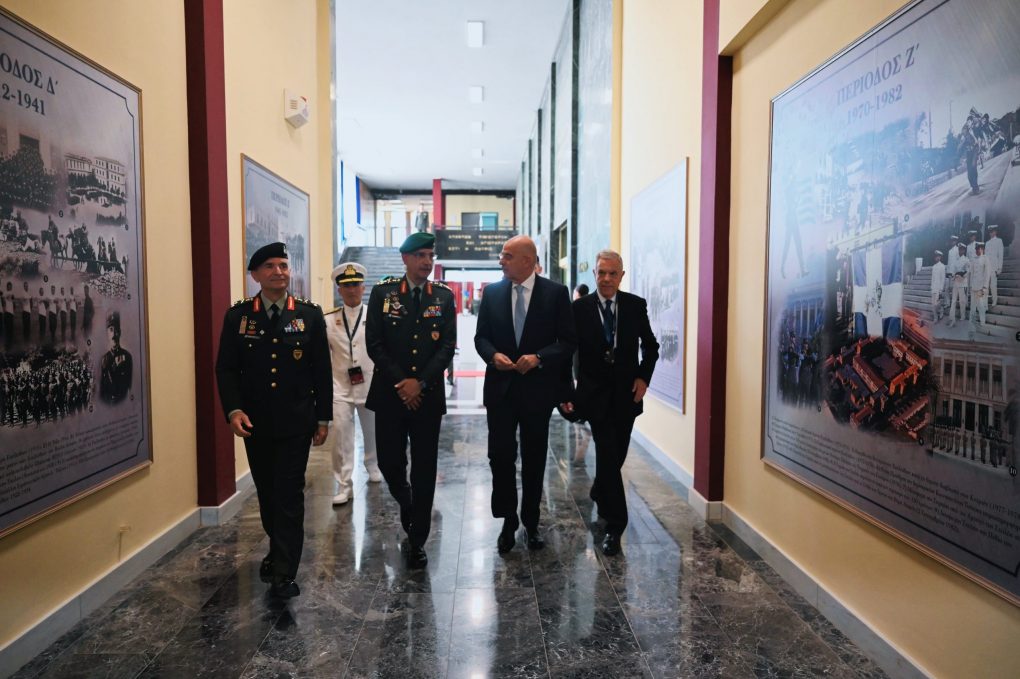
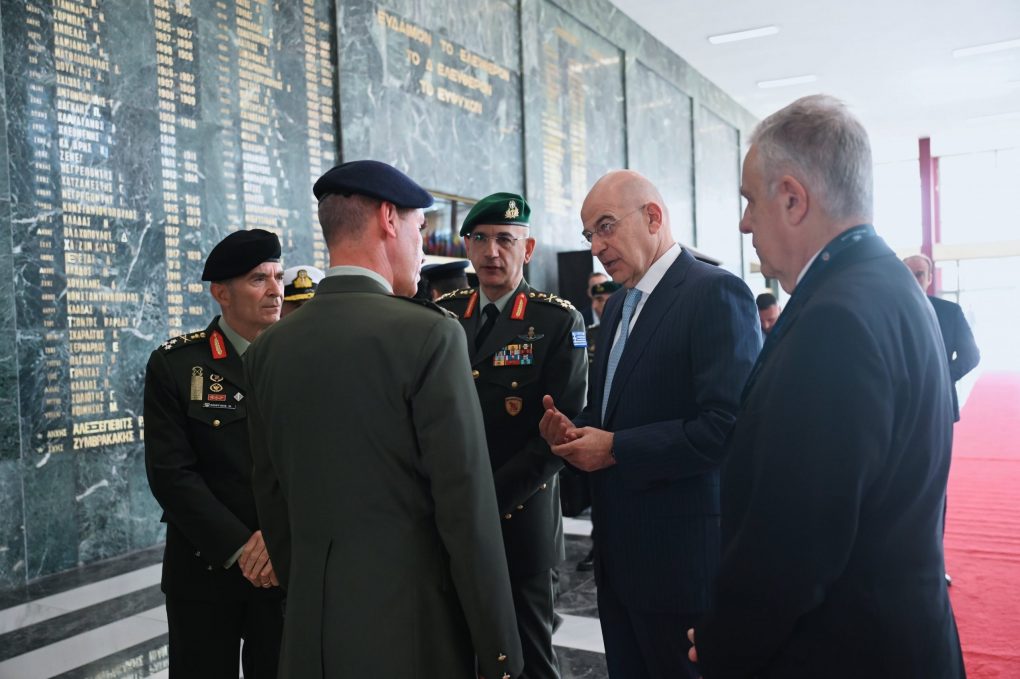
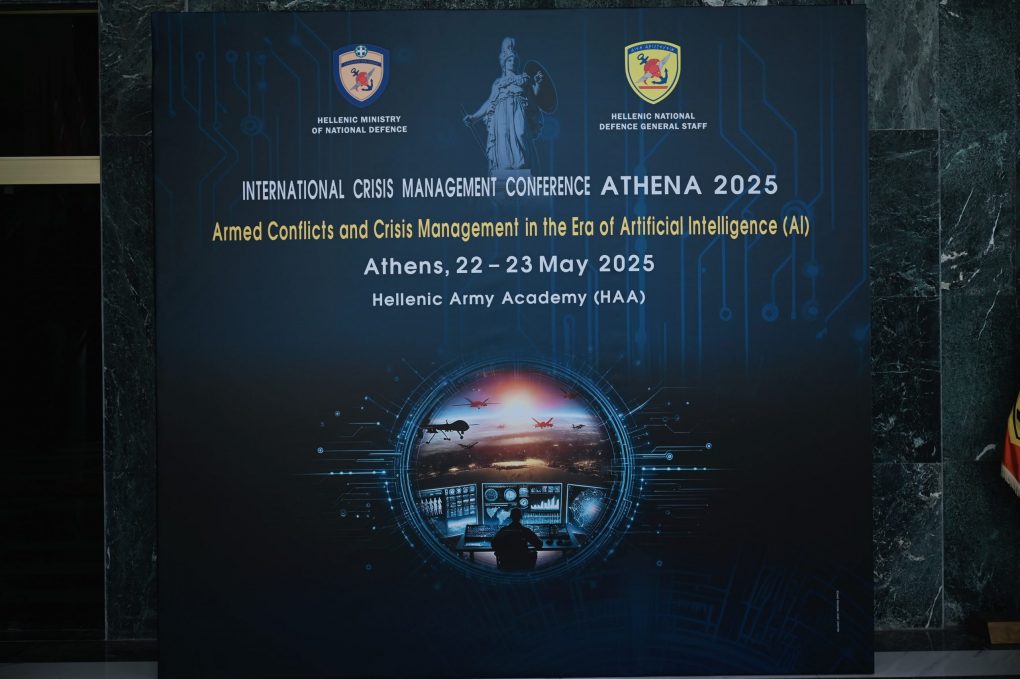
The Minister of National Defence Nikos Dendias declared today, Thursday 22 May 2025, the commencement of proceedings of the International Crisis Management Conference “ATHINA – 25”, focused on “Armed Conflicts and Crisis Management in the Era of Artificial Intelligence (AI)”, organised by the HNDGS, under the auspices of the Ministry of National Defence, in cooperation with the General Directorate for National Defence Policy and International Relations, at the Amphitheatre of the Hellenic Army Academy (Evelpidon).
Other attendants to the Conference were Chief/HNDGS General Dimitrios Choupis, Ambassadors of foreign states stationed in Greece, Chief/HAGS Lieutenant General Georgios Kostidis, Rear Admiral Spyridon Tsiafoutis HN as representative of the Chief of HNGS, Major General (Pilot) Georgios Christodoulou as representative of the Chief of HAFGS, the Chief of the Hellenic Port Authority – Coastguard Vice Admiral Tryfon Kontizas, the Secretary General for National Security Thanos Ntokos and the Director General of the General Directorate for National Defence Policy and International Relations Ambassador (honorary) Michail Spinellis, a representative of the Chief of the Hellenic Police, Senior Officers of the Armed Forces, Defence Attachés, Academics and members of the military personnel.
Mr Dendias, during his address, stressed the following:
“It is a particular honour for me to welcome you to the Hellenic Army Academy (Evelpidon), to participate in the two-day international Conference “ATHINA 2025”, titled “Armed Conflicts and Crisis Management in the Era of Artificial Intelligence”.
As the rapid technological development of Artificial Intelligence continues to shape the global security environment, all interested parties are obligatorily required to engage in constructive dialogue, oriented towards the future.
Together we must face not only the complex challenges and the moral dimensions arising from the integration of Artificial Intelligence in the field of Defence, but also to explore the transformational opportunities it presents – from the strategic advantages and the operational effectiveness, to increased citizens’ protection during armed conflicts.
The International Crisis Management Conference “ATHINA” constitutes a meeting for the exchange of views, dedicated to a topical and multilevel subject which, however, concerns our Armed Forces. The convergence of Artificial Intelligence to crisis management and the conduct of field operations.
Artificial Intelligence gradually becomes a pivotal factor of defence planning here in our Homeland too.
It shapes not just a technological reality, but also the architecture of international security.
Defence policies are not materialised if the satisfactory amount of algorithmic systems and interpretation tools, the processing capacity of Big Data and the automated risk assessment are not secured.
The integration of Artificial Intelligence in the military field has also affected the ways and assets with which operations are conducted.
The Artificial Intelligence Military applications have contributed significant, not to say absolutely definitive, advantages in operations:
Quicker decision-making, due to the rapid Command and Control operation (Command and Control System).
Achievement of greater accuracy in hitting targets, decrease of collateral losses.
Scouting, verification, evaluation, prioritisation of threats.
Better operational situational awareness in real-time.
Support of the supply chain.
Enhancement of human capabilities in complex conditions.
Effective processing of the huge volume of data in a minimum amount of time, as well as, of course, of the personnel training in modern platforms through the production of realistic complex scenarios, which are automatically readjusted, depending on the decision of action of the trainees and the extraction of analyses, conclusions and their evaluations.
However, all of the above may seem positive but we cannot ignore the fact that technological progress is combined with a number of complex and multidimensional legal, moral, technological and political challenges, which also require an in-depth analysis and an in-depth evaluation.
The uncontrollable use of AI can similarly undermine peace, stability and security at a global level.
The technological capabilities propagate at great speed – and this is something that you all know. This subsequently increases both the prospect of their use, but also the dangers from their use by non-state actors, even terrorist associations, and also countries and state agents that profess revisionism and ignore, or even violate International Law in order to serve their own geopolitical aspirations, thus undermining regional and international stability and security.
The development of military systems with Machine Learning capabilities incites worry and concern.
These systems might work as “black boxes” – let me use a common phrase – with non-transparent, developing and, I believe in the case of our broader region, incomprehensible decision-making mechanisms.
In addition, the potential use of Generative AI in military equipment adds an extra level of complexity, or even uncertainty.
This is because these systems will maybe be able to create autonomously, generating new solutions, analysing independently and self-instructing from new data.
This way, they will succeed in adapting to the rapidly changing conditions, without being humanly supervised, though.
These are excellent capabilities which, however, for this reason exactly, need to be closely and firmly controlled.
We are presented with a fundamental question: How much is it technically feasible for an AI algorithm, even the most developed one, to encompass complex concepts of International Humanitarian Law pertaining to the law and the values, such as the principle of separation and the principle of proportionality.
And how could it implement these imperative principles at a rapidly developing operational environment.
Planning should ensure that every use of new technology will be governed by a specific institutional framework.
Artificial Intelligence is not asked to substitute or replace the human factor, but to rather reinforce and facilitate him.
Therefore, we cannot ignore the increasing danger of complete automatisation in life or death decisions.
I believe there is a well-known incident with a Soviet officer, Stanislav Petrov, who in 1983 realised on time a false alarm for a missile attack by the United States to the Soviet Union – at the time.
His reaction, the fact that he ignored certain data, saved humanity, yet will always remind us how close we can get to a catastrophe.
By the way, if you haven’t spared an hour and a half of your life to watch the movie Dr. Strangelove with Peter Sellers, I would suggest that you do. Besides the fact that you are going to have a good laugh, it is a brilliant movie almost 50 years old, filmed half a century back, which gives us the opportunity to apprehend a distressing environment of doom, formed by the submission to data, having left the human factor, as the last parameter, out.
For this reason, it is absolutely necessary to institute explicit operational limits and specific legal limitations, so as to ensure that the man will always remain at the centre of critical decision making, especially when lethal force is used.
No matter how familiarised we may become to the use of lethal force, it shall always remain a hovering ethical leap for humanity and in particular – may I say – for Christian Humanity.
The acceptance of the use of lethal force requires taking into consideration and weighing a series of ethical parameters that cannot be isolated from human conscience and individual judgement.
The person who decides to take a fellow human’s life should be able to answer to his Creator for this decision.
As a concluding remark, we need to remain a society of humans.
With these thoughts, I wish everyone a fruitful, constructive discussion. I am sure of it; so that we can form a common, responsible stance in view of breaking developments.
I hope that the conclusions of this meeting will help us determine our course of action.
I wish you all good luck and I would like, Mr. Ambassador, Mr. Spinellis, to congratulate you and your colleagues for this event.
Thank you very much”.
(*Photο Credits: Dte of Press and Public Information/Hellenic Ministry of National Defence /Evaggelos Karaiskos)