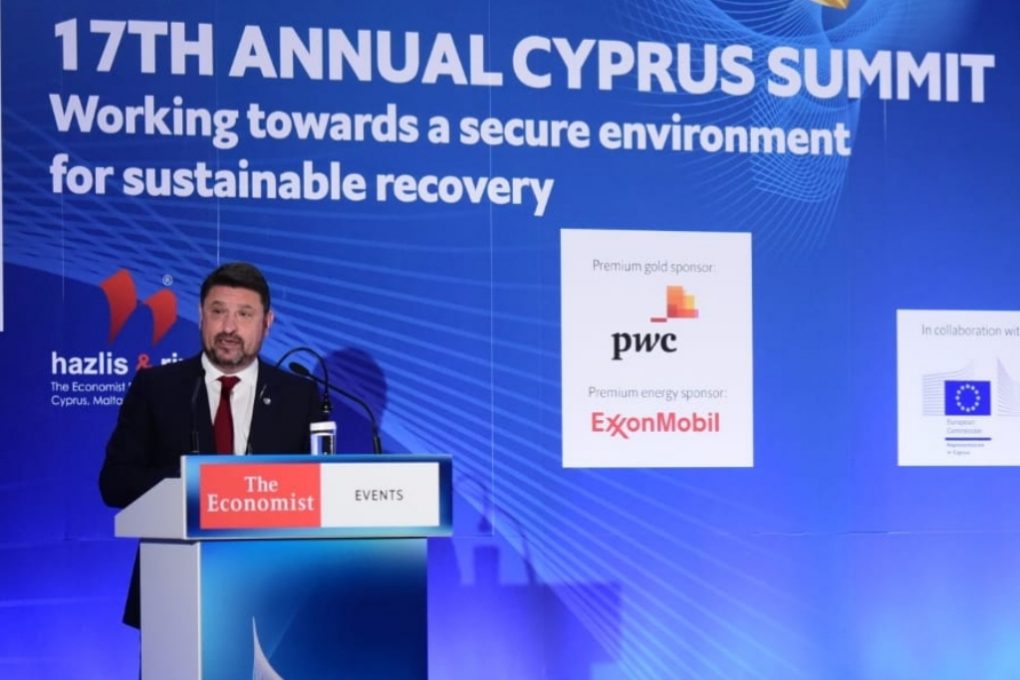
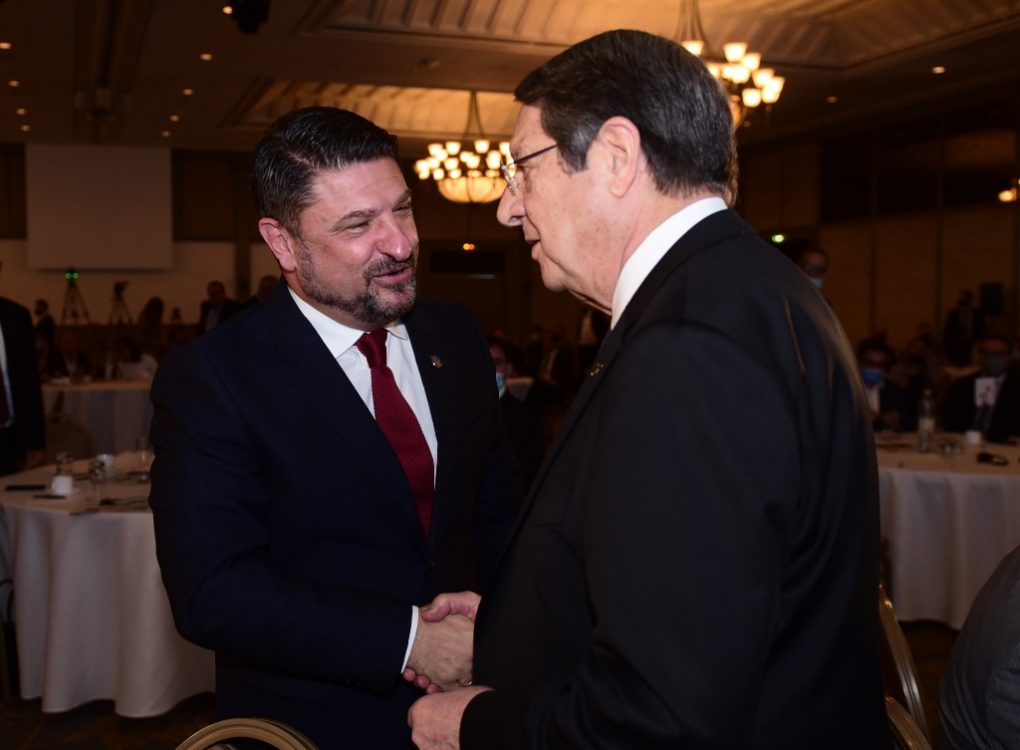
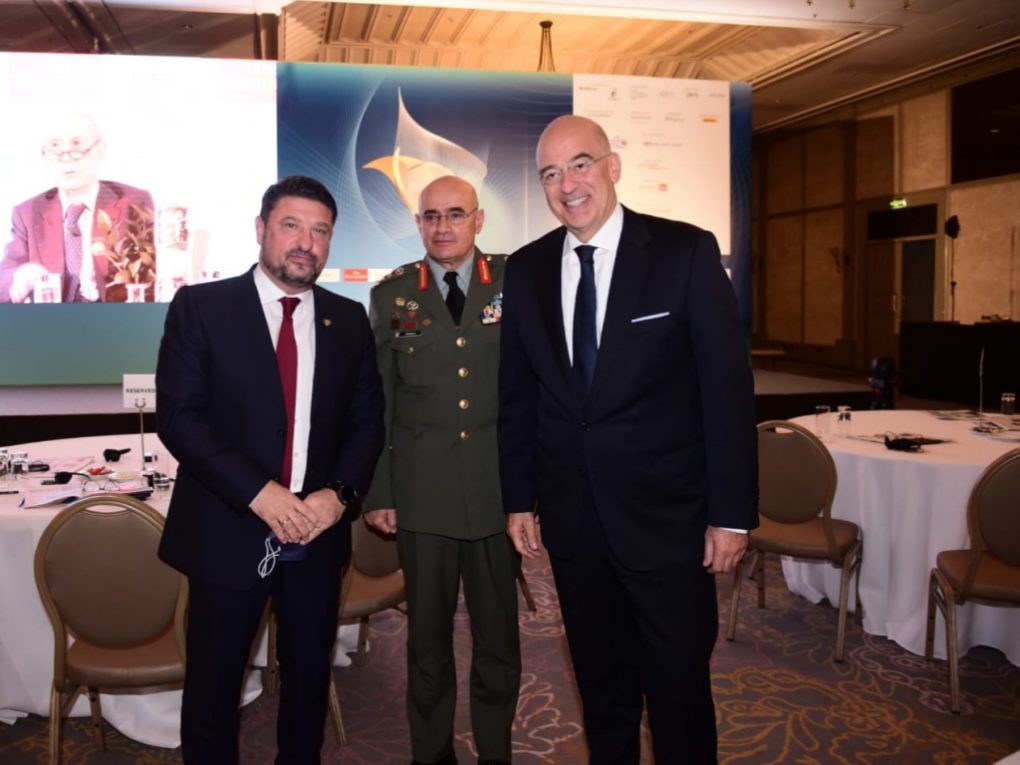
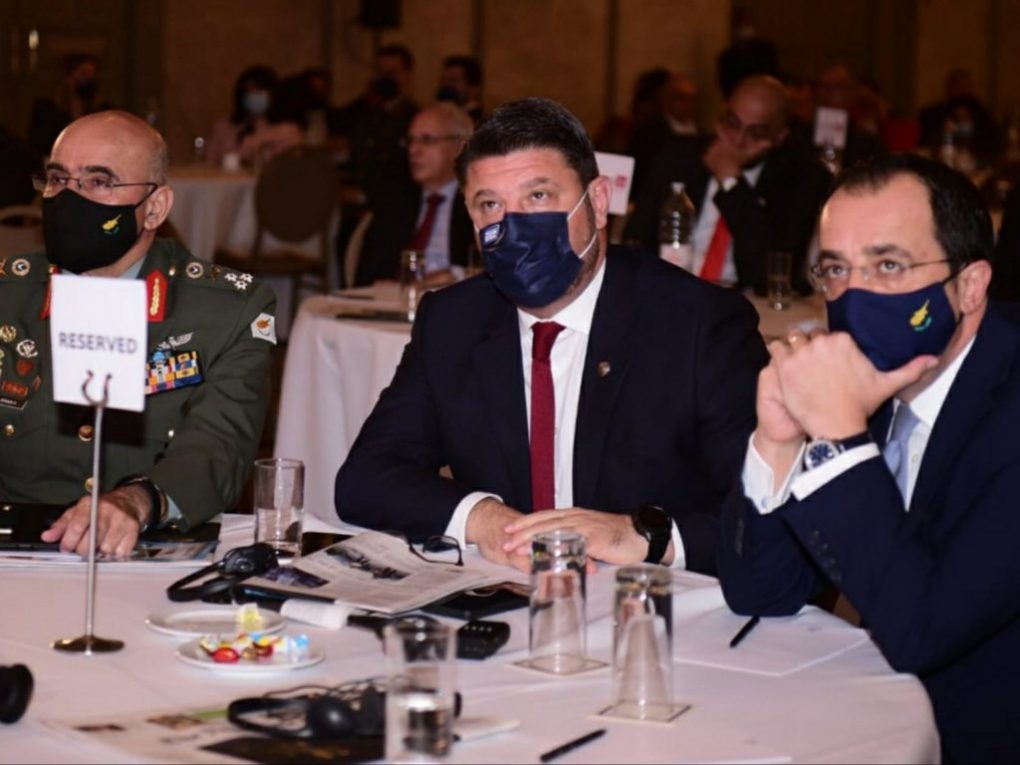
The Deputy Minister of National Defence Mr. Nikolaos Chardalias participated today, Tuesday 16 November 2021, as the main speaker, in the 17th Annual Cyprus Summit (17th Annual Cyprus Summit “Working towards a secure environment for sustainable recovery”), organised by “The Economist” in Nicosia.
The opening address of the second day of the summit was given by the President of the Republic of Cyprus, Mr. Nicos Anastasiades; the Summit was also attended by the Greek Minister of Foreign Affairs, Mr. Nikos Dendias and the Cypriot Minister of Foreign Affairs, Mr. Nikos Christodoulidis.
In his address, regarding “The Strengthening of the Permanent Stability in the Eastern Mediterranean: Building Strategic Cooperations”, the Deputy Minister of National Defence stated the following:
“It is a special honour and privilege for me to speak for the first time in this distinguished Summit. The presence of so many leaders from the entrepreneurial sector and from governments undoubtedly creates expectations for the expression of important opinions, with regard to critical issues such as the recovery from COVID-19 pandemic, in a solid and sustainable manner, or the financial situation in Europe and finally, the threats and challenges in the Eastern Mediterranean.
My contribution in today’s discussion will focus on Greece’s initiatives and efforts to promote cooperations and alliances, for the security, stability and prosperity in our wider region.
Traditionally, the Eastern Mediterranean was a mosaic of various cultures, the interaction of which facilitated important developments, and framed events which were landmarks in the world’s history. In addition, it is a region of great importance for Hellenism, Greece and Cyprus, from time out of mind. The large number of ancient Greek cities on the coastline of the Mediterranean is a testimony of the Greek presence and culture. The connection with the sea and especially with the vital regions of the Aegean and Eastern Mediterranean has always been the “centre of gravity” of the Greeks, in accordance with Clausewitz theory.
Regarding foreign policy, critical situations are can usually be estimated through retrospections with similar cases of the past. The historic framework is crucial, in order to be familiarized with the subject. Keeping that in mind, it seems to me that there is only one question to be answered at the moment: “What is going on here?”. For my country, the answer to this question is even more important, since, as it was expressed recently by the Prime Minister Mr. Kyriakos Mitsotakis, Greece is the last stronghold of the West in the East.
It is clear that the situation today, in the Eastern Mediterranean region, is more turbulent and volatile than ever. In addition, it comprises of a variety of many actors, state officials or not, who have different goals, means and manners of operation. This – let us call it – “slippery” regional framework, creates a complex security environment, which contains both challenges and opportunities.
Regarding the challenges, no one can overlook the references on international security and peace issues existing in the wider region of the Eastern Mediterranean. The so called “Arab Spring” created a dynamic, which, a decade later, is contested by the local weaknesses in the countries in which it appeared, and it has been repeatedly fallen short of its aim. The geostrategic games, the increasing tension of the so called wars through representatives, the issue of the illegal migration, the refugees’ flows, the Islamic radicalism, sectarianism, organised crime and terrorism, worsen instability and create uncertainty regarding the future of the region.
No one can allege that already existing problems and arguments have suddenly disappeared. Unfortunately, the Eastern Mediterranean continues to be haunted by flagrant violations of the International Law, existing and going on for decades, or they are added to previous violations. This sad situation, in which more problems are added to the existing ones, tends to create a toxic international framework, where militarization of differences will be the rule, and the efforts of finding common ground through well-intentioned diplomacy will be an exception.
Furthermore, we are witnessing new “players” who wish to reinforce their imprint in the region, in terms of commercial and security matters, while others try to exercise sovereign influence, violating sovereignty and sovereign rights of the region’s countries, in a context that they falsely consider as a power gap. Obviously, such an explosive mixture of long lasting problems, new security threats, imponderable factors and adventurous revisionism, show an environment in which the destabilization forces create serious concern regarding peace and stability in the region.
These challenges, existing in the Eastern Mediterranean, reflect a wider spectrum of cases, which includes energy security, migration management, delimitation of sea zones, guarding the sea boundaries and protecting environment and climate, which, I would call “the great battle of our times”. So, how can we deal with these problems and move on, avoiding mistakes and regression? This is the hard question. In this spirit, I will try to outline the basic pillars of the Greek policy regarding defence and security in the Eastern Mediterranean region.
The first and basic guideline of our foreign policy is our firm devotion to International Law, including the rules of settling disputes peacefully, set out in the UN Charter. These provisions naturally include the inborn right of individual or collective self-defence, as well as the obligation of complying with the resolutions of the UN Security Board. In addition, Greece has repeatedly declared its belief that only through the full and precise application of the Law of the Sea in its total, statute and custom law, can the long lasting issues, ravaging the delimitation of sea zones in the Eastern Mediterranean be resolved in a just and satisfactory way.
On the contrary, not all actors in the region share the same vision of peace and security, or to be more precise, they have a different perspective. This is the reason Greece has intensified its efforts over the last decade and especially in the last two and a half years, in order to foster close ties with states of the region that share the same views.
In this direction, I would like to point out the recently signed Agreement of Strategic Partnership Relation regarding Defence and Security Cooperation, between Greece and France, which contains a specific clause for joint defence, in case of an armed attack. I would also like to point out the importance of the excellent relations with our Israeli partners, with whom we share a similar approach, regarding irresponsible behaviours of other actors in the region.
Egypt is another important protagonist in the region, with which we maintain close ties of long lasting friendship and close cooperation, as it was also confirmed by the agreement on the delimitation of sea zones between the two countries, in August 2020, our tripartite Meetings with Cyprus and the joint military exercises of our Armed Forces.
Above all, I would like to point out the Interstate Energy Agreement of 2020, concerning the construction of EASTMED pipeline. It is the most important European energy project in the Mediterranean, which brought Greece, Italy, Cyprus and Israel even closer. The EASTMED pipeline is not only an energy project, but an opportunity to expand peace and stability in the wider region.
Finally, I cannot omit a special reference to our American allies, with whom we have strong ties, based on the common values of our peoples. The recently signed Protocol of the Amendment of the Mutual Defence Cooperation Agreement between Greece and the U.S. shows our common desire to further expand and deepen the Strategic Partnership Relation between our countries.
This multidimensional and multilateral diplomacy is not a new perspective for our foreign policy, since the Greek approach regarding security problems has always had to do with the many-sided cooperation. So, by investing in reinforcing the relations with other strong actors in the region, we promote the final goal of our policy for the security in the Eastern Mediterranean, which is the creation of a stability, solidarity, tolerance and deterrence pillar, having International Law as its flagship and the smart power enforcement as its basic tool.
The alliances and cooperations among states which share the same values and approaches in problems are of course the best way to alienate and face international “trouble-makers”. On the other hand, the realistic approach of international relations imposes to every state that faces security threats or has as a goal to project its power in an area of its interest, to pursue its strategic autonomy in the highest level. This entails the correct use of all power tools and our Armed Forces play a very important role in this sector.
Greece is absolutely devoted to defending its sovereignty and sovereign rights with all available means and under all circumstances. It is also ready and willing to support its partners and allies, whenever its international obligations impose so.
To put it differently, we do not perceive our role in the new security environment as a weak partner seeking aid to offset its limited capabilities, but as an independent and trustworthy factor with an important influence, which treats the alliances as a defence power multiplier. The continuous upgrade of our Armed Forces aims exactly at the potential of projecting the maximum possible defence power in the Eastern Mediterranean, whenever required.
The F-16 aircraft upgrade to the Viper version, the expected delivery of 24 state-of-the-art Rafale aircraft, as well as the state of the art (3+1) Belharra frigates acquisition, will increase our already high operational capabilities for intervention in the most advanced spots of sea zones under our jurisdiction, in the Eastern Mediterranean or elsewhere.
So, these are our policy’s basic goals and tools in the fields of security and defence in the Eastern Mediterranean. It is important, as we analyze them, to avoid confusion and misunderstandings. We aim at the stability, but not at the immobility. We desire to have friendly relations with everyone, but we never rest. We abide by the rules of law, but we are not naive. We are flexible, but extremely far from compliance. We seek multilateral cooperation, but we do not disclaim sovereign equality.
Ladies and gentlemen,
States must be finally activated in a complex and dynamic world, in which many multi-faceted threats can influence an increasingly volatile international chessboard. Few people oppose to the perception that our world undergoes an evident change, but the perspectives of the time to come remain vague and questionable. So, understanding the viewpoint of others is of vital importance.
With these thoughts and looking forward to hearing your views, I would like to thank you for your attention, to congratulate the staff which organised the 17th Annual Summit of the Economist in Cyprus and of course, to thank our hosts for their hospitality!”.